Table of Contents
What Are SOAR Tools?
SOAR tools, short for Security Orchestration, Automation, and Response, are platforms that help cybersecurity teams manage and respond to security threats more efficiently. They work by integrating various security tools, automating repetitive tasks, and orchestrating complex incident response workflows through predefined “playbooks”. Key benefits include increased productivity, faster response times to threats, better use of resources, and a centralized view of security activities, leading to a stronger overall security posture.
The primary goal is to improve the efficiency and effectiveness of security operations centers (SOCs) by automating repeatable tasks and offering a centralized environment for incident management. The tools collect security data from multiple sources, correlate the information, and trigger rule-based responses without the need for constant human intervention.
SOAR improves incident response times and allows security analysts to focus on higher-priority tasks that require human judgment. As a result, SOAR platforms are now an essential component for organizations aiming to mature their security posture and manage the ever-increasing volume of alerts and security events.
Editor’s note: Updated the article to cover recent market trends, updated product information to reflect features and capabilities in 2026, and added 2 new tools.
The SOAR Market Trends
Market Size and Growth Outlook
The SOAR market is valued at USD 1.87 billion and is projected to reach USD 4.42 billion by 2030, growing at a CAGR of 18.82%. This growth is driven by increasing cyber threats and the need for faster, automated response capabilities. Organizations are investing in platforms that can process large volumes of alerts in real time and reduce manual workload.
Key Adoption Drivers
Several factors are accelerating SOAR adoption. Rising alert volumes and increasing complexity of security environments are overwhelming analysts, making automation essential. A global shortage of cybersecurity professionals is also pushing teams to rely on automation for routine tasks. In addition, regulatory requirements and compliance mandates are forcing organizations to implement automated response and reporting mechanisms.
Technology and Architecture Trends
Modern SOAR platforms are evolving alongside cloud-first and API-driven architectures. Cloud deployments dominate the market due to their scalability and ability to integrate across distributed environments. Composable SOC models are also gaining traction, allowing organizations to build flexible security stacks using interoperable tools. Generative AI is a major trend, enabling dynamic playbooks and reducing the time to design and maintain workflows.
Challenges and Constraints
Despite strong growth, several challenges remain. Legacy systems often lack modern integration capabilities, making SOAR implementation complex and costly. Budget constraints, especially among smaller organizations, can limit adoption due to high upfront and operational costs.
There are also concerns around data security and intellectual property when using AI-driven features. Additionally, overlapping capabilities with SIEM and XDR platforms can create confusion and slow decision-making when selecting tools.
Features and Capabilities to Look for in SOAR Tools
Integration Capability
A SOAR platform’s effectiveness strongly depends on its ability to integrate with a wide array of security products, such as SIEM, firewalls, endpoint protection, threat intelligence feeds, ticketing systems, and more. Robust integration support yields a unified workflow, enabling seamless data exchange and simplified incident response. Organizations should prioritize SOAR solutions with extensive APIs, prebuilt connectors, and easy customization to extend integrations as their environments grow and diversify.
Lack of integration flexibility results in information silos and reduces the value of orchestration and automation. When evaluating SOAR tools, ensure they can accommodate both legacy and modern security systems, and that they provide mechanisms to create custom connectors for homegrown or niche point solutions.
Playbook / Runbook Flexibility
Modern SOAR platforms rely on playbooks (or runbooks) to automate investigation, triage, and response. The platform should offer intuitive playbook editors and flexibility to tailor workflows to adapt to evolving threats, use cases, and internal processes. Essential functions include branching logic, conditional actions, user prompts, automated approvals, and the ability to call external services as part of workflows.
Relying on rigid, limited playbooks restricts the SOAR tool’s value. Analysts should be able to create, modify, and test playbooks without extensive coding knowledge, while advanced options (such as scripting support) should be available for complex automation scenarios. Playbook versioning, auditing capabilities, and reusable components further simplify automation deployment.
Alert Management
SOC teams face overwhelming alert volumes. SOAR tools must intelligently collect, deduplicate, enrich, and prioritize incoming security alerts from heterogeneous sources. Effective alert management reduces noise, guides analysts toward relevant incidents, and provides automated contextualization with threat intelligence and asset information.
Automation capabilities should extend to responding to common alert patterns, escalations, and false positive suppression. Analysts benefit from alert grouping, timeline visualizations, and correlation to related incidents. The SOAR solution should provide robust alert tracking and notification mechanisms so that critical issues are surfaced rapidly and routine ones are handled automatically.
Case / Incident Management
At the heart of SOAR platforms lies a robust case or incident management system. This feature enables analysts to track, document, and coordinate responses to security events, ensuring visibility and accountability throughout the incident lifecycle. The platform should support comprehensive evidence collection, workflow assignment, collaboration features, and time-stamped audit trails for each case.
Effective incident management extends to linking related alerts, tracking mitigation actions, and preserving forensics for post-incident analysis. SOAR tools should allow customizable case templates, enable role-based access control, and offer seamless integration with ticketing or ITSM solutions to align with broader business processes.
Reporting, Dashboards, Metrics and Analytics
Visibility into SOC activities is critical for operational success. SOAR tools should provide customizable dashboards and automated reporting to surface key security metrics, such as response times, incident volumes, automation efficacy, and analyst workload. Real-time and historical analytics enable organizations to spot trends, uncover gaps in detection or response, and justify investments to stakeholders.
Beyond basic reporting, advanced SOAR platforms deliver drill-down capabilities, interactive data visualization, and integration with business intelligence tools. Automated and scheduled reports can be tailored for executive, compliance, or technical audiences, ensuring all stakeholders remain informed.
Scalability, Performance, and Reliability
A SOAR platform must scale with an organization’s needs, handling surges in alert or incident volumes without performance degradation. Scalability includes support for distributed or multi-tenant architectures, horizontal scaling, and high-availability deployment options to minimize downtime and business impact. Responsive user interfaces and low-latency automation execution ensure analysts remain effective even during peak periods.
Reliability also includes built-in fault tolerance, disaster recovery features, and robust support for upgrade or patching cycles without data loss. Monitoring and alerting on SOAR health, system utilization, and workflow status prevent technology from becoming a bottleneck.
Compliance, Audit and Governance Support
Organizations across regulated industries need SOAR tools to aid compliance, audit, and governance efforts. Centralized incident records, immutable audit trails, and detailed documentation of every response action make it easier to demonstrate regulatory adherence. SOAR platforms should automate evidence collection, maintain chain-of-custody records, and support custom reporting for compliance frameworks such as GDPR, HIPAA, or PCI DSS.
Advanced SOAR solutions offer granular role-based access control and customizable data retention policies to protect sensitive information and ensure only authorized personnel have access. Workflow approvals, sign-off tracking, and clear escalation paths underpin effective governance.
Notable SOAR Tools
SIEM-Integrated / Platform-Centric SOAR
1. Exabeam

Exabeam combines SIEM, UEBA, and built-in automation to streamline threat detection, investigation, and response. It unifies telemetry from identity systems, endpoints, networks, cloud services, and threat intelligence into a single analytics layer, then automates investigations and playbook-driven actions. The Nova agentic AI accelerates case summaries, suggests next steps, and helps analysts prioritize response while low-code playbooks orchestrate actions across the stack.
Key features include:
- Integrated SIEM and SOAR: Exabeam’s SIEM provides advanced log management and behavioral analytics that feed its automation capabilities. Detections can trigger standardized response workflows, allowing analysts to move from alert to action without switching tools.
- Low-code playbooks and workflow automation: Prebuilt and customizable playbooks enable rapid containment, eradication, and recovery. Analysts can view, modify, and reuse workflows to match evolving threats and operational preferences.
- Agentic AI for faster TDIR: Nova’s agentic AI automatically summarizes cases, classifies threats, identifies attack paths, and recommends next steps, reducing mean time to respond by 80% and improving consistency.
- Behavioral analytics and risk-based prioritization: Exabeam’s UEBA models typical user and entity behavior to establish baselines. When deviations occur, it assigns dynamic risk scores that help analysts focus on the most critical threats and automate related responses.
- Broad ecosystem integrations: The platform connects with EDR, NDR, IAM, cloud security, and ticketing systems to enrich alerts and execute response actions such as account lockdown, device isolation, or policy updates.
- Incident response at scale: Machine-built timelines, guided investigations, and automated workflows reduce manual effort throughout the entire detection and response lifecycle.
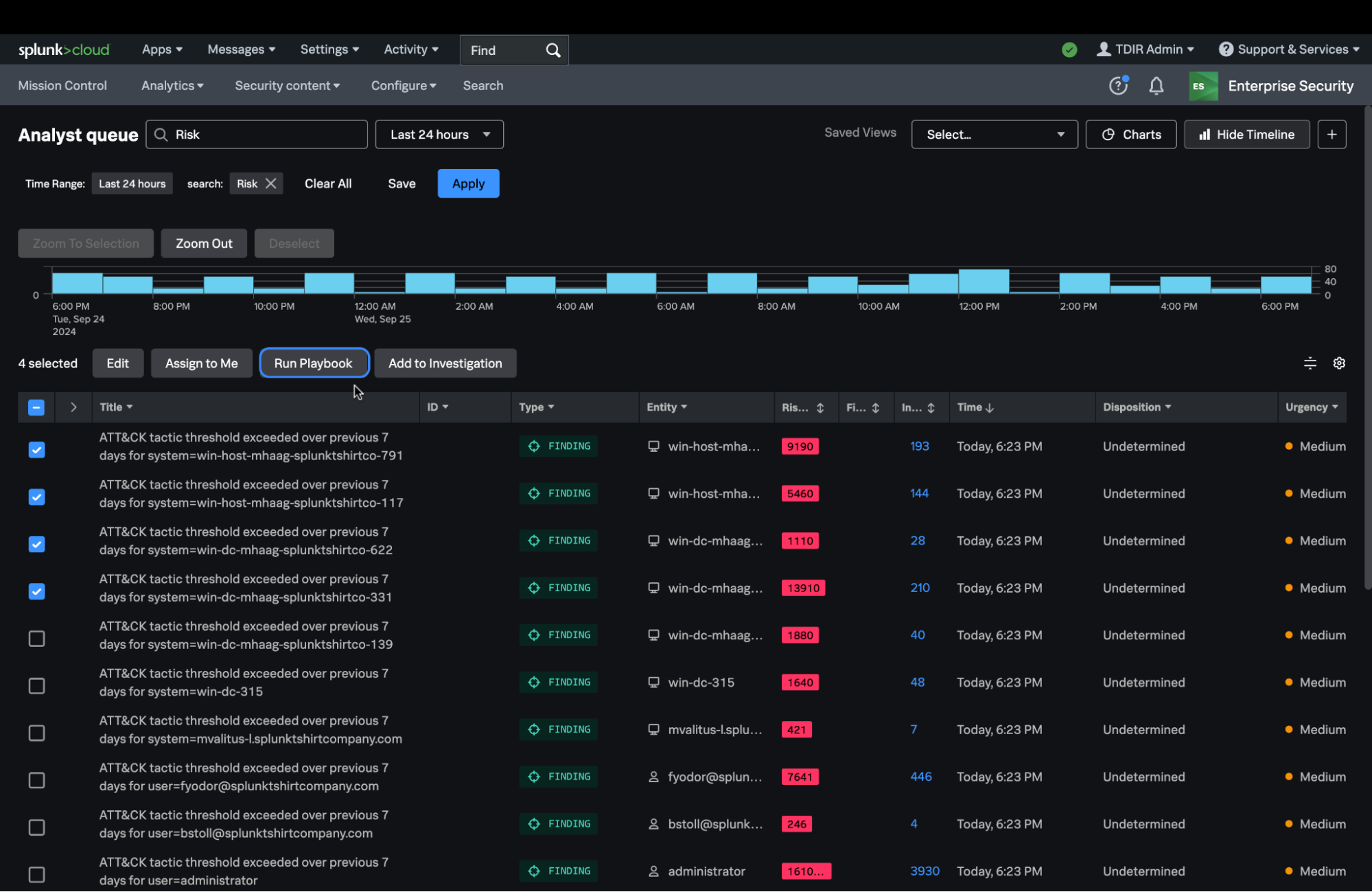
2. Splunk SOAR

Splunk SOAR focuses on unifying security operations by connecting tools, automating workflows, and centralizing investigation and response activities. It integrates with a large ecosystem of third-party tools and supports a range of automated actions, allowing teams to orchestrate workflows without replacing existing systems. The platform consolidates alerts and contextual data, applies machine learning for prioritization, and enables analysts to act through customizable playbooks.
Key features include:
- Extensive integrations and automation actions: Connects with over 300 tools and supports thousands of automated actions to coordinate workflows across systems
- Automated and customizable playbooks: Prebuilt and editable playbooks aligned with frameworks like MITRE ATT&CK enable end-to-end workflow automation
- Visual playbook editor: Low-code interface for building workflows using reusable components and code blocks
- Centralized case management: Supports task assignment, collaboration, and documentation throughout investigations
- Built-in threat intelligence and insights: Provides contextual threat data and prioritization through an integrated investigation panel
- Flexible deployment models: Supports cloud, on-premises, and hybrid deployments with integration into Splunk Enterprise Security

Source: Splunk
3. FortiSOAR

FortiSOAR acts as a centralized operations platform to standardize and automate security workflows across IT and OT environments. It reduces operational complexity by integrating multiple tools, automating repetitive analyst tasks, and providing a unified interface for incident management. The platform includes AI capabilities to guide investigations, recommend actions, and assist in playbook creation.
Key features include:
- Broad integrations and prebuilt workflows: Supports hundreds of integrations and thousands of ready-to-use playbooks for common use cases
- AI-driven operations: Uses generative AI and recommendation engines to guide investigations and automate decision-making
- Centralized incident management: Provides a unified workspace to investigate, respond, and coordinate across teams
- No/low-code playbook creation: Visual drag-and-drop interface enables rapid workflow development and customization
- Built-in threat intelligence: Enriches investigations using FortiGuard Labs and external intelligence sources
- Flexible and scalable deployment: Available as SaaS, on-premises, cloud, or MSSP-managed deployments with multi-tenant support

Source: Fortinet
4. IBM QRadar SOAR

IBM QRadar SOAR helps standardize and automate incident response processes while improving decision-making across security teams. It uses automation for enrichment, correlation, and prioritization, allowing analysts to focus on validated threats. The platform emphasizes dynamic playbooks that adapt during investigations and integrates with existing tools to simplify workflows without requiring major changes to the environment.
Key features include:
- Dynamic playbook automation: Playbooks adapt in real time as incidents evolve, with built-in guidance for analysts
- Automated enrichment and prioritization: Correlates and enriches alerts to identify true incidents and reduce false positives
- Customizable case management: Supports structured workflows aligned with organizational response processes
- Integrated threat intelligence support: Enhances investigations with contextual data and response recommendations
- Regulatory and breach response support: Includes capabilities to manage compliance with a wide range of data breach regulations
- Broad integration ecosystem: Connects with existing security tools to orchestrate end-to-end response workflows

Source: IBM
5. Cortex XSOAR

Cortex XSOAR emphasizes an automation-first approach to incident response, reducing manual effort and improving operational efficiency. It centralizes incident data, threat intelligence, and collaboration into a single workspace, allowing analysts to investigate and respond without switching tools.
Key features include:
- Automation and orchestration at scale: Automates repetitive tasks and coordinates workflows across tools and teams
- Integrated incident workspace: Combines alerts, indicators, and intelligence in a centralized “war room” for collaboration
- Extensive integration and content packs: Provides hundreds of integrations and prebuilt automation packs for rapid deployment
- Visual playbook editor: Enables code-free workflow creation with support for complex automation scenarios
- Alert triage and enrichment: Improves prioritization by enriching alerts with contextual threat intelligence
- Incident lifecycle management: Supports investigation, response, and post-incident analysis within a single platform

Source: Microsoft
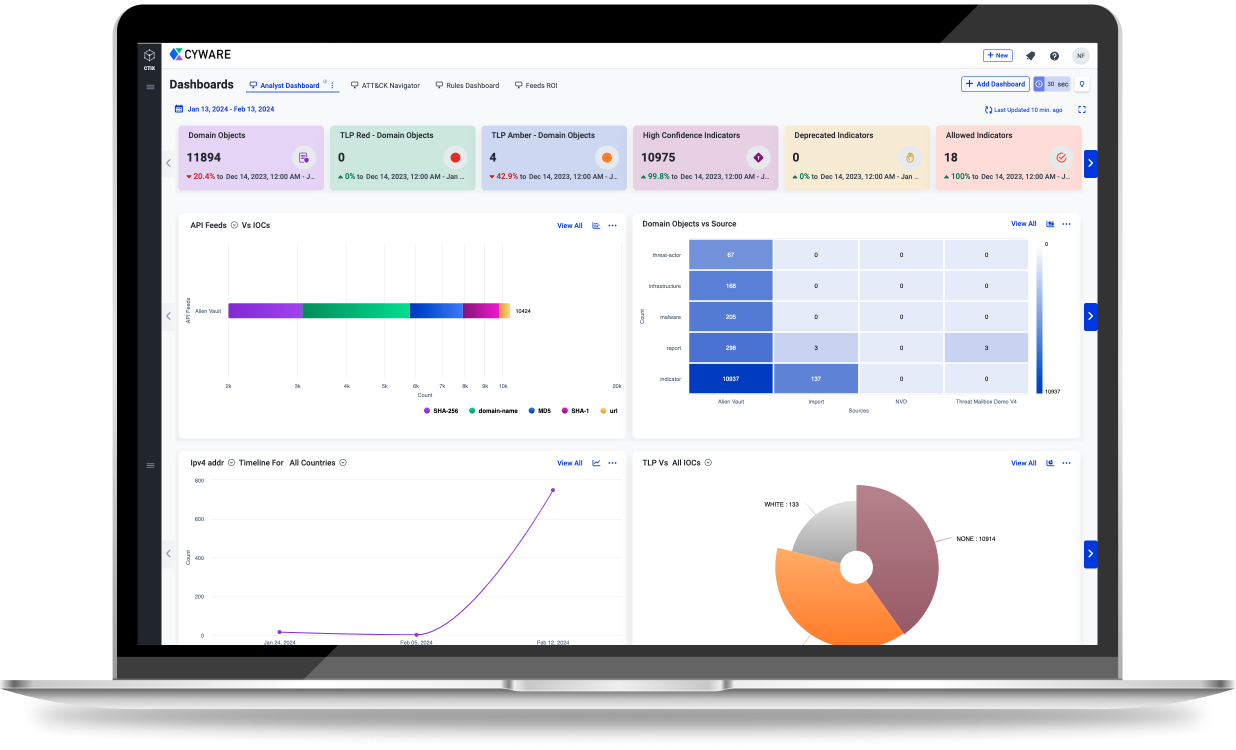
6. Cyware

Cyware focuses on unifying threat intelligence management with orchestration and automated response. It enables organizations to ingest, enrich, and act on threat intelligence in real time while supporting collaboration across teams and external partners. The platform combines AI-driven analysis with automation to accelerate detection, investigation, and response processes.
Key features include:
- Unified threat intelligence management: Aggregates, deduplicates, enriches, and operationalizes intelligence from multiple sources
- AI-powered automation and orchestration: Uses agentic AI and automated playbooks to drive faster response actions
- Real-time threat response: Enables immediate action on intelligence across the security stack
- Collaboration and intelligence sharing: Facilitates secure sharing of threat data across teams and external ecosystems
- Broad integration support: Connects with hundreds of tools to support end-to-end detection and response workflows
- Scalable intelligence processing: Handles large volumes of threat data and automated actions at scale

Source: Cyware
7. Tines
Tines is a vendor-agnostic automation platform focused on building secure, scalable workflows across security and IT operations. It provides a flexible integration layer that connects tools, teams, and data, enabling organizations to automate processes without being tied to specific vendors. The platform supports both human-driven and fully automated workflows, with built-in governance and AI-assisted capabilities.
Key features include:
- Vendor-agnostic integrations: Connects with any system that exposes an API, including internal tools and external services
- Flexible workflow builder: Provides an interface (Storyboard) for designing and managing automation workflows
- AI-assisted automation: Includes an AI copilot to interact with systems and execute actions in real time
- Case management capabilities: Supports tracking, managing, and responding to incidents within workflows
- Collaboration and team accessibility: Enables both technical and non-technical users to build and manage automations
- Governance and security controls: Provides monitoring, guardrails, and policy enforcement across workflows

Source: Tines
Conclusion
SOAR tools are a critical enabler for modern security operations, helping organizations manage increasing alert volumes and complex threat landscapes with greater speed and efficiency. By automating repetitive tasks, orchestrating multi-step workflows, and centralizing incident management, these platforms free up analysts to focus on higher-value activities. Their integration capabilities and built-in intelligence streamline response efforts and reduce the likelihood of human error.
Learn More About Exabeam
Learn about the Exabeam platform and expand your knowledge of information security with our collection of white papers, podcasts, webinars, and more.