


- Home >
- Explainers >
- SIEM
Biggest Pain Points of Traditional SIEM and 8 Modern Platforms Compared
- 19 minutes to read
Table of Contents
TL;DR: Modern SIEM platforms centralize security data across cloud and on-premises sources, then apply behavioral analytics and automation to detect and investigate threats. Best for: Exabeam for behavior-based detection, Microsoft Sentinel for Microsoft-centric SOCs, Splunk ES for large enterprises, Elastic Security for open deployments.
What Is a Traditional SIEM Platform?
Traditional Security Information and Event Management (SIEM) platforms suffer from high implementation complexity, massive log data noise, and punitive volume-based pricing models that hinder effective threat detection. Their architecture is often on-premises, involving complex deployments and ongoing maintenance. While they support regulatory compliance and forensic investigations, their effectiveness depends heavily on manual configuration and tuning
Major pain points:
- High cost and ingestion pricing: Volume-based licensing penalizes organizations for collecting comprehensive logs, creating a perverse incentive to limit security visibility to save money.
- Alert fatigue and false positives: Processing vast quantities of undifferentiated log data generates a high volume of noise, burying true threats and burning out analysts.
- Deployment and integration complexity: Legacy platforms require painful installation processes, manual rule configurations, and expensive ongoing maintenance or consulting fees.
- Poor scalability for modern data volumes: Traditional on-premises or monolithic architectures degrade when trying to ingest and query the massive datasets generated by modern cloud-heavy infrastructures.
- Limited advanced threat detection: Rigid, rule-based correlation struggles to uncover modern, sophisticated zero-day attacks or stealthy lateral movements without behavioral analytics.
- Limited visibility across cloud and hybrid environments: Legacy SIEMs often struggle to collect and correlate telemetry consistently across on-premises, cloud, SaaS, and multi-cloud systems, creating monitoring blind spots.
- Heavy reliance on manual rules and detection engineering: Security teams must continuously create, tune, and maintain detection rules as infrastructure and threats change, increasing operational overhead and the risk of coverage gaps.
How modern SIEM solutions are addressing these pain points:
- Centralized security data collection: Aggregates logs, events, and telemetry from endpoints, networks, applications, and cloud services into one repository for better visibility and investigation.
- Cloud-native scalability: Uses elastic cloud architecture to handle changing data volumes without costly hardware upgrades or complex capacity planning.
- Advanced analytics and behavioral detection: Applies analytics, machine learning, and behavioral baselines to detect anomalies, reduce false positives, and uncover sophisticated threats.
- Machine learning and AI capabilities: Automates threat detection, correlation, and response while continuously improving accuracy as new data and feedback are collected.
- Advanced search and investigation: Enables fast querying, filtering, timeline reconstruction, and collaboration to speed up incident response and root cause analysis.
- Flexible data normalization and enrichment: Converts diverse log formats into consistent schemas and adds context such as asset, user, location, vulnerability, and threat intelligence data.
- Built-in threat intelligence: Integrates threat feeds and attacker context to identify known malicious activity, prioritize alerts, and reduce manual research.
The Biggest Pain Points of Traditional SIEM Platforms
1. High Cost and Ingestion Pricing
Traditional SIEM platforms often come with significant upfront and ongoing costs, including:
- Licensing
- Hardware costs
- Storage fees
A major driver of cost is the pricing model based on the volume of data ingested. As organizations generate more logs (especially with the growth of cloud and IoT) the costs can escalate quickly, often outpacing budget projections. This frequently leads to organizations limiting the scope of log collection or reducing data retention periods, which can undermine the effectiveness of the SIEM.
The high cost structure can also impact security operations by forcing teams to make trade-offs between coverage and affordability. When organizations are unable to collect or retain all relevant security data, incident detection and response capabilities suffer. This creates blind spots that adversaries can exploit, and increases the risk that critical events go unnoticed or are discovered too late for effective mitigation.
2. Alert Fatigue and False Positives
Traditional SIEMs are notorious for generating high volumes of alerts, many of which are false positives or of low value. Security analysts often find themselves overwhelmed by the sheer number of notifications, making it difficult to distinguish between real threats and benign activity. This constant flood of alerts can lead to alert fatigue, where critical warnings are ignored or missed altogether.
The reliance on static, rule-based detection further exacerbates the issue. Without context or advanced analytics, SIEMs often trigger on generic patterns that fail to account for the unique behaviors and risks of the environment. As a result, security teams spend excessive time triaging and investigating non-issues, reducing their ability to focus on genuine incidents and proactive threat hunting.
3. Deployment and Integration Complexity
Deploying a traditional SIEM platform is often a complex, time-consuming process. It requires careful planning, extensive configuration, and significant infrastructure investment. Integrating diverse data sources (each with its own format and protocol) can introduce additional challenges, as custom connectors and parsers may be needed to ensure accurate and comprehensive log collection.
Ongoing integration efforts are also resource-intensive:
- As organizations evolve, add new technologies, or migrate to cloud services, the SIEM platform must be continuously updated to maintain visibility.
- This ongoing complexity not only increases operational overhead but also delays the realization of value from the SIEM investment.
- Security teams are forced to spend more time on maintenance than on actual security monitoring.
4. Poor Scalability for Modern Data Volumes
Traditional SIEMs were not designed to handle the scale and velocity of data produced by modern IT environments. As organizations adopt cloud services, containers, and microservices, the volume of security-relevant data grows exponentially. Legacy SIEM architectures often struggle to scale efficiently, resulting in:
- Performance bottlenecks
- Delayed processing
- Reduced visibility
Scalability limitations force organizations to make compromises, such as sampling data, reducing log retention, or limiting the scope of monitoring. These trade-offs can create security gaps and hinder compliance efforts. The inability to scale flexibly with business growth leaves organizations exposed to emerging threats and unable to adapt quickly to changing requirements.
5. Limited Advanced Threat Detection
Traditional SIEMs primarily rely on signature-based and rule-driven detection methods. While effective for known threats, these approaches fall short in identifying sophisticated attacks that use novel tactics or evade standard detection logic. Some threats often go unnoticed in environments that lack behavioral analytics and contextual awareness, including:
- Advanced persistent threats (APTs)
- Insider threats
- Fileless malware
The absence of advanced threat detection capabilities limits the SIEM’s ability to surface subtle indicators of compromise or detect threats in real time. As attackers employ more complex techniques, the gap between what traditional SIEMs can detect and the threats organizations face continues to widen, leaving critical assets vulnerable to compromise.
6. Limited Visibility Across Cloud and Hybrid Environments
Many traditional SIEM platforms were built for on-premises environments and lack robust support for cloud and hybrid infrastructures. As organizations transition workloads to public and private clouds, SIEMs often face challenges in ingesting and normalizing data from diverse sources such as:
- SaaS applications
- Cloud-native services
- Multi-cloud deployments
This limited visibility results in fragmented monitoring and inconsistent coverage across the enterprise. Security teams may struggle to correlate events or detect lateral movement across different environments, increasing the risk of undetected attacks. Without comprehensive visibility, organizations cannot maintain a consistent security posture or ensure compliance with regulatory requirements across all their assets.
7. Heavy Reliance on Manual Rules and Detection Engineering
Traditional SIEM platforms depend heavily on manual rule creation and ongoing tuning by security analysts. Developing effective detection content requires deep expertise in both the SIEM platform and evolving threat landscapes. This manual effort is time-consuming and resource-intensive, and often struggles to keep pace with new attack techniques or changes in the IT environment.
Frequent changes to infrastructure, applications, or business processes require constant updates to detection rules and correlation logic. This reliance on manual engineering not only increases operational overhead but also introduces the risk of misconfiguration or oversight. As a result, organizations may experience inconsistent detection coverage, delayed incident response, and gaps in their security monitoring.
How Do Modern SIEM Platforms Address These Pain Points?
Centralized Security Data Collection
Modern SIEM platforms are designed to collect security data from a wide range of sources, both on-premises and in the cloud. This centralized approach ensures that logs, events, and telemetry from endpoints, networks, applications, and cloud services are aggregated in a single repository. Comprehensive data collection enables more effective threat detection, investigation, and compliance reporting.
Centralized collection also simplifies data management and enhances visibility across the organization. With all relevant security data in one place, analysts can perform holistic investigations, identify patterns, and correlate events that may otherwise go unnoticed. This approach reduces blind spots and supports a unified security strategy, regardless of the complexity or distribution of the IT environment.
Cloud-Native Scalability
Modern SIEM solutions are built to leverage cloud-native architectures, providing elastic scalability that adjusts to changing data volumes and organizational needs. Unlike legacy systems, which often require costly hardware upgrades and complex capacity planning, cloud-native SIEMs can scale resources automatically in response to demand. This ensures consistent performance, even as organizations grow or face spikes in activity.
Cloud-native scalability also supports global deployments and distributed teams, enabling security operations to monitor large, complex environments without geographic limitations. By removing the constraints of on-premises infrastructure, organizations can collect and analyze more data without worrying about storage, compute, or network bottlenecks. This flexibility is essential for adapting to evolving business and security requirements.
Advanced Analytics and Behavioral Detection
Modern SIEM platforms incorporate advanced analytics to move beyond static rule-based detection. By leveraging statistical analysis, machine learning, and behavioral modeling, these platforms can identify anomalies and suspicious activities that would evade traditional correlation rules. Behavioral detection helps surface threats such as insider attacks, account compromise, and lateral movement by focusing on deviations from established baselines.
The integration of advanced analytics also improves the signal-to-noise ratio, reducing false positives and allowing analysts to focus on high-fidelity alerts. By continuously analyzing user, device, and network behaviors, modern SIEMs provide deeper context for investigations and enable proactive threat hunting. This capability is critical for detecting sophisticated threats and minimizing dwell time.
Related content: Read our detailed guide to SIEM analytics.
Machine Learning and AI Capabilities
Machine learning and artificial intelligence are core differentiators of modern SIEM platforms. These technologies automate the analysis of vast amounts of security data, enabling real-time detection of complex threats. ML and AI can identify subtle patterns, correlate disparate events, and adapt to evolving attack techniques without requiring constant manual intervention.
AI-driven SIEMs also support automated response and remediation, reducing the burden on security teams and accelerating incident containment. By continuously learning from new data and feedback, these platforms improve detection accuracy over time and adapt to changes in the environment. The use of ML and AI not only enhances security outcomes but also addresses resource constraints and skills shortages within security operations centers.
Advanced Search and Investigation
Modern SIEM platforms offer advanced search and investigation capabilities, allowing analysts to query large volumes of security data with speed and precision. Advanced search features include full-text indexing, contextual filtering, and timeline reconstruction, enabling rapid investigation of incidents and root cause analysis. These capabilities are essential for responding to threats and fulfilling regulatory or audit requirements.
Effective investigation tools also support collaboration among security team members, enabling knowledge sharing and coordinated response. With intuitive interfaces and automated workflows, modern SIEMs simplify the investigative process, reducing time-to-resolution and improving overall security posture. The ability to quickly search and analyze historical data is critical for understanding attack chains and preventing future incidents.
Flexible Data Normalization and Enrichment
Modern SIEM platforms normalize data from different sources into consistent schemas, making events easier to search, correlate, and analyze. Flexible parsing and mapping allow teams to integrate new data sources without extensive custom development. This helps analysts work with a common set of fields even when the original logs use different formats and naming conventions.
Data enrichment adds context such as asset details, user identities, geolocation, vulnerability information, and threat intelligence to raw events. This context helps analysts assess the severity and relevance of suspicious activity more quickly. It also improves correlation and detection by connecting individual events to the users, systems, and risks involved.
Built-In Threat Intelligence
Modern SIEM platforms integrate threat intelligence to identify activity associated with known malicious infrastructure, indicators of compromise, and attacker techniques. Threat feeds can include malicious IP addresses, domains, file hashes, and other indicators from commercial, open-source, and internal sources. The SIEM can automatically compare this intelligence against collected security data to identify potential threats.
Built-in threat intelligence also provides context that helps analysts prioritize alerts and investigations. For example, an outbound connection becomes more significant when its destination is linked to an active malware campaign. By enriching detections with information about known threats and attacker behavior, modern SIEMs can reduce manual research and help security teams respond more quickly.
Modern SIEM Platforms at a Glance
The table below summarizes the key differences between the platforms covered in this section. We explore each of them in more detail below.
| Category | Solution | Best For | Key Strengths | Things to Consider |
| Cloud-native SIEM platforms | Exabeam New-Scale SIEM | Behavior-based detection and machine-built investigation timelines | Fast search, 7,000+ prebuilt parsers, agent-driven case automation | Dashboard customization options are still expanding |
| Cloud-native SIEM platforms | Securonix Unified Defense SIEM | Unifying SIEM, UEBA, SOAR, and threat intelligence in one platform | 365 days of hot data, pipeline-based ingestion cost control | Support responsiveness and console behavior draw complaints |
| Cloud-native SIEM platforms | Microsoft Sentinel | SOCs standardized on Microsoft Defender and Azure | Built-in data lake, SOAR, UEBA, and 400+ data connectors | Setup and tuning generally need dedicated expertise |
| Cloud-native SIEM platforms | Google Security Operations | High-volume telemetry with Google-curated detections | Built-in SOAR, curated detections, Gemini-assisted search | Onboarding and rule authoring involve a learning curve |
| SIEM built on broader security and data platforms | Splunk Enterprise Security | Large SOCs with dedicated platform and detection engineers | Risk-based alerting, detection lifecycle tools, federated search | Cost and implementation effort are common complaints |
| SIEM built on broader security and data platforms | IBM QRadar SIEM | Regulated enterprises correlating log and network flow data | Sigma rule support, UBA, and 700 prebuilt integrations | Search performance and reporting draw user criticism |
| SIEM built on broader security and data platforms | Elastic Security | Teams wanting open detection rules and flexible deployment | Automatic schema mapping, native workflows, federated search | Cluster management and query languages take time to learn |
| SIEM built on broader security and data platforms | CrowdStrike Falcon Next-Gen SIEM | Teams already running the CrowdStrike Falcon platform | Index-free search, data pipelines, agentic SOAR workflows | Premium pricing and a distinct query language to learn |
Notable Modern SIEM Platforms
How we selected these platforms: We shortlisted SIEM platforms based on centralized data collection across cloud and on-premises sources, data normalization and enrichment, advanced analytics and behavioral detection, automation and AI-assisted investigation, and search, reporting, and compliance capabilities.
Cloud-Native SIEM Platforms
1. Exabeam New-Scale SIEM

Best for: Behavior-based detection and machine-built investigation timelines
Strengths: Fast search, prebuilt parsers, and agent-driven case automation
Things to consider: Dashboard customization options are still expanding
Exabeam New-Scale SIEM is a cloud-native SIEM that combines log management, search, correlation, and centralized case management in a single platform. Data reaches the platform through collectors, log forwarding, or API-based ingestion, including telemetry forwarded from other SIEMs such as QRadar, Microsoft Sentinel, and Splunk, as well as from AWS, Azure, GCP, and SaaS applications.
The service is delivered from Google Cloud Platform, and customers select their hosting region at purchase. It is sold as part of New-Scale Fusion, a modular platform that pairs New-Scale SIEM with New-Scale Analytics to add behavioral analytics and dynamic risk scoring, and can either replace an existing SIEM or run alongside one.
Key features include:
- High-performance search: Queries terabytes of data using either advanced query builders or natural-language search, and moves from search results into timelines and visualizations without switching tools.
- Common Information Model: Normalizes data at ingestion into standardized event structures, so logs from different sources share consistent fields for search, correlation, and analysis.
- Prebuilt log collection: Includes more than 7,000 prebuilt log parsers and collectors that process over 2 million events per second, plus a guided wizard for creating custom parsers from templates or existing configurations.
- Threat Center workbench: Brings alerts, cases, detections, and watchlists into one interface and automates prioritization, triage, and evidence collection across an investigation.
- Custom detection engineering: Converts saved searches into correlation rules with one click, and supports building, testing, publishing, and monitoring up to 1,000 rules with priority assigned by threat context.
- Threat Intelligence Service: Ingests and scores commercial and open-source threat feeds, refreshes every 24 hours at no additional cost, and accepts custom feeds through a STIX/TAXII cloud collector.
- Exabeam Nova agents: Automate routine and complex security operations tasks, generating case summaries and classifying threats to reduce manual validation and documentation.
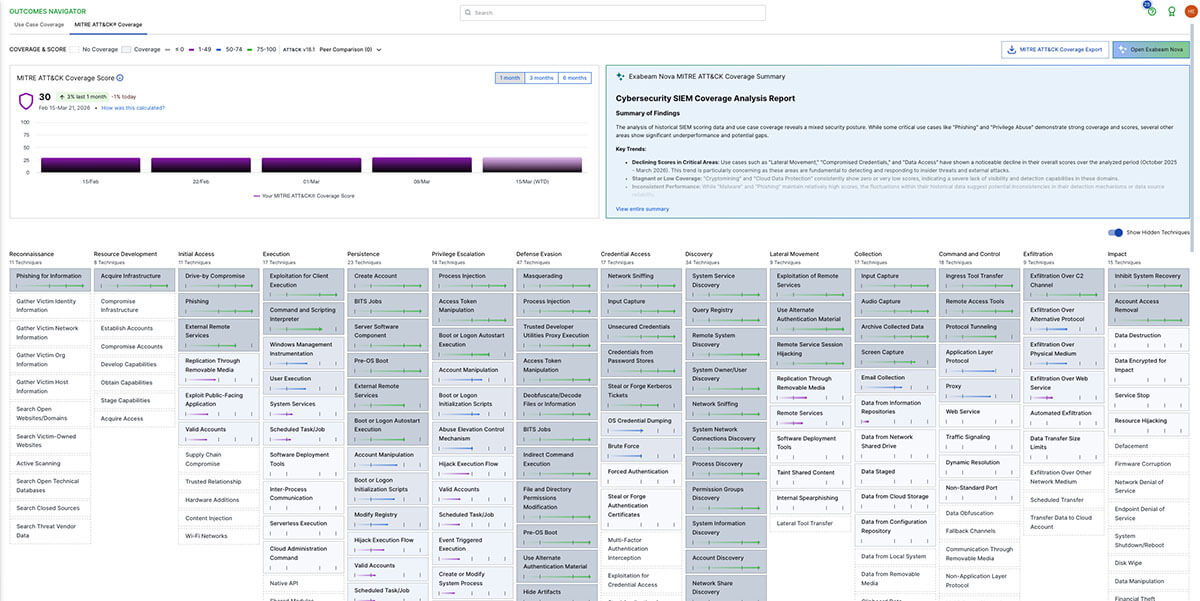
- Outcomes Navigator: Maps ingested data to security use cases, MITRE ATT&CK, and the OWASP Agentic Top 10, and supports peer benchmarking across security programs.
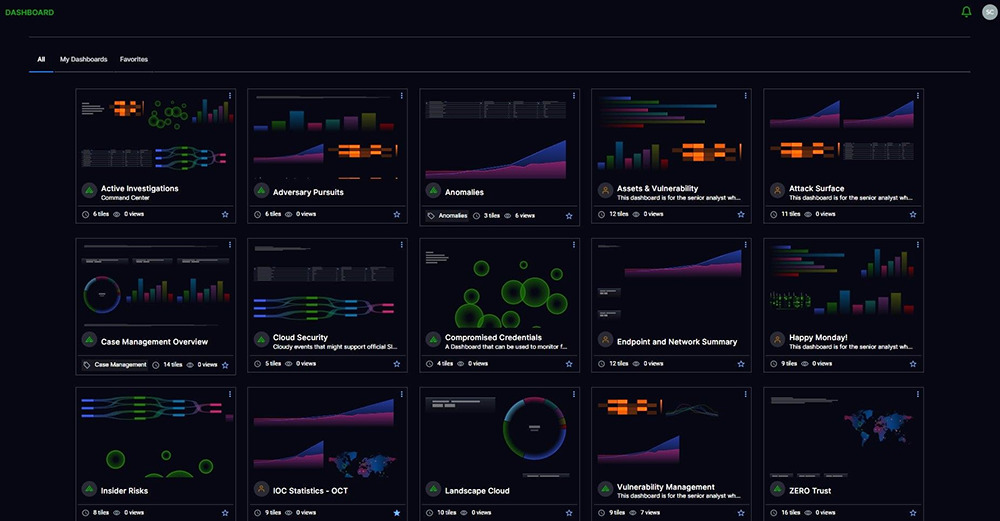
- Reporting and dashboards: Builds dashboards from 14 chart types, schedules automated report delivery, and accepts natural-language prompts for report creation.
- Agent Behavior Analytics (ABA): Tracks telemetry across major large language models to normalize prompt and response flows, detect configuration drift, prompt abuse, and privilege misuse.
- Praxen and Observra open-source projects: Validate configured agent permissions before deployment with Praxen, and capture runtime activity logs directly to the SIEM using Observra.
Limitations (as reported by users on PeerSpot):
- Dashboard customization: Some users want more dashboard options, including the ability to sort by most recent detection rather than highest risk score.
- Out-of-the-box integrations: Several reviewers note that certain integrations require additional configuration or professional services to complete.
- Documentation depth: Some users find documentation incomplete in specific areas, particularly around API usage.
Source: Exabeam
2. Securonix Unified Defense SIEM

Best for: Unifying SIEM, UEBA, SOAR, and threat intelligence in one platform
Strengths: 365 days of hot data and pipeline-based ingestion cost control
Things to consider: Support responsiveness and console behavior draw complaints
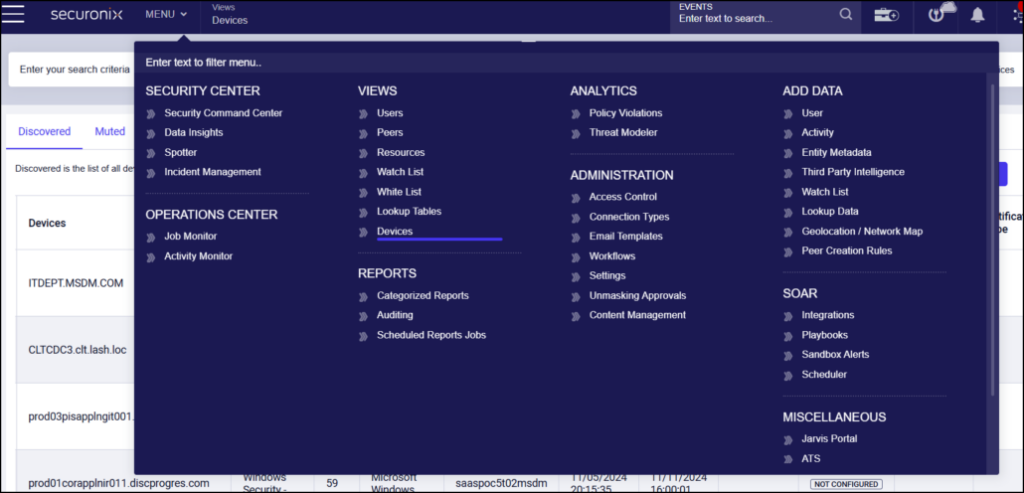
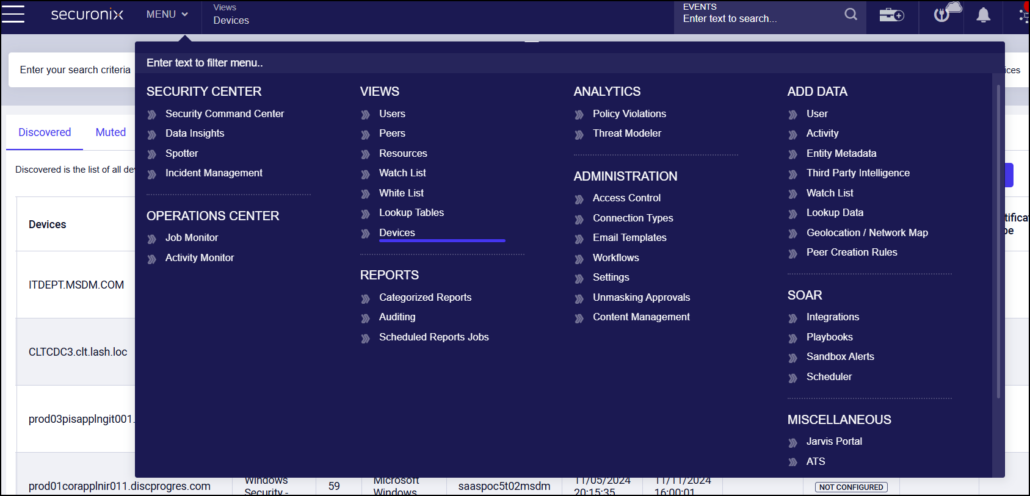
Securonix Unified Defense SIEM is a cloud-native platform that combines SIEM, user and entity behavior analytics, SOAR, and a threat intelligence platform in one product rather than as separately licensed components. Agentic AI is applied across detection, triage, enrichment, and response steps.
The platform runs on a single-tier cloud architecture with one data layer, so telemetry is ingested once and then used for detection, investigation, and response. Threat content is delivered as a service by Securonix Threat Labs, and the consumption-based pricing model covers SOAR, UEBA, and analytics without separate line-item fees.
Key features include:
- Unified data layer: Ingests telemetry once and makes it available across detection, investigation, and response workflows, removing the need to duplicate data between modules.
- Data Pipeline Manager: Classifies and organizes data before storage, controlling which events are analyzed in real time, held for later forensics, or archived for compliance.
- 365 days of hot data: Keeps a full year of telemetry immediately searchable, so investigations and audits do not wait on archived data being restored.
- Behavioral analytics: Applies AI-driven behavioral analysis to detect threats in real time, with UEBA built into the same platform as the SIEM.
- Noise control: Filters false positives before alerts reach analysts, reducing the volume of low-value notifications in the queue.
- Agentic Mesh: Provides governed AI with explainable guidance at each step, plus automated enrichment, triage, and response actions.
- Compliance reporting: Aligns detections, investigations, response actions, and policy enforcement to frameworks including SEC, GDPR, and DORA, producing time-stamped, traceable, exportable evidence.
Limitations (as reported by users on G2):
- Support responsiveness: Reviewers describe slow support and escalations that require senior or executive involvement to resolve.
- SOAR reliability: Some users report that SOAR functions do not always work as expected and that the console can log users out unexpectedly.
- Configuration lag: Setting changes made in the interface can take a long time to take effect, which complicates troubleshooting.
- Case management usability: Several reviewers describe the case management experience as unintuitive.
- Connector coverage: Users ask for a wider set of data connectors and stronger third-party integration options.
- Fit for smaller teams: Reviewers note the platform is generally oriented toward large customers.
Source: Securonix
3. Microsoft Sentinel

Best for: SOCs standardized on Microsoft Defender and Azure
Strengths: Built-in data lake, SOAR, UEBA, and 400+ data connectors
Things to consider: Setup and tuning generally need dedicated expertise
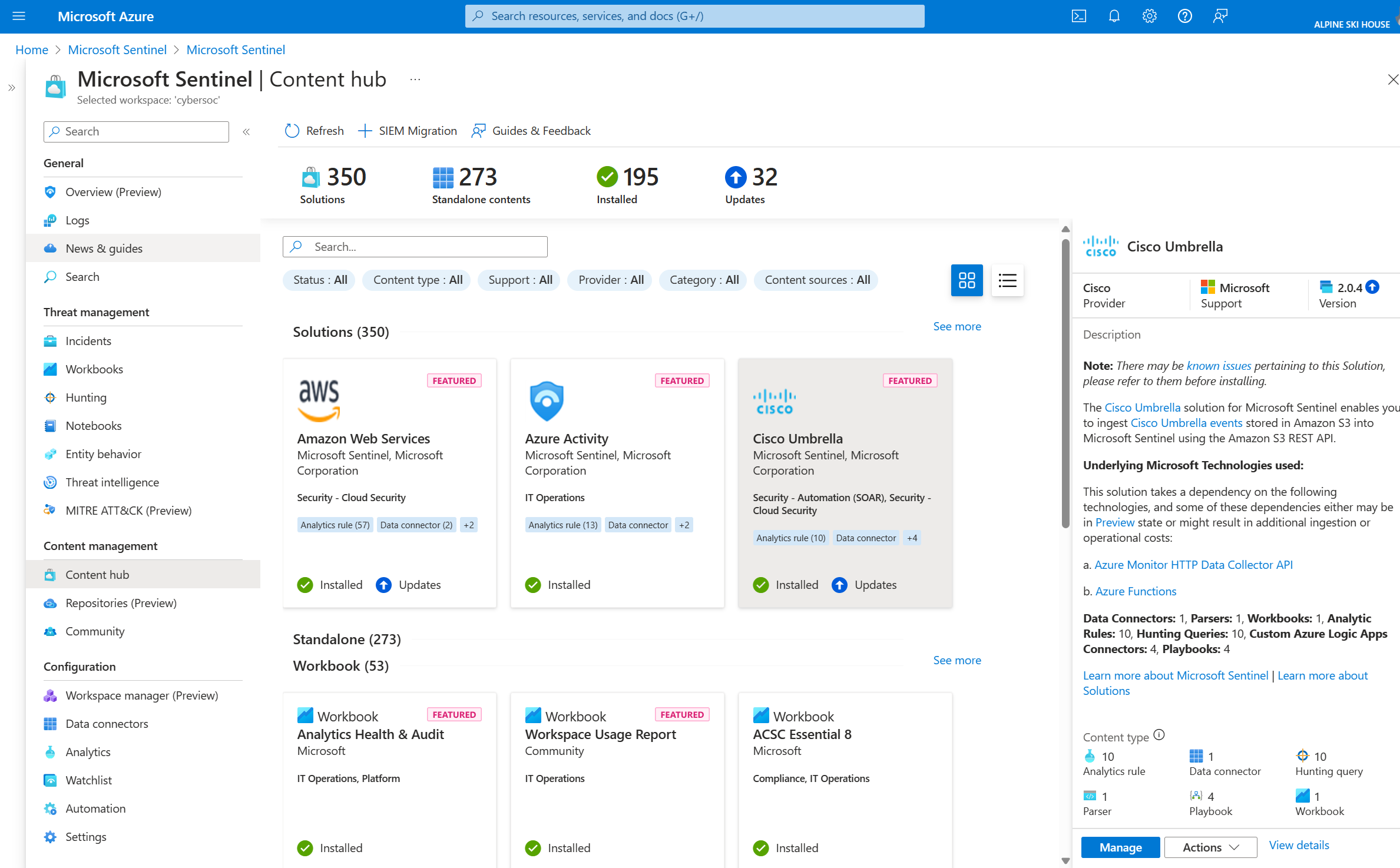
Microsoft Sentinel is a cloud-native SIEM that correlates signals across identities, endpoints, cloud applications, and infrastructure in multi-cloud and multi-platform environments. It runs inside the Microsoft Defender portal, where SIEM and XDR incidents are handled in a single workflow.
Sentinel bundles SOAR, UEBA, threat intelligence, and case management rather than selling them as add-on modules, and pairs the SIEM with a built-in data lake for long-term log retention. Pricing is based on the volume of data ingested, stored, and consumed, with commitment tiers available.
Key features include:
- Built-in data lake: Stores and queries years of security data at lower cost than hot SIEM storage, keeping logs available for hunting, compliance, and AI-powered detection.
- Connector coverage: Supports more than 400 native connectors plus a codeless connector framework for building custom ones, and a catalog of over 480 customizable security solutions.
- Built-in SOAR: Includes out-of-the-box playbooks and codeless automation for orchestrating response and reducing manual triage steps.
- Built-in UEBA: Baselines normal user and entity activity and flags deviations that rule-based detection alone does not surface.
- Native XDR integration: Unifies SIEM and XDR visibility and control in the Defender portal so incidents are investigated in one workflow.
- SOC optimization: Provides AI-driven recommendations that tune analytics rules, surface higher-fidelity alerts, and point analysts to the next action.
- Security Copilot: Summarizes incidents, drafts Kusto Query Language queries, and recommends next steps inside the investigation workflow.
- AI-assisted migration: Converts detection rules and alerts from Splunk and QRadar into native Sentinel detections, starting with an analysis-only review of legacy exports.
- Threat intelligence: Combines Microsoft threat signals with third-party feeds using industry-standard threat feed formats for alert enrichment.
Limitations (as reported by users on G2):
- Configuration complexity: Reviewers report that effective setup and ongoing configuration require advanced technical skills.
- Setup expertise: Users note that deployment is difficult without dedicated security specialists and formal training.
- Interface navigation: Some reviewers find the interface hard to navigate and certain features difficult to locate.
- Cloud dependency: Users raise concerns about reliance on connectivity, with degraded experience on slower connections.

Source: Microsoft
4. Google Security Operations

Best for: High-volume telemetry with Google-curated detections
Strengths: Built-in SOAR, curated detections, and Gemini-assisted search
Things to consider: Onboarding and rule authoring involve a learning curve
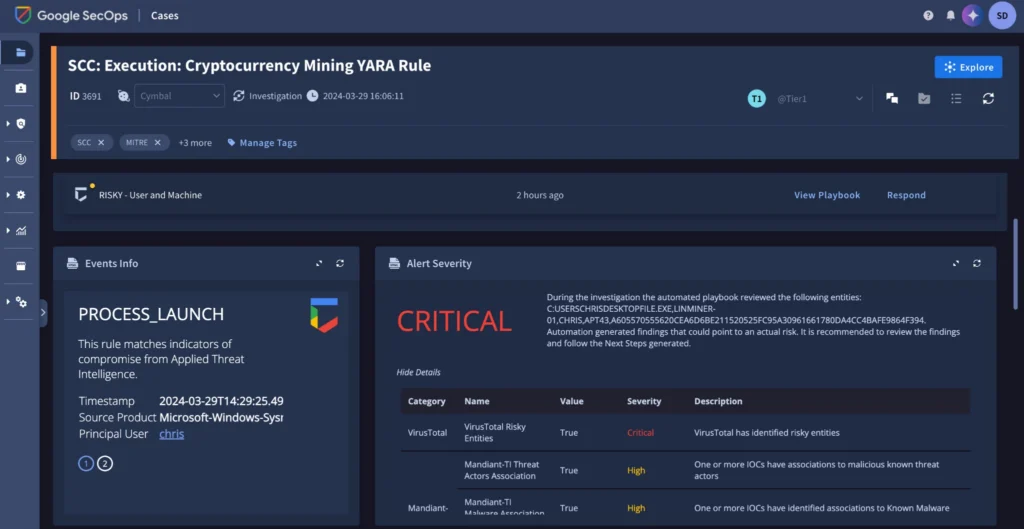
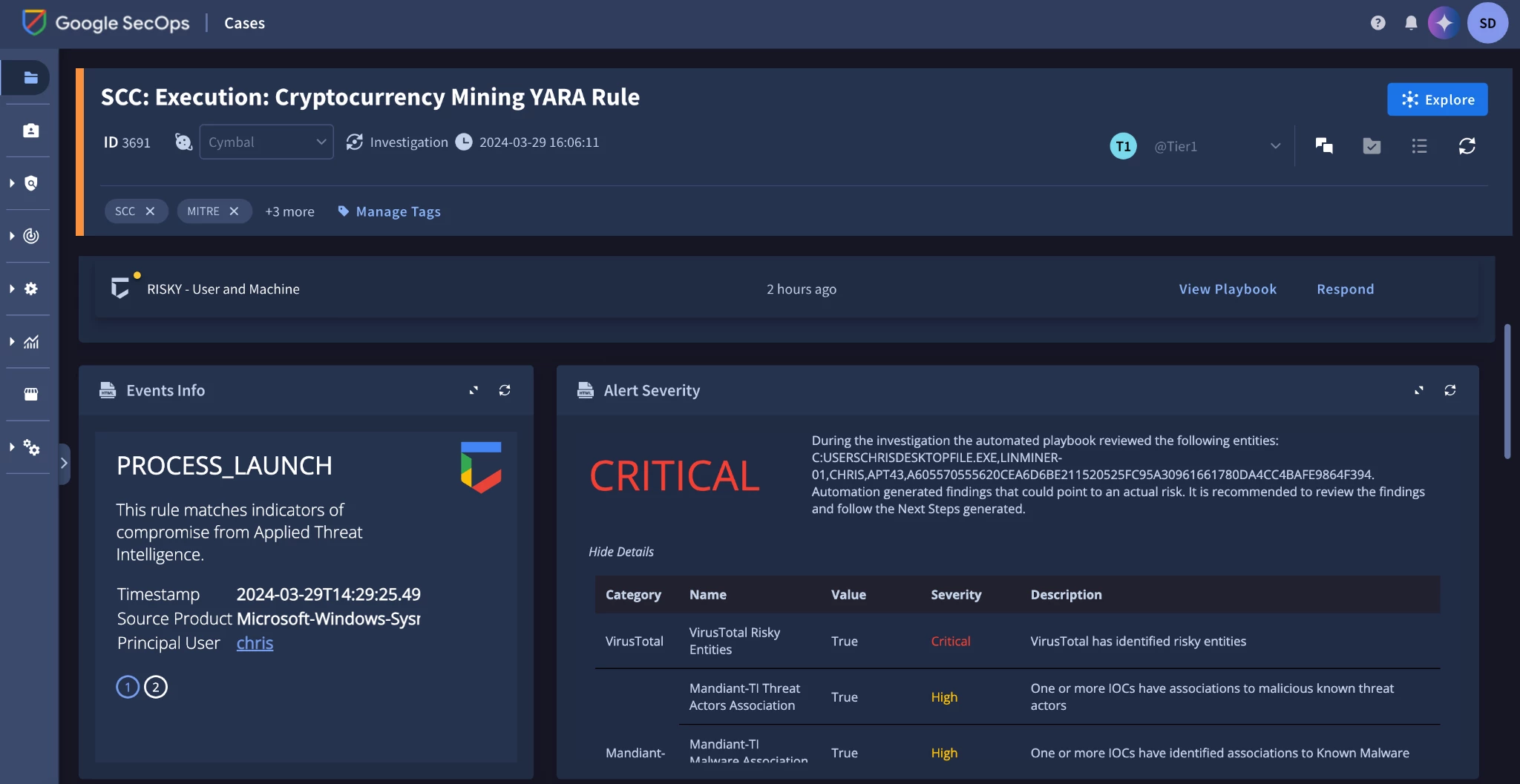
Google Security Operations is a cloud-native platform that combines SIEM, SOAR, and applied threat intelligence in one experience. It collects security telemetry from on-premises systems and all major cloud providers, not only Google Cloud, and normalizes it for detection, investigation, and response.
The platform is sold in Standard, Enterprise, and Enterprise Plus packages priced on ingestion, with one year of telemetry retention included. Higher tiers expand the detection engine, add UEBA and Gemini assistance, and unlock Google Threat Intelligence sourced from Mandiant and VirusTotal.
Key features include:
- Curated detections: Ships with a growing set of out-of-the-box detections developed and maintained by Google threat researchers, covering on-premises and cloud threats.
- YARA-L rule authoring: Supports custom detection writing in the YARA-L language, alongside the curated rule sets.
- Gemini assistance: Handles natural-language search by generating the underlying query and showing the mapped syntax, produces case summaries and response recommendations, and creates detections and playbooks through chat.
- Built-in SOAR: Automates response through playbooks, orchestrates more than 300 tools including EDR, identity, and network security products, and records actions on an auto-documenting case wall.
- Case management and alert graphing: Provides threat-centric case management, interactive context-rich alert graphs, and automatic stitching of related entities.
- Data pipeline management: Routes, filters, redacts, and transforms telemetry before it is stored, with advanced tiers adding routing to a second destination during SIEM migrations.
- Parsers and integrations: Includes access to more than 700 parsers and 300 SOAR integrations, with 12 months of hot data retention.
- UEBA: Uses YARA-L rules for user and entity behavior analytics, with a risk dashboard and out-of-the-box behavior-style detections.
- Applied threat intelligence: Prioritizes indicator matches using machine learning that factors in the customer environment, and extends beyond indicators to attacker tactics and techniques.
Limitations (as reported by users on G2):
- Setup and maintenance complexity: Reviewers describe both initial configuration and ongoing maintenance as demanding.
- Learning curve: Users report that the platform takes time to use effectively, with complex features and configuration options.
- Implementation effort: Several reviewers note that getting to full value requires significant time and internal resources.
- Customization limits: Some users find customization options narrower than expected, which affects how the platform fits existing workflows.
- Cost: Reviewers flag cost as a consideration alongside the complexity of the deployment.
Source: Google
SIEM Platforms Built on Broader Security and Data Platforms
5. Splunk Enterprise Security

Best for: Large SOCs with dedicated platform and detection engineers
Strengths: Risk-based alerting, detection lifecycle tools, federated search
Things to consider: Cost and implementation effort are common complaints
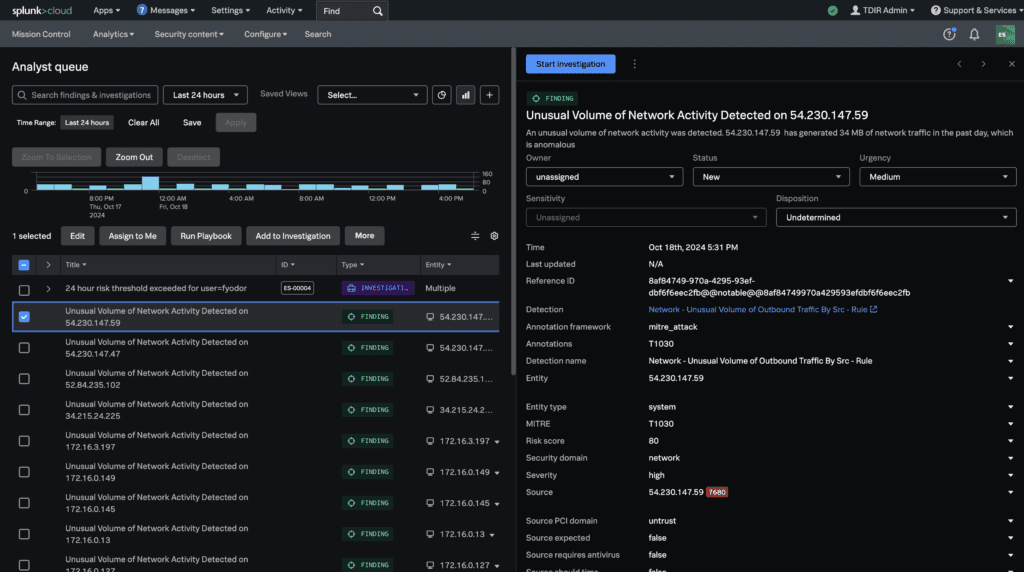
Splunk Enterprise Security is a threat detection, investigation, and response platform built on the Splunk data platform. It combines SIEM, SOAR, UEBA, and AI-assisted workflows in one interface, and lets teams search and analyze data across domains, clouds, and devices regardless of where it is stored.
The product is sold in two editions. Essentials covers the SIEM, threat intelligence, Detection Studio, and Exposure Analytics. Premier adds SOAR, UEBA, and Automated Threat Analysis. Cisco Talos threat intelligence is included at no additional cost in both editions.
Key features include:
- Risk-based alerting: Aggregates risk across related events to cut alert volumes and raise the proportion of alerts that represent genuine threats.
- Detection Studio: Covers the full detection lifecycle, letting engineers plan, develop, test, deploy, and monitor detections and map coverage against MITRE ATT&CK.
- UEBA: Applies behavior-based anomaly detection and machine learning to identify account misuse, compromised credentials, and lateral movement.
- SOAR: Automates response workflows and playbooks for the whole SOC, integrated directly with Enterprise Security rather than as a separate console.
- Federated search and analytics: Queries and analyzes data across sources without forcing ingestion into Splunk first.
- Exposure Analytics: Continuously identifies assets and users, enriches security findings with context, and produces reporting for risk prioritization.
- Automated Threat Analysis: Breaks down phishing attack chains and delivers automated phishing forensics inside the analyst workspace.
- AI agents and assistant: Includes a triage agent that evaluates, prioritizes, and explains alerts, malware reversing that analyzes malicious scripts line by line and extracts indicators, and natural-language creation of playbooks and detection rules.
- Threat intelligence enrichment: Adds context to investigations through integrated feeds, with Cisco Talos intelligence included.
Limitations (as reported by users on G2):
- Cost: Reviewers repeatedly cite high cost as a drawback, particularly for smaller organizations.
- Implementation complexity: Users report that initial onboarding needs expert resources and significant time.
- Learning curve: Several reviewers describe the platform as difficult for newcomers to pick up.
- Setup effort: Users note that the extended setup process is time-consuming and requires ongoing expertise.
Source: Splunk
6. IBM QRadar SIEM
Best for: Regulated enterprises correlating log and network flow data
Strengths: Sigma rule support, UBA, and 700 prebuilt integrations
Things to consider: Search performance and reporting draw user criticism
IBM QRadar SIEM centralizes security visibility across an organization’s tools and data sources, applying real-time detection and correlation to identify threats before incidents escalate. It is designed to work across data source types and to interoperate with existing detection tooling rather than replace it.
The platform combines log analysis with network-level analytics and behavioral detection, and supports compliance work by producing evidence for regulatory statutes and internal audits. It is commonly paired with QRadar SOAR for case management and orchestration, and QRadar EDR for endpoint visibility.
Key features include:
- Centralized security visibility: Aggregates data across the security ecosystem into one view, with real-time threat detection and reduced manual work on tasks such as case creation and risk prioritization.
- User behavior analytics: Surfaces insider threats and anomalous behavior, identifies risky users, and generates supporting context for investigations.
- Sigma community rules: Provides native support for thousands of open-source Sigma rules, so analysts can import crowdsourced detection logic as threats evolve.
- Network threat analytics: QRadar Network Detection and Response analyzes network activity in real time, adding network-level visibility alongside log data.
- Prebuilt integrations: Includes 700 prebuilt integrations and partner extensions for connecting existing threat detection tools.
- Threat hunting: Converts disparate datasets into intelligence analysts can hunt against in near real time.
- Compliance reporting: Produces evidence of compliance and declarations of conformity for applicable regulations and internal audit requirements.
- SOAR and EDR pairing: Combines with QRadar SOAR for case management, orchestration, and dynamic playbooks, and with QRadar EDR for endpoint visibility without affecting the EPS count.
Limitations (as reported by users on G2):
- Interface and reporting: Reviewers point to interface shortcomings, search limitations, and difficulty building reports.
- Cost: Users describe the platform as expensive, with the burden falling hardest on small and mid-size organizations.
- Dashboard constraints: Reviewers report limited editing rights and difficulties with offense management and reporting.
- Query performance: Several users find search queries slow and inefficient when retrieving logs.

Source: IBM

7. Elastic Security

Best for: Teams wanting open detection rules and flexible deployment
Strengths: Automatic schema mapping, native workflows, federated search
Things to consider: Cluster management and query languages take time to learn
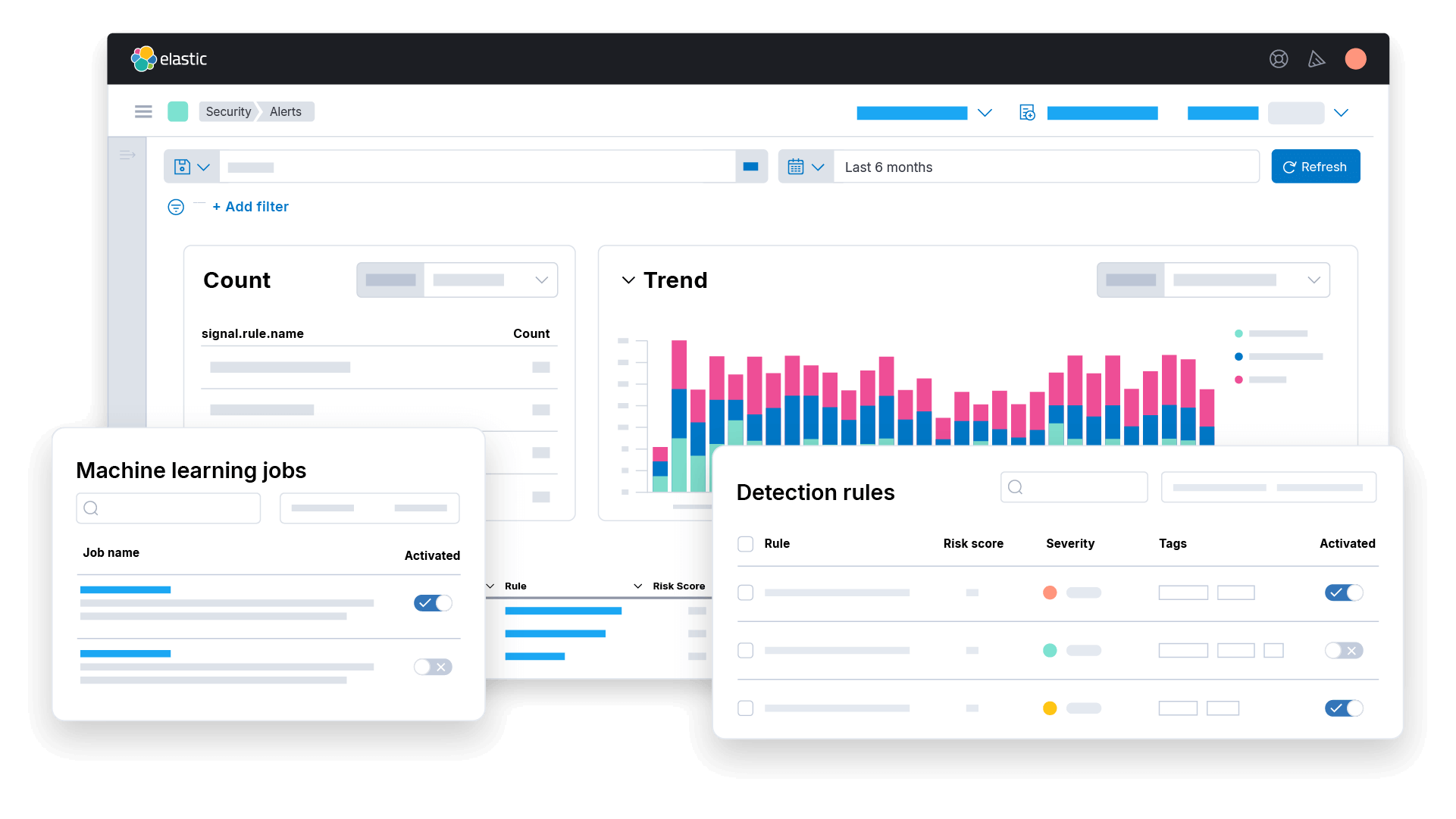
Elastic Security is a SIEM built on the Elasticsearch data platform that combines SIEM, XDR, and native automation in one product. Detection rules are developed by Elastic Security Labs, reviewed by the community, and published in a public repository, and AI reasoning runs directly over data where it is stored rather than through a connector layer.
The platform deploys on-premises, in the cloud, or in air-gapped environments with no data movement required, and supports any large language model, including on-premises models for isolated networks. Elastic Cloud holds certifications including PCI DSS, HIPAA, FedRAMP, GDPR, and TISAX.
Key features include:
- Automatic schema mapping: Identifies the data type when a new source connects, maps the schema, and recommends detection rules without a separate pipeline engineering effort.
- Open detection rules: Publishes rules openly for community review, maps them to MITRE ATT&CK, and applies a universal schema across ECS and OCSF so one detection works across formats. Data shipped via OpenTelemetry is supported natively.
- Attack Discovery: Correlates individual alerts into prioritized attack narratives, and the Alert Analysis skill classifies alerts, enriches them with entity context and threat intelligence, and assembles an investigation timeline.
- Elastic Workflows: Runs automation natively on security data, combining scripted playbooks with agentic reasoning to disable accounts, block IP addresses, and isolate hosts without a separate SOAR product.
- Entity analytics: Records every entity attribute change with a timestamp, updates risk scores as context changes, and feeds organizational knowledge in through watchlists.
- Composable AI skills: Provides purpose-built skills for threat hunting, alert analysis, detection engineering, entity analytics, and anomaly investigation, which invoke each other and run via Workflows, Agent Builder, or any MCP-compatible tool.
- Federated search: Queries and correlates across cloud, on-premises, and air-gapped deployments using cross-cluster ES|QL, with frozen and long-term data searchable in the same query.
- Automatic Import and Migration: Builds custom integrations from sample logs and converts existing SIEM content such as detection rules during a migration.
- Integration coverage: Supports more than 400 prebuilt integrations and up to 1,000 total security and data source integrations.
Limitations (as reported by users on G2):
- Learning curve and overhead: Reviewers report steep learning curves and operational overhead that affect team capacity.
- Implementation complexity: Users describe deployment and ongoing maintenance of the underlying infrastructure as demanding.
- Query languages: Several reviewers note the effort required to learn new query languages before working efficiently.
- Integration issues: Some users report integration problems that complicate log correlation and overall functionality.

Source: Elastic
8. CrowdStrike Falcon Next-Gen SIEM

Best for: Teams already running the CrowdStrike Falcon platform
Strengths: Index-free search, data pipelines, and agentic SOAR workflows
Things to consider: Premium pricing and a distinct query language to learn
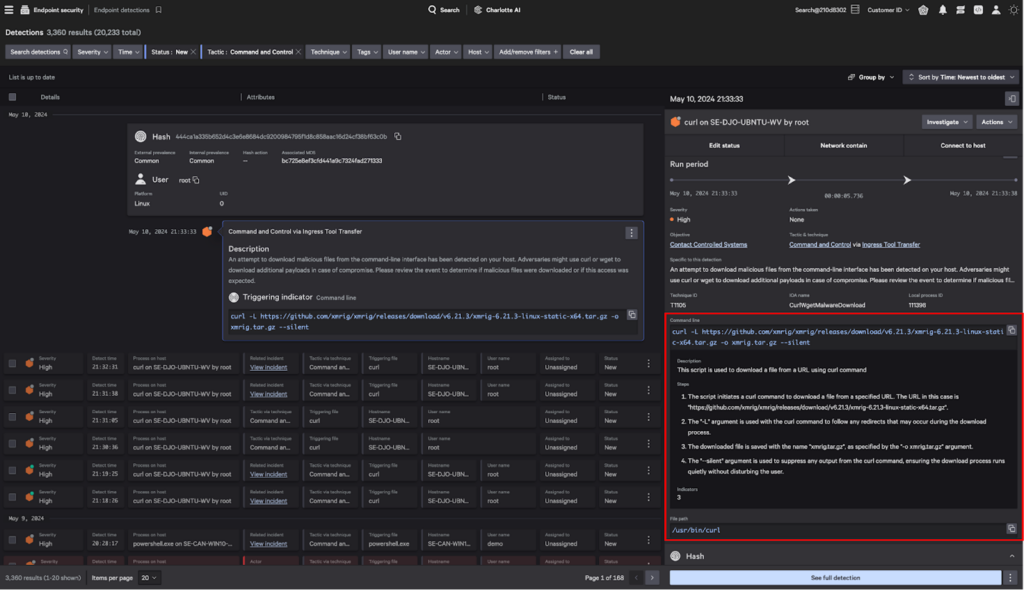
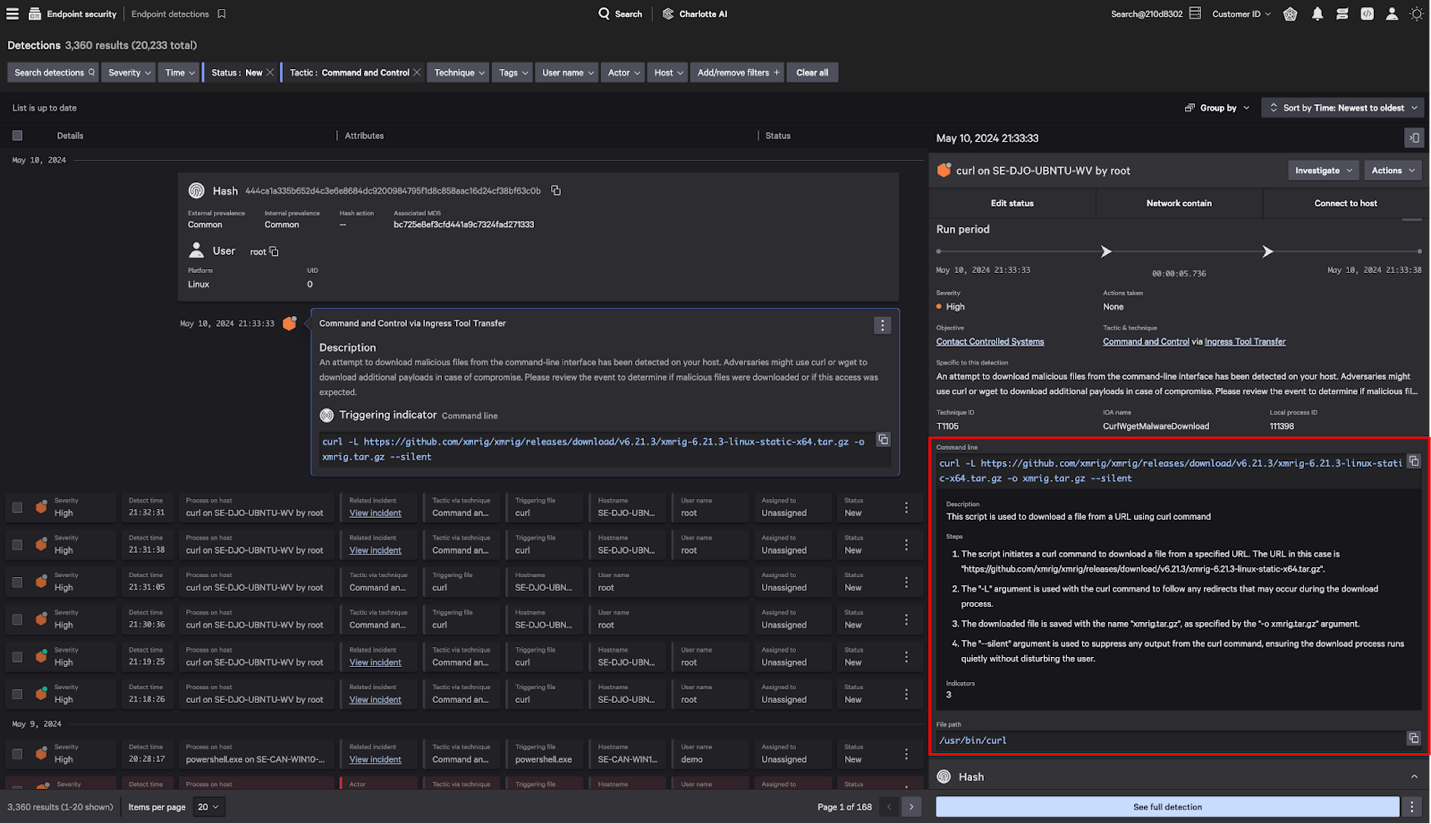
CrowdStrike Falcon Next-Gen SIEM consolidates security tools and data into a single AI-native platform that sits at the center of the SOC. It combines native Falcon platform telemetry with ingested third-party data, and applies AI agents across data onboarding, correlation rule generation, and search analysis.
The platform is built on an index-free architecture for search at petabyte scale, paired with Falcon Onum for data pipeline management. It can also be deployed alongside existing Microsoft Defender environments without a full replacement of the current stack.
Key features include:
- Index-free search: Removes indexing from the search path so analysts can search, hunt, investigate, and build dashboards across diverse datasets at petabyte scale.
- Falcon Onum data pipelines: Delivers AI-powered data pipelines that clean, transform, and stream telemetry in real time before it reaches storage.
- Federated search: Queries data where it lives across sources, so teams reach the relevant dataset without first centralizing everything.
- Unified detection and response: Applies AI-driven detection to cross-domain attacks, with centralized case management and unified management of third-party threat indicators.
- Charlotte Agentic SOAR: Combines Falcon Fusion SOAR, Charlotte AI, and AgentWorks to run agentic workflows that pair automated actions with analyst oversight.
- SOC agents: Includes agents for data onboarding, correlation rule generation, search analysis, workflow creation, and data transformation.
- Falcon Next-Gen SIEM for Defender: Supports deployment into environments already running Microsoft Defender without replacing the incumbent tooling.
- Falcon platform data: Ingests native CrowdStrike endpoint, identity, and cloud telemetry alongside third-party sources for correlated context.
Limitations (as reported by users on G2):
- Cost and licensing: Reviewers place the platform at the premium end of the market and describe the licensing model as complex to navigate, with data ingestion costs that can escalate.
- Query language learning curve: Analysts coming from platforms such as Splunk or Microsoft Sentinel report a ramp-up period before writing efficient queries.
- Documentation and guidance: Users ask for better documentation and stronger in-product guidance during that transition.
- Third-party integration effort: Reviewers note that ingesting non-CrowdStrike telemetry still requires significant work despite ongoing improvements.
Source: CrowdStrike
Conclusion
Modern SIEM platforms address many of the limitations of legacy systems by combining scalable data collection, flexible normalization, behavioral analytics, threat intelligence, automation, and faster investigation workflows. The main advantage is not simply storing more logs, but turning large volumes of security telemetry into higher-confidence detections and actionable context. Organizations evaluating a modern SIEM should focus on data coverage, detection quality, automation depth, search performance, operational overhead, and total ingestion and retention cost.
Learn More About Exabeam
Learn about the Exabeam platform and expand your knowledge of information security with our collection of white papers, podcasts, webinars, and more.