


Best AI Tools for Reducing False Positives in the SOC: Top 8 in 2026
- 16 minutes to read
Table of Contents
TL;DR: AI platforms for reducing false positives in SOCs correlate telemetry, baseline behavior, and use AI agents to triage alerts before analysts see them. Best for: Exabeam for UEBA-driven risk scoring with AI agents, Google SecOps for Gemini-led triage, Microsoft Sentinel for Microsoft-centric SOCs, and Dropzone AI for Tier 1 automation.
Which AI Tools Can Reduce False Positives in SOCs?
AI-powered security operations tools reduce false positives by analyzing alerts in the context of user behavior, asset criticality, threat intelligence, and related security events. They collect and correlate telemetry from endpoints, networks, cloud services, and identity systems to distinguish legitimate activity from potential threats. Machine learning models establish behavioral baselines, identify unusual activity, and assign risk scores based on the available evidence.
These tools also reduce alert noise by grouping related detections, deprioritizing low-risk events, and suppressing activity with strong evidence of being benign. Rather than requiring analysts to investigate every alert independently, AI platforms can present higher-confidence incidents with supporting context. This helps SOC teams focus on genuine threats while retaining the underlying telemetry for further investigation.
Core strategies used by AI SOC tools:
- Cross-environment telemetry collection: Collects security data from SIEM, EDR, identity, cloud, network, and application systems to evaluate alerts using multiple sources of evidence.
- Security event normalization and correlation: Standardizes event data and connects related activity across tools to reduce duplicate alerts and reconstruct incident timelines.
- Behavioral baselining: Learns normal activity patterns for users, devices, applications, and service accounts to distinguish expected behavior from suspicious changes.
- Identity, asset, and threat enrichment: Adds account privileges, asset criticality, vulnerability information, and threat intelligence to improve alert classification.
- Behavioral anomaly detection: Identifies unusual authentication, process execution, resource access, and network activity while evaluating deviations against surrounding context.
- Multi-signal incident correlation: Combines individual low-confidence detections into higher-confidence incidents when related events indicate a possible attack sequence.
- Contextual risk scoring: Prioritizes alerts and incidents using behavioral deviations, threat indicators, affected assets, account permissions, and related suspicious activity.
- Low-risk alert suppression and deprioritization: Groups, suppresses, or lowers the priority of alerts associated with verified benign activity while retaining event data for auditing and investigation.
This is part of a series of articles about AI cyber security
AI SOC Tools at a Glance
The table below summarizes the key differences between the platforms covered in this guide. We explore each platform in more detail in the sections that follow.
| Category | Solution | Best For | Key Strengths | Things to Consider |
| AI-driven SIEM and security operations platforms | Exabeam New-Scale Fusion | SOCs reducing alert noise with behavioral analytics and AI agents | UEBA baselines, dynamic risk scoring, and Nova triage agents | Some users want more dashboard customization options |
| AI-driven SIEM and security operations platforms | Palo Alto Networks Cortex XSIAM | Enterprises consolidating SIEM, XDR, and SOAR on one platform | Large ML detection library and alert grouping into cases | Users report complex data onboarding and costly licensing |
| AI-driven SIEM and security operations platforms | Google Security Operations | Teams that want Gemini agents to triage alerts in a cloud SIEM | Triage agent verdicts, curated detections, Google threat intel | Users cite integration and log-source visibility gaps |
| AI-driven SIEM and security operations platforms | Microsoft Sentinel | Organizations invested in Microsoft Defender and Azure | Built-in UEBA, SOAR, and AI-driven SOC optimization | Costs grow with data ingestion; KQL has a learning curve |
| AI-driven SIEM and security operations platforms | CrowdStrike Falcon Next-Gen SIEM | Falcon customers extending endpoint data into a unified SIEM | Index-free search, agentic investigations, native Falcon data | Query language and customization have a learning curve |
| AI SOC analyst and autonomous triage platforms | Dropzone AI | Teams automating Tier 1 alert investigation on existing tools | Glass-box investigations, context memory, 90+ integrations | Licensed by investigation capacity per AI analyst |
| AI SOC analyst and autonomous triage platforms | Prophet AI | SOCs combining AI triage, threat hunting, and detection tuning | Auditable determinations and backtested detection changes | Few independent user reviews are available so far |
| AI SOC analyst and autonomous triage platforms | Torq AI SOC Platform | SOCs automating triage through response with agentic AI | Auto Triage verdicts, HyperAgents, and 300 integrations | Users report a steep learning curve and setup effort |
Why Are False Positives a Problem for SOC Teams?
False positives burden security operations center (SOC) teams with alerts about harmless activity. This noise consumes resources, complicates triage, and makes it harder to identify and respond to genuine threats.
- Alert fatigue: Repeated low-value alerts can desensitize analysts, making them more likely to overlook genuine threats that resemble routinely dismissed activity.
- Wasted analyst time: Investigating benign events takes time away from threat hunting, detection engineering, and incident response improvements. Recurring alerts can also lead to duplicated work.
- Slower investigation of real threats: False positives crowd alert queues, delaying investigation and response while giving attackers more time to escalate privileges, move laterally, or access sensitive data.
- Inconsistent alert prioritization: Similar severity ratings and limited context make triage subjective. Asset criticality, user privileges, and related activity help analysts distinguish urgent threats from low-risk events.
How Do AI Tools Reduce False Positives in SOCs?
Collect Security Telemetry Across the Environment
AI platforms start by collecting telemetry from multiple security and IT systems. Sources can include SIEM platforms, EDR tools, identity providers, firewalls, cloud services, email security products, applications, and network monitoring systems.
Using multiple data sources gives the platform more evidence for evaluating an alert. For example, a suspicious login becomes easier to assess when the system can also examine endpoint activity, authentication history, device information, and network connections.
Broader telemetry also reduces reliance on individual detection rules. Instead of treating one event as proof of malicious activity, the platform can evaluate what happened before and after the event.
Normalize and Correlate Related Security Events
Security products produce events in different formats and use different fields, identifiers, and severity models. AI platforms normalize this data into a common structure so events from separate tools can be analyzed together.
The platform can then correlate events based on attributes such as user accounts, devices, IP addresses, processes, domains, and timestamps. Several alerts generated by one underlying activity can be grouped rather than investigated separately.
Correlation reduces duplicate alerts and gives analysts a more complete incident timeline. It also helps distinguish isolated events from sequences of activity that provide stronger evidence of an attack.
Establish Baselines for Normal User and Entity Behavior
AI platforms can analyze historical activity to establish baselines for users, endpoints, service accounts, applications, and other entities. These baselines describe patterns such as normal login times, commonly accessed systems, typical network traffic, and usual process activity.
Baselines are generally dynamic rather than fixed. They can change as employees change roles, workloads move between systems, or normal usage patterns evolve.
This approach provides context that static rules cannot easily capture. An action that looks suspicious according to a general rule may be normal for a particular administrator or server and can therefore receive a lower risk assessment.
Related content: Read our article about behavioral profiling
Add Identity, Asset, and Threat Context to Alerts
Raw security events often provide too little information to determine whether activity represents a meaningful risk. AI platforms enrich alerts with context from identity systems, asset inventories, vulnerability data, threat intelligence, and other security sources.
Identity context can show whether an account has administrative privileges or has recently experienced suspicious authentication activity. Asset context can identify whether the affected system contains sensitive data, runs a critical service, or has known vulnerabilities.
Threat intelligence adds information about indicators such as IP addresses, domains, URLs, and file hashes. Combining these details helps the platform distinguish benign activity from events that deserve further investigation.
Detect Behavioral Deviations and Anomalies
Once normal behavior has been modeled, the platform can identify activity that differs significantly from established patterns. Examples include unusual login locations, unexpected access to sensitive resources, abnormal data transfers, or processes that rarely execute on a particular endpoint.
An anomaly alone does not necessarily indicate an attack. Legitimate business changes can also produce unusual behavior, so treating every anomaly as a high-severity alert would create additional false positives.
AI platforms therefore evaluate anomalies alongside other evidence. The degree of deviation, affected entity, historical behavior, and surrounding security events can all influence whether the activity is escalated.
Related content: Read our article about AI anomaly detection
Correlate Multiple Weak Signals Into Higher-Confidence Incidents
Many attacks consist of individual actions that appear harmless when examined separately. A failed login, new process, unusual network connection, or permission change may not provide enough evidence to justify a high-priority alert on its own.
AI platforms can connect these weak signals across users, endpoints, networks, and time periods. For example, an unusual login followed by privilege escalation and access to sensitive systems provides stronger evidence than any of those events independently.
This correlation allows the platform to suppress isolated low-confidence signals while escalating combinations that resemble attack behavior. Analysts receive fewer individual alerts and more complete incidents containing the evidence that caused the escalation.
Assign Risk Scores Based on Context and Behavior
AI platforms can assign risk scores to alerts, incidents, users, or assets based on multiple factors. Inputs can include detection severity, behavioral deviation, asset criticality, account privileges, threat intelligence, and the number of related suspicious events.
Risk scoring provides more useful prioritization than relying only on the severity assigned by an individual security tool. The same detection can receive different scores depending on where it occurs and which entities are involved.
Scores can also change as new evidence becomes available. An initially low-risk event may be elevated when it is later associated with suspicious endpoint activity or credential abuse, while an alert supported by benign context can be downgraded.
Suppress or Deprioritize Low-Risk Activity
After evaluating an alert, the platform can suppress, group, or lower the priority of activity that has strong evidence of being benign. Examples include expected administrative actions, known internal scanners, approved applications, or behavior that consistently matches an established baseline.
Suppression does not always mean deleting the underlying event. Platforms can retain telemetry for investigation and auditing while preventing low-risk events from repeatedly entering an analyst’s active queue.
This approach reduces alert volume without requiring SOC teams to disable useful detections entirely. Analysts can concentrate on higher-confidence incidents while the platform continues monitoring lower-risk activity for changes that could increase its risk score.
Related content: Read our article about AI-driven cyber security
Notable AI Tools for Reducing False Positives in SOCs
How we selected these platforms: We shortlisted AI platforms for SOC teams based on their ability to correlate multi-source telemetry, baseline normal user and entity behavior, score risk using identity and asset context, and triage alerts autonomously with transparent reasoning.
AI-Driven SIEM and Security Operations Platforms
1. Exabeam New-Scale Fusion

Best for: SOCs reducing alert noise with behavioral analytics and AI agents
Strengths: UEBA baselines, dynamic risk scoring, and Nova triage agents
Things to consider: Some users want more dashboard customization options
Exabeam New-Scale Fusion is a cloud-native security operations platform that combines New-Scale SIEM and New-Scale Analytics. It ingests and normalizes security data, builds behavioral baselines for users, devices, service accounts, applications, and other non-human identities, and applies dynamic risk scoring so analysts work from deviations in behavior rather than isolated rule matches.
Nova AI, a set of AI capabilities embedded across the platform, collects background context, runs secondary searches, classifies threats, and builds case summaries as analysts move between screens. Teams can use New-Scale Fusion to replace a SIEM, or keep an existing SIEM and add New-Scale Analytics and automation on top of it.
Key features include:
- Behavioral baselining: New-Scale Analytics learns normal behavior for human and non-human entities and flags meaningful deviations. This surfaces insider threats, credential misuse, and attacks that static rules can miss.
- Dynamic risk scoring: The threat scoring capability applies machine learning and customizable business context to prioritize threats. Activity that matches established behavior is ranked lower, while activity that needs immediate review is pushed to the top.
- AI-driven investigation: The investigation capability creates case summaries, analyzes threats, and recommends next steps. It prioritizes events using background context, entity profiles, and interaction details to help analysts assess intent.
- Entity context for prioritization: Attack Surface Insights aggregates data from existing tools into entity profiles with contextual attributes and relationships. Analysts get a full view of users and devices when assessing exposure.
- Normalization at ingestion: Data is parsed, normalized with a Common Information Model (CIM), and enriched at ingestion. It becomes immediately available for search, investigation, and analytics across sources.
- Agent Behavior Analytics (ABA): ABA extends behavioral detection to non-human identities. When ABA flags an anomaly, Nova AI adds context to distinguish approved use from a genuine threat.
- AI-assisted detection engineering: The rule creator capability generates correlation rules from natural language, refines existing detections, and converts third-party content into Exabeam-ready rules.
- Natural-language search: The search capability translates natural-language questions about users, hosts, and logs into Exabeam Query Language aligned with the CIM, in multiple languages.
- Automation and integrations: Low-code automation and standards-based APIs connect 1,000+ tools for detection, investigation, and response workflows. An MCP server extends New-Scale data into external workflows and other AI capabilities.
Limitations (as reported by users on PeerSpot):
- Dashboard customization: Some users would like additional dashboards and more options for customizing existing ones.
- Documentation depth: Users note that documentation could be more detailed, particularly for configuration and case management tasks.
- Pricing expectations: One user described the pricing as reasonable but somewhat higher than initially expected.

2. Palo Alto Networks Cortex XSIAM

Best for: Enterprises consolidating SIEM, XDR, and SOAR on one platform
Strengths: Large ML detection library and alert grouping into cases
Things to consider: Users report complex data onboarding and costly licensing
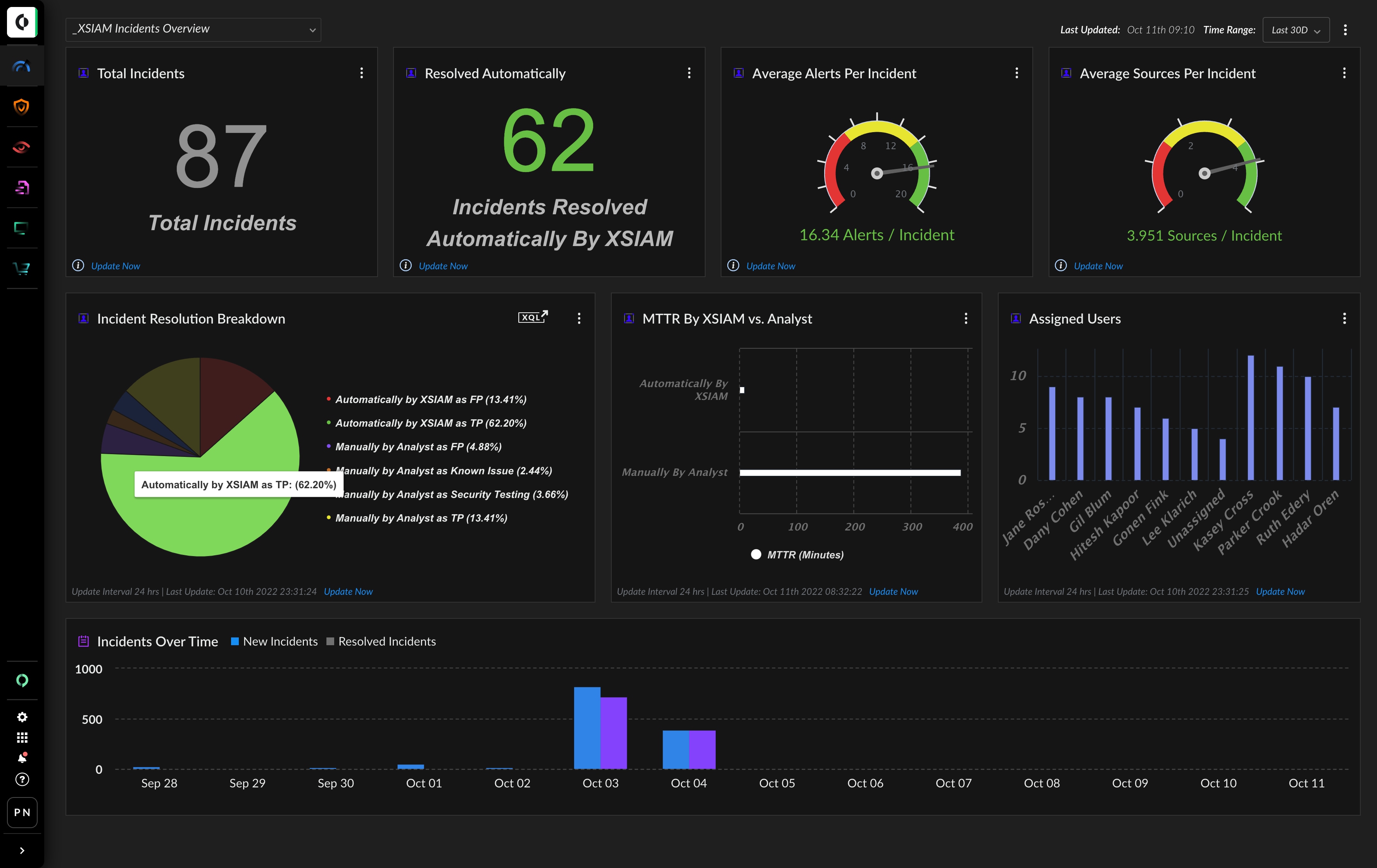
Cortex XSIAM is an AI-driven security operations platform that replaces a traditional SIEM by combining SIEM, SOAR, EDR, NDR, and CDR capabilities on a unified data layer, Cortex XDL. It automatically prepares and enriches collected data, stitches it into security intelligence, and applies machine learning detection analytics.
For alert reduction, XSIAM groups large volumes of alerts into a smaller number of prioritized cases that show the attack sequence and root cause. Cortex AgentiX adds AI agents that plan, reason, and act on response tasks within enterprise guardrails.
Key features include:
- Data stitching and enrichment: XSIAM brings telemetry from endpoints, networks, identities, cloud, and third-party sources into one platform. It enriches and stitches the data together before detection runs.
- Machine learning detection: The platform applies 2,900+ ML models and 13,300+ maintained detections to EDR telemetry, enriched firewall logs, and other sources.
- Alert grouping into cases: AI turns thousands of alerts into a few prioritized cases. Each case shows the full attack story, including root cause, in one place.
- Automated triage and guided actions: XSIAM triages alerts automatically and offers guided response actions from within the same platform.
- Agentic AI with Cortex AgentiX: AI agents plan, reason, and take action on response tasks, with enterprise-grade guardrails that keep analysts in control.
- Integrated threat intelligence and incident management: Threat intelligence, incident management, and automation run alongside detection rather than in separate tools.
- Extended capabilities: Email security, exposure management, threat intelligence platform, and identity threat detection and response modules extend the platform.
Limitations (as reported by users on PeerSpot):
- Data onboarding effort: Users report that data onboarding, parsers, and third-party integration support need improvement.
- Pricing and licensing: Several users describe XSIAM as expensive and the licensing process as less straightforward than some alternatives.
- Interface performance: Some users experience slowdowns and longer page loads when multiple tabs are open.
- Support consistency: Support quality varies, with premium support viewed more favorably than distributor-based support.

Source: Palo Alto Networks
3. Google Security Operations

Best for: Teams that want Gemini agents to triage alerts in a cloud SIEM
Strengths: Triage agent verdicts, curated detections, Google threat intel
Things to consider: Users cite integration and log-source visibility gaps
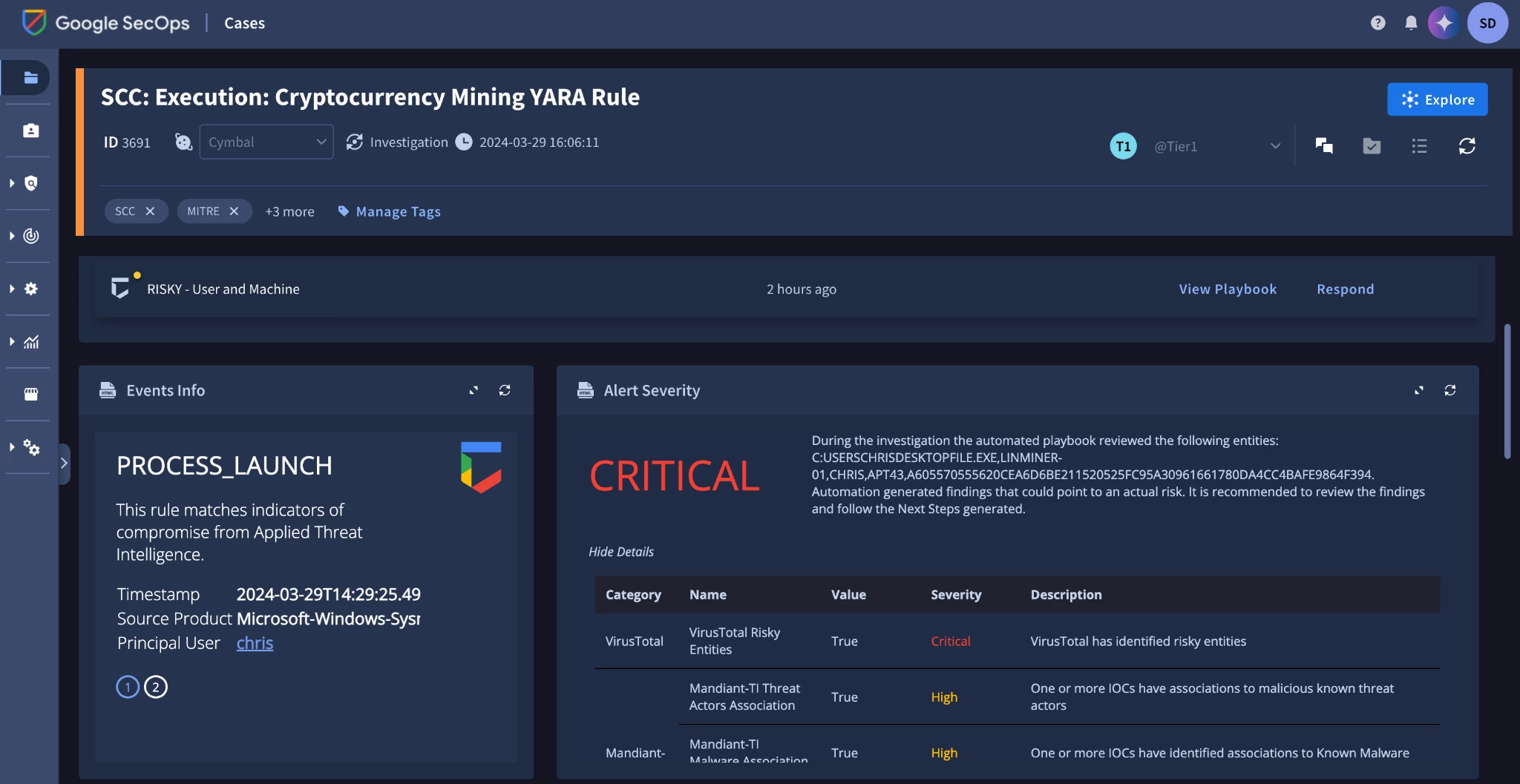
Google Security Operations (Google SecOps) is a cloud-native platform that combines SIEM, SOAR, and threat intelligence. It provides curated detections maintained by Google threat researchers, custom detection authoring in YARA-L, and threat-centric case management that automatically stitches related entities together.
Gemini-based agents handle parts of the triage workload. The Triage and Investigation agent investigates alerts, enriches them with threat intelligence, and returns a verdict with an explanation, which teams can use to drive alert closure and remediation flows.
Key features include:
- Triage and Investigation agent: The agent autonomously investigates incoming alerts, gathers evidence, and provides a verdict with a detailed explanation. It can automate decision-making, alert closure, and remediation flows.
- Agentic automation: AI agents that gather evidence and reason through alerts are combined with deterministic playbooks. Analysts remain in control of critical, high-impact actions.
- Curated and custom detections: Google maintains a growing set of out-of-the-box detections, and teams can write custom rules in YARA-L. The Detection Engineering agent creates and tests rules and validates them with synthetic events.
- Applied threat intelligence: The Enterprise Plus package includes Google Threat Intelligence (Mandiant, VirusTotal, and Google). ML-based prioritization of IoC matches factors in each customer’s environment.
- Context-rich investigation: Interactive alert graphing, automatic entity stitching, and a Gemini chat assistant provide case context, AI-generated summaries, and response recommendations.
- UEBA: The Enterprise package supports YARA-L rules for user and entity behavior analytics, a risk dashboard, and out-of-the-box behavior-style detections.
- Data pipeline management: Teams can route, filter, redact, and transform security telemetry before it is used for detection.
Limitations (as reported by users on PeerSpot):
- Log source monitoring: Users want better visibility when a feed or host stops sending logs to the platform.
- Third-party integrations at scale: Some users see room for improvement in integrating third-party applications as environments grow.
- Documentation: Users report that documentation and knowledge base articles could be improved.
- Cost: Some users identify cost as an area for improvement.

Source: Google
4. Microsoft Sentinel

Best for: Organizations invested in Microsoft Defender and Azure
Strengths: Built-in UEBA, SOAR, and AI-driven SOC optimization
Things to consider: Costs grow with data ingestion; KQL has a learning curve
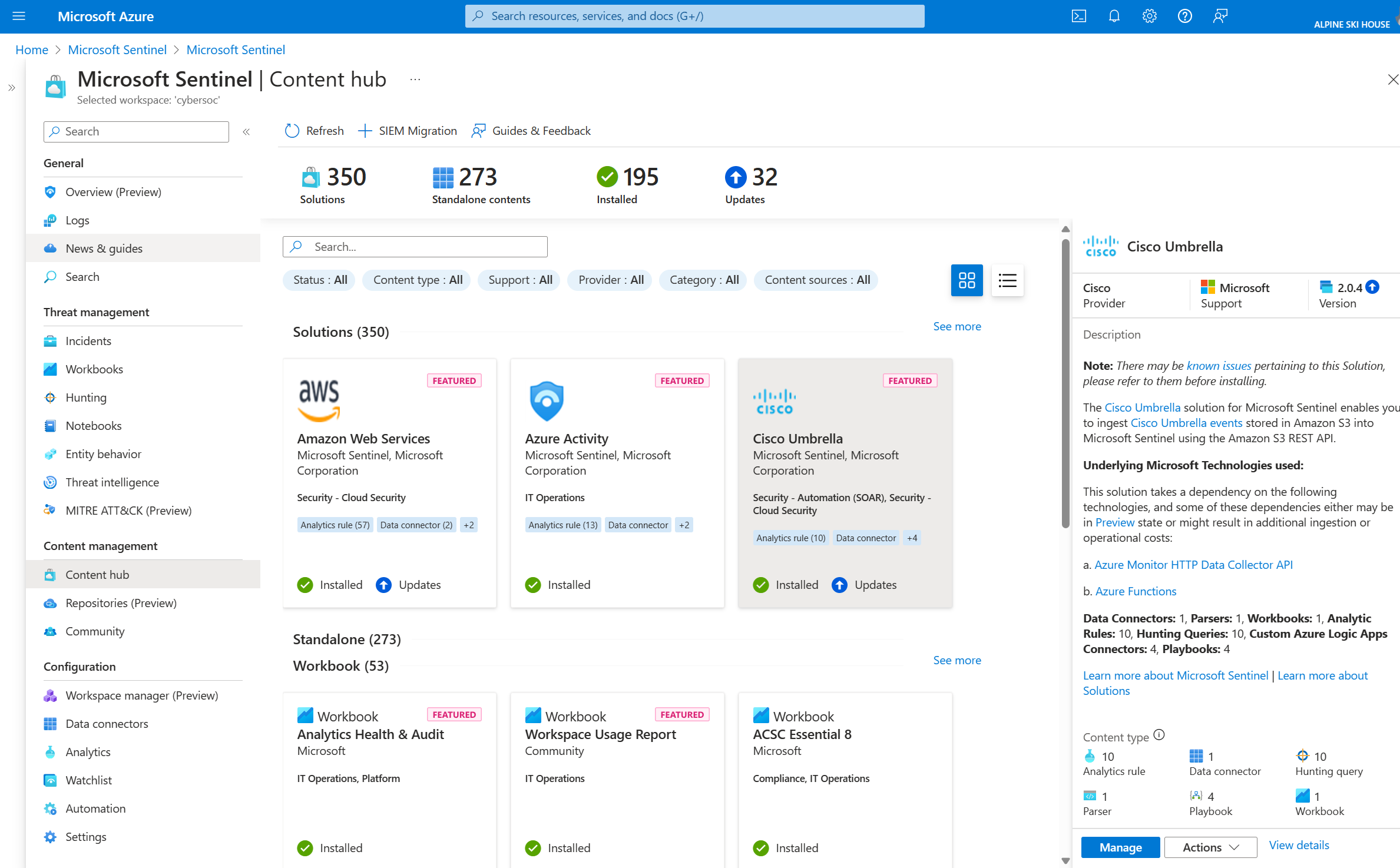
Microsoft Sentinel is a cloud-native SIEM that correlates signals across identities, endpoints, cloud apps, and infrastructure, and runs within the Microsoft Defender experience alongside Defender XDR. It includes built-in SOAR, UEBA, threat intelligence, case management, and a data lake for long-term log retention.
For noise reduction, Sentinel combines behavior analytics that baseline normal activity with AI-driven SOC optimization that tunes rules and surfaces high-fidelity alerts. Security Copilot, built into Sentinel, summarizes incidents, drafts Kusto Query Language (KQL) queries, and recommends next steps.
Key features include:
- User and entity behavior analytics: Built-in UEBA baselines normal activity and flags what rule-based detection misses, such as compromised accounts and insider risk.
- AI-driven SOC optimization: Sentinel automatically tunes rules, surfaces high-fidelity alerts, and points analysts to the next best action. It also recommends ways to lower ingestion costs.
- Security Copilot: Copilot summarizes incidents, drafts KQL queries, and recommends response steps to reduce repetitive triage work.
- Built-in SOAR: Out-of-the-box playbooks and codeless automation handle manual triage steps and common response actions.
- Threat intelligence enrichment: Microsoft threat signals are combined with third-party feeds in industry-standard formats to enrich alerts with context.
- Native XDR integration: Sentinel and Defender XDR share a unified incident workflow in the Defender portal for cross-domain investigation.
- Data connectors and data lake: 400+ connectors and a codeless connector framework bring in multi-cloud and on-premises data, with a built-in data lake for long-term hunting and compliance.
Limitations (as reported by users on PeerSpot):
- Cost at scale: Users report that costs rise as data ingestion increases and can be hard to estimate in advance.
- Query language: Effective use requires KQL expertise, and some users request an alternative for those without it.
- Integration gaps: Some users face challenges connecting legacy systems and certain third-party or multi-cloud sources.
- Built-in content: Users would like more built-in use cases and automation templates.

Source: Microsoft
5. CrowdStrike Falcon Next-Gen SIEM

Best for: Falcon customers extending endpoint data into a unified SIEM
Strengths: Index-free search, agentic investigations, native Falcon data
Things to consider: Query language and customization have a learning curve
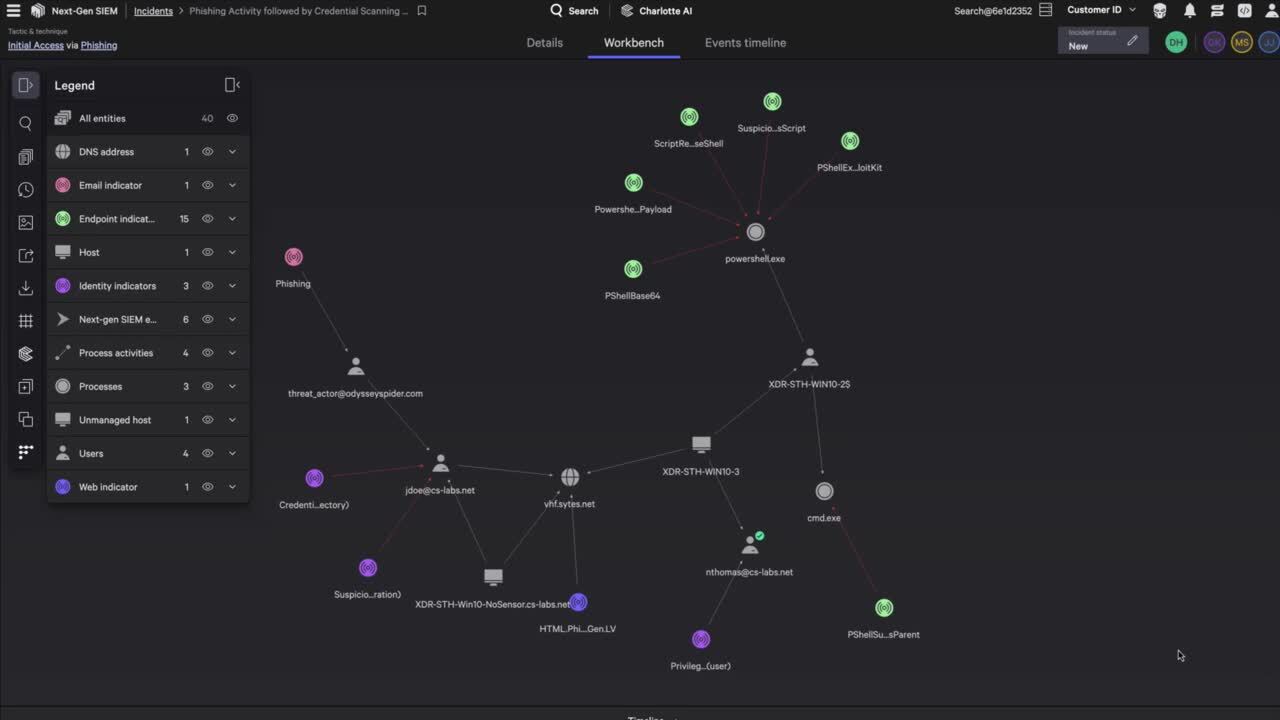
Falcon Next-Gen SIEM is CrowdStrike’s SIEM built on the Falcon platform. It unifies cross-domain security data, AI-powered detection, and automated response. Data from licensed Falcon modules is available without additional ingestion charges, and the SIEM can also be purchased standalone to analyze third-party data.
Falcon Onum filters, transforms, enriches, and routes telemetry in real time before it reaches the SIEM. Coordinated expert agents investigate detections across domains in parallel, and Charlotte Agentic SOAR orchestrates agents and workflows with configurable autonomy.
Key features include:
- Agentic investigations: An orchestrator agent calls on specialist agents built by CrowdStrike Falcon Complete, which work each related domain in parallel. They share context and converge on a single verdict.
- Environment-specific context layer: The shared context used by investigation agents is unique to each customer environment and builds up with every verdict.
- Falcon Onum data pipelines: Telemetry is filtered, transformed, enriched, and routed in real time, with shift-left detection and federated search across distributed data sources.
- Index-free search: Search runs at petabyte scale without indexing, and federated search reaches data in sources such as Snowflake and ExtraHop.
- Charlotte Agentic SOAR: Teams build and govern AI agents, orchestrate workflows, and automate response with configurable autonomy, end-to-end governance, and auditability.
- Native Falcon telemetry: Endpoint, identity, cloud, and other Falcon telemetry flows into the SIEM, and Falcon Next-Gen SIEM can also extend to third-party EDR, starting with Microsoft Defender.
Limitations (as reported by users on G2):
- Query language learning curve: Analysts moving from platforms such as Splunk or Microsoft Sentinel report a steep learning curve with the query language.
- Customization: Users note limited customizability and fewer query commands than they expected.
- Integrations: Some users describe third-party integrations as still evolving.
- Pricing for smaller teams: Some reviewers mention higher pricing for smaller teams.

Source: CrowdStrike
AI SOC Analyst and Autonomous Triage Platforms
6. Dropzone AI

Best for: Teams automating Tier 1 alert investigation on existing tools
Strengths: Glass-box investigations, context memory, 90+ integrations
Things to consider: Licensed by investigation capacity per AI analyst
Dropzone AI provides an AI SOC Analyst that investigates alerts end to end across SIEM, EDR, cloud, identity, and email tools. It queries existing tools through their APIs, so it does not require data migration or log normalization, and it runs investigations without pre-built playbooks.
Each investigation forms hypotheses, gathers evidence, and reaches a conclusion that dismisses the alert as benign, escalates it, or triggers containment. Findings are written in plain English, with a record of every question asked and tool queried.
Key features include:
- Autonomous alert investigation: Investigations start as soon as an alert arrives and use multiple tools and data sources to gather evidence. The analyst reasons recursively until it reaches a conclusion.
- Glass-box reasoning: Every question, tool query, and finding is recorded, providing a full audit trail for compliance and governance.
- Context memory: Context memory learns details about the environment through analyst input and on its own. For example, after a benign verdict it can remember a user’s expected permissions.
- Custom investigation strategies: Teams set investigation strategies, outcome rules, and what counts as normal in their environment.
- Auto-containment: When a threat is confirmed, containment actions such as blocking malicious IPs or disabling compromised accounts can run immediately.
- Analyst chatbot: A built-in chatbot lets analysts ask follow-up questions and run ad-hoc investigations without switching tools.
- AI Threat Hunter: A separate agent runs hypothesis-driven hunts across SIEM, EDR, and cloud data.
Limitations (based on publicly available sources):
- Tuning period: A reviewer on Gartner Peer Insights notes that fine-tuning takes time before the product meets all requirements.
- Capacity-based licensing: Plans include up to 4,000 full investigations per year per AI analyst, which requires capacity planning for high alert volumes.
- Downstream tool costs: Some security tools the AI analyst queries may carry additional API or usage costs.
- Data quality dependence: Investigation quality can be sensitive to data quality and environment specifics, and tuning may be required.

Source: Dropzone AI

7. Prophet AI

Best for: SOCs combining AI triage, threat hunting, and detection tuning
Strengths: Auditable determinations and backtested detection changes
Things to consider: Few independent user reviews are available so far
Prophet AI is Prophet Security’s agentic AI SOC platform, built as a set of agents covering alert investigation and response, threat hunting, and detection engineering. The AI SOC Analyst investigates every alert and delivers determinations that can be audited, and it responds through scoped Agent Actions, either autonomously or with analyst sign-off.
The platform adapts to each customer’s context and policies, which are previewed and backtested before they are applied. It deploys as a dedicated single-tenant environment with a bring-your-own-key option and connects to existing tools through 200+ integrations.
Key features include:
- AI SOC Analyst: The agent investigates alerts from endpoint, email, identity, cloud, DLP, and network sources and produces determinations with supporting evidence that analysts can audit.
- Scoped Agent Actions: Response actions are scoped and can run autonomously or wait for analyst approval.
- AI Detection Engineer: The agent maps actual MITRE ATT&CK coverage from the platform’s own investigations and ships tuned and net-new detections, backtested and ready for approval.
- AI Threat Hunter: Analysts ask questions of their environment in plain language, and the agent researches emerging threats and provides hunts that can be run or scheduled.
- Context and policy adaptation: Customer context and policies are previewed, backtested, and then applied across the platform.
- Prophet AI Watchtower: A human expert team reviews every malicious determination around the clock and provides validated escalations in under 30 minutes.
Limitations (based on publicly available sources):
- Limited independent reviews: G2 and TrustRadius list few or no user reviews, which makes peer comparison difficult.
- Data and context dependency: Without comprehensive telemetry and organizational context, AI-generated investigations may be less accurate.
- Staged autonomy: Organizations often review AI recommendations manually before allowing autonomous actions, which extends the time to full automation.

Source: Prophet

8. Torq AI SOC Platform

Best for: SOCs automating triage through response with agentic AI
Strengths: Auto Triage verdicts, HyperAgents, and 300 integrations
Things to consider: Users report a steep learning curve and setup effort
The Torq AI SOC Platform combines agentic AI with Torq’s Hyperautomation engine to handle triage, investigation, and response. It ingests and normalizes telemetry from across the security stack, correlates and deduplicates events, and analyzes risk context and threat intelligence to deliver verdicts that separate false positives from real risk.
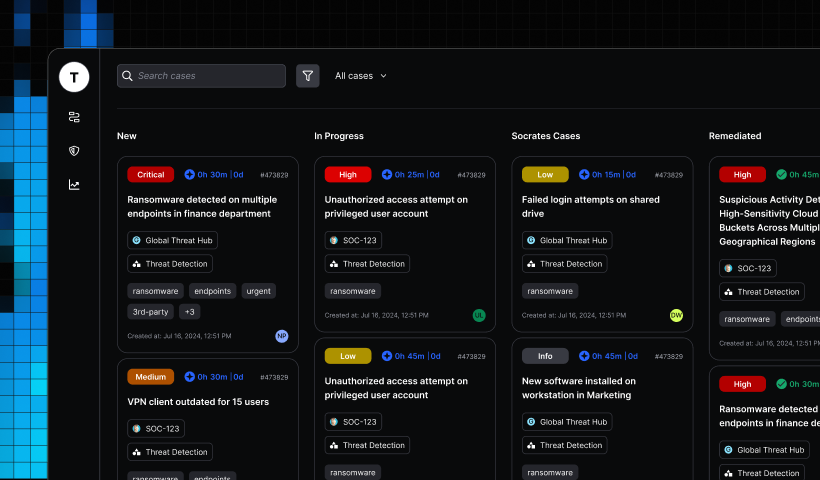
Cases are opened and assigned to customizable AI agents that gather evidence, assemble timelines, and summarize findings. Socrates coordinates these agents and manages cases end to end, while response actions contain threats and route critical issues to the right people.
Key features include:
- Universal Auto Triage: The agentic engine prioritizes threats and separates noise from risk. It learns and retains how a specific SOC works to inform future verdicts.
- Correlation and deduplication: Normalized events from across the stack are correlated and deduplicated before triage.
- Torq HyperAgents: A group of autonomous, transparent, and customizable AI agents automates routine tasks and adapts to each team’s use cases.
- Socrates: Socrates coordinates specialized agents, manages cases end to end, and lets analysts work through natural language.
- Native case management: Each case holds evidence, timelines, and summaries as a single, continuously updated record.
- Hyperautomation: 300 prebuilt integrations and 4,000+ prebuilt steps support workflow automation, and AI agents can build new integrations and workflows.
Limitations (as reported by users on PeerSpot):
- Learning curve: Users report that setup takes time and the learning curve is steep.
- Documentation clarity: Some users find the documentation unclear.
- Reporting constraints: Platform constraints prevented some users from using the full dataset in reports.
- Pricing: Some users describe Torq as expensive.

Source: Torq
Conclusion
Reducing false positives in SOCs requires moving beyond static rules and isolated alert queues toward AI-driven context and behavioral baselines. By unifying telemetry, enriching events with entity details, and automating Tier 1 triage, security teams can significantly minimize operational noise. This empowers analysts to focus their time and expertise on detecting, investigating, and responding to high-confidence threats.
Learn More About Exabeam
Learn about the Exabeam platform and expand your knowledge of information security with our collection of white papers, podcasts, webinars, and more.
- Webinar
The Insider Risk Program Just Got Bigger: How Digital Workers Are Changing Identity, Behavior, Ownership, and...
-
 Blog
What Is the Difference Between Exabeam and CrowdStrike for SIEM and Security Operations?
- Show More