Best Enterprise Platforms for AI Agent Security Monitoring: Top 8 in 2026
- 18 minutes to read
Table of Contents
TL;DR: These platforms discover AI agents, baseline their behavior, and enforce policy at runtime. Exabeam is best for behavior-led SOC detection, Microsoft fits Microsoft-native estates, Prisma AIRS fits unified AI security, Zenity fits SaaS agents.
What Are Enterprise Platforms for AI Agent Security Monitoring?
Enterprise platforms for AI agent security monitoring track, govern, and secure autonomous AI behaviors, tool usage, and data access across organizations. Their focus is to identify risks stemming from the unique behaviors and privileges of AI-driven processes, which differ from traditional software bots or user accounts.
Core capabilities to evaluate:
- AI agent discovery and inventory: Automatically discover AI agents and maintain an inventory of their owners, permissions, and integrations.
- Agent identity and access monitoring: Continuously monitor agent identities, permissions, authentication, and privileged access.
- Runtime activity monitoring: Track AI agent actions, resource access, and execution behavior in real time.
- Tool call and API interaction visibility: Log and analyze agent interactions with tools, APIs, and external services.
- Prompt and response inspection: Inspect prompts and model outputs for sensitive data exposure, prompt injection, and policy violations.
- Behavioral anomaly detection: Detect unusual agent behavior by comparing activity against established behavioral baselines.
- Policy enforcement and automated containment: Enforce security policies and automatically block, isolate, or suspend risky agent activity.
AI Agent Security Monitoring Platforms at a Glance
The table below summarizes the key differences between the platforms covered in this section. Each one is explored in more detail below, including capabilities and reported limitations.
| Category | Solution | Best For | Key Strengths | Things to Consider |
| Security operations platforms | Exabeam Agent Behavior Analytics | Behavior-led detection of AI agent activity inside the SOC | UEBA baselines for agents, open telemetry, machine-built timelines | Dashboard customization and documentation depth are limited |
| Security operations platforms | Microsoft Security for AI | Organizations standardized on the Microsoft security stack | Agent inventory, conditional access, runtime defense, compliance | Licensing is complex and non-Microsoft coverage is thinner |
| Security operations platforms | CrowdStrike Falcon AI Detection and Response | Runtime inspection of prompts, agents, and MCP interactions | Prompt injection blocking, full prompt logs, automated response | Alert tuning, reporting flexibility, and cost for smaller teams |
| Security operations platforms | SentinelOne Securing AI | Teams governing workforce AI use and agent actions together | Shadow AI discovery, least-privilege agent policy, AI-SPM, DSPM | Console navigation, false positives, and support response times |
| Purpose-built AI and agent security | Palo Alto Networks Prisma AIRS Agent Security | Full lifecycle agent security from supply chain to runtime | Agent discovery, red teaming, identity checks, MCP traffic control | Cost, licensing complexity, and rigid policy configuration |
| Purpose-built AI and agent security | Zenity | Securing agents built on SaaS and low-code business platforms | Agent inventory, posture checks, exploitability testing, AIDR | Narrower coverage of custom agent frameworks; no public pricing |
| Purpose-built AI and agent security | Wiz AI-SPM | Cloud teams mapping AI and agent risk against infrastructure | Agentless discovery, AI-BOM, attack path analysis, tool mapping | Runtime detection depth, alert noise, and pricing model |
| Purpose-built AI and agent security | SailPoint Agent Identity Security | Governing AI agents as identities alongside humans and machines | Agent onboarding, owner assignment, access certification, audit | High cost, complex configuration, limited native connectors |
Why AI Agents Require Dedicated Security Monitoring
Autonomous Access to Enterprise Systems
AI agents frequently require autonomous access to enterprise systems, allowing them to perform tasks without human intervention. This autonomy can lead to efficiency gains but also introduces significant security risks if access is not carefully managed and monitored. Agents may be granted credentials or API tokens to interact with sensitive applications, databases, and cloud resources, making them attractive targets for attackers seeking to exploit privileged access.
Without robust monitoring, it becomes difficult to ensure that AI agents are only accessing what they are authorized to and not exceeding their intended scope. Unauthorized access or privilege escalation can go unnoticed, resulting in data breaches or system compromise. Effective security monitoring platforms provide continuous oversight of AI agent access patterns, flagging deviations from expected behavior and enabling rapid response to suspicious activities.
Related content: Read our article about security-focused AI agents
Dynamic and Unpredictable Agent Behavior
AI agents are designed to adapt and make context-driven decisions, which can result in highly dynamic and sometimes unpredictable behaviors. Unlike traditional scripts that follow predefined logic, AI agents may alter their actions based on new data, changing conditions, or evolving objectives. This unpredictability complicates security oversight, as it is challenging to define static rules or anticipate every possible action an agent might take.
Security monitoring platforms must therefore incorporate advanced analytics and behavioral modeling to detect abnormal or risky agent activities. By establishing baselines of normal agent behavior and continuously analyzing deviations, these platforms help identify potential threats that might otherwise be missed. This approach enables organizations to respond quickly to emerging risks, reducing the likelihood of unauthorized actions or unintended consequences caused by AI agent decision-making.
Related content: Read our article about UEBA
Non-Human Identities and Excessive Privileges
AI agents operate under non-human identities, such as service accounts or machine identities, which are often overlooked in traditional identity management frameworks. These identities can accumulate excessive privileges over time, either due to misconfiguration or as a result of privilege creep. Excessive privileges increase the risk of lateral movement, data exfiltration, or system misuse if an agent is compromised or behaves unexpectedly.
Monitoring and managing non-human identities is a core requirement for securing AI agents. Security platforms must provide visibility into which privileges have been granted to each agent and enforce the principle of least privilege. By continuously auditing agent permissions and detecting privilege escalation attempts, organizations can minimize the attack surface and prevent unauthorized access to critical resources. This proactive approach reduces the risk of damage from compromised or over-privileged AI agents.
Multi-Step Actions Across Tools and Applications
AI agents are often designed to execute multi-step actions that span across multiple tools, applications, and data sources. This ability to orchestrate complex workflows increases operational efficiency but also creates new security challenges. Each step in a workflow can introduce vulnerabilities, especially if it involves transferring sensitive data or invoking privileged functions across disparate systems.
Effective security monitoring must track the entire sequence of actions performed by AI agents, not just isolated events. By maintaining an end-to-end audit trail, organizations gain visibility into how agents interact with various tools and can identify anomalous or unauthorized sequences of activity. This comprehensive oversight is critical for detecting sophisticated attacks, policy violations, or unintended consequences that may arise from complex agent workflows.
Core Capabilities of Enterprise AI Agent Security Platforms
1. AI Agent Discovery and Inventory
AI agent discovery and inventory is the process of identifying all AI agents operating within an enterprise environment and maintaining an up-to-date catalog of their attributes. This capability is essential for establishing visibility and control, as organizations often deploy agents across diverse platforms, cloud services, and on-premises systems. Without accurate discovery, it is impossible to manage security risks or enforce policies consistently.
A robust security platform automates the discovery process, detecting new agents as they are deployed and capturing details such as their:
- Purpose
- Owners
- Permissions
- System integrations
The inventory serves as a single source of truth for all AI-driven automation, enabling security teams to assess exposure, track changes, and quickly identify unauthorized or orphaned agents. This foundational capability supports further security monitoring and policy enforcement across the AI agent lifecycle.
2. Agent Identity and Access Monitoring
Agent identity and access monitoring focuses on tracking the credentials, roles, and permissions assigned to each AI agent. Since agents often operate under non-human identities, it is critical to ensure that access is limited to only what is necessary for their function. Continuous monitoring helps prevent:
- Privilege escalation
- Unauthorized access
- Lateral movement across systems
Security platforms provide real-time visibility into agent authentication events, permission changes, and resource access attempts. They alert security teams to suspicious access patterns, such as agents attempting to reach unauthorized data or systems. By integrating with identity and access management (IAM) solutions, these platforms enable automated enforcement of least privilege and rapid response to identity-related incidents, reducing the risk of breaches linked to AI agent misuse.
3. Runtime Activity Monitoring
Runtime activity monitoring involves observing AI agents as they execute tasks within live environments. Monitoring runtime activity is essential for detecting unauthorized behavior, policy violations, or signs of compromise that may occur during agent operation. This capability allows organizations to track:
- The actions agents perform
- The actions agents perform
- The resources they modify
Security platforms capture detailed logs of agent activities, providing context around each action and enabling forensic analysis when incidents occur. Real-time alerts notify security teams of unusual or risky behaviors, such as attempts to access restricted files or execute unauthorized commands. By maintaining visibility into agent runtime activity, organizations can quickly identify and mitigate threats before they escalate.
4. Tool Call and API Interaction Visibility
AI agents frequently interact with external tools and APIs to complete tasks or access data. Tool call and API interaction visibility provides organizations with a clear view of these interactions, helping to identify unauthorized or malicious activities. Monitoring these connections is critical, as compromised agents can use legitimate APIs to exfiltrate data or manipulate systems.
Security platforms log all tool calls and API requests made by AI agents, capturing details such as:
- Endpoint data
- Parameters
- Response data
This visibility enables security teams to detect suspicious patterns, such as high-frequency requests, access to sensitive endpoints, or deviations from expected workflows. By analyzing these interactions in real time, organizations can respond swiftly to potential threats and maintain control over how AI agents leverage enterprise resources.
Related content: Read our article about agentic AI tools
5. Prompt and Response Inspection
Prompt and response inspection is the process of analyzing the inputs (prompts) given to AI agents and the outputs (responses) they generate. This capability is especially important for agents that leverage large language models or similar AI technologies, as it helps detect:
- Injection attacks
- Data leakage
- The generation of inappropriate content
Inspecting prompts and responses ensures that agents are operating within defined boundaries and not exposing sensitive information. Security platforms use automated tools to scan and analyze prompt-response pairs for signs of malicious intent, policy violations, or unexpected behavior. This inspection can identify attempts to manipulate agent outputs or extract confidential data through crafted prompts.
6 Behavioral Anomaly Detection
Behavioral anomaly detection identifies AI agent activities that deviate from established patterns of normal operation. Rather than relying solely on predefined rules or known attack signatures, this capability uses behavioral baselines to recognize unusual actions, access patterns, or workflow sequences. It is particularly valuable for detecting threats that traditional rule-based monitoring may miss, such as:
- Novel threats
- Compromised agents
- Unintended behavior
Security platforms continuously analyze factors such as resource access, API usage, execution frequency, and task sequences to identify anomalies in real time. When significant deviations are detected, the platform generates alerts and provides contextual information to help security teams investigate the cause. By detecting abnormal behavior early, organizations can reduce response times and limit the impact of security incidents involving AI agents.
7. Policy Enforcement and Automated Containment
Policy enforcement and automated containment ensure that AI agents operate within predefined security, compliance, and operational boundaries. Organizations define policies governing what resources agents can access, which actions they are permitted to perform, and how sensitive data may be handled. Enforcing these policies consistently reduces the likelihood of unauthorized activity and helps maintain regulatory compliance.
When a policy violation or high-risk behavior is detected, security platforms can automatically initiate containment actions without waiting for manual intervention. These actions may include:
- Blocking API requests
- Revoking credentials
- Suspending agent execution
- Isolating affected workloads
- Requiring human approval before high-privilege operations continue
Automated containment limits the spread of potential threats while allowing security teams to investigate and remediate incidents more efficiently.
Notable Enterprise Platforms for AI Agent Security Monitoring
How we selected these platforms: We shortlisted enterprise platforms for AI agent security monitoring based on agent discovery and inventory, agent identity and access monitoring, runtime activity and tool call visibility, prompt and response inspection, behavioral anomaly detection, and policy enforcement with automated containment.
Security Operations Platforms with AI Agent Monitoring
1. Exabeam Agent Behavior Analytics

Best for: Behavior-led detection of AI agent activity inside the SOC
Strengths: UEBA baselines for agents, open telemetry, machine-built timelines
Things to consider: Dashboard customization and documentation depth are limited
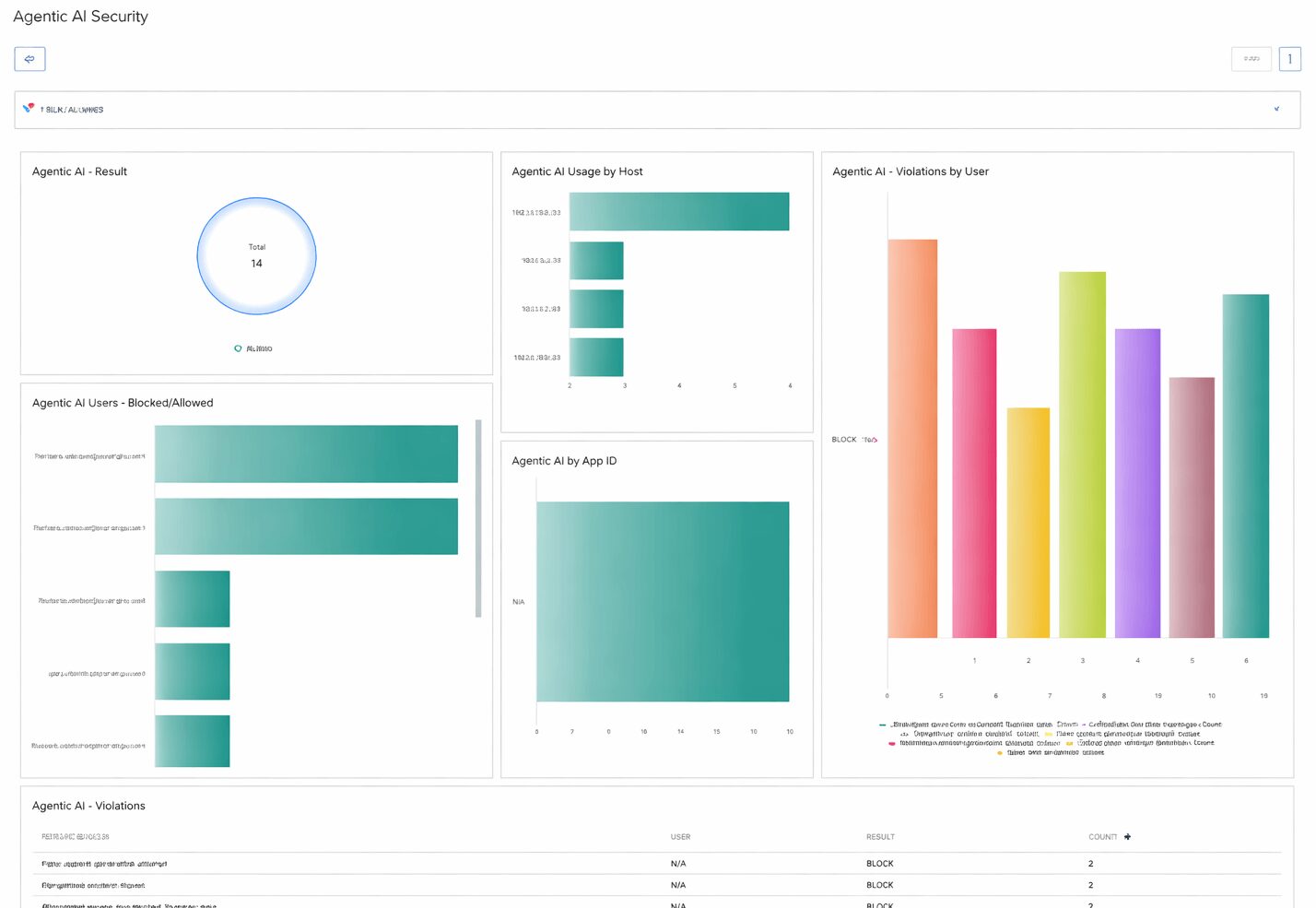
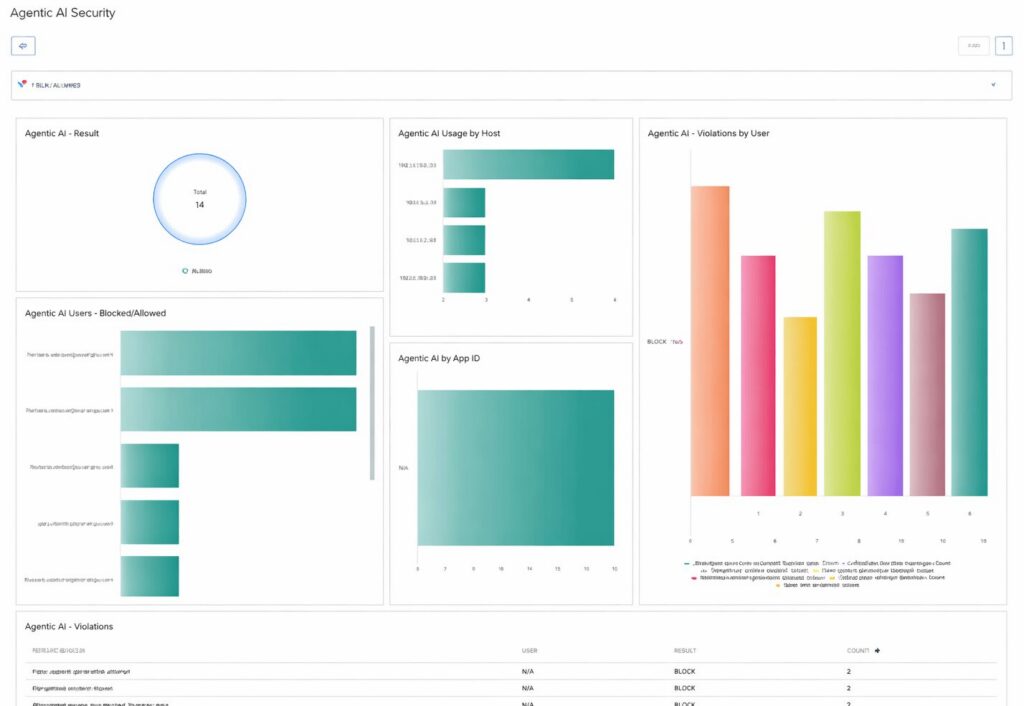
Exabeam extends user and entity behavior analytics to AI agents and autonomous workflows through Agent Behavior Analytics. ABA establishes behavioral baselines for each agent to detect misuse, drift, abnormal tool use, risky access, and activity outside an agent’s expected role. The capability allows organizations to discover shadow AI, analyze logs, and identify the subtle anomalies that reveal credentials misuse, insider threats, and adversarial AI activity across human and non-human identities.
By extending security operations to the entire AI lifecycle, organizations can govern AI agents and autonomous workflows before and after deployment. This includes pre-deployment policy verification, runtime telemetry collection, and secure model connections to ensure all AI tool actions are fully audited and aligned with user permissions. Teams can add ABA to an existing SIEM through New-Scale Analytics, or deploy New-Scale Fusion for integrated detection, investigation, and response.
Key features include:
- Behavioral detections for agents: Baselines expected agent behavior and detects autonomous installation and execution, tool usage and MCP activity, and actions outside an agent’s defined role.
- Pre-deployment verification (Praxen): Leverages the open-source Praxen framework to compare declared agent policies with code, configuration, and logs before deployment, identifying excessive permissions and configuration gaps before agents enter production.
- Runtime agent telemetry (Observra): Uses the open-source Observra SDK to capture, normalize, and enrich runtime activity such as model calls, tool execution, and token usage, eliminating visibility blind spots across different agentic frameworks.
- Open agent telemetry: Analyzes activity from Claude, ChatGPT, Google Gemini, Microsoft Copilot, GitHub Copilot, and any agent that emits open telemetry.
- Telemetry normalization: Observra standardizes agent-native telemetry using a Common Information Model, and Exabeam Agent Sensor collects and normalizes activity across models and runtime environments.
- Coverage mapping to OWASP Agentic Top 10: Outcomes Navigator maps ABA coverage to the framework, highlights gaps, and uses the Nova Advisor Agent to recommend data sources and detection content.
- Machine-built investigation timelines: Correlates agent actions with related user, entity, and application activity, with Exabeam Nova summarizing threats and recommending next steps while analysts stay in control.
- Editable detection content: ABA detections are exposed in Threat Detection Management for review, cloning, and tuning, and Nova Rule Creator builds behavioral models and correlation rules from natural language and converts Sigma and YARA rules.
Limitations (as reported by users on PeerSpot):
- Dashboard customization: Users would like more built-in dashboard options and deeper customization of existing views.
- Documentation depth: Some areas of the documentation, including API guidance, are described as incomplete.
- Integration breadth: Several reviewers want a wider set of out-of-the-box integrations for data collection.
Source: Exabeam
2. Microsoft Security for AI

Best for: Organizations standardized on the Microsoft security stack
Strengths: Agent inventory, conditional access, runtime defense, compliance
Things to consider: Licensing is complex and non-Microsoft coverage is thinner
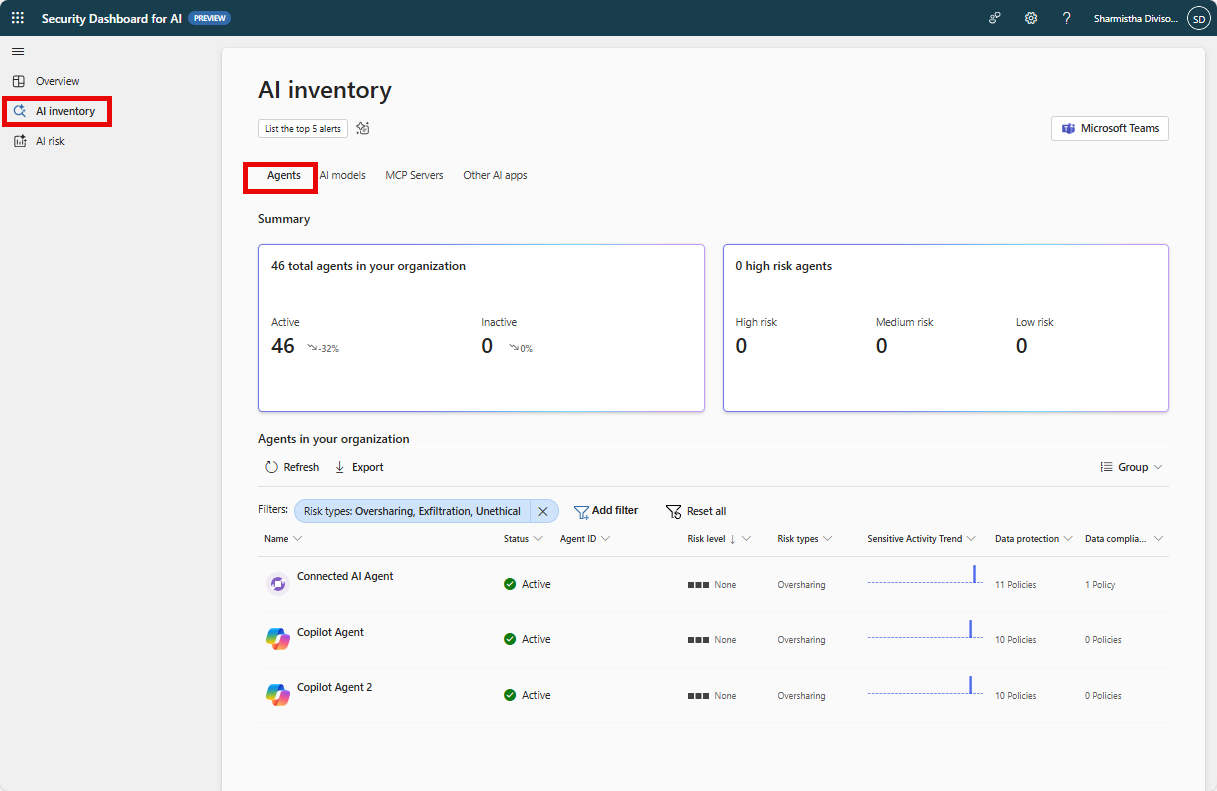
Microsoft Security for AI is a solution grouping rather than a single product. It combines Microsoft Agent 365, Defender, Entra, Purview, and Foundry to discover an organization’s AI and agent estate, control what agents can access, monitor their activity, and report against regulatory requirements.
Coverage extends to agents built in Microsoft Foundry, Microsoft 365 Copilot, and Copilot Studio, as well as third-party applications and agents. Agent 365 acts as the control plane, providing centralized observation and governance across the agent estate.
Key features include:
- AI and agent estate discovery: Builds visibility into AI applications and agents across the organization so security teams can govern access and reduce agent sprawl.
- Access and permission control: Secures and manages access for users, AI apps, agents, and resources using risk-based conditional access, strong authentication, and real-time traffic filtering.
- Agent lifecycle governance: Manages agent activity and development with unified visibility and control over lifecycle risks.
- Data exposure controls: Identifies data risks tied to AI apps and agents, prevents sensitive data from being shared into them, and enforces guardrails on how AI uses organizational data to generate responses or perform tasks.
- Threat detection and response: Detects known and emerging threats targeting agents and presents a view of the attack chain with prioritized investigation and response at the incident level.
- Runtime defense: Blocks malicious traffic and prompt injection attacks and prevents prompt manipulation and data exfiltration as they occur.
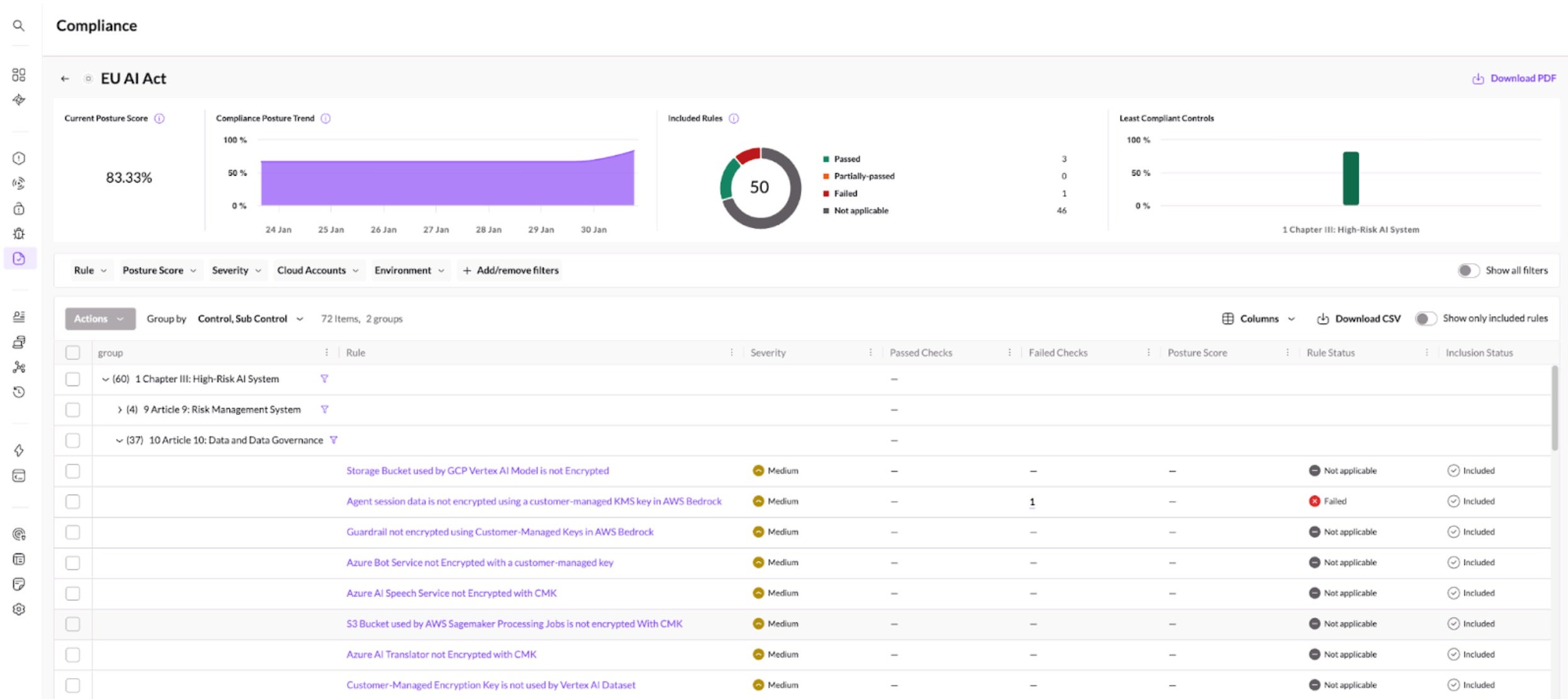
- Regulatory reporting: Supports audit, retention, transparency, and data protection requirements, including data residency and encryption controls.
Limitations (as reported by users on PeerSpot): Reviews cover Microsoft Defender XDR, the threat protection component of this solution set, rather than the AI agent capabilities in isolation.
- Licensing complexity: Users describe the number of plans and frequent licensing changes as difficult to track, with high overall cost.
- Alert tuning: Reviewers report that alerts require manual tuning and that incident management can be slow.
- Third-party integration: Coverage of non-Microsoft tools is seen as limited compared with the native Microsoft estate.
- Portal changes: Frequent changes to the portal and dashboard layout are described as confusing.
- Onboarding effort: Initial onboarding is reported as challenging, and customized automation playbooks require additional work.
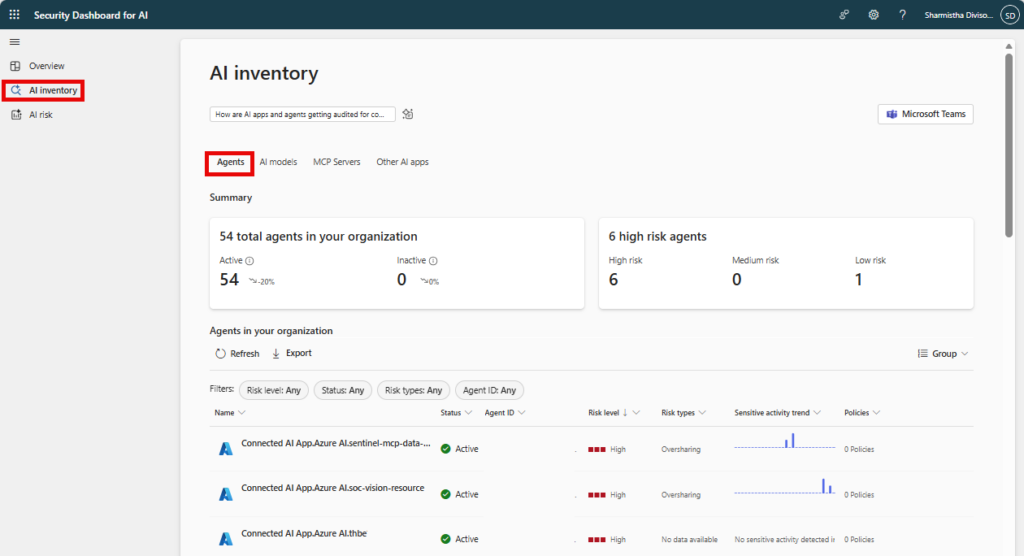
Source: Microsoft
3. CrowdStrike Falcon AI Detection and Response

Best for: Runtime inspection of prompts, agents, and MCP interactions
Strengths: Prompt injection blocking, full prompt logs, automated response
Things to consider: Alert tuning, reporting flexibility, and cost for smaller teams
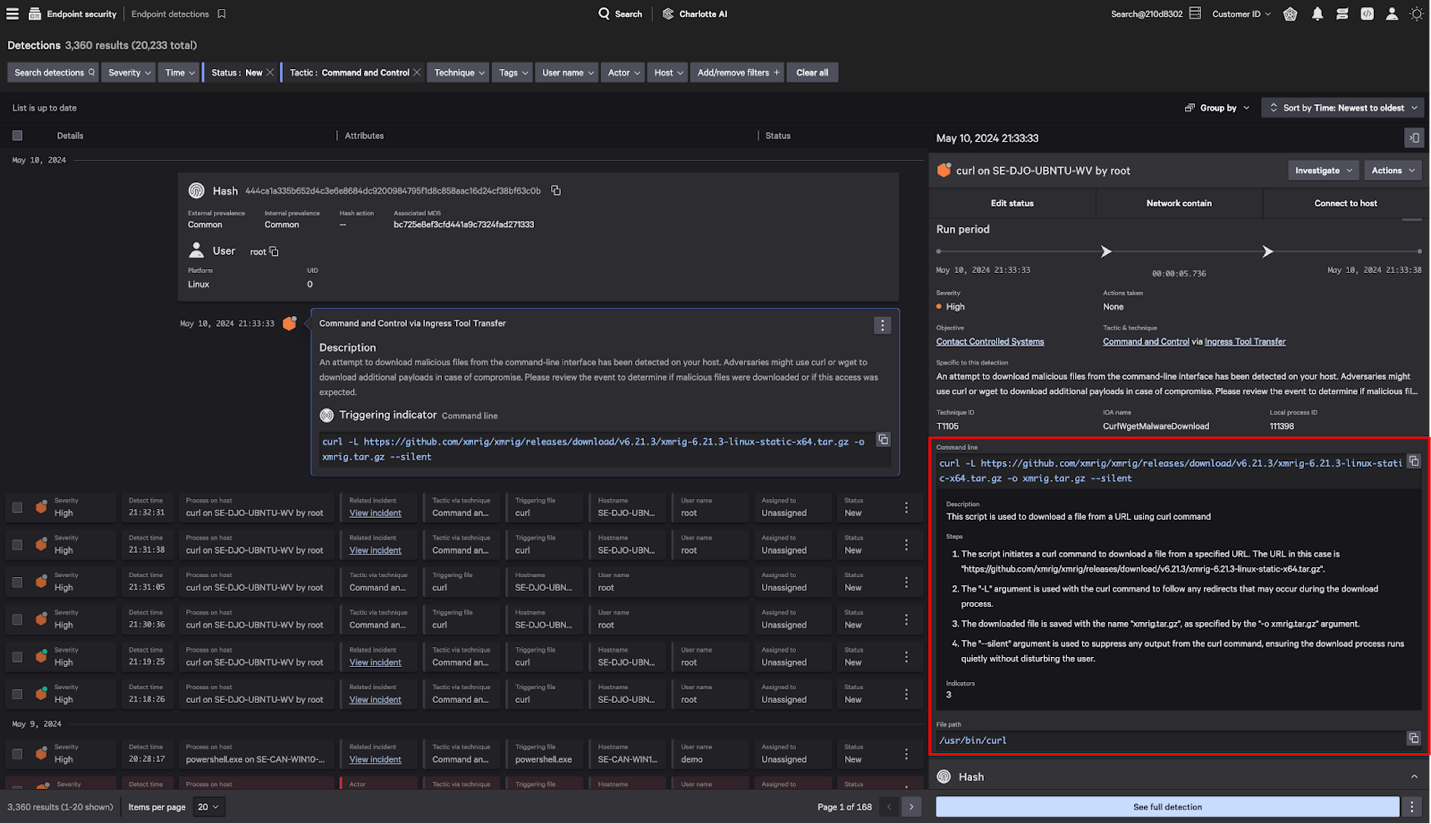
CrowdStrike Falcon AI Detection and Response (AIDR) secures the layer where users, models, and agents interact. It provides runtime visibility, real-time protection, and automated response across the AI attack surface, and is delivered through the Falcon platform.
AIDR maps the relationships between users, prompts, models, agents, MCP servers, and cloud workloads, then captures runtime logs that support compliance work, investigations, and continuous monitoring. CrowdStrike reports 99% detection efficacy against prompt attacks at sub-30 millisecond latency based on internal benchmark testing.
Key features include:
- Unified AI visibility: Maps how employees use AI and how agents operate, connecting users, prompts, models, agents, MCP servers, and cloud workloads in one view.
- Policy enforcement across the AI stack: Applies AI security policies to users, agents, tools, and models, and automatically masks or encrypts sensitive data before exposure.
- Prompt injection detection: Detects and stops direct and indirect prompt injection, inspecting each AI interaction to identify hidden instructions.
- Runtime activity logging: Produces AI event logs containing full prompt and response content, model versions, and user details, with pivoting on any field to investigate related activity over time.
- Data leak prevention: Identifies and blocks confidential information, including credentials and regulated data, before it is uploaded, shared, or processed by a model or agent.
- Automated containment: Blocks unsafe interactions, contains threats, prevents exfiltration, and enforces policy without manual intervention.
Limitations (as reported by users on PeerSpot): Reviews cover the broader CrowdStrike Falcon platform rather than the AIDR module specifically.
- Alert management: Users report a high number of false positives and want better alert handling.
- Dashboard and reporting flexibility: Customization of dashboards and reports is described as limited.
- Legacy system compatibility: Reviewers note compatibility gaps with older systems and with macOS and Unix environments.
- Pricing: Cost is raised as a concern, particularly by smaller organizations.
- Learning curve: The interface is described as complex for new users, and training resources and support are areas users want improved.
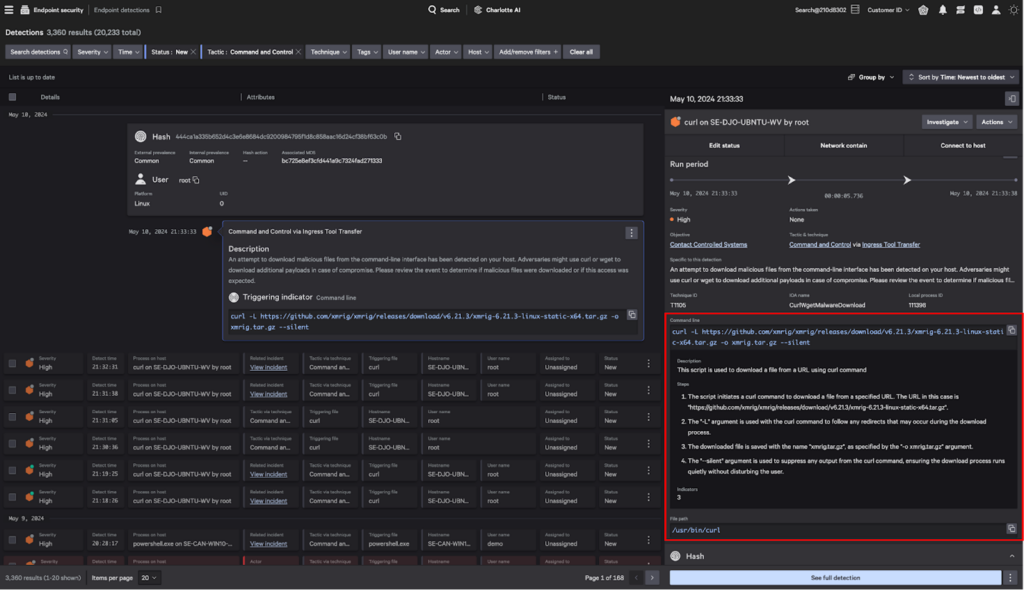
Source: CrowdStrike
4. SentinelOne Securing AI

Best for: Teams governing workforce AI use and agent actions together
Strengths: Shadow AI discovery, least-privilege agent policy, AI-SPM, DSPM
Things to consider: Console navigation, false positives, and support response times
SentinelOne’s Securing AI offering covers employee AI usage, custom AI applications, agentic workflows, and the data and infrastructure behind them. It is delivered on the Singularity Platform and includes Prompt Security, which SentinelOne acquired and now offers as its AI security component.
For agents specifically, the platform defines what an agent can access, retrieve, and execute, and monitors agent behavior to flag unauthorized actions before they chain into further steps. Coverage spans cloud workloads, on-premises infrastructure, and hybrid environments.
Key features include:
- Agentic AI policy controls: Applies policy-based controls to agentic workflows across tools and data sources and enforces least-privilege access for agents.
- Agent behavior monitoring: Monitors what agents do and flags unauthorized actions before they cascade into further steps.
- Shadow AI discovery: Discovers and inventories AI tool usage across the workforce in real time, covering more than 15,000 AI tools, with selective data redaction instead of blanket blocking.
- AI application protection: Applies controls against prompt injection and sensitive data disclosure in custom AI apps, with context-aware guardrails and pre-production stress testing.
- AI security posture management: Treats AI systems as first-class assets with unified inventory, continuous posture assessment, and visibility into misconfigurations across training pipelines, inference endpoints, and managed AI services.
- Data security posture management: Discovers and classifies sensitive data and enforces safe-to-train policies so high-risk datasets do not feed AI pipelines.
- Pre-deployment testing: Provides automated code and AI secrets scanning alongside AI red teaming that surfaces prompt injection, data poisoning, and policy bypass risks during development.
Limitations (as reported by users on PeerSpot): Reviews cover SentinelOne Singularity Endpoint, the wider platform this AI security capability sits on.
- Console usability: Users describe navigation and reporting in the management console as an area needing work.
- False positives: Reviewers report alert noise that required custom rule tuning before it settled.
- Resource consumption: Some users note high resource use on endpoints, leading to performance issues.
- Integration and customization: Native integration with third-party security platforms and dashboard customization options are described as limited.
- Support response times: Reviewers ask for faster responses from support.
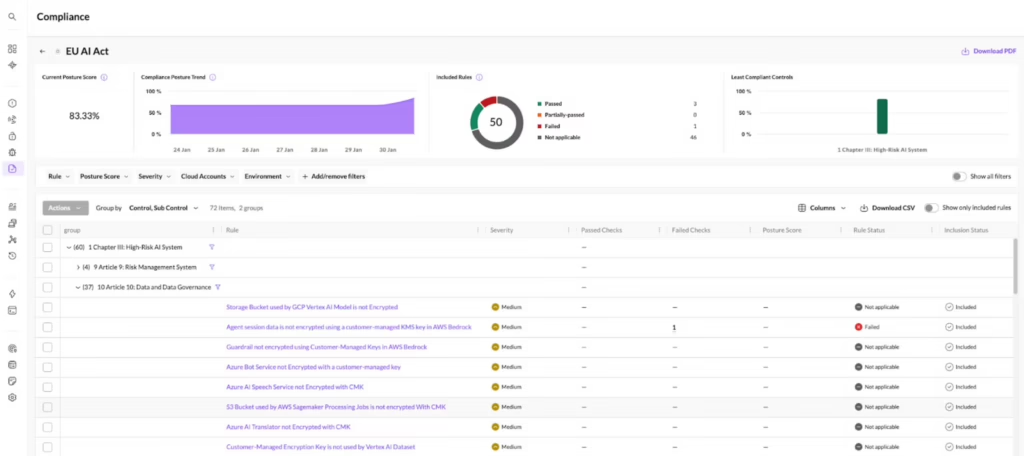
Source: SentinelOne
Purpose-Built AI and Agent Security Platforms
5. Palo Alto Networks Prisma AIRS Agent Security

Best for: Full lifecycle agent security from supply chain to runtime
Strengths: Agent discovery, red teaming, identity checks, MCP traffic control
Things to consider: Cost, licensing complexity, and rigid policy configuration
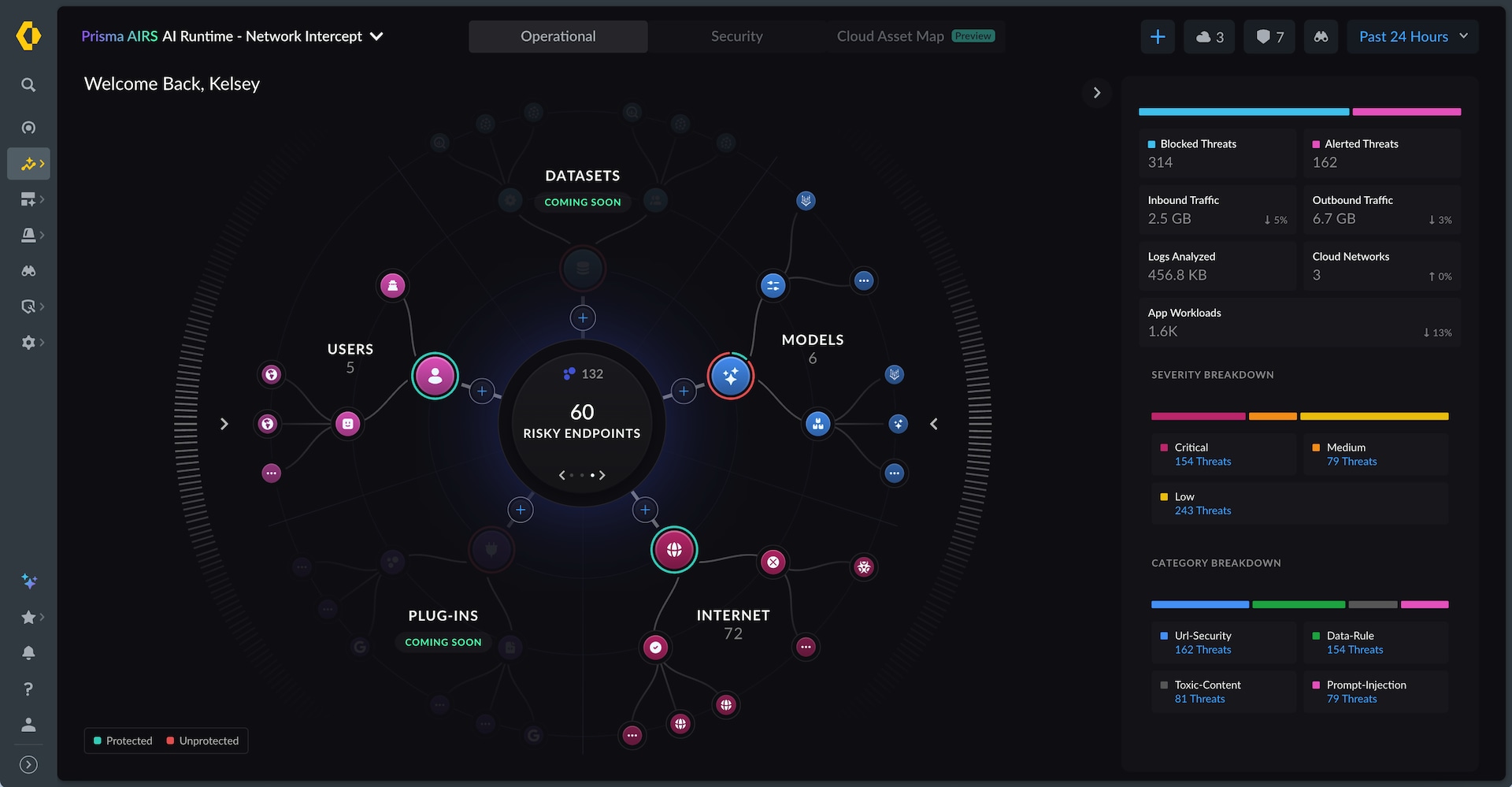
Prisma AIRS Agent Security covers the agentic AI lifecycle from configuration through runtime. It assesses risk before deployment, verifies agent identity, and enforces controls on what agents are allowed to do once they are live.
Palo Alto Networks is integrating Portkey’s AI Gateway into Prisma AIRS to provide a single control plane for monitoring agent actions, verifying agent identity, and applying runtime policies. The platform is positioned to replace separate point tools with one console for agents, models, and interactions.
Key features include:
- Automated agent discovery: Finds AI agents across SaaS platforms, cloud services, low-code tools, and custom environments, and surfaces what each agent does, what it can access, and how it makes decisions.
- Agentic supply chain scanning: Scans agent artifacts including agent code, MCP servers, and skills for vulnerabilities, with remediation guidance.
- Agent behavior testing: Runs behavior tests against agents using a library of attacks or a dynamic red teaming agent that generates real-world scenarios.
- Over-privilege detection: Identifies excessive access and supports revoking unnecessary privileges to reduce the blast radius of a compromised or misconfigured agent.
- Agent identity verification: Inventories and validates the identities of agents operating in the enterprise, defines ownership and permissions, and enforces least-privileged access.
- Runtime protection: Addresses AI-specific threats such as prompt injection and agent-specific risks such as tool misuse, with policies aimed at preventing sensitive data exposure.
- Centralized AI traffic control: Applies granular policies to tool calls, LLM interactions, and Model Context Protocol connections.
Limitations (as reported by users on Gartner Peer Insights):
- Cost and ecosystem dependence: Reviewers describe the platform as expensive and note that full value depends on committing to the broader Palo Alto Networks ecosystem.
- Licensing complexity: Licensing is described as a significant barrier for smaller organizations.
- Policy configuration: Setting up granular policies is reported as cumbersome, with a meaningful learning curve for administrators.
- Feature maturity: Some capabilities are described as early-stage, requiring time to learn how to use them effectively.
- Alert and report tuning: Certain alerts and reports need extra adjustment to fit a specific environment, adding manual work.
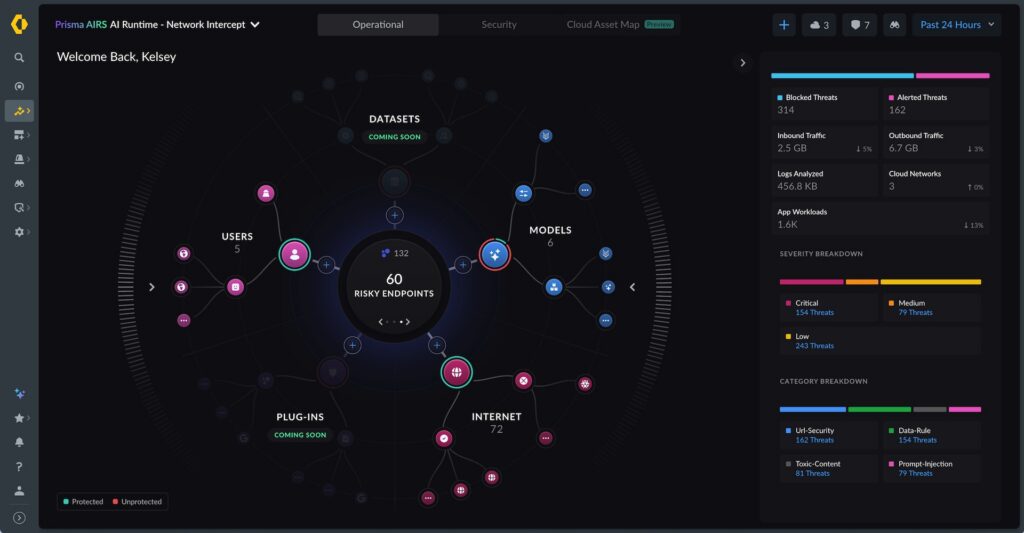
Source: Palo Alto Networks
6. Zenity

Best for: Securing agents built on SaaS and low-code business platforms
Strengths: Agent inventory, posture checks, exploitability testing, AIDR
Things to consider: Narrower coverage of custom agent frameworks; no public pricing
Zenity is a security and governance platform built specifically for AI agents. It is structured in three layers, Surface, Enforce, and Protect, on the premise that an agent’s decision depends on what it can reach, who it acts for, and what it is trying to do, none of which appears in a single log.
Coverage spans agents embedded in productivity and business SaaS such as Salesforce Agentforce and Copilot Studio, homegrown agents on platforms including AWS Bedrock and Google Vertex AI, and personal and coding agents running on endpoints.
Key features include:
- AI observability: Builds a live inventory of agents across SaaS, custom, and endpoint deployments and tracks the data each one touches.
- AI security posture management: Evaluates agent configuration and permissions against policy before an agent goes live.
- AI exposure management: Validates which of an agent’s attack paths are actually exploitable, scores each one, and produces a fix that can be applied through Runtime Boundaries.
- Runtime boundaries and AIDR: Provides enforcement and AI detection and response for agents once they are operating.
- Agentic identity and MCP security: Covers agent identity and the Model Context Protocol connections agents use to reach tools and systems.
- Endpoint agent monitoring: Applies lightweight monitoring, detection, and response to local personal and coding agents.
- Broad platform connectors: Supports Amazon Bedrock and Bedrock AgentCore, ChatGPT Enterprise, Claude Enterprise, Copilot Studio, Google Vertex AI, Microsoft 365 Copilot, Microsoft Foundry, Power Platform, Salesforce, Agentforce, and ServiceNow.
Limitations (based on publicly available sources):
- Agent framework coverage: Depth is strongest on major SaaS and cloud agent platforms, and agents built on frameworks such as LangChain or inside data platforms may require other tooling.
- No offensive testing: The platform is oriented toward detection and prevention and does not provide attack simulation or automated red teaming workflows.
- Scope boundaries: Coverage centers on AI agents and apps rather than wider collaboration and lifecycle governance across services such as Teams, SharePoint, or Exchange.
- Pricing transparency: Pricing is not published, and quotes typically depend on user count, agent volume, and deployment complexity.
7. Wiz AI-SPM

Best for: Cloud teams mapping AI and agent risk against infrastructure
Strengths: Agentless discovery, AI-BOM, attack path analysis, tool mapping
Things to consider: Runtime detection depth, alert noise, and pricing model
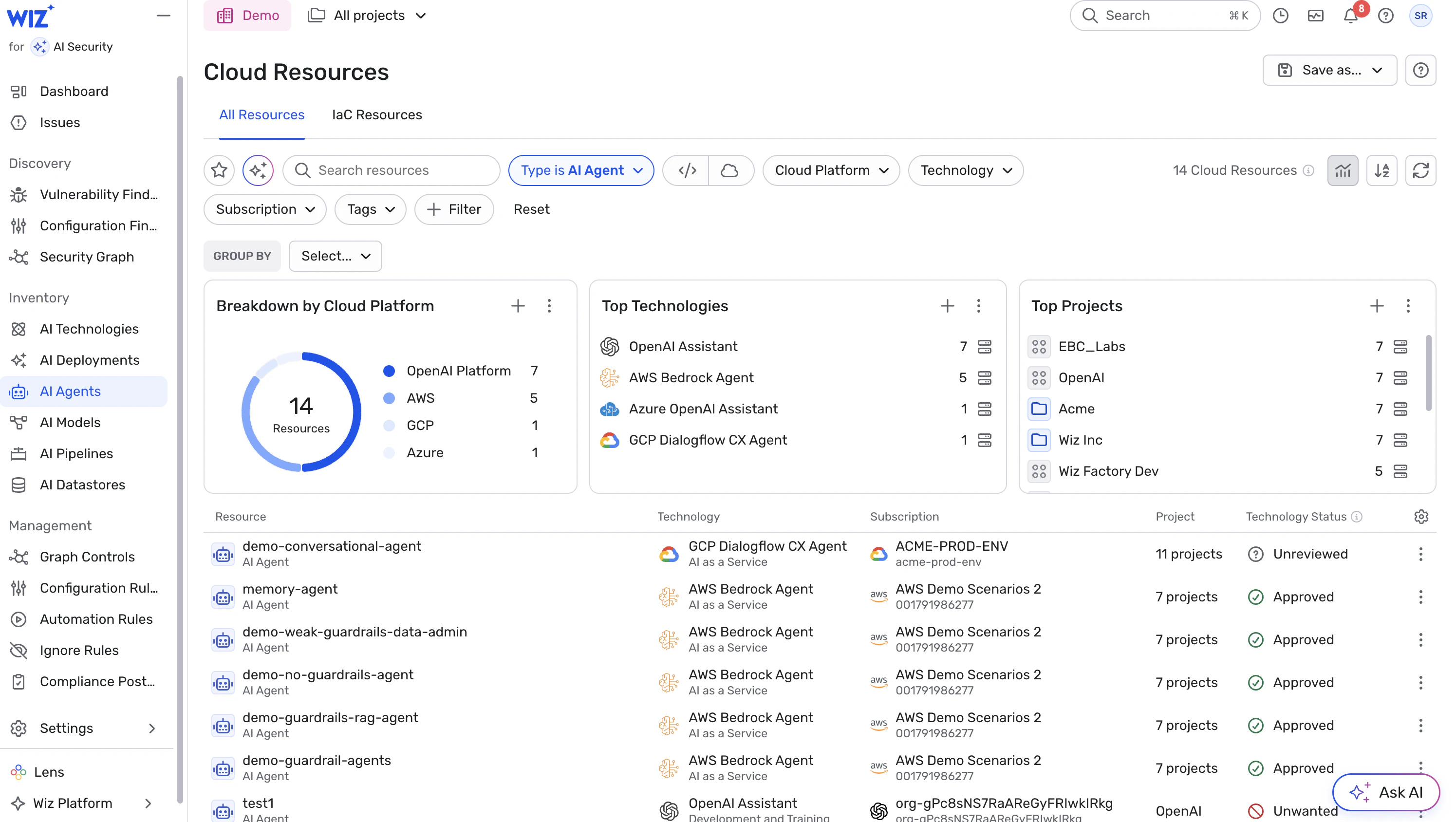
Wiz AI Security Posture Management extends the Wiz cloud security platform to AI models, agents, and services. It discovers AI pipelines without agents, detects misconfigurations, and traces attack paths to AI services using the Wiz Security Graph. Wiz was acquired by Google in March 2026 and continues to operate under its own brand.
The approach connects AI findings to surrounding cloud context, including infrastructure, identities, and sensitive data, so teams can judge which AI risks are actually exploitable rather than treating every misconfiguration equally.
Key features include:
- AI discovery and inventory: Discovers and catalogs AI models, agents, and services across PaaS platforms, SaaS AI applications, and custom deployments without deploying agents.
- AI bill of materials: Analyzes the components powering AI systems, including models, frameworks, dependencies, and libraries, and surfaces shadow AI across the environment.
- AI tool identification: Identifies and classifies the tools agents can access so teams can understand what actions those agents are able to perform.
- AI security rules: Detects AI-native risks including insecure configurations, unsafe deployments, and logic flaws, and extends checks into the pipeline through IaC scanning.
- Sensitive data and endpoint exposure: Identifies where AI systems can access or expose sensitive data and detects publicly exposed inference endpoints and APIs.
- AI attack path analysis: Uses the Wiz Security Graph to connect infrastructure, identity, models, data, and applications and uncover exploitable paths to AI assets.
- AI runtime protection: Detects prompt injection, rogue agents, and malicious behavior targeting AI systems, with AI-powered agents that investigate threats and guide remediation.
Limitations (as reported by users on PeerSpot):
- Runtime detection maturity: Reviewers compare runtime detection unfavorably with dedicated endpoint and detection platforms and want stronger behavior-based detections.
- Alert management: Users ask for better context to reduce false positives and refine how alerts are handled.
- Integration model: Adding a new integration is described as lacking a straightforward plug-and-play path across platforms.
- Reporting customization: Customization of reports and dashboards is called out as an area needing work.
- Pricing model: Several reviewers criticize how the platform is priced.
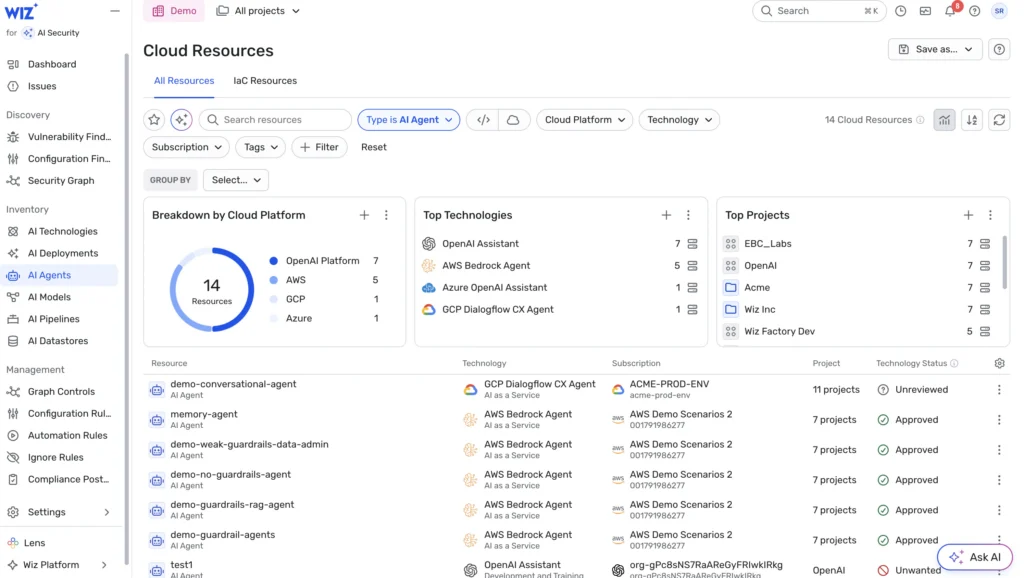
Source: Wiz
8. SailPoint Agent Identity Security

Best for: Governing AI agents as identities alongside humans and machines
Strengths: Agent onboarding, owner assignment, access certification, audit
Things to consider: High cost, complex configuration, limited native connectors
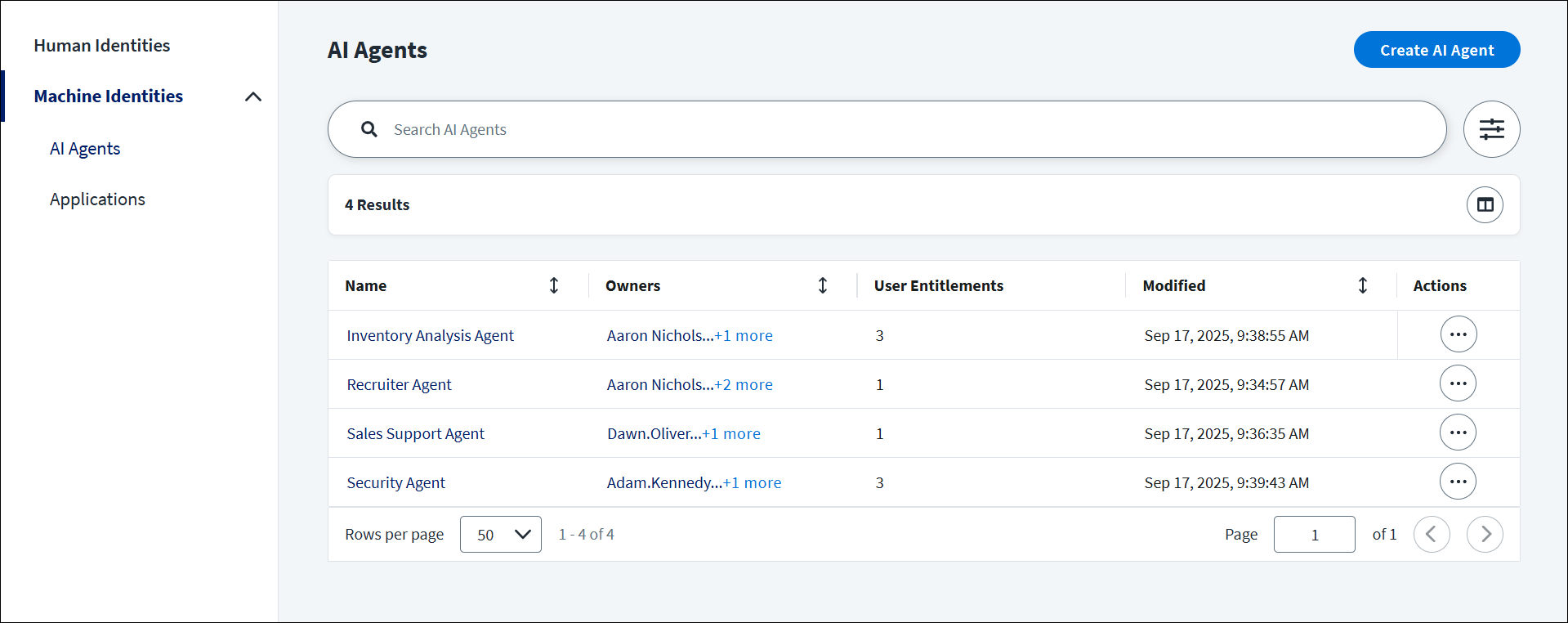
SailPoint Agent Identity Security treats AI agents as an identity type to be governed with the same processes applied to employees and machine accounts. It brings agents, the people who use them, and the tools they reach into a single governed view within Identity Security Cloud.
The add-on aggregates agents from cloud and agent platforms, registers each with a unique identity enriched with business and access context, and then applies ownership, certification, and revocation workflows to that population.
Key features include:
- Multi-platform agent aggregation: Connects to AWS, Microsoft Azure, Google Cloud Platform, Salesforce, and Microsoft Copilot Studio to automatically onboard agents into a single system of record.
- Ownership assignment and succession: Designates one or multiple human owners per agent, with automated updates that keep ownership aligned as roles change and built-in succession planning.
- Access certification for agents: Reviews agent access against business need and security policy and supports revoking inappropriate or excessive permissions.
- Indirect access detection: Detects when human identities gain new entitlements or data access through an AI agent, exposing indirect access pathways.
- Service account governance: Governs the service accounts each agent uses to reach systems such as HR and ITSM platforms, from creation through retirement.
- Shadow AI visibility: Surfaces unmonitored AI tool use and supports remediation, including redirecting users toward approved alternatives.
- Unified identity governance: Manages human, non-employee, machine, and agent identities in one platform for consistent policy enforcement and certification.
- MCP server for agent interaction: Provides a standardized bridge that translates third-party agent requests into SailPoint API calls with auditability.
Limitations (as reported by users on PeerSpot): Reviews cover SailPoint Identity Security Cloud, the platform this capability is an add-on to.
- Cost: Licensing and implementation are described as expensive, with pricing tied to identity counts and additional fees for modules.
- Configuration complexity: Setup often requires extensive coding and specialist consultants, adding to project cost and timelines.
- Connector coverage: Reviewers report a limited set of out-of-the-box connectors, particularly for infrastructure and non-human identities such as shared and service accounts.
- Reporting and interface: Reporting and analytics capabilities and interface intuitiveness are both cited as areas needing improvement.
- Support consistency: Response times and regional language support vary, with some users needing to escalate.
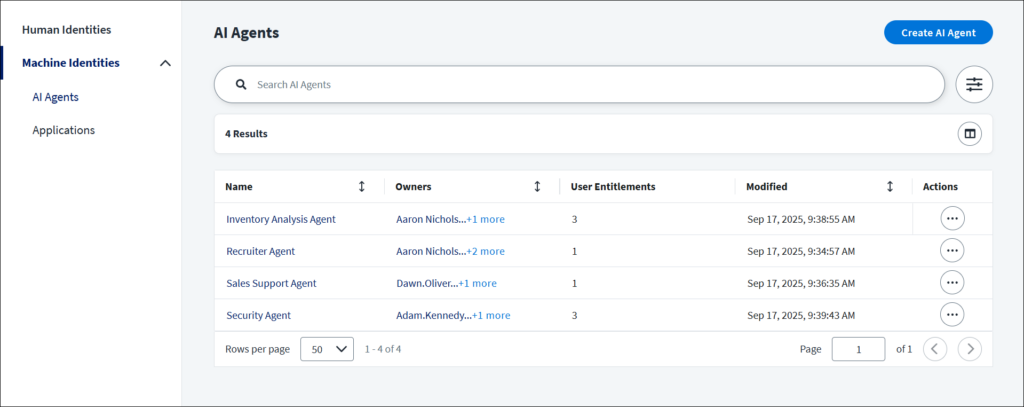
Source: SailPoint
Conclusion
As AI agents become more autonomous and gain broader access to enterprise systems, organizations need security monitoring that extends beyond traditional endpoint, identity, and application controls. Effective AI agent security platforms combine continuous visibility into agent identities, behavior, prompts, tool usage, and data access with real-time policy enforcement and automated response. By continuously monitoring how agents operate throughout their lifecycle, organizations can reduce the risk of unauthorized actions, limit the impact of compromised agents, and safely scale agentic AI while maintaining security, compliance, and operational oversight.
Learn More About Exabeam
Learn about the Exabeam platform and expand your knowledge of information security with our collection of white papers, podcasts, webinars, and more.