Choosing an Effective Insider Threat Monitoring Platform: 8 Solutions Compared
- 18 minutes to read
Table of Contents
TL;DR: Insider threat monitoring platforms detect risky activity by users and AI agents with legitimate access. Exabeam is best for SOC-led UEBA programs, Splunk ES suits Splunk shops, Proofpoint ITM offers endpoint forensics, and Purview fits Microsoft 365.
What Is an Insider Threat Monitoring Platform?
Choosing an effective insider threat monitoring platform requires balancing cross-channel data visibility, automated enforcement, and strict employee privacy guardrails. The right solution helps organizations detect, investigate, and respond to risks caused by users with legitimate access to internal systems and data. These users may include employees, contractors, business partners, and third-party vendors.
Insider threats can involve malicious actions, such as data theft or sabotage, as well as accidental incidents caused by human error or negligence. Insider threat monitoring platforms collect and analyze activity data from endpoints, applications, networks, and cloud services. They track events such as file transfers, access to sensitive information, unusual login activity, and changes to system configurations. By correlating these events with user behavior patterns, the platform can identify activities that may indicate a security risk.
Key evaluation criteria:
Use these criteria to compare insider threat monitoring platforms:
- Behavioral analytics depth: How the platform baselines users, peers, and entities and detects meaningful deviations over time.
- Data source coverage and correlation: Which telemetry the platform ingests and how it links events across identities, endpoints, and applications.
- Risk scoring and prioritization: How the platform aggregates signals into risk scores that focus analysts on the highest-risk activity.
- Investigation and response automation: Timelines, evidence, AI assistance, and automated response workflows that speed up triage.
- Coverage of non-human identities and AI agents: Whether service accounts, automation, and AI agents are monitored alongside human users.
- Deployment flexibility: Cloud, self-hosted, and add-on options, and how the platform fits with an existing SIEM.
Platforms covered in this guide:
- Security analytics platforms with UEBA:
- Exabeam: Behavioral analytics for users, service accounts, and AI agents, with dynamic risk scoring and AI-assisted investigations.
- Securonix: User and entity behavior analytics with peer-group analysis, cross-account identity correlation, and automated response workflows.
- Splunk Enterprise Security: Native UEBA, entity risk scoring, and multi-entity threat correlation within the ES Premier edition.
- Dedicated insider risk management platforms:
- Proofpoint Insider Threat Management: Cross-channel user activity monitoring, forensic evidence collection, and adaptive data movement controls.
- DTEX Platform: Endpoint activity analytics, intent-based risk detection, and monitoring of human and AI-driven activity.
- Microsoft Purview Insider Risk Management: Microsoft 365-based insider risk detection, policy templates, case management, and adaptive DLP controls.
- Teramind: Endpoint monitoring, behavioral analytics, real-time activity blocking, and session replay for investigations.
Why Do Organizations Need Insider Threat Monitoring Platforms?
Detecting Malicious, Negligent, and Compromised Insiders
Insider threats generally fall into three categories: malicious insiders who intentionally misuse their access, negligent insiders who accidentally expose sensitive information, and compromised insiders whose accounts are controlled by external attackers. Each category creates different security risks and requires different detection methods.
Insider threat monitoring platforms analyze user activities to identify behaviors associated with these threats. For example, they can detect employees deliberately copying confidential files, users accidentally uploading sensitive documents to unauthorized cloud services, or compromised accounts accessing resources outside their normal usage patterns.
Identifying Suspicious Activity Involving Legitimate User Credentials
Attackers who obtain valid user credentials can access corporate resources without triggering security controls designed to detect unauthorized logins. Similarly, malicious employees may abuse permissions they already possess. In both cases, authentication succeeds, making it difficult for access-based security systems to recognize the threat.
Insider threat monitoring platforms address this challenge by analyzing what users do after authentication. They monitor activities such as unusual file downloads, access to unfamiliar systems, unexpected privilege changes, and data transfers outside normal working patterns.
Preventing Sensitive Data Theft and Intellectual Property Loss
Sensitive business information, including customer records, financial data, source code, product designs, and proprietary research, is often accessible to employees who need it for their work. This legitimate access creates opportunities for intentional data theft and accidental exposure that conventional perimeter security tools may not detect.
Insider threat monitoring platforms help protect this information by tracking how users access, copy, modify, and transfer sensitive files. They can identify suspicious activities such as bulk downloads, transfers to personal cloud storage accounts, copying files to removable devices, or sending confidential documents to external email addresses.
How Does an Insider Threat Monitoring Platform Work?
Collecting User Activity and Security Telemetry Across Enterprise Systems
Insider threat monitoring platforms gather activity data from multiple sources, including endpoints, identity providers, cloud applications, file servers, email systems, and network infrastructure. Data collection typically relies on endpoint agents, application programming interfaces (APIs), and integrations with existing security tools.
Collected telemetry may include:
- File access events
- Authentication attempts
- Application usage
- Privilege changes
- Data transfers
- Removable storage activity
Each event is associated with relevant metadata, such as user identity, device, timestamp, resource accessed, and action performed. The platform normalizes this information into a consistent format for analysis. Centralizing activity data enables security teams to examine user actions across systems rather than investigating isolated events.
Establishing Behavioral Baselines for Users and Entities
Behavioral baselines represent the normal activities of users, devices, and other entities within an organization. Insider threat monitoring platforms establish these baselines by analyzing historical activity patterns, including:
- Typical login times
- Frequently accessed resources
- Data transfer volumes
- Application usage
Baselines may account for differences between individual users and peer groups. For example, a database administrator regularly accessing production databases may be considered normal, while the same activity by a marketing employee could warrant investigation.
These baselines are updated as legitimate behavior changes. This helps the platform distinguish unusual activities from expected changes in work patterns, reducing unnecessary alerts while maintaining visibility into potential threats.
Detecting Anomalous Activities with AI and Machine Learning
Insider threat monitoring platforms use artificial intelligence (AI) and machine learning (ML) to identify activities that deviate from established behavioral patterns. Detection methods may include:
- Statistical analysis
- Anomaly detection models
- Supervised learning algorithms trained on known threat indicators
For example, a platform might identify an employee who suddenly downloads significantly more files than usual, accesses unfamiliar repositories, or transfers sensitive information to an external destination. Individually, these actions may be legitimate, but their frequency, timing, or combination can indicate elevated risk.
Machine learning models can identify subtle patterns that static detection rules may miss. However, anomalous behavior does not necessarily indicate malicious intent. Security teams must evaluate detected deviations alongside business context and supporting evidence.
Correlating Security Events Across Identities, Endpoints, and Applications
Individual security events often provide insufficient evidence to determine whether an insider threat exists. Event correlation connects related activities across enterprise systems to identify suspicious sequences and patterns. For example, a user might:
- Authenticate from an unfamiliar device
- Access a restricted file repository
- Download confidential documents
- Upload them to an external cloud service
Each action may appear legitimate when examined separately. Correlating these events reveals a sequence consistent with potential data exfiltration. Insider threat monitoring platforms associate events with common identities, devices, sessions, and resources. This creates a more complete view of user activity and helps investigators understand how suspicious actions relate to one another.
Assigning Dynamic Risk Scores to Users and Suspicious Activities
Risk scoring helps security teams prioritize potential insider threats based on their severity and likelihood of causing harm. Insider threat monitoring platforms calculate risk scores using factors such as:
- Behavioral deviations
- Sensitivity of accessed data
- Privilege levels
- Policy violations
- Combinations of suspicious events
For example, an unusual login may contribute relatively little to a user’s risk score. However, if the same user subsequently accesses confidential files and transfers large amounts of data externally, the score may increase substantially.
Risk scores are dynamic and can change as new activity is observed or previous events are investigated. Platforms may also adjust scores based on contextual information, such as approved administrative tasks or authorized data migrations. This enables security teams to focus on higher-risk activities instead of treating every anomaly equally.
Generating Contextual Alerts and Supporting Threat Investigations
When suspicious activity exceeds predefined detection thresholds or risk levels, the platform generates an alert for security analysts. Unlike basic security notifications, contextual alerts include supporting information such as:
- The affected user
- Associated devices
- Relevant activities
- Accessed resources
- Reasons the behavior was flagged
Investigators can use activity timelines, event logs, file operation records, and related security events to reconstruct what occurred. Some platforms also provide session recordings or detailed endpoint activity histories, depending on their monitoring capabilities and configuration.
Insider threat monitoring platforms may integrate with security information and event management (SIEM), security orchestration, automation, and response (SOAR), and case management systems. These integrations support incident escalation, evidence collection, and coordinated response actions, such as disabling compromised accounts or restricting sensitive data access.
How to Choose an Insider Threat Monitoring Platform
The criteria below reflect what security teams typically need to verify before selecting a platform for an insider threat program.
Behavioral Analytics Depth
Insider threats rarely trigger signature-based rules, because the activity is performed with valid credentials and approved access. The quality of a platform’s behavioral analytics determines whether it can separate a database administrator’s routine work from the same activity performed by a marketing employee. Look at how baselines are built, whether peer groups are used, and whether the platform tracks behavior that accumulates gradually rather than in a single event.
Evaluation criteria:
- Does it build individual and peer-group baselines for users and entities?
- Does it detect slow, multi-step behavior changes over weeks or months?
- Can analysts view, clone, and customize behavioral detections?
- Does it include prebuilt content for common insider scenarios such as exfiltration and privilege abuse?
Data Source Coverage and Correlation
A platform can only detect what it can see. Some tools rely on endpoint agents, others on logs from identity providers, cloud applications, and network infrastructure, and some combine both. Correlation across these sources is what turns isolated events, such as a new device login and a large download, into a recognizable exfiltration sequence.
Evaluation criteria:
- Which sources are supported: endpoints, identity, cloud apps, email, network, HR systems, physical access?
- Does it correlate events across multiple accounts belonging to the same person?
- Does it require endpoint agents, and on which operating systems?
- Can it ingest third-party security tool data, not only one vendor’s ecosystem?
Risk Scoring and Prioritization
Insider threat programs fail when analysts drown in low-value anomalies. Risk scoring aggregates weak and strong signals into a single view of each user or entity, so the team can focus on the small number of identities that represent real risk. Context such as asset criticality and data sensitivity should influence the score.
Evaluation criteria:
- Does it aggregate signals into a dynamic per-user or per-entity risk score?
- Does scoring factor in business context, asset criticality, and data sensitivity?
- Can high-risk users be placed on watch lists or under elevated monitoring?
- Does it reduce alert volume by grouping related anomalies into a single case?
Investigation and Response Automation
Once an alert fires, investigators need to reconstruct what happened quickly and share evidence with HR, legal, or compliance. Platforms differ in how they present timelines, how much evidence they capture, and whether AI assistants or automation playbooks support triage and containment.
Evaluation criteria:
- Does it build activity timelines automatically?
- Are AI assistants available to summarize cases or recommend next steps?
- Does it integrate with SOAR, ticketing, and case management for response actions?
- Can evidence be shared with non-security stakeholders under access controls?
Coverage of Non-Human Identities and AI Agents
Service accounts, scripts, and AI agents now access data and invoke tools with increasing autonomy. These identities can be compromised or misused like human accounts, and their behavior also drifts over time. A modern platform should monitor them with the same behavioral rigor applied to employees.
Evaluation criteria:
- Does it baseline service accounts and other non-human identities?
- Does it ingest activity from AI agents and AI platforms, such as prompts and tool calls?
- Can it detect abnormal agent behavior, such as unexpected tool use or role drift?
- Does it distinguish human actions from automated or agent-driven actions?
Deployment Flexibility
Organizations have different constraints around data residency, existing SIEM investments, and operational capacity. Some need a cloud-native service, some need self-hosted deployment, and others want to add insider threat analytics to a SIEM they already run.
Evaluation criteria:
- Is it available as cloud-native, self-hosted, or both?
- Can it augment an existing SIEM rather than replace it?
- Which licensing tier or edition is required for insider threat capabilities?
- How long does it take to reach useful visibility after deployment?
Common Insider Threat Monitoring Platforms and How They Meet the Criteria
The table below summarizes how each platform measures up against the evaluation criteria. Each solution is explored in detail in the next section.
| Category | Solution | How It Meets the Criteria |
| Security Analytics Platforms With UEBA | Exabeam | Combines UEBA and Agent Behavior Analytics to baseline users, service accounts, and AI agents, with dynamic risk scoring, Exabeam Nova AI agents, and cloud-native, add-on, or self-hosted deployment options. |
| Security Analytics Platforms With UEBA | Securonix | Provides UEBA with peer group analysis and cross-account identity profiles, built-in response orchestration, and real-time threat hunting on historical and streaming data. |
| Security Analytics Platforms With UEBA | Splunk Enterprise Security | Adds native UEBA with entity risk scoring and multi-entity correlation to Splunk ES, available only in the ES Premier edition. |
| Dedicated Insider Risk Management Platforms | Proofpoint Insider Threat Management | Monitors user activity across endpoints, browsers, cloud, and email with sentiment analysis, forensic evidence, and adaptive data movement controls. |
| Dedicated Insider Risk Management Platforms | DTEX Platform | Collects 500+ endpoint metadata elements to model intent, differentiates human and AI activity, and adds agentic triage and hunting assistants. |
| Dedicated Insider Risk Management Platforms | Microsoft Purview Insider Risk Management | Uses Microsoft 365 signals with agentless policy templates, case management, and Adaptive Protection for DLP, licensed through the Purview Suite. |
| Dedicated Insider Risk Management Platforms | Teramind | Endpoint-based monitoring of human and AI identities with UEBA, risk scoring, real-time blocking, and session replay forensics. |
Notable Insider Threat Monitoring Platforms
How we selected these solutions: We shortlisted insider threat monitoring platforms based on behavioral analytics, data source coverage, risk scoring, investigation and response capabilities, coverage of non-human identities and AI agents, and deployment options.
Security Analytics Platforms with UEBA
1. Exabeam

Best for: SOC teams detecting insider threats across users and AI agents
Strengths: UEBA and agent analytics, risk scoring, AI-assisted investigation
Things to consider: Initial tuning effort in complex multi-site environments
Exabeam detects insider threats by modeling normal activity for human users, service accounts, and AI agents, then tracking meaningful changes in that behavior over time. Its user and entity behavior analytics (UEBA) analyzes users, entities, and non-human identities, while Agent Behavior Analytics (ABA) extends the same behavioral detection to AI agents and autonomous activity.
The platform covers insider scenarios such as abnormal authentication, lateral movement, privilege escalation, account manipulation, data exfiltration, audit tampering, and data destruction. It correlates events into unified timelines so analysts can determine whether activity is accidental, automated, or malicious. Exabeam can run as a complete security operations platform or add UEBA and ABA to an existing SIEM.
Key features include:
- Behavioral baselines for humans and AI: Models normal activity for users, service accounts, and AI agents, and surfaces deviations that accumulate gradually, even when individual actions appear legitimate.
- Agent Behavior Analytics: Centralizes activity from AI platforms such as Claude, ChatGPT, Gemini, and Microsoft Copilot, and detects abnormal tool use, rogue agents, and drift from expected roles.
- Dynamic risk scoring with entity context: Applies business context to risk scores, and Attack Surface Insights enriches detections with entity attributes, relationships, and criticality.
- Exabeam Nova AI: It’s investigative capabilites retrieve profiles and related context, while it also summarizes activity and recommends response steps.
- Nova Rule Creator: Generates behavioral models and correlation rules from natural language, tunes existing detections, and converts Sigma and YARA content into Exabeam detections.
- Broad insider use case coverage: Includes detections for physical security anomalies, such as badge use in multiple locations within an impossible timeframe, and at-risk employees identified by correlating HR signals with behavioral changes.
- Open agent telemetry: Observra standardizes prompts, tool calls, actions, approvals, and outcomes in a Common Information Model to support behavioral analysis of AI agents.
| Criterion | Solution Fit | Key Considerations |
| Behavioral analytics depth | Baselines users, entities, service accounts, and AI agents; detections are viewable, cloneable, and customizable | Behavioral models benefit from an initial tuning period to fit the environment |
| Data source coverage and correlation | Correlates authentication, access, data, HR, and physical access signals into unified timelines | Niche or legacy log sources may need additional parser configuration |
| Risk scoring and prioritization | Dynamic risk scoring enriched with entity criticality and relationships | Thresholds are best refined as the program matures |
| Investigation and response automation | Machine-built timelines, Nova AI, playbooks, and response recommendationsco-investigator, playbooks, and response recommendations | Teams new to the platform may use training resources to get the most from analytics |
| Coverage of non-human identities and AI agents | ABA monitors AI agents across major AI platforms; UEBA covers service accounts and non-human identities | Agent coverage depends on connecting the relevant AI platforms |
| Deployment flexibility | New-Scale Fusion for full platform deployments, New-Scale Analytics to augment an existing SIEM, plus a self-hosted platform | Self-hosted deployments involve more administration than the cloud-native option |
2. Securonix

Best for: Organizations wanting UEBA within a cloud SIEM for hybrid clouds
Strengths: Peer group analysis, cross-account tracking, real-time threat hunting
Things to consider: Rule tuning and parser work often require in-house expertise
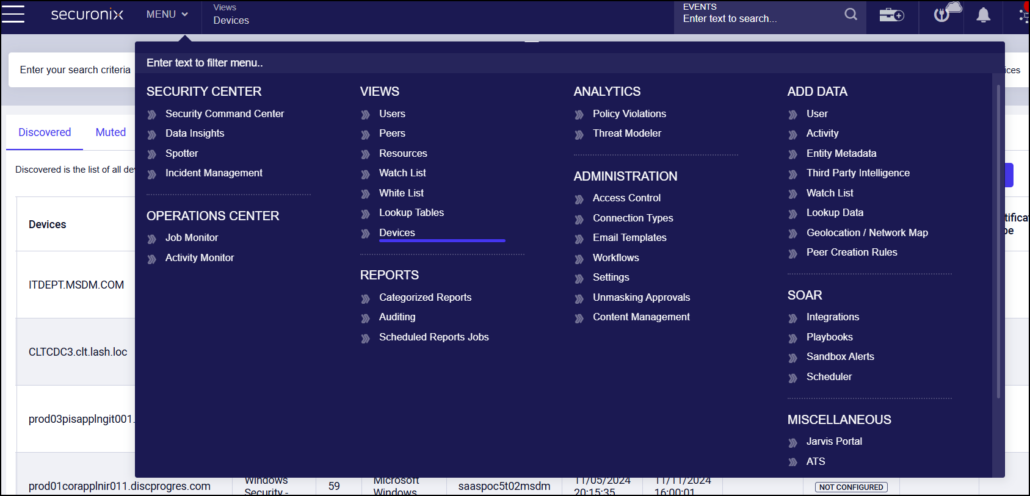
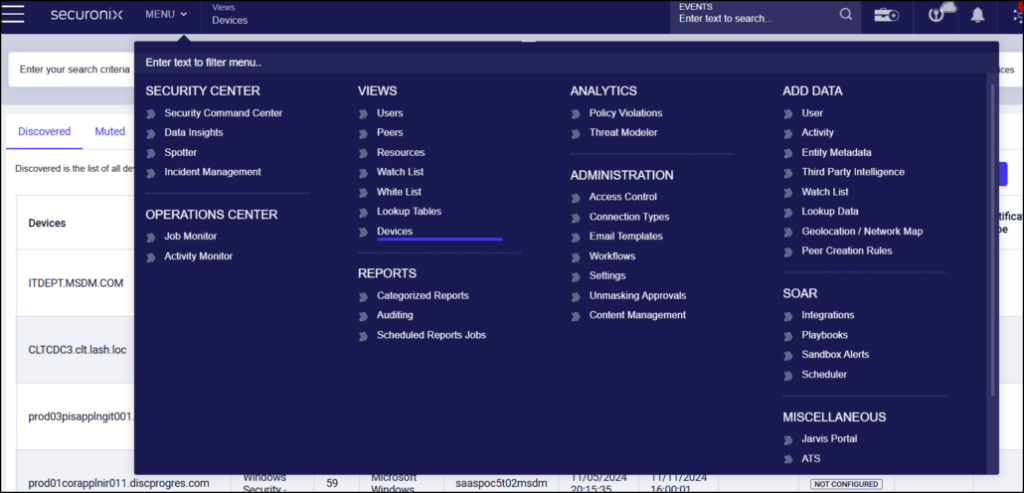
Securonix detects insider threats in hybrid cloud environments using behavior analytics combined with its next-gen SIEM. It monitors user access and activity around critical assets using out-of-the-box analytics content and machine learning algorithms, and groups insider attacks that span multiple alerts. The company has also introduced behavioral analytics that cover both UEBA and AI entity behavior for abnormal human and AI activity.
Securonix builds an identity and risk profile for every user and entity, tracking users across multiple accounts and networks to trace lateral movement. It includes built-in incident response orchestration and a threat hunting capability that searches both historical and streaming data.
Key features include:
- Advanced behavior analytics: Monitors access and activity around critical assets with prebuilt analytics content and machine learning to detect deviations from normal baselines.
- Privileged access monitoring: Tracks users with privileged access to critical databases, servers, and applications to identify compromised or abused credentials.
- Cross-account identity profiles: Links multiple accounts to a single user or entity to trace lateral movement and focus on high-risk users.
- Peer group analysis: Compares a user’s actions against peers to flag outliers, with watch lists for ongoing monitoring of high-risk users.
- Incident response orchestration: Provides built-in orchestration and automation to investigate and remediate insider threats without switching tools.
- Real-time threat hunting: SearchMore supports hunting on historical data without affecting SIEM performance, and on streaming data before parsing.
| Criterion | Solution Fit | Key Considerations |
| Behavioral analytics depth | Baselines and peer group comparisons with prebuilt analytics content | Building and tuning detections for targeted or low-and-slow attacks often requires specialists |
| Data source coverage and correlation | Cross-account correlation for users and entities across hybrid cloud environments | Reviewers cite limited data connectors and reliance on vendor help for parsers |
| Risk scoring and prioritization | Identity and risk profile per user and entity, with watch lists | False-positive management still requires skilled tuning |
| Investigation and response automation | Built-in response orchestration and real-time threat hunting | Some reviewers describe case management as non-intuitive |
| Coverage of non-human identities and AI agents | Announced behavioral analytics for abnormal human and AI activity | AI entity coverage details are limited on the insider threat page |
| Deployment flexibility | Next-gen SIEM operating across hybrid cloud environments | Reviewers report complex deployment; specific deployment models are not detailed on the product page |
Source: Securonix
3. Splunk Enterprise Security

Best for: Existing Splunk customers adding UEBA to their SIEM workflows
Strengths: Entity risk scoring and multi-entity correlation in Splunk ES
Things to consider: UEBA requires the ES Premier edition; cost rises with data volume
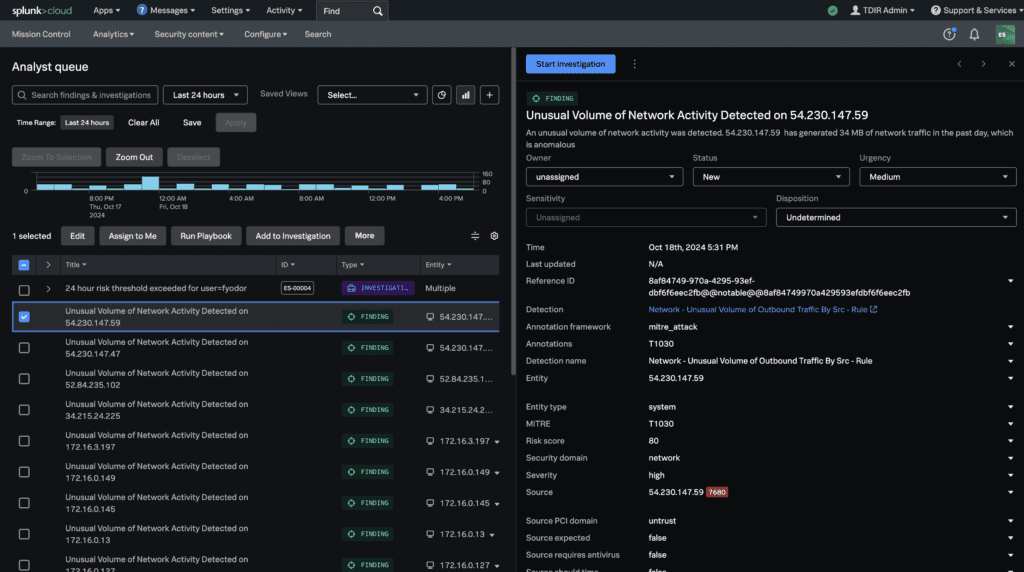
Splunk Enterprise Security (ES) includes user and entity behavior analytics as a native capability, replacing the standalone Splunk User Behavior Analytics product, which reached end of sale in December 2025. UEBA uses machine learning to baseline users and entities and detect deviations that indicate account misuse, compromised credentials, lateral movement, and data exfiltration.
Behavioral signals are aggregated into an entity risk score and combined with SIEM correlation rules inside ES detection, investigation, and response workflows. UEBA is included only in the ES Premier edition and is not sold standalone or as an add-on to ES Essentials.
Key features include:
- Behavioral analytics and machine learning: Continuously learns normal user and entity behavior to detect deviations that rule-based tools miss.
- Entity risk scoring and aggregation: Combines risk signals from multiple sources into a single risk score per user or entity.
- Multi-entity correlation: Correlates behavior across users, devices, endpoints, and cloud applications to detect patterns such as lateral movement and privilege abuse.
- Contextual risk insights: Enriches alerts with metadata, peer group comparisons, and historical context, with threat timelines and risk heat maps.
- Automated detection and prioritization: Uses multiple machine learning models to detect threats and rank events by risk level.
- Native ES integration: Combines UEBA findings with SIEM correlation rules and centralized incident views inside Splunk ES.
| Criterion | Solution Fit | Key Considerations |
| Behavioral analytics depth | Machine learning baselines for users and entities with peer group comparisons | Detection availability differs between ES Premier for Cloud and on-premises |
| Data source coverage and correlation | Correlates users, devices, endpoints, and cloud applications using Splunk data | Data ingestion costs can grow with volume, as many reviewers note |
| Risk scoring and prioritization | Aggregated entity risk score with automated prioritization | Getting value from custom searches requires familiarity with SPL |
| Investigation and response automation | Threat timelines and end-to-end investigation within ES, alongside SOAR and agentic AI | Reviewers describe some features as resource intensive |
| Coverage of non-human identities and AI agents | Covers devices and applications as entities | Monitoring of AI agents is not addressed on the UEBA product page |
| Deployment flexibility | Available in ES Premier for cloud and on-premises | Not available standalone or with ES Essentials; standalone UBA customers must migrate before end of support |
Source: Splunk
Dedicated Insider Risk Management Platforms
4. Proofpoint Insider Threat Management

Best for: Teams needing endpoint activity evidence and data movement controls
Strengths: Sentiment analysis, forensic screenshots, adaptive blocking
Things to consider: Endpoint agent licensing and reported performance overhead
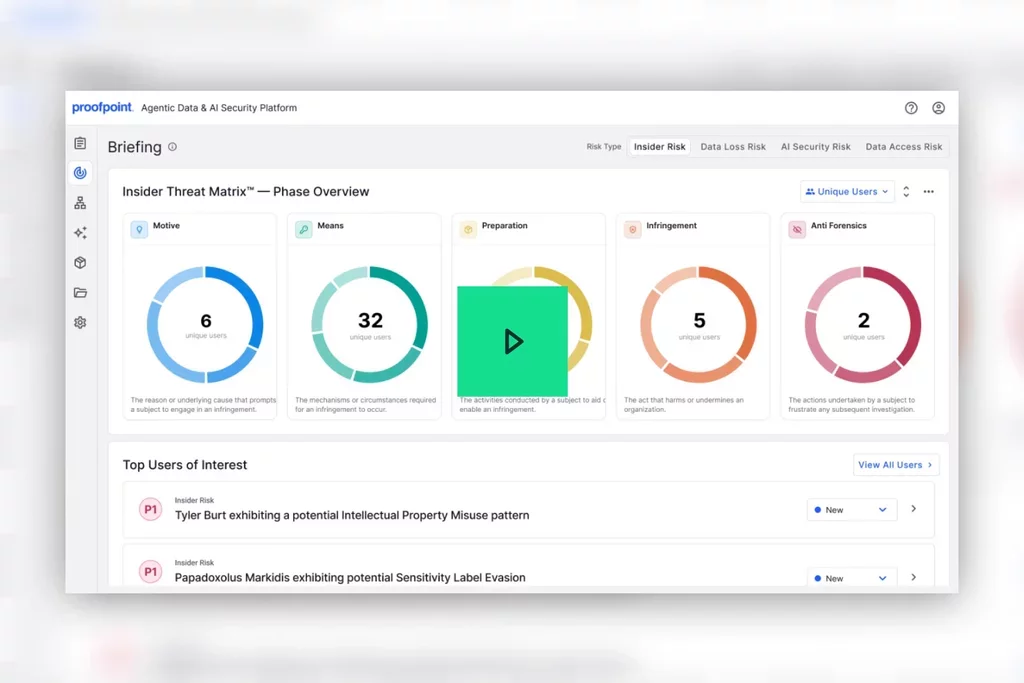
Proofpoint Insider Threat Management (ITM) monitors user activity and behavior across endpoints, browsers, cloud, email, chat, web, and AI tools. It identifies high-risk users by combining behavioral insights, user activity, data movement, and human risk signals, and raises monitoring levels when users take risky actions.
ITM collects forensic evidence, including screenshots, and presents activity before, during, and after an incident in a timeline-based investigation workflow. It can block risky data transfers in real time and integrates with SIEM and SOAR workflows through APIs and webhooks.
Key features include:
- User activity monitoring: Shows user behavior and activity in real time across endpoints, browsers, cloud, and email.
- Sentiment analysis: Analyzes workplace communications to identify early motive and risk signals.
- Prebuilt risk detections: Includes out-of-the-box alert libraries, insider threat scenarios, and customizable detection rules.
- Adaptive risk monitoring: Elevates monitoring automatically when users take risky actions, combining behavior, identity, data, and motive.
- Forensic evidence and sharing: Captures screenshots and activity context and shares investigation evidence with HR, legal, and compliance teams.
- Real-time data protection: Blocks risky transfers to USB devices, cloud sync apps, web uploads, and GenAI tools, with in-the-moment user coaching.
- Privacy controls: Applies anonymization, data masking, and role-based access controls to protect user privacy during investigations.
| Criterion | Solution Fit | Key Considerations |
| Behavioral analytics depth | Behavioral insights combined with sentiment analysis and prebuilt scenarios | Detection relies heavily on rule libraries alongside behavioral signals |
| Data source coverage and correlation | Activity from endpoints, browsers, cloud, email, chat, web, and AI tools | Endpoint coverage depends on deploying and licensing the agent per device |
| Risk scoring and prioritization | Prioritizes users by combining behavior, identity, data, and motive | Scaling and performance tuning in large environments can require additional effort |
| Investigation and response automation | Timeline investigations, screenshots, evidence sharing, and SIEM/SOAR integration via APIs and webhooks | Some reviewers report endpoint performance lag and want more detailed reporting |
| Coverage of non-human identities and AI agents | Monitors user activity in GenAI tools | AI agent security is offered as separate Proofpoint products |
| Deployment flexibility | Not addressed on the product page | Confirm SaaS and on-premises options during evaluation |

Source: Proofpoint
5. DTEX Platform
Best for: Insider risk programs needing intent-focused endpoint telemetry
Strengths: 500+ metadata elements, intent-based risk models, AI agents
Things to consider: Relies on endpoint forwarders; custom enterprise pricing
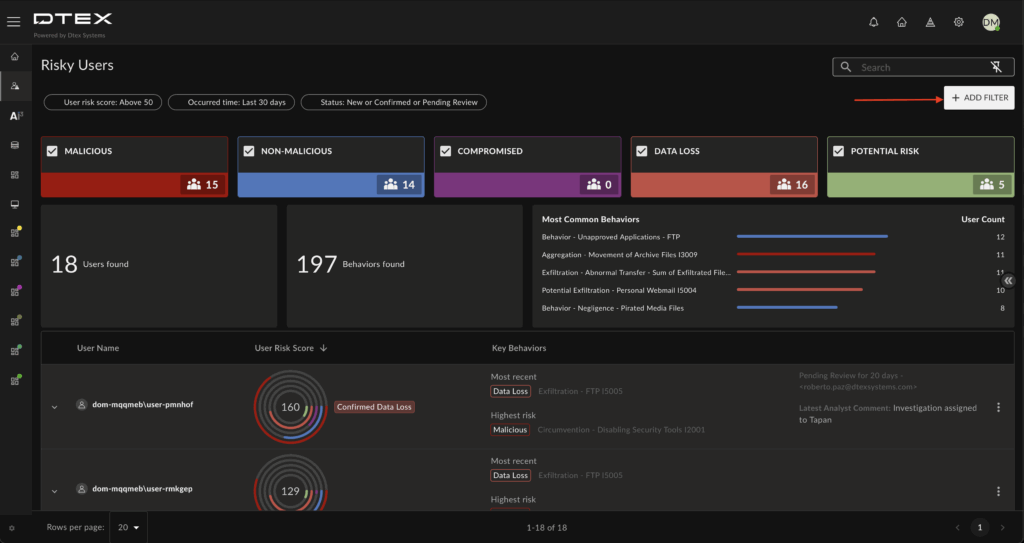
The DTEX Platform detects human, data, and AI threats using behavioral intelligence built on endpoint telemetry. Lightweight forwarders collect activity around the clock, on and off the network, capturing more than 500 metadata elements across 12 human-driven behavioral domains.
DTEX risk models map behavior patterns to intent categories such as malicious, non-malicious, compromised, AI activity, and data loss, and stack related alerts into a single risk view. The platform also includes AI agents for triage, threat hunting, and investigation assistance, plus pseudonymization to remove personal identifiers from activity data.
Key features include:
- High-fidelity telemetry: Collects more than 500 metadata elements from forwarders that generate 3-5 MB of data per user per day.
- Intent-based risk models: Distinguishes malicious, careless, and compromised behavior and aggregates behavior scores through alert stacking.
- Dynamic risk scores: Baselines behavior by role, department, and geography and differentiates human from AI activity.
- User timelines and data lineage: Reconstructs user activity into a chronological narrative and tracks the full history of every file in use, in motion, and at rest.
- DTEX Agentic Defenders: Triage Guardian evaluates alerts and gathers evidence, Threat Hunter runs proactive hunts, and Risk Assistant supports investigations.
- Privileged and server monitoring: Monitors CLI tools for cloud-native workloads, detects admin privilege misuse, and differentiates misconfigurations from sabotage.
- Pseudonymization: Removes personal identifiers from activity data to protect employee privacy.
| Criterion | Solution Fit | Key Considerations |
| Behavioral analytics depth | 12 behavioral domains with risk models mapped to intent | Model depth depends on endpoint telemetry rather than broad log sources |
| Data source coverage and correlation | Endpoint telemetry correlated across devices into one risk score; integrations listed for Splunk, Microsoft 365, and CrowdStrike | Visibility requires forwarders on monitored endpoints and servers |
| Risk scoring and prioritization | Dynamic risk scores baselined by role, department, and geography | Limited public review volume makes independent validation harder |
| Investigation and response automation | User timelines, data lineage, one-click reporting, and agentic triage and hunting | Agentic capabilities are newly introduced |
| Coverage of non-human identities and AI agents | Differentiates human and AI activity and monitors AI agents for uncontrolled data flows | Coverage of agents operating outside monitored endpoints is not detailed |
| Deployment flexibility | Forwarders deploy in minutes, with visibility within 24 hours | Pricing uses custom enterprise subscriptions; deployment model details are not on the platform page |

Source: DTEX
6. Microsoft Purview Insider Risk Management

Best for: Microsoft 365-centric organizations with E5 or Purview Suite
Strengths: Agentless M365 signals, policy templates, Adaptive Protection
Things to consider: Every user in policy scope must be licensed; M365-focused signals
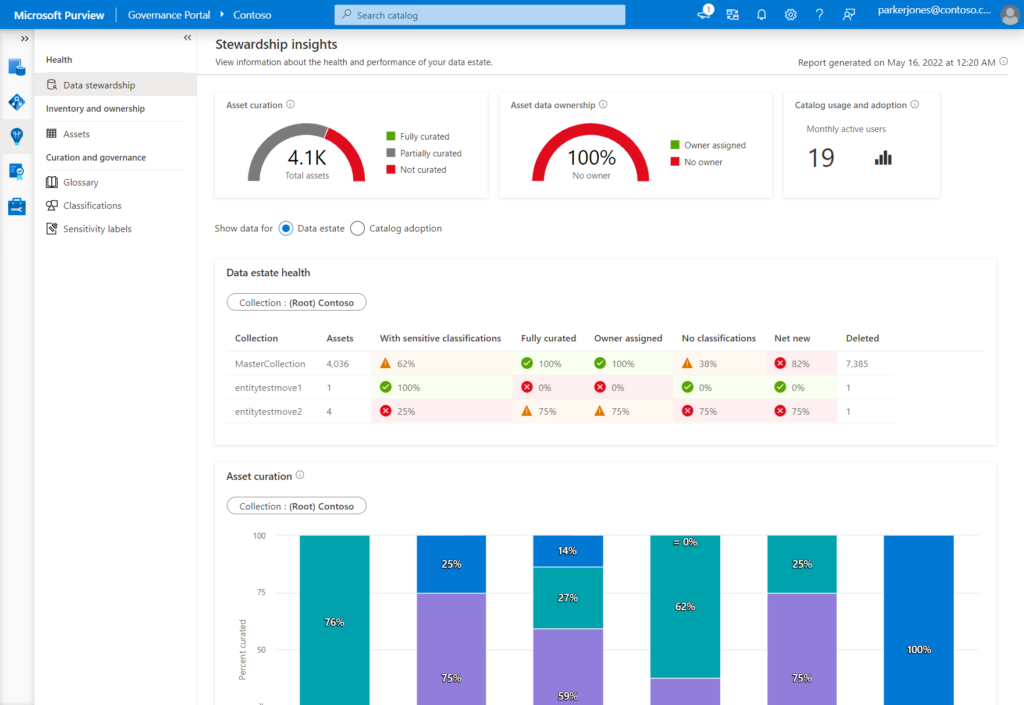
Microsoft Purview Insider Risk Management helps organizations identify, investigate, and remediate insider risks using signals from Microsoft 365. It can run an evaluation of potential insider risks before any policies are configured, and policies are created from customizable machine learning templates that require no scripting or endpoint agents.
The solution provides case management and integrated investigation workflows for security, HR, and legal teams, with pseudonymization to protect user privacy. Adaptive Protection lets Purview Data Loss Prevention adjust protection levels based on a user’s insider risk level.
Key features include:
- Risk evaluation without policies: Assesses potential insider risks in the organization before any insider risk policies are configured.
- Policy templates: Provides customizable machine learning templates to create policies without scripting or endpoint agents.
- Case management: Supports integrated investigation workflows across security, HR, and legal departments.
- Pseudonymization and controls: Masks user identities and applies access controls during investigations.
- Adaptive Protection: Adjusts Purview Data Loss Prevention controls dynamically based on user risk.
- Data security investigations: Launches pre-scoped investigations from an insider risk case to search documents, emails, Teams messages, and Copilot prompts and responses.
- Microsoft Security integration: Works with Microsoft Defender, Microsoft Sentinel, Microsoft Entra, and Security Copilot.
| Criterion | Solution Fit | Key Considerations |
| Behavioral analytics depth | Customizable machine learning policy templates | Default policies tend to generate noise and need refinement in the first weeks |
| Data source coverage and correlation | Native Microsoft 365 signals with a data risk graph linking data, users, and activity | Coverage is strongest in Microsoft environments; heterogeneous estates need additional connectors |
| Risk scoring and prioritization | User risk levels feed Adaptive Protection and DLP | Permission model and policy scoping take time to navigate |
| Investigation and response automation | Case management, data security investigations, and Security Copilot assistance | Response actions are centered on Microsoft tools |
| Coverage of non-human identities and AI agents | Extends Purview data security controls to Microsoft 365 Copilot and agents | Agent coverage focuses on the Microsoft ecosystem |
| Deployment flexibility | Agentless for Microsoft 365, included in the Purview Suite on top of Microsoft 365 E3 | Every user included in a policy must hold the required license, which can raise costs |
Source: Microsoft
7. Teramind

Best for: Organizations needing endpoint monitoring with session forensics
Strengths: Session replay, OCR search, real-time blocking, PII masking
Things to consider: Steep learning curve and endpoint resource consumption
Teramind combines endpoint-based insider threat monitoring with user and entity behavior analytics, covering both human employees and non-human identities such as agentic AI tools running on endpoints. It establishes behavioral baselines for users, peer groups, and system entities, and assigns machine learning risk scores to incidents.
The platform enforces policies in real time, blocking actions such as unauthorized uploads, USB transfers, printing, and use of unauthorized AI tools. For investigations, it provides session replays, OCR keyword indexing, and activity timelines, with role-based access control and masking for PII and PHI.
Key features include:
- Human and AI identity monitoring: Tracks actions taken by employees as well as non-human identities and agentic AI tools executing tasks on the endpoint.
- Behavioral baselines: Builds baselines for users, peer groups, and system entities to flag suspicious deviations.
- Machine learning risk scoring: Assigns dynamic risk scores to incidents so teams can prioritize urgent threats.
- Real-time policy enforcement: Blocks uploads to unauthorized cloud storage, USB transfers, printing, screen capture, and exfiltration via personal email or AI tools.
- Defensible forensics: Provides session replays, OCR keyword indexing, and detailed activity timelines.
- Sabotage and fraud detection: Flags unauthorized configuration and registry changes, code deletion, and anomalous financial transactions.
- Privacy governance: Applies role-based access controls and data masking for PII and PHI, aligned with GDPR, HIPAA, and SOC 2.
| Criterion | Solution Fit | Key Considerations |
| Behavioral analytics depth | Baselines users, peer groups, and system entities | Coverage is endpoint-agent centric rather than identity or SaaS log based |
| Data source coverage and correlation | Endpoint activity including files, apps, email, printing, and screen capture; SIEM, EDR, ITSM, and ticketing integrations | Signal quality depends on complete agent deployment and OS support |
| Risk scoring and prioritization | Machine learning risk scores for incidents | Reviewers report a steep learning curve for configuring rules and alerts |
| Investigation and response automation | Session replay, OCR search, timelines, and real-time blocking | Complex multi-tool response depends on external orchestration |
| Coverage of non-human identities and AI agents | Monitors non-human identities and agentic AI tools on the endpoint | Agents running outside monitored endpoints are not covered |
| Deployment flexibility | Not addressed on the product page | Reviewers cite endpoint resource consumption and complex initial setup; confirm cloud and on-premises options during evaluation |

Source: Teramind
Conclusion
Effective insider threat monitoring requires visibility into user and entity behavior across endpoints, identities, applications, and cloud services. Organizations should prioritize platforms that combine behavioral analytics, cross-source event correlation, contextual risk scoring, and investigation workflows to detect malicious activity, accidental data exposure, and compromised accounts. Evaluation should also consider coverage of non-human identities and AI agents, integration with existing security tools, and deployment requirements. Employee privacy controls, including data minimization, pseudonymization, and role-based access, are equally important. The right platform should help security teams identify meaningful risks, investigate incidents efficiently, and prevent sensitive data loss without creating excessive alerts or unnecessary employee surveillance.
Learn More About Exabeam
Learn about the Exabeam platform and expand your knowledge of information security with our collection of white papers, podcasts, webinars, and more.
-
Webinar
The Insider Risk Program Just Got Bigger: How Digital Workers Are Changing Identity, Behavior, Ownership, and...
-
 Blog
What Is the Difference Between Exabeam and CrowdStrike for SIEM and Security Operations?
- Show More