


Best AI Platforms for Security Analysts: Top 8 Solutions in 2026
- 22 minutes to read
Table of Contents
TL;DR: AI support platforms for security analysts use machine learning, LLMs, and AI agents to triage alerts, investigate incidents, and answer questions about security data. Exabeam Nova is best for SIEM and UEBA-driven SOCs, Microsoft Security Copilot suits Microsoft environments, CrowdStrike Charlotte AI suits Falcon users, and Prophet AI suits teams adding an AI analyst to existing tools.
What Are AI Platforms for Security Analysts?
AI support platforms for security analysts act as central command hubs that automate threat detection, triage, and response using agentic artificial intelligence. They help analysts process large volumes of alerts, logs, threat intelligence, and endpoint data faster than manual investigation alone.
These platforms can summarize incidents, correlate events across systems, identify suspicious patterns, enrich alerts with external context, and suggest investigation or remediation steps. Some also let analysts query security data in natural language, generate detection rules, or automate repetitive triage tasks.
Core capabilities include:
- Agentic orchestration and autonomous security workflows: Coordinates specialized AI agents to investigate threats, collect evidence, and execute approved security actions across connected tools.
- Shadow AI and agent discovery: Identifies unmanaged AI agents, their identities, connected tools, MCP servers, permissions, and access to enterprise resources.
- Unified telemetry across human, machine, and AI agent identities: Correlates activity across users, service accounts, workloads, and AI agents to reconstruct actions and identify suspicious behavior.
- Autonomous alert triage and evidence-based investigation: Investigates alerts, retrieves supporting telemetry, evaluates potential threats, and recommends escalation or closure.
- Multi-agent threat hunting and attack path investigation: Uses specialized agents to develop threat hypotheses, search security data, and identify potential attack paths across connected systems.
- AI-driven detection engineering and validation: Identifies detection coverage gaps, generates new security rules, and tests their effectiveness before deployment.
- Agent identity monitoring and runtime threat protection: Monitors AI agent permissions and actions to detect prompt injection, unauthorized tool execution, and abnormal data access.
- AI-powered vulnerability discovery and exploitability analysis: Analyzes code and application behavior to identify vulnerabilities, assess exploitability, and recommend remediation.
- Contextual attack surface and exposure analysis: Correlates vulnerabilities, asset criticality, identity permissions, and reachable attack paths to prioritize security risks.
- Adaptive incident response and automated containment: Selects and coordinates approved response actions, such as revoking credentials or isolating endpoints, with human approval for high-impact operations.
This is part of a series of articles about AI cyber security
AI Support Platforms for Security Analysts at a Glance
The table below summarizes the key differences between the platforms covered in this article. We explore each platform in more detail in the sections that follow.
| Category | Solution | Best For | Key Strengths | Things to Consider |
| Security operations platforms with built-in AI analysts | Exabeam Nova | SOC teams using SIEM and UEBA workflows | Multi-agent triage, NL search, rule creation, MITRE gap mapping | Runs on the cloud-native New-Scale platform |
| Security operations platforms with built-in AI analysts | Microsoft Security Copilot | Microsoft Defender, Sentinel, and Entra users | Embedded agents across Microsoft security products | Usage metered in Security Compute Units |
| Security operations platforms with built-in AI analysts | CrowdStrike Charlotte AI | Falcon customers | Multi-agent investigations, no-code agent builder | Built on Falcon; credit-based usage |
| Security operations platforms with built-in AI analysts | SentinelOne Purple AI | Singularity users | NL hunting over OCSF-normalized data | Response runs through Hyperautomation |
| Standalone AI SOC analyst platforms | Prophet AI | Adding autonomous investigation to an existing stack | Investigation, hunting, and detection engineering agents | Relies on telemetry from existing tools |
| Standalone AI SOC analyst platforms | Dropzone AI | SOCs and MSSPs automating Tier 1 investigation | API-based investigation across 90+ tools | Threat intel agent not yet available |
| Standalone AI SOC analyst platforms | Torq AI SOC Platform | Combining agentic triage with automation | Auto triage, case management, 300 integrations | Requires workflow design effort |
| Standalone AI SOC analyst platforms | Intezer AI SOC | Offloading Tier 1 and Tier 2 investigation | Forensic analysis including memory scanning | Focused on triage, not SIEM functions |
Why Do Security Analysts Need AI Support?
Rapid Growth of AI-Generated Code and Software Vulnerabilities
AI coding assistants and autonomous development agents allow organizations to generate, modify, and deploy software much faster than traditional development workflows. However, increased development speed does not guarantee secure code. AI-generated applications may introduce insecure authentication logic, injection vulnerabilities, exposed credentials, unsafe dependencies, and other security weaknesses.
In its 2025 GenAI Code Security Report, Veracode found that 45% of evaluated AI-generated code samples failed security tests. As organizations adopt autonomous coding agents that can modify entire repositories, security teams must review a growing volume of changes while ensuring that vulnerabilities are identified before deployment.
AI-powered security analysis helps address this challenge by reviewing code, examining dependencies, identifying vulnerable execution paths, and proposing remediation. It also allows security teams to investigate weaknesses introduced by AI coding agents without manually reviewing every generated change.
Proliferation of AI Agents and Non-Human Identities
Organizations are deploying AI agents across software development, IT operations, customer support, finance, and other business functions. These agents frequently use service accounts, API tokens, workload identities, and delegated user permissions to access enterprise resources and perform tasks autonomously.
Unlike traditional applications, agents can dynamically select tools, initiate actions, and interact with other agents. Their permissions and behavior may change as workflows evolve, creating security risks that are difficult to capture through periodic access reviews. Unmanaged agents can also introduce new attack paths involving excessive privileges, credential exposure, and unauthorized data access.
Security analysts therefore need visibility into both human and non-human identities, including the relationships between agents, credentials, tools, and resources. AI-assisted investigation can help identify suspicious agent behavior, evaluate permission misuse, and determine the potential impact of a compromised identity.
AI-Driven Cyberattacks and Frontier Models Such as Claude Mythos
Frontier AI models are demonstrating cybersecurity capabilities that extend beyond generating phishing messages or writing simple malicious scripts. Advanced reasoning models can analyze complex codebases, discover previously unknown vulnerabilities, reproduce security flaws, and support multi-step exploit development.
Anthropic’s Claude Mythos Preview, introduced through Project Glasswing in April 2026, demonstrated this shift. By May 2026, Anthropic and its partners reported finding more than 10,000 high- or critical-severity vulnerabilities using the model. The subsequent expansion of Mythos capabilities illustrated how frontier models could significantly increase the speed and scale of vulnerability discovery.
Although Mythos has been deployed through controlled defensive access programs, similar capabilities could be misused by attackers as they become more widely available. Security analysts must prepare for adversaries that can automate technical research, identify exploitable weaknesses, and adapt their operations more rapidly. AI-powered defense helps analysts investigate and prioritize threats at a pace that is increasingly difficult to sustain manually.
Attacks That Operate at Machine Speed
Traditional security operations assume that analysts have time to review alerts, investigate evidence, and approve defensive actions before an attacker completes their objective. AI-assisted offensive operations challenge this assumption by reducing the time required to perform reconnaissance, analyze vulnerabilities, and execute sequences of malicious actions.
Attackers can use AI tools to automate parts of their workflows, evaluate unsuccessful attempts, and adapt subsequent actions. When combined with existing attack automation, this can shorten the interval between initial compromise, privilege escalation, lateral movement, and attempted data theft.
AI security agents help reduce the gap between detection and response by continuously investigating suspicious activity and initiating predefined containment workflows. High-impact response actions can remain subject to human approval, while low-risk investigative tasks and approved actions execute automatically.
Fragmented Security Visibility Across Human, Machine, and Agent Activity
Security teams increasingly investigate environments containing human users, traditional applications, service accounts, cloud workloads, and autonomous AI agents. These entities interact across endpoints, SaaS applications, cloud services, and internal infrastructure, but their activities are often recorded in separate monitoring systems.
For example, an investigation into suspicious data access may require correlating a human user’s authentication, an agent’s delegated permissions, an MCP tool invocation, and an API request made by a backend service. Analyzing these events separately can obscure the complete sequence of actions.
AI-powered security platforms can combine telemetry and entity relationships to reconstruct activity across these systems. This provides analysts with a more complete understanding of which identity initiated an action, which agent or service performed it, and which resources were affected.
How Agentic AI Is Transforming the Role of Security Analysts
From Manual Alert Triage to Supervising Autonomous Investigations
Traditionally, Tier 1 security analysts spend much of their time reviewing incoming alerts, gathering context, and deciding whether incidents require escalation. Agentic AI changes this workflow by autonomously retrieving evidence, investigating suspicious activity, and producing findings that analysts can validate.
For example, an investigation agent can examine an identity alert, retrieve endpoint and cloud activity, compare the evidence against threat intelligence, and determine whether additional investigation is necessary. Rather than directing each step, analysts can review the completed investigation and focus on cases involving uncertainty, conflicting evidence, or significant business risk.
The analyst’s role increasingly involves evaluating investigation quality, identifying incorrect conclusions, and deciding when an AI agent should escalate an incident. This requires understanding both attacker behavior and the limitations of autonomous security systems.
Related content: Read our guide to the AI-powered SOC
From Individual Investigations to Orchestrating Teams of AI Agents
Agentic security platforms can coordinate multiple specialized AI agents to investigate different aspects of an incident. Instead of requiring one analyst to operate several security tools manually, an orchestration agent can divide the investigation into tasks and delegate them to agents specializing in endpoint analysis, identity security, threat intelligence, or cloud environments.
For example, an analyst investigating suspicious cloud activity might direct an orchestrator to determine the attack’s scope. The orchestrator can assign identity analysis to one agent, endpoint investigation to another, and threat intelligence enrichment to a third. It can then combine their findings and initiate additional investigations when evidence is incomplete.
This changes the analyst’s role from executing each investigation task to defining objectives, overseeing agent collaboration, and evaluating combined findings. Analysts also need to recognize when automated workflows are producing unreliable results or overlooking important evidence.
From Reactive Alert Handling to Proactive Threat Hunting
Traditional SOC workflows often prioritize responding to existing alerts, leaving limited time for proactive threat hunting. Agentic AI can handle portions of routine triage and investigation, allowing analysts to focus on detecting threats that have not triggered conventional security controls.
Threat hunting agents can generate investigation hypotheses, execute searches, analyze findings, and refine their approach based on new evidence. Analysts can use these capabilities to investigate emerging attacker techniques, suspicious identity relationships, and potential attack paths across cloud and on-premises environments.
Human expertise remains essential for developing meaningful hypotheses, understanding attacker objectives, and interpreting ambiguous results. Instead of spending most of their time constructing individual queries, threat hunters increasingly direct exploratory investigations and determine which findings justify further action.
From Responding to Incidents to Improving Detection and Prevention
Agentic AI enables security teams to move beyond investigating individual incidents toward identifying weaknesses that allow similar attacks to occur. Specialized agents can examine previous incidents, evaluate detection coverage, and identify opportunities to improve monitoring and defensive controls.
For example, after investigating credential theft, AI agents might identify related authentication weaknesses, recommend additional detection rules, or highlight overly permissive access policies. Detection engineering agents can help create new rules, test them against relevant telemetry, and evaluate their effectiveness before deployment.
Security analysts and detection engineers become responsible for defining reliable security signals, reviewing proposed improvements, and establishing confidence thresholds. Their work increasingly focuses on improving the security system itself rather than repeatedly investigating similar incidents.
From Executing Response Playbooks to Governing Autonomous Containment
Traditional incident response often requires analysts to choose and execute predefined playbooks after investigating an alert. Agentic AI can automate parts of this process by selecting appropriate response workflows based on available evidence and coordinating actions across connected security systems.
An autonomous agent might identify compromised credentials, investigate related endpoint activity, and initiate approved containment measures such as revoking sessions or isolating a device. More sensitive operations, including disabling critical infrastructure access or modifying production security policies, can require explicit analyst approval.
This creates new responsibilities for security analysts, who must define operational boundaries, review high-impact actions, and evaluate whether automated responses were appropriate. Human oversight remains particularly important when containment could interrupt legitimate business activity or when the AI’s findings are uncertain.
From Managing Alert Queues to Optimizing AI Security Operations
As autonomous agents assume responsibility for more routine investigations, measuring SOC effectiveness solely through alert counts and manually closed tickets becomes less useful. Security teams must also evaluate how accurately agents investigate threats, whether their conclusions are supported by evidence, and how their actions affect security outcomes.
Analysts can review agent performance, identify recurring investigation failures, adjust escalation criteria, and improve access to reliable security context. For example, an agent that repeatedly misclassifies administrative activity may require better environmental information, updated instructions, or revised confidence thresholds.
This introduces responsibilities around AI evaluation and continuous improvement. Security teams increasingly need to monitor investigation accuracy, autonomous action success rates, missed detections, and time to containment while ensuring that AI-generated decisions remain auditable and correctable.
Core Capabilities of AI Support Platforms for Security Analysts
Agentic Orchestration and Autonomous Security Workflows
Agentic orchestration allows AI systems to plan and execute multi-step security workflows using reasoning models and connected security tools. Unlike traditional SOAR platforms that primarily execute predefined playbooks, agentic systems can dynamically select investigation steps, retrieve evidence, and adjust their actions based on newly discovered information.
Advanced platforms can coordinate specialized agents responsible for threat intelligence, identity investigation, endpoint analysis, and incident response. These agents can share context and contribute to a coordinated investigation rather than operating independently. Depending on their configured autonomy levels, they can also initiate containment actions, such as disabling compromised accounts or isolating affected endpoints, while requiring human approval for sensitive operations.
Shadow AI and Agent Discovery
Shadow agent discovery identifies AI agents operating outside established security inventories and governance processes. These may include employee-installed desktop agents, autonomous coding assistants, SaaS agents, and agents deployed through cloud AI development platforms.
Discovery capabilities can identify where agents are running, which identities they use, which tools and MCP servers they connect to, and which enterprise resources they can access. Security teams can use this information to locate unsanctioned deployments, assess their permissions, determine ownership, and apply appropriate monitoring or restrictions. Discovery coverage varies by platform and integration.
Unified Telemetry Across Human, Machine, and AI Agent Identities
Unified telemetry brings together security information about human users, service accounts, applications, workloads, endpoints, and AI agents. Rather than analyzing each category in isolation, modern platforms can associate activity with identities, resources, permissions, and related actions across different systems.
For example, an investigation might connect a user’s request to an AI agent, the agent’s subsequent tool invocation, a service account’s API call, and a resulting database change. Combining these events helps analysts trace the complete activity chain and determine whether each action was authorized. Effective implementations preserve the originating evidence and identity relationships instead of relying on LLM-generated summaries alone.
Autonomous Alert Triage and Evidence-Based Investigation
Autonomous triage agents investigate security alerts by retrieving evidence, evaluating possible explanations, and producing findings with supporting context. Instead of simply assigning a severity score, these agents can use security tools to determine whether suspicious activity represents a real threat.
An agent might investigate an unusual login by examining account permissions, recent authentication history, endpoint processes, and related cloud activity. It can then classify the alert, explain its assessment, and recommend escalation or closure. Some platforms support automated handling of defined alert categories, while complex or uncertain incidents remain subject to analyst review.
Multi-Agent Threat Hunting and Attack Path Investigation
AI threat hunting agents proactively investigate suspicious activity that has not triggered existing security detections. They can develop hypotheses from threat intelligence, generate searches, examine results, and iteratively expand investigations when new evidence appears.
Multi-agent systems can investigate different aspects of a potential attack in parallel. For example, one agent may examine suspicious identity activity while another analyzes endpoint behavior and a third evaluates cloud exposure. Combining their findings helps analysts identify previously overlooked threats and understand how an attacker could move between connected systems.
AI-Driven Detection Engineering and Validation
AI-driven detection engineering uses reasoning models and specialized agents to identify gaps in existing security coverage and generate new detection logic. Agents can examine threat intelligence, attack techniques, historical incidents, and available telemetry to determine which behaviors are not adequately monitored.
Modern implementations can also create test events, validate proposed detection rules, and assess whether the rules produce useful results before deployment. This supports more continuous adaptation to emerging threats and reduces the manual effort required to create and maintain detections. Automated validation is particularly important because AI-generated rules may otherwise introduce false positives or fail to detect the intended behavior.
Agent Identity Monitoring and Runtime Threat Protection
Agent identity monitoring provides visibility into the actions and permissions of autonomous AI systems. Security platforms can associate agents with dedicated identities, delegated user permissions, credentials, connected tools, and the resources they are authorized to access.
Runtime protection can inspect agent activity for threats such as prompt injection, unauthorized tool execution, abnormal data access, and attempts to bypass security restrictions. Depending on the platform, controls may block suspicious actions, restrict access to sensitive resources, or generate alerts for investigation. This enables security teams to protect AI agents as active participants in the enterprise environment rather than treating them as ordinary background applications.
AI-Powered Vulnerability Discovery and Exploitability Analysis
Frontier reasoning models can analyze source code, application architecture, and execution paths to identify security vulnerabilities that may be difficult to detect through conventional pattern-based scanning. Advanced models can also investigate whether suspected vulnerabilities are exploitable by examining relevant conditions and, in authorized environments, attempting controlled reproduction.
Security platforms can use these capabilities to validate findings, investigate root causes, and recommend fixes. Research involving Anthropic’s Claude Mythos models demonstrates how frontier AI can discover vulnerabilities at a scale that changes traditional security review processes. However, model-generated findings and proposed remediations still require validation, and unrestricted offensive testing should not be part of routine production workflows.
Contextual Attack Surface and Exposure Analysis
AI-powered exposure analysis evaluates security weaknesses in the context of an organization’s assets, identities, permissions, and reachable attack paths. Rather than prioritizing findings solely by vulnerability severity, reasoning models can investigate how weaknesses interact and whether they create a practical route to sensitive resources.
For example, an agent may identify that a vulnerable cloud workload has access to an overprivileged service account that can reach a production database. It can then explain the relationships involved, assess the potential impact, and recommend remediation priorities. This connects security operations with cloud posture management, identity security, and vulnerability management.
Adaptive Incident Response and Automated Containment
Adaptive incident response allows AI systems to select and coordinate defensive actions according to the findings of an investigation. Traditional automation typically follows predetermined sequences, while agentic systems can reason about incident context and determine which approved response workflow is appropriate.
Possible actions include revoking compromised sessions, disabling credentials, isolating endpoints, creating firewall restrictions, and initiating remediation tickets. Advanced systems combine AI-driven decision-making with deterministic execution controls, permission boundaries, and approval requirements. This allows organizations to automate routine containment while retaining oversight of changes that could disrupt business operations.
Notable AI Support Platforms for Security Analysts
How we selected these platforms: We shortlisted AI support platforms for security analysts based on their ability to triage and prioritize alerts, investigate incidents across multiple data sources, answer natural language questions about security data, and recommend or execute response actions.
Security Operations Platforms with Built-In AI Analysts
1. Exabeam Nova

Best for: SOC teams using SIEM and UEBA workflows
Strengths: Exabeam Nova AI spanning triage, search, and rule creation
Things to consider: Runs within the Exabeam New-Scale Fusion platform
Nova AI is a platform-wide AI co-investigator built into Exabeam New-Scale Fusion. It works as a persistent sidebar that follows analysts across Threat Center, search timelines, and Outcomes Navigator. It automates background context collection and secondary searches during triage, investigation, and response.
Nova AI is made up of specialized capabilities for threat scoring, investigation, analyst assistance, search, visualization, advisory insights, and rule creation. The agents work on curated, normalized security data from New-Scale Fusion. Nova also works with Agent Behavior Analytics (ABA) to review activity from AI agents and other non-human identities.
Key features include:
- investigation capability: Creates case summaries, analyzes threats, and recommends next steps. It prioritizes events using background context, entity profiles, and interaction details to help analysts assess intent and contain threats.
- threat scoring capability: Applies machine learning and customizable business context to prioritize threats, reduce alert noise, and direct analysts to activity that needs immediate review.
- search capability: Powers Global Search across users, hosts, and logs. It accepts queries in multiple languages and translates them into Exabeam Query Language aligned with the Common Information Model.
- analyst assistant capability: Answers case-specific and general questions in context, surfacing relevant information without manual searches across documentation or data.
- rule creator capability: Generates correlation rules from natural language, refines existing detections, and converts third-party content into Exabeam-ready rules.
- advisory capability: Maps detection coverage to MITRE ATT&CK, OWASP, and compliance frameworks in Outcomes Navigator, highlighting coverage gaps for security leaders.
- visualization capability: Converts natural-language queries into charts and dashboards for tracking metrics and detection trends.
- AI agent activity review: When ABA flags anomalous AI agent activity, Nova AI adds context that helps analysts separate approved AI use from genuine threats.
- Data protection controls: Nova AI uses Google Gemini models within Google Cloud Platform, encrypts prompts and responses, processes data in-region when possible, and does not store, cache, or use customer data for model training.
Limitations (as reported by users on PeerSpot):
- Learning curve for new users: One reviewer noted that new users may need several hours to work through the product documentation.
- Update timing: One reviewer reported that applying new releases can take time.
- Pricing expectations: One reviewer found pricing somewhat higher than initially expected, while noting it was not cost prohibitive.

2. Microsoft Security Copilot

Best for: Teams using Microsoft Defender, Sentinel, Entra, and Purview
Strengths: Embedded agents for phishing, alert, and vulnerability triage
Things to consider: Capacity is billed in Security Compute Units (SCUs)
Microsoft Security Copilot is a generative AI security product that combines a specialized language model with security-specific skills informed by Microsoft threat intelligence. It is available as a standalone experience and embedded in Microsoft Defender, Entra, Intune, and Purview, where teams use it to detect, investigate, and respond to incidents.
Security Copilot agents automate high-volume tasks such as phishing triage, alert triage, and vulnerability remediation, and they adapt based on feedback. Capacity is provisioned through Security Compute Units. Security Copilot is also being rolled out to Microsoft 365 E5 and E7 customers with an included monthly SCU allocation.
Key features include:
- Embedded Microsoft agents: Ready-to-use agents inside Defender, Entra, Intune, and Purview handle tasks such as phishing triage, alert triage, and vulnerability remediation within the tools teams already use.
- Partner and custom agents: Teams can deploy agents built by Microsoft partners or build their own agents for specific workflows without writing code.
- Incident investigation and remediation: Summarizes complex alerts into actionable summaries and provides step-by-step response guidance for remediation.
- Query and script assistance: Translates natural-language requests into query-language scripts and helps analysts reverse-engineer malware scripts.
- Stakeholder reporting: Generates reports that summarize context, open issues, and protective measures, written for the tone and language of the intended audience.
- Promptbooks and embedded skills: Provides promptbooks and embedded skills that package common security tasks into repeatable workflows.
- Microsoft and third-party integrations: Uses data from Defender XDR, Sentinel, Intune, Entra, Purview, Defender for Cloud, Defender External Attack Surface Management, Azure WAF, and Azure Firewall, and extends to partner products through plugins.
Limitations (as reported by users on TrustRadius):
- Answer accuracy: One reviewer reported frequently incorrect answers and a need to redirect the assistant repeatedly during investigations.
- Cost and SCU visibility: Reviewers describe the product as costly for small businesses and report limited visibility into how agents and add-ons consume SCUs.
- Documentation pace: Users report that the product changes frequently and that documentation and user guides do not always keep up.
- Response speed: One reviewer noted that responses are often slower than expected.
- Microsoft-centric fit: Reviewers note that configuration requires knowledge of the Microsoft stack and that integrations are weaker for organizations built mainly on non-Microsoft security tools.

Source: Microsoft

3. CrowdStrike Charlotte AI

Best for: CrowdStrike Falcon customers adding agentic triage and response
Strengths: No-code custom agents and governed workflows via AgentWorks and SOAR
Things to consider: Response actions require configuration; prebuilt agents only advise
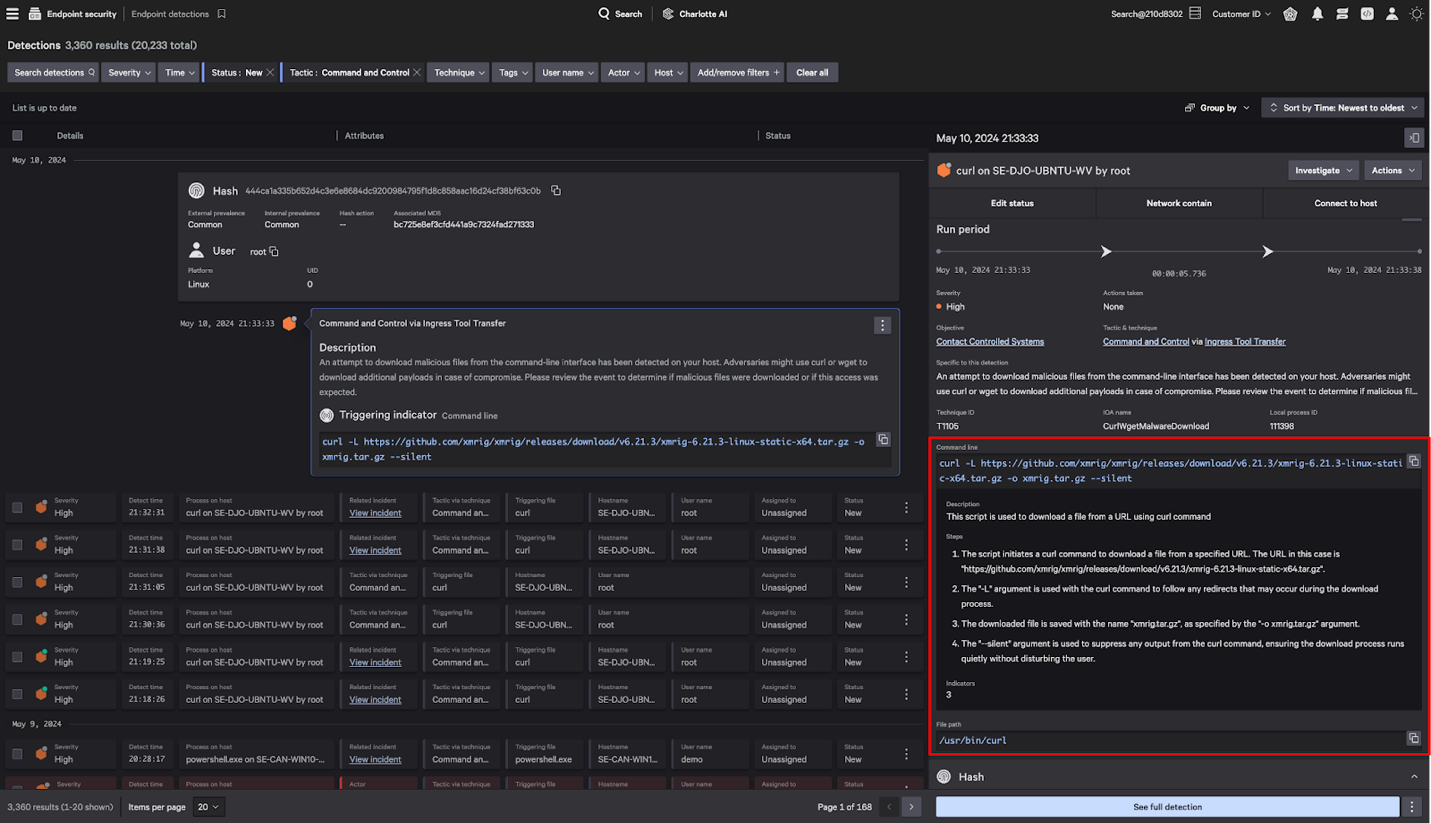
CrowdStrike Charlotte AI is an agentic AI security analyst built natively on the CrowdStrike Falcon platform. It uses a multi-agent architecture that assembles cross-domain context, dispatches specialized agents to investigate endpoint, identity, cloud, and network activity in parallel, and converges their findings into a single verdict.
Charlotte AI also includes prebuilt agents for tasks such as exposure prioritization, malware analysis, and query writing. Charlotte AI AgentWorks is used to build custom agents without code, and Charlotte Agentic SOAR orchestrates agents and workflows. By default, prebuilt agents only generate information and recommendations, and response actions must be configured and approved by the security team.
Key features include:
- Agentic detection triage: Charlotte AI Detection Triage evaluates first-party detections and returns a verdict, confidence score, recommendation, and explanation of its reasoning. Teams decide whether to escalate, close, or route detections based on their own criteria.
- Parallel cross-domain investigations: Specialized agents investigate endpoints, identities, cloud, and network surfaces simultaneously while sharing one memory of the environment.
- Prebuilt security agents: Out-of-the-box agents handle exposure prioritization, malware analysis, reconnaissance, command-line analysis, query writing, workflow generation, and threat intelligence analysis.
- Charlotte AI AgentWorks: Teams build custom agents in plain language on the model of their choice, defining instructions, knowledge files, authorized tools, outputs, and activation conditions.
- Charlotte Agentic SOAR: Combines agentic reasoning and deterministic workflows in one workspace, where teams define triggers, data, rules, agents, and actions, and connect to third-party tools and agents through bidirectional MCP.
- Governance controls: Provides role-based access controls, execution traces, audit logs, agent version history and rollback, credit caps, and configurable approval workflows, and respects each user’s existing permissions.
- Report generation options: Teams can generate incident reports and executive summaries through AgentWorks agents, the LLM-Completion action in the Falcon Fusion workflow editor, or promptbooks.
Limitations (as reported by users on PeerSpot):
- False positives: One reviewer would like to see the false positive rate decrease.
- Answer precision: Reviewers note that answers could be more precise when questions are asked, and one reviewer reported low confidence in some responses and recommendations.
- Stability: One reviewer reported downtime, crashes, and performance issues, while noting that their frequency has decreased over time.

Source: CrowdStrike
4. SentinelOne Purple AI

Best for: SentinelOne Singularity customers seeking agentic investigation
Strengths: Reasons over OCSF-normalized native and third-party data
Things to consider: Tied to the Singularity Platform; response runs via Hyperautomation
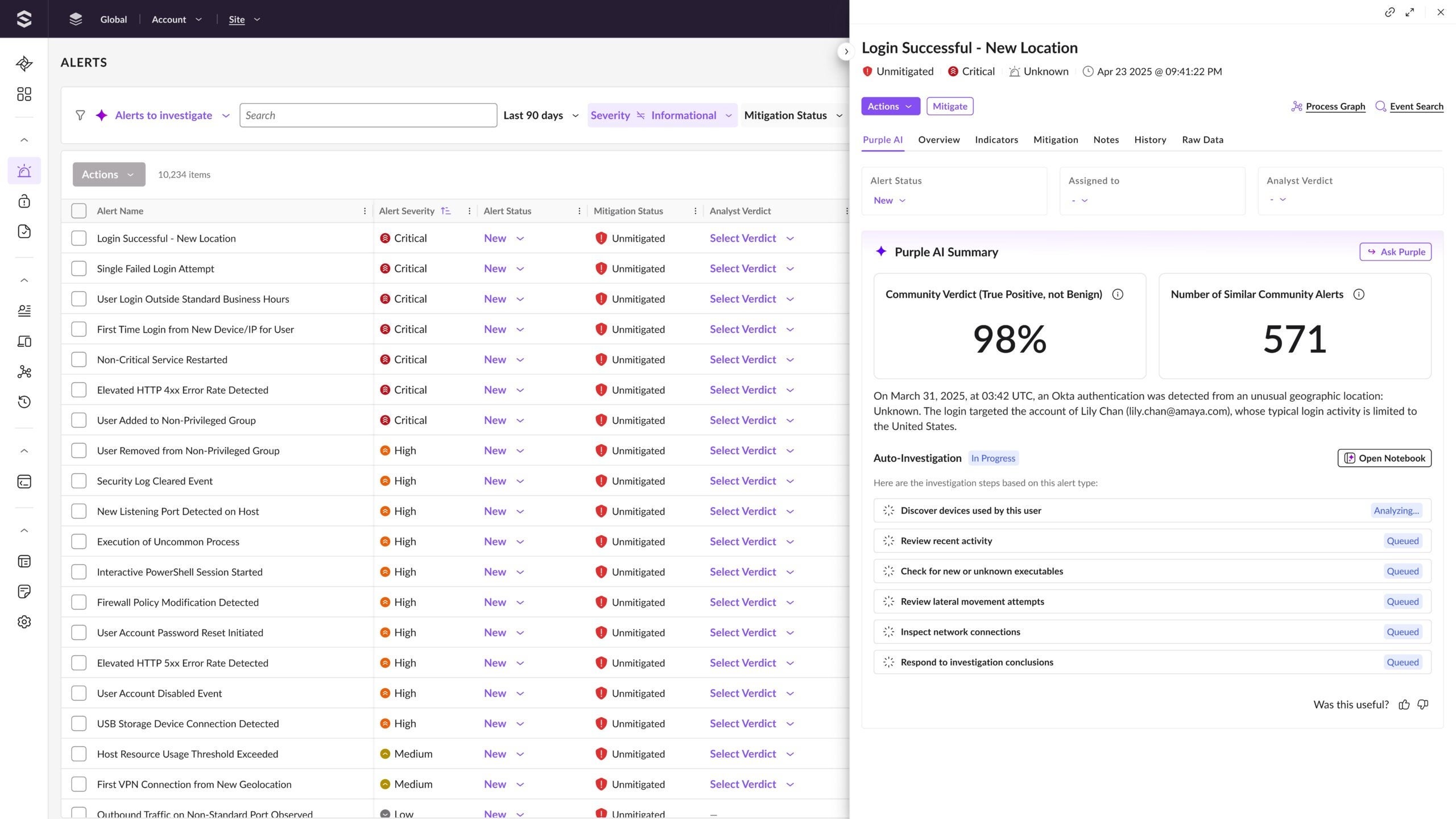
Purple AI is an agentic AI security analyst embedded in the SentinelOne Singularity Platform. It reasons over OCSF-normalized data from native SentinelOne telemetry and integrated third-party sources to guide investigations, explain risk, and recommend next actions inside detection and response workflows.
Its Agentic Investigation capability runs analysis from alert to verdict and surfaces the supporting evidence, while Singularity Hyperautomation executes response actions within pre-approved policies. Analysts can also query data in natural language, document their work in Investigation Notebooks, and use an MCP server to bring Purple AI data into their own AI agents.
Key features include:
- Agentic Investigation: Runs the analysis on an alert, surfaces evidence, and recommends next steps, with intelligent follow-ups that keep investigations moving.
- Natural-language questions and summaries: Analysts ask questions without writing queries and receive AI-generated summaries of the activity, its impact, and the recommended next step.
- Auto-Triage and Community Verdict: Auto-Triage prioritizes high-risk activity, Similarity Analysis pulls context from the SentinelOne community, and Community Verdict, trained on Wayfinder managed services investigations, indicates which alerts to prioritize.
- Investigation Notebooks: Document investigation work automatically to support consistency across analysts with different experience levels.
- Verdict Justification and policy-bound automation: Each AI decision includes an explainable Verdict Justification, and automated actions run only within pre-approved policies, with every action logged.
- Purple AI MCP Server: Extends security data and workflows from the platform into customers’ own AI agents.
- Deployment and data controls: Supports swappable foundation models and FedRAMP High environments, and customer data is not used to train models.
Limitations (as reported by users on PeerSpot):
- Pricing: Reviewers describe the product as expensive for smaller businesses and note that ingestion-based pricing becomes higher at scale.
- Question comprehension: Users report room for improvement in how Purple AI understands questions, and one reviewer noted that prompts must be phrased carefully.
- Responses for complex alerts: One reviewer found that responses are sometimes too generic for complex high or critical alerts.
- Interface performance: One reviewer reported slow loading and cases where alerts did not display until they logged out and back in.

Source: SentinelOne
Standalone AI SOC Analyst Platforms
5. Prophet AI

Best for: Teams that want every alert investigated across existing tools
Strengths: Auditable investigation steps and backtested, approval-gated actions
Things to consider: Few independent user reviews; autonomy is widened in stages
Prophet AI SOC Analyst is part of the Prophet Agentic AI SOC Platform, which also includes an AI Threat Hunter and an AI Detection Engineer. It runs a dynamically planned investigation on every alert at every severity as it arrives, summarizing the alert, extracting artifacts, and planning the questions an experienced analyst would ask.
It runs those questions across SIEM, EDR, identity, cloud, and email tools, documents each query and reasoning step, and reaches a determination. Prophet AI then groups related investigations into incidents, pushes evidence into case management tools, and can run scoped, permissioned remediation under rules the team defines.
Key features include:
- Planned investigations on every alert: Summarizes each alert, extracts artifacts, plans investigative questions, and runs them across connected tools. Alerts are investigated in parallel on arrival, so investigation time does not grow with alert volume.
- Auditable evidence: Documents every question asked, query run, and reasoning step so analysts can verify how a determination was reached.
- Incident grouping: Groups related investigations into a single incident so that a campaign appears as one case rather than many separate tickets.
- Scoped remediation: Supports permissioned actions, from notifications to quarantining a machine, that are previewed before they run and backtested against the organization’s history.
- Approval-based autonomy: Investigates autonomously from the start but only takes actions the team has approved, with the team deciding when to widen that scope.
- Plain-language guidance: Teams teach Prophet AI their playbooks, policies, and preferences at the organization, investigation, or single-step level. Each learned entry is visible, correctable, previewed, and backtested before it applies.
- Integrations and collaboration: Offers 200+ integrations with security tools, SIEMs, security data lakes, threat intelligence feeds, and case management tools, and delivers results in-product, in Slack or Teams, or through webhooks.
Limitations (based on publicly available sources):
- Limited independent reviews: Major review platforms list few or no user reviews for the product, which limits independent feedback for buyers.
- Dependence on telemetry and context: Third-party analysis notes that investigation accuracy depends on comprehensive telemetry and organizational context, so gaps in connected data can affect results.
- Staged autonomy: Response actions are limited to those the team explicitly approves, so autonomous remediation typically requires a staged rollout with human review first.

Source: Prophet

6. Dropzone AI

Best for: SOC teams and MSSPs automating Tier 1 alert investigations
Strengths: 90+ integrations queried via API with no data migration
Things to consider: Plans cap annual investigation volume per AI analyst
Dropzone AI provides AI SOC agents that investigate security alerts end to end across an organization’s existing tool stack. Its AI SOC Analyst collects alerts, queries connected tools through their APIs, reaches a conclusion such as benign or malicious, and presents the findings behind each verdict in plain language.
The platform also includes an AI Threat Hunter that runs hypothesis-driven hunts across SIEM, EDR, and cloud data, and an AI Threat Intel Analyst, listed for fall 2026, that turns new advisories into hunt packs. Teams set custom investigation strategies, outcome rules, and context memory, and confirmed threats can trigger auto-containment actions.
Key features include:
- End-to-end alert investigation: Investigates phishing, endpoint, network, cloud, identity, and insider threat alerts 24/7 through a collect, investigate, conclude, contain, and adapt sequence.
- Investigation audit trail: Records every question asked, tool queried, and finding generated, providing a full audit trail for compliance and governance.
- Context memory: Learns details about the environment, such as user permissions and expected activity, through analyst input and on its own to inform future investigations.
- Ad hoc investigation chatbot: A built-in AI chatbot lets analysts ask follow-up questions and run ad hoc investigations without switching tools.
- Auto-containment: When agents confirm a threat, containment actions such as blocking malicious IPs and disabling compromised accounts run automatically.
- AI Threat Hunter: Runs hypothesis-driven hunts across SIEM, EDR, and cloud environments on a recurring basis.
- Integrations without data migration: Connects to 90+ SIEM, EDR, cloud, identity, email, and SOAR tools via API, without data migration or log normalization.
Limitations (based on publicly available sources):
- Investigation capacity limits: Plans cap annual investigation volume per AI analyst, at up to 4,000 full investigations per year, with overage purchases required beyond that.
- Tuning period: A Gartner Peer Insights reviewer noted that fine-tuning takes time after deployment.
- Dependence on data quality: Third-party analysis notes that investigation quality depends on data quality and the customer environment, and that public independent reviews are relatively few.
- Roadmap capabilities: The AI Threat Intel Analyst is listed for fall 2026 rather than as a currently available agent.

Source: Dropzone AI

7. Torq AI SOC Platform

Best for: Teams combining AI SOC agents with no-code security automation
Strengths: Socrates orchestrates HyperAgents from triage through response
Things to consider: Pricing tiers can cap on-demand and scheduled workflows
The Torq AI SOC Platform combines agentic AI with Torq Hyperautomation to manage threats from triage through investigation and response. It ingests and normalizes telemetry from across the security stack, correlates and deduplicates events, and uses Universal Auto Triage to separate false positives from actual risk.
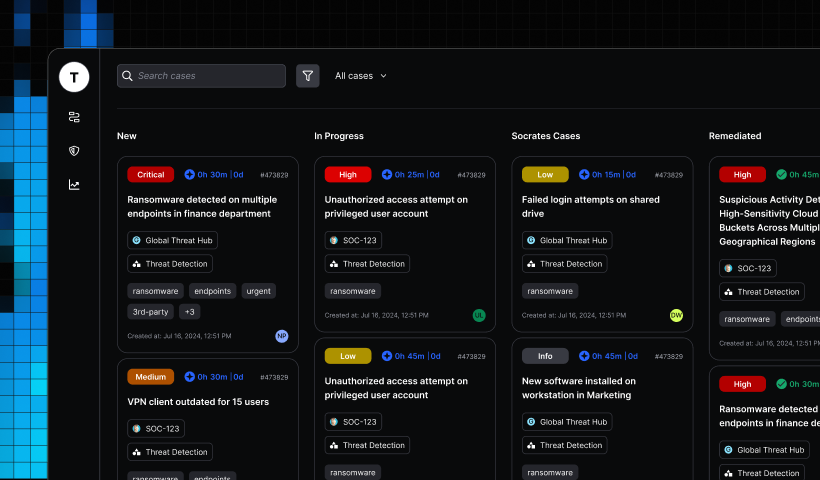
Socrates, the platform’s central interface and orchestrator, plans and coordinates specialized Torq HyperAgents that gather evidence, assemble timelines, and execute authorized containment and remediation. The Torq Context Graph provides agents with current organizational context and case history, and native case management keeps evidence, timelines, and summaries in one place.
Key features include:
- Universal Auto Triage: Prioritizes threats and separates noise from actual risk, learning and remembering how the organization’s SOC works.
- Socrates orchestration: Delegates work to specialized HyperAgents and lets analysts request case summaries, enrich IOCs, or query event data in natural language, while keeping an auditable record of the reasoning behind each agentic decision.
- Torq HyperAgents: A group of customizable AI agents that adapt to specific use cases and automate routine SecOps tasks under direction set by the security team.
- Agentic Builder: Analysts describe a need in natural language, and Socrates plans the approach, selects tools and integrations, defines guardrails, and builds HyperAgents or Hyperautomation workflows that can be tested with sample data.
- Autonomous response: Coordinates containment and remediation actions across the security stack once an investigation completes.
- Context Graph: Gives Socrates and HyperAgents continuous access to up-to-date organizational context and case history.
- Integrations and prebuilt steps: Provides 300 prebuilt integrations and 4,000+ prebuilt workflow steps, and AI agents can build new integrations.
Limitations (as reported by users on PeerSpot):
- Reporting constraints: One reviewer reported that platform constraints prevented the full dataset from being available for reporting.
- Case management gaps: Reviewers note limited bulk editing across cases, filtering limits, case notes that are not searchable, and out-of-the-box case templates that need substantial modification.
- Pricing structure: Reviewers describe the product as expensive, and one reported that workflow and execution-based charges and tier-based caps on on-demand and scheduled workflows increased costs.
- Large workflow performance: Reviewers note that browser issues can occur when working with large workflows.

Source: Torq
8. Intezer AI SOC

Best for: Teams seeking forensic-depth triage on every alert
Strengths: Combines sandboxing, memory, and code forensics with AI reasoning
Things to consider: Org Brain and native workflows are recent additions
Intezer AI SOC investigates every alert raised by an organization’s security tools, including low-severity alerts, and returns a verdict. For each alert, it collects the evidence a human analyst would request and analyzes it with deterministic forensic methods alongside proprietary and commercial AI models.
These methods include correlation, sandboxing, reverse engineering, script analysis, network artifact analysis, and live memory forensics. Verdicts feed back into detection engineering and an organizational memory called Org Brain. The platform also includes custom agents, workflows, policy-based response, built-in case management, and on-call access to Intezer analysts.
Key features include:
- Forensic alert triage: Collects SIEM and EDR logs, files, processes, memory images, network artifacts, and organizational context, then analyzes them with forensic tools and LLM reasoning to reach a verdict.
- Coverage across alert sources: Triages endpoint alerts from CrowdStrike, SentinelOne, and Microsoft Defender, identity alerts from Entra ID, Okta, and JumpCloud, and reported phishing, network, cloud, and DLP alerts.
- Attack story grouping: Groups alerts that belong to the same attack into a single story for review.
- Continuous detection engineering: Maps SIEM and EDR detection coverage and MITRE ATT&CK gaps, builds and tests behavioral rules, and provides quarterly executive posture and MITRE reports.
- Org Brain: Learns from years of past cases and tickets, retrieves live context during investigations, and writes each verdict back to refine future triage.
- Policy-based response: Triggers actions such as escalating, notifying, deactivating users, blocking IOCs, isolating machines, or calling webhooks, with the option of explicit human approval.
- Extensibility and integrations: Supports custom agents, workflows, and custom triage logic per alert type, connects to AI workspaces through MCP, and offers 100+ native bidirectional integrations.
Limitations (based on publicly available sources):
- Initial tuning: A Gartner Peer Insights reviewer reported that setup required some fine-tuning before the platform ran reliably in their SIEM and EDR environment.
- Recently added capabilities: Org Brain is rolling out gradually without published validated performance results, and native Workflows were introduced in 2026, so these capabilities have a shorter track record.
- Limited AI SOC-specific reviews: Many public user reviews of Intezer relate to its earlier malware analysis product rather than the AI SOC platform, which limits independent feedback on current capabilities.

Source: Intezer

Conclusion
AI support platforms help security analysts manage growing alert volumes, investigate complex threats, and respond faster by automating evidence collection, triage, threat hunting, and detection engineering. Agentic AI extends these capabilities through multi-step investigations, cross-platform correlation, and coordinated response workflows. When evaluating solutions, security teams should prioritize integration with existing security tools, investigation accuracy, transparent verdicts, and auditable actions. They should also assess support for monitoring AI agents and non-human identities, validating detection rules, and enforcing approval requirements for sensitive remediation.
Learn More About Exabeam
Learn about the Exabeam platform and expand your knowledge of information security with our collection of white papers, podcasts, webinars, and more.
- Webinar
The Insider Risk Program Just Got Bigger: How Digital Workers Are Changing Identity, Behavior, Ownership, and...
-
 Blog
What Is the Difference Between Exabeam and CrowdStrike for SIEM and Security Operations?
- Show More