Top 8 Vendors Offering Analytics for NHI and AI Agents
- 16 minutes to read
Table of Contents
TL;DR: Analytics platforms can discover non-human identities and AI agents, baseline behavior, and flag misuse. Best for behavioral detection: Exabeam; best for hybrid service accounts: Silverfort; best for NHI lifecycle: Oasis; best for AI agent governance: Zenity.
What Are Non-Human Identities and AI Agent Identities?
Non-human identities (NHIs) refer to digital entities that interact with systems and data but are not tied to individual users. These include service accounts, application identities, machine accounts, and increasingly, autonomous software agents such as bots or scripts. NHIs are responsible for automated tasks like accessing databases, running batch jobs, or integrating with third-party APIs. With the rise of cloud infrastructure and microservices, organizations now manage thousands or even millions of NHIs, often far outnumbering human users.
AI agent identities are a specialized type of NHI. AI agents make autonomous decisions or take actions based on data, policies, or contextual signals. Examples include AI coding agents, AI assistants, and automated security responders. These agents can create, access, or modify sensitive data without direct human oversight. As organizations deploy more AI agents to streamline processes and enhance productivity, the complexity and risk associated with managing their identities and permissions grow accordingly.
Why Organizations Need Analytics for Non-Human Identity Activity
Organizations need analytics for non-human identity (NHI) activity because these identities often operate without the same ownership, review, and control processes applied to human users. Analytics provide visibility into who or what is using NHIs, what access they have, how credentials are managed, and whether autonomous activity aligns with expected behavior.
- Lack of clear identity ownership: NHIs are often created by tools or teams without a defined owner, making it hard to monitor, rotate, or retire them. Analytics help attribute ownership and reduce orphaned, unmanaged identities.
- Excessive and accumulated permissions: NHIs can accumulate broad privileges over time, increasing risk if compromised. Analytics identify overprivileged accounts and support least-privilege enforcement.
- Persistent secrets and credentials: API keys, certificates, and passwords used by NHIs may remain static, exposed, or unrotated. Analytics detect stale or risky credentials and support better secret hygiene.
- Autonomous access to enterprise applications: AI agents and other NHIs can act independently across critical systems. Analytics monitor behavior, detect anomalies, and help prevent unintended or unauthorized actions.
Related content: Read our detailed guide to AI cyber security
At a Glance: Analytics Platforms for NHI and AI Agents
The table below summarizes the main differences between the platforms covered in this article. Each one is examined in more detail in the sections that follow.
| Category | Solution | Best For | Key Strengths | Things to Consider |
| Security analytics and identity threat detection | Exabeam Agent Behavior Analytics | SOC teams adding behavioral detection for AI agents to a SIEM | Behavioral baselines and machine-built timelines for agent activity | Dashboard customization and integration depth draw user requests |
| Security analytics and identity threat detection | CrowdStrike Falcon Next-Gen Identity Security | Teams unifying NHI discovery with real-time access enforcement | Behavior analytics plus just-in-time authorization for NHIs | Cost and policy strictness are recurring user complaints |
| Security analytics and identity threat detection | Microsoft Entra Agent ID | Microsoft-centric orgs governing agent identities at scale | Conditional Access, governance and logging applied to agents | Licensing structure and third-party coverage add complexity |
| Security analytics and identity threat detection | Silverfort Non-Human Identity Security | Hybrid estates protecting Active Directory service accounts | Per-account behavioral baselines with inline policy enforcement | Upgrades and some admin tasks still route through support |
| Non-human identity and AI agent security | Oasis Security | Cloud-first teams inventorying and governing NHI lifecycles | Ownership attribution, posture ranking and anomaly detection | Limited independent review coverage for a 2022 vendor |
| Non-human identity and AI agent security | Token Security | Enterprises mapping AI agent access against intended purpose | Agent and MCP server discovery with intent-based permissioning | Coverage depends heavily on integration breadth |
| Non-human identity and AI agent security | Saviynt | IGA programs extending governance to NHIs and AI agents | Unified inventory, access maps and runtime authorization | Interface, documentation and support response draw criticism |
| Non-human identity and AI agent security | Zenity | Security teams governing agent behavior across AI platforms | AI observability, exposure validation and runtime detection | Scope covers AI agents, not the wider NHI estate |
Key Capabilities of Purpose-Built Analytics Platforms for NHI and AI Agents
Continuous NHI and AI Agent Discovery
Continuous discovery is a foundational capability for managing NHIs and AI agents. Analytics platforms automatically identify new identities as they are created across cloud environments, on-premises infrastructure, and SaaS applications. This inventory helps organizations maintain visibility over a changing landscape and ensures that no identity operates outside of security policies.
By correlating discovery data with existing asset and user inventories, analytics tools can highlight unknown or unmanaged NHIs. This enables security teams to prioritize investigation and onboarding for identities that may represent a risk. Continuous discovery also supports compliance efforts by providing up-to-date records for audits and regulatory reporting.
Unified Identity and Credential Inventory
A unified inventory consolidates information about all NHIs, AI agents, and their associated credentials into a single, searchable repository. This centralized view helps organizations understand identity-related risk. It also simplifies processes such as access reviews, credential rotation, and incident response, as relevant data is accessible.
Such inventories integrate with identity providers, cloud platforms, and configuration management tools to ensure completeness and accuracy. By maintaining a single source of truth, organizations can reduce unmanaged or orphaned identities. This approach also simplifies reporting and supports security automation.
Human Owner and Business Context Attribution
Assigning clear ownership and business context to each NHI supports governance and accountability. Analytics platforms should map NHIs to responsible individuals, teams, or business units. This allows organizations to enforce policies, track usage, and ensure that each identity has a defined lifecycle, from creation to decommissioning.
Attribution provides context during security investigations or audits. When an incident occurs, knowing the owner and intended purpose of an NHI accelerates root cause analysis and remediation. Business context attribution ensures that NHIs align with organizational goals and comply with relevant regulations.
Agent Tool and API Usage Analytics
Monitoring the tools, libraries, and APIs used by NHIs and AI agents helps detect unauthorized activity or misuse. Analytics platforms provide insights into which resources are being accessed, how often, and by which identities. This visibility helps organizations spot anomalies, such as unexpected API calls or connections to unapproved services.
By analyzing usage patterns, security teams can identify inefficiencies, vulnerabilities, or policy violations. This approach supports operational improvement and threat detection. It also informs decisions about access controls, resource allocation, and integration strategies.
Related content: Read our detailed guide to agentic AI tools
MCP Server and Plugin Visibility
Many NHIs and AI agents rely on management control plane (MCP) servers and plugins to orchestrate tasks or extend functionality. Visibility into these components is necessary to understand identity activity and potential attack vectors. Analytics platforms track which MCP servers and plugins are deployed, their configuration, and their relationship to specific NHIs.
This insight enables organizations to detect unauthorized changes, outdated plugins, or misconfigured servers. By correlating MCP and plugin data with identity activity, security teams can address vulnerabilities and enforce best practices. MCP visibility also supports compliance and audit requirements.
Related content: Read our detailed guide to the Model Context Protocol
Privilege Escalation Detection
Privilege escalation occurs when an NHI or AI agent gains access rights beyond what was originally intended, either through misconfiguration, exploitation, or policy drift. Detecting these events quickly helps prevent lateral movement and data breaches. Analytics platforms monitor for changes in permission levels, access patterns, and role assignments.
Automated alerts and forensic tools help security teams investigate escalation incidents and remediate affected identities. Historical records of privilege changes support incident response and access reviews. Detecting privilege escalation reduces the risk of unauthorized actions and strengthens identity governance.
Permission Drift Detection
Permission drift refers to the gradual accumulation of permissions by NHIs and AI agents, often due to operational changes or ad hoc access grants. Over time, this leads to overprivileged accounts that deviate from least privilege. Analytics platforms detect permission drift by comparing current access levels to baseline configurations and flagging deviations.
Regular detection and remediation of permission drift help organizations maintain a secure and compliant environment. Automated workflows can recommend or enforce permission reductions, ensuring that NHIs only have the access necessary for their current functions.
Anomalous Behavior Detection
Detecting anomalous behavior is critical for identifying compromised NHIs or AI agents. Analytics platforms use machine learning and statistical analysis to establish normal activity patterns and flag deviations. Examples include unusual access times, atypical data transfers, or unexpected interactions with sensitive systems.
Timely detection of anomalies supports rapid investigation and response, reducing the likelihood of successful attacks or operational disruptions. Integration with incident response processes allows organizations to automate containment actions or escalate alerts for review.
Notable Analytics Platforms for Non-Human Identities and AI Agent Activity
How we selected these platforms: We shortlisted analytics and security platforms for non-human identities and AI agents based on continuous identity discovery, unified inventory and ownership attribution, agent tool and API usage visibility, privilege and permission drift detection, and behavioral anomaly detection.
Security Analytics and Identity Threat Detection Platforms
1. Exabeam Agent Behavior Analytics (ABA)

Best for: SOC teams adding behavioral detection for AI agents to a SIEM
Strengths: Behavioral baselines and machine-built timelines for agent activity
Things to consider: Dashboard customization and integration depth draw user requests
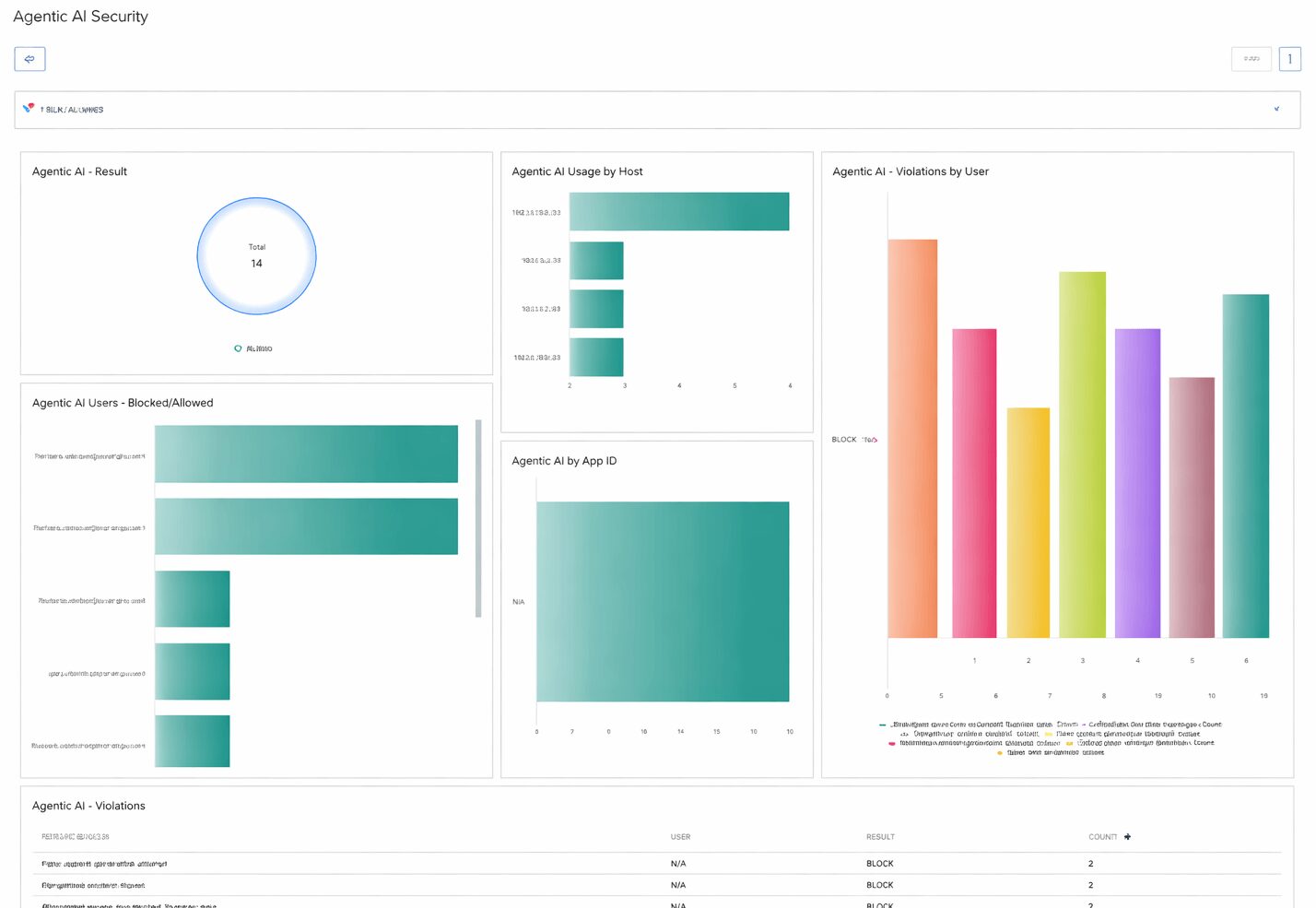
Exabeam extends user and entity behavior analytics to AI agents and autonomous workflows through Agent Behavior Analytics. ABA establishes behavioral baselines for each agent to detect misuse, drift, abnormal tool use, risky access, and activity outside an agent’s expected role.
The platform analyzes activity from commercial platforms like ChatGPT, Google Gemini, and Microsoft Copilot, alongside custom and open-source agents. The open-source Observra SDK standardizes and normalizes runtime agent activity across development frameworks into a consistent schema, while the Exabeam Agent Sensor runs on endpoints to capture local AI CLI interactions. These normalized events feed directly into Agent Behavior Analytics, which can be deployed within New-Scale Fusion or added to an existing SIEM via New-Scale Analytics.
Key features include:
- Behavioral baselines for agents: ABA models expected behavior for each AI agent and autonomous workflow, then flags deviations such as abnormal tool use, risky access, and activity outside an agent’s intended role.
- Open agent telemetry: Observra standardizes prompts, tool calls, actions, approvals, and outcomes into a common information model and provides a developer library so custom agents can emit structured telemetry.
- Endpoint agent activity capture: Exabeam Agent Sensor collects activity from AI CLI tools running on user machines and normalizes it alongside activity from commercial AI platforms.
- Tool use and MCP activity detection: Detections cover autonomous installation and execution, tool usage and MCP activity, and connections to third-party AI platforms.
- Machine-built investigation timelines: Timelines correlate agent actions with related user, entity, and application activity.
- Coverage mapping to OWASP Agentic Top 10: Outcomes Navigator maps ABA coverage to the OWASP Agentic Top 10 and highlights data and detection gaps.
- Pre-deployment verification (Praxen): Leverages the open-source Praxen framework to compare declared agent policies with code, configuration, and logs before deployment, identifying excessive permissions and configuration gaps to govern AI systems in accordance with the NIST AI RMF.
- Runtime agent telemetry (Observra): Uses the open-source Observra SDK to capture, normalize, and enrich runtime activity such as model calls, tool execution, and token usage, eliminating visibility blind spots to map and measure AI risks.
- Editable detection content: ABA detections are available in Threat Detection Management, where teams can review, clone, tune, and customize them.
Limitations (as reported by users on PeerSpot):
- Dashboard customization: Users ask for additional dashboards and deeper customization options beyond what is currently available.
- Out-of-the-box integrations: Some teams would like a broader set of ready-made integrations and more threat intelligence feed options.
- Documentation depth: Reviewers note that documentation could go further, particularly around API interactions.

Source: Exabeam
2. CrowdStrike Falcon Next-Gen Identity Security

Best for: Teams unifying NHI discovery with real-time access enforcement
Strengths: Behavior analytics plus just-in-time authorization for NHIs
Things to consider: Cost and policy strictness are recurring user complaints
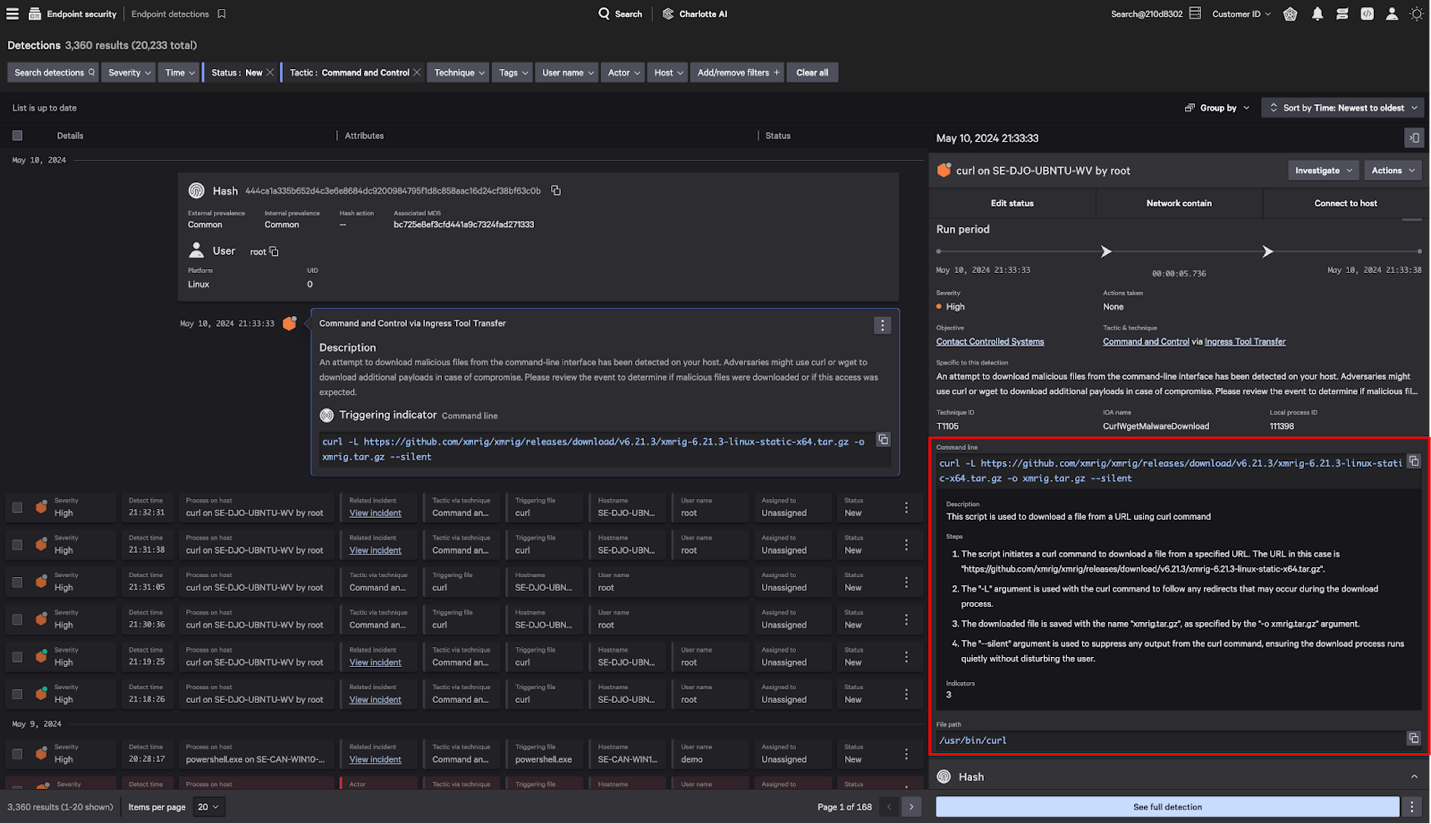
CrowdStrike secures non-human identities through Falcon Next-Gen Identity Security on the Falcon platform. It continuously discovers and correlates non-human identities and AI agents across hybrid environments, connecting each identity to the applications, workloads, devices, and data it accesses.
The platform surfaces overprivileged access, unmanaged accounts, and risky permission combinations. It applies behavior analytics, threat intelligence, and real-time telemetry to detect compromised credentials, potential attack paths, abnormal NHI behavior, and identity misuse during active attacks.
Key features include:
- Continuous NHI and agent discovery: The platform discovers service accounts, workloads, API keys, and AI agents across on-premises, cloud, and SaaS environments.
- Identity-to-resource correlation: Each non-human identity is connected to the applications, workloads, devices, and data it touches, exposing risk and toxic permission combinations.
- Behavior analytics for NHI activity: Behavior analytics combined with threat intelligence and real-time telemetry identify abnormal non-human identity behavior and credential misuse.
- Real-time containment actions: Detected threats can be contained by revoking access, reducing privileges, or enforcing additional verification.
- Zero standing privilege enforcement: Standing access is replaced with just-in-time authorization and continuous validation.
- Continuous access evaluation: Access is evaluated throughout a session rather than only at login, using the Continuous Access Evaluation Protocol across SaaS, cloud, endpoint, and hybrid environments.
- Single control plane across domains: Identity visibility, privileged access, and threat detection are managed from one console spanning endpoint, cloud, SaaS, and AI environments.
Limitations (as reported by users on G2):
- Subscription cost: High pricing is a commonly cited limitation and a barrier for some organizations.
- Policy strictness: Users working across multiple sites report that enforcement can feel restrictive, with frequent re-authentication interrupting daily work.
- Complexity for new users: Reviewers note that the product takes time to learn and would benefit from simpler day-to-day operation.

Source: CrowdStrike
3. Microsoft Entra Agent ID

Best for: Microsoft-centric orgs governing agent identities at scale
Strengths: Conditional Access, governance and logging applied to agents
Things to consider: Licensing structure and third-party coverage add complexity
Microsoft Entra Agent ID extends Microsoft Entra identity and access management to AI agents. Each agent is assigned an identity that supports authentication, policy enforcement, and integration with existing organizational policies. Agents are managed from the Microsoft Entra admin center alongside workforce identities.
The product applies Conditional Access, identity governance, identity protection, and network controls to agents. Agent ID capabilities are available in Microsoft Agent 365 and Microsoft 365 E7 plans, which include a unified agent registry covering agents from Microsoft AI platforms, partner agents registered through the SDK, and self-registered agents.
Key features include:
- Agent identity provisioning at scale: Agents are assigned built-in identities that enable authentication and policy enforcement, with blueprints acting as templates for creating individual agent identities.
- Unified agent registry: A central inventory covers agents from Microsoft AI platforms, Agent 365 ecosystem partners using the SDK, and synced or self-registered agents from platforms outside Agent 365.
- Conditional Access for agents: Real-time access policies can block risky agents and apply granular controls based on configured security attributes.
- Lifecycle governance and sponsorship: Governance runs from deployment to expiration, with sponsors assigned and maintained and access assignments made auditable and time-bound.
- Identity protection for agent behavior: Unusual or unauthorized agent activity is detected and flagged.
- Network-level controls and logging: Agent network activity is logged for audit and threat detection, web categorization is applied to APIs and MCP servers, file uploads and downloads can be restricted, and malicious destinations are blocked automatically.
- Usage insights and activity mapping: Agent 365 provides usage insights and visual mapping of agent activity and connections.
Limitations (as reported by users on PeerSpot):
- Licensing complexity: Pricing and licensing structures create difficulty for organizations trying to determine requirements.
- Third-party integration: Integration with non-Microsoft applications is an area users identify as needing improvement.
- Interface and policy management: The UI and UX are described as requiring simplification, and policy management is seen as more complicated than necessary.
- Documentation currency: Reviewers report that documentation does not always keep pace with frequent product updates.

Source: Microsoft
Note: Reviews cover the broader Microsoft Entra ID platform of which Agent ID is a component.
4. Silverfort Non-Human Identity Security

Best for: Hybrid estates protecting Active Directory service accounts
Strengths: Per-account behavioral baselines with inline policy enforcement
Things to consider: Upgrades and some admin tasks still route through support
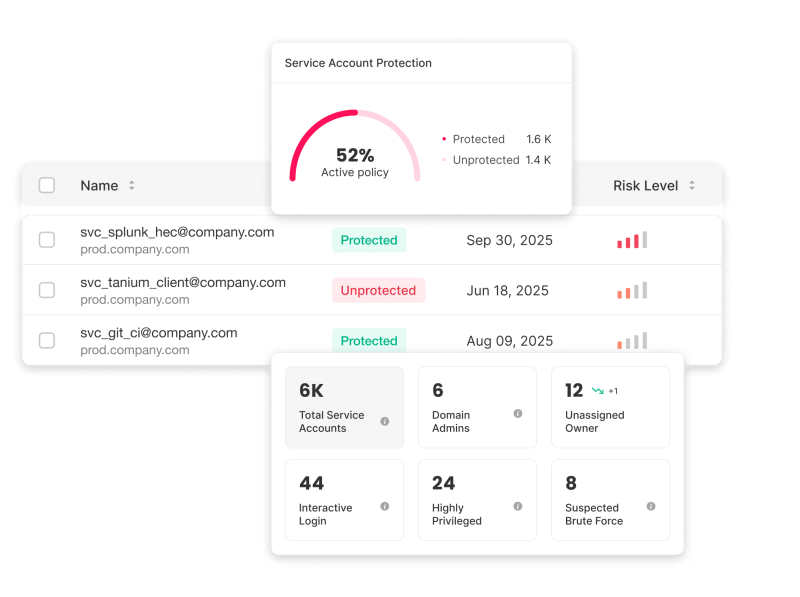
Silverfort discovers and secures non-human identities across hybrid environments, including unmanaged, unknown, and unvaulted service accounts. It continuously discovers and maps Active Directory service accounts and cloud NHIs, providing visibility into their activities, risk indicators, and usage patterns based on real access telemetry.
The platform builds a behavioral baseline for every service account, learning its usual access paths, privileges, and frequency of activity. It scores predictability and detects anomalies such as new hosts, unusual destinations, or sudden privilege elevation. During the learning phase, policies run in alert-only mode so automations are not disrupted.
Key features include:
- Automated NHI discovery: Silverfort uncovers non-human identities across environments, including service accounts, tokens, and workloads that traditional IAM and PAM tools do not monitor.
- Human ownership mapping: Shadow accounts are mapped to human owners, sources, destinations, privilege levels, and associated risks.
- Per-account behavioral baselines: A behavioral fingerprint is built for each service account, covering access paths, privileges, and activity frequency, with a predictability score.
- Anomaly detection on access paths: The platform flags new hosts, unusual destinations, and sudden privilege elevation as deviations from the established baseline.
- Virtual fencing and adaptive policies: Adaptive policies permit only expected behavior and block abnormal activity such as unexpected sources, unexpected destinations, or lateral movement attempts.
- Inline enforcement through Runtime Access Protection: RAP technology operates at the authentication layer to apply controls in real time across on-premises, cloud, and hybrid resources.
- Protection without password rotation: Privileged service accounts can be secured without rotating their passwords.
Limitations (as reported by users on G2):
- Upgrade process: Version upgrades cannot be downloaded and triggered from the admin console and require approval from support or an account manager before being pushed to appliances.
- Mobile app: Users describe the mobile application as dated and note the absence of an import feature from other MFA applications.
- Past stability issues: Earlier versions had problems with virtual nodes, which required workarounds before a patch was issued.
- Workflow automation: Reviewers would like more built-in workflow creation within the console.

Source: Silverfort
Non-Human Identity and AI Agent Security Platforms
5. Oasis Security

Best for: Cloud-first teams inventorying and governing NHI lifecycles
Strengths: Ownership attribution, posture ranking and anomaly detection
Things to consider: Limited independent review coverage for a 2022 vendor
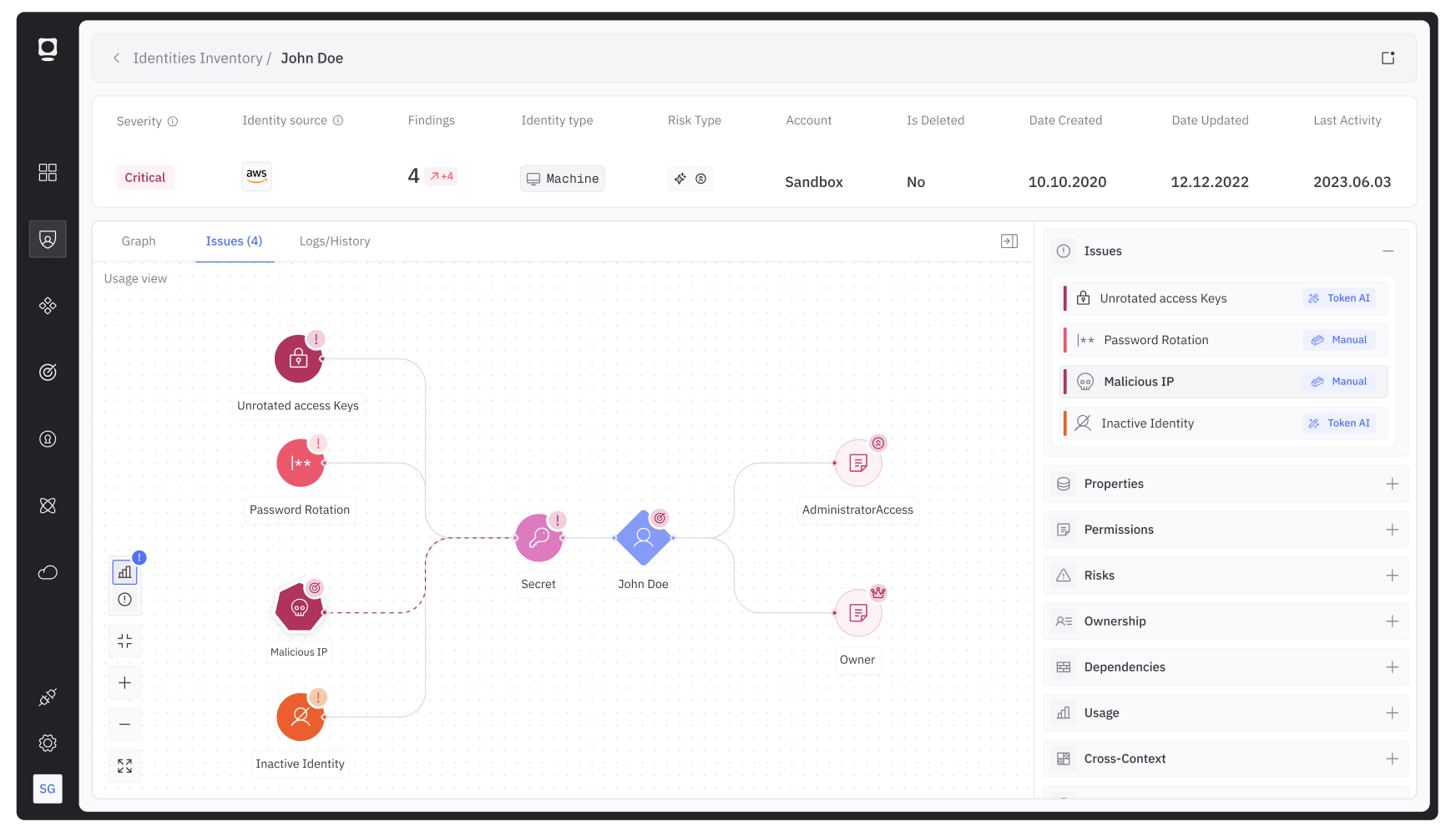
Oasis Security is an enterprise platform for visibility, security, and governance of non-human identities across hybrid cloud. It connects to an environment and builds an inventory of non-human identities in a consolidated view, then adds context on usage, consumers, resources, privileged status, and ownership.
Ownership data is assembled from integrations with cloud, SaaS, and on-premises environments and enriched with CMDB data. The platform uses heuristics and machine learning to suggest owners, identify gaps, and resolve them through certification campaigns. Coverage extends to AI security posture management and agentic access control for AI agents.
Key features include:
- Automatic NHI inventory: Oasis connects to an environment and creates an inventory of non-human identities in a single view.
- Contextual enrichment: Each identity is enriched with usage, consumers, resources accessed, privileged status, and ownership.
- Ownership attribution: Heuristics and machine learning suggest owners, identify gaps, and resolve them through certification campaigns, with CMDB data used for enrichment.
- Posture assessment and ranking: Automated assessments evaluate configuration and compliance, then rank posture issues by severity.
- Threat and anomaly detection: Oasis Scout monitors for leaked credentials, unauthorized access, and account takeover, with AuthPrint matching anomalies to known threat actor fingerprints.
- AI security posture management: The platform checks AI agent configurations, permissions, and risk posture across AI platforms.
- Agentic intent and access control: Agent intent is assessed and time-bound access is enforced for AI agents.
- Lifecycle management: Provisioning, ownership assignment, vaulting, posture, rotation, and decommissioning are orchestrated from a single interface.
Limitations (based on publicly available sources):
- Limited independent review coverage: Public analysis notes an absence of published customer reviews across major enterprise review platforms.
- Pricing scales with environment: Subscription tiers depend on the number of integrated cloud services and the level of automation required.
- Young vendor in a consolidating category: Oasis was founded in 2022 and competes in a market where several peer vendors have been acquired.

Source: Oasis Security
6. Token Security

Best for: Enterprises mapping AI agent access against intended purpose
Strengths: Agent and MCP server discovery with intent-based permissioning
Things to consider: Coverage depends heavily on integration breadth
Token Security is a platform for AI agents and non-human identities structured around three pillars: discover every agent, understand its intent, and enforce its boundaries. It discovers AI agents and MCP servers, covering autonomous agents, copilots, custom GPTs, service-integrated agents and bots, agent frameworks and orchestration layers, and the non-human identities and tokens they use.
The platform analyzes identity logs and telemetry data to establish ownership, accessible APIs, services, and systems, required permissions and credentials, and behavior over time. Intent-based permissioning aligns access with what an agent is meant to do.
Key features include:
- AI agent and MCP server discovery: Discovery covers cloud environments, SaaS platforms, internal tools, and custom frameworks, including shadow AI and unsanctioned deployments.
- Broad integration coverage: Over 1,000 built-in integrations span AI platforms, cloud providers, CI/CD and DevOps tools, identity providers and PAM, AppSec, SIEM, CNAPP, and business systems.
- Behavior and access mapping: The platform maps agent ownership, reachable APIs and systems, required permissions and credentials, and behavior changes over time.
- Intent-based permissioning: Permissions are defined by agent purpose and expected actions.
- Multi-agent traceability: Logging of AI actions and correlation of multi-agent sequences support accountability across agent chains.
- Policy enforcement for agent operations: Policies cover approved services and data sources, allowed tools and integrations, access reviews with automated remediation, and environmental and runtime constraints.
- Natural language interface: The Token MCP Server allows security teams to query their environment from chat applications or agent-based tools.
- Continuous compliance evaluation: Agents are evaluated against internal policies and external requirements, producing audit trails and forensic evidence.
Limitations (based on publicly available sources):
- Sparse independent review coverage: The small number of verified entries on enterprise review platforms provides limited critical feedback.
- Integration-dependent visibility: Discovery and access mapping rely on connecting the platform to cloud, SaaS, CI/CD, and identity systems.
- Smaller installed base: Token Security is a newer vendor competing against established identity suites.

Source: Token Security
7. Saviynt

Best for: IGA programs extending governance to NHIs and AI agents
Strengths: Unified inventory, access maps and runtime authorization
Things to consider: Interface, documentation and support response draw criticism
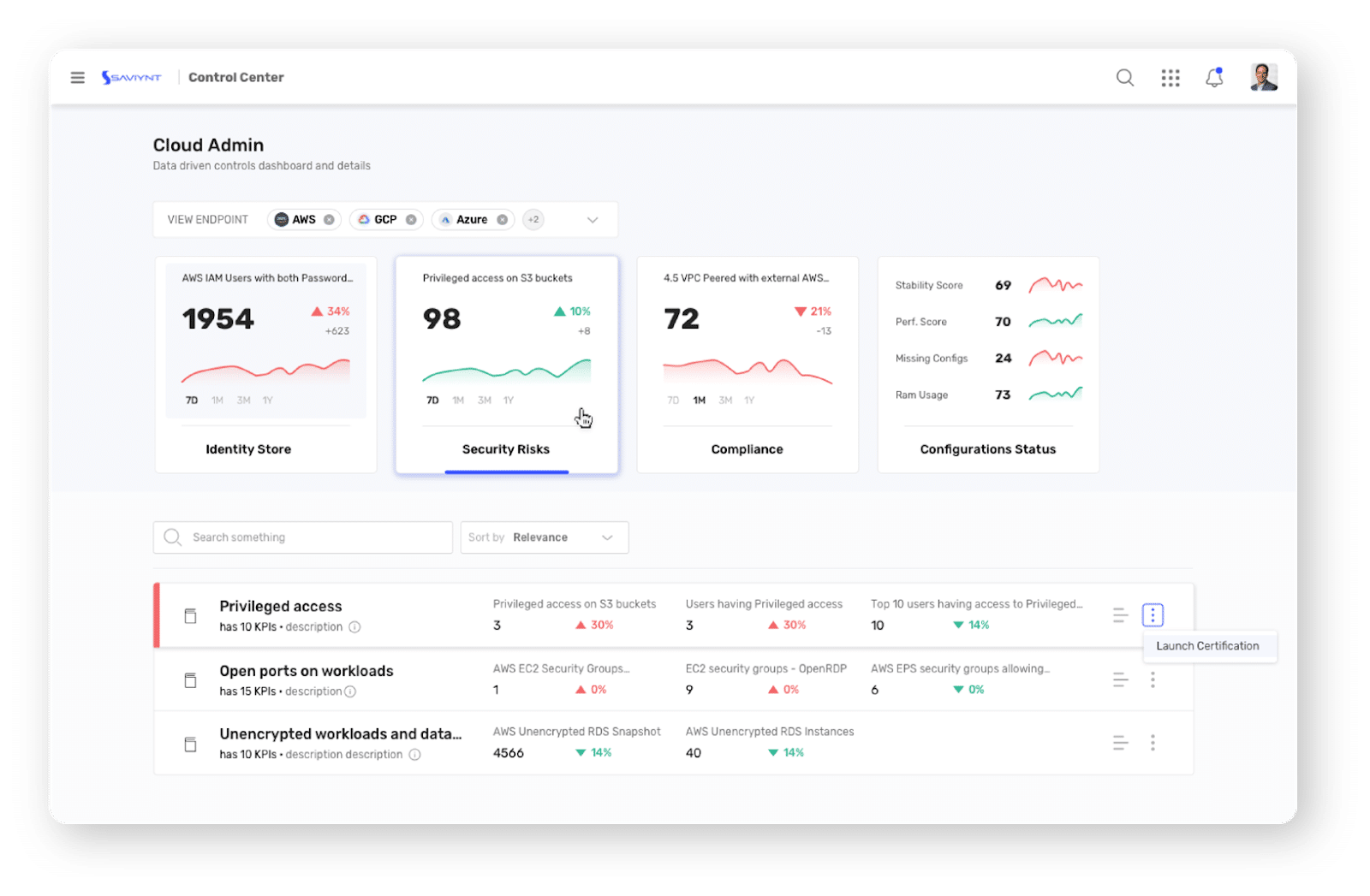
Saviynt covers non-human identities and AI agents within its identity platform, applying the same discovery, posture, and governance processes used for human identities. It builds a real-time inventory of workloads, accounts, and credentials across environments and presents NHI policies, violations, status, and severity in a single view.
Saviynt Identity Security for AI adds an identity control plane for AI agents. It discovers, registers, and inventories approved, unmanaged, and unknown agents, maps what each agent can access, tracks activity on a timeline, and applies intent-aware runtime authorization so agents can only take actions aligned with approved objectives.
Key features include:
- Real-time NHI inventory: An NHI dashboard discovers workloads, accounts, and credentials across environments, with filters for identity type, ownership, and risk level.
- Unified NHI policy view: Non-human identity policies are shown in one place, including violations, status, and severity.
- AI agent discovery and registration: Agents across the AI ecosystem are discovered, registered, and inventoried.
- Access mapping: Access maps visualize how AI agents and non-human identities interact with critical applications, data, and tools.
- Timeline visualization: Lifecycle events, agent actions, ownership changes, and permission modifications are tracked on a timeline.
- Intent-aware runtime authorization: Authorization evaluates the purpose behind a request and restricts agents to actions that match approved objectives and policies.
- Ownership and lifecycle governance: Every agent is tied to an owner, with governance from registration through change and retirement.
- Risk insights and prioritization: Security and governance risks across AI and non-human identities are identified and prioritized.
Limitations (as reported by users on PeerSpot):
- Interface customization: The interface is described as lacking customization and intuitive design.
- Historical logs and monitoring: Users report difficulty accessing historical logs and carrying out server monitoring.
- Support response times: Slow responses from customer support are a recurring theme.
- Documentation and training: Reviewers describe documentation and training resources as insufficient.
- Scalability in complex environments: Scaling is reported as more difficult in complex deployments.

Source: Saviynt
8. Zenity

Best for: Security teams governing agent behavior across AI platforms
Strengths: AI observability, exposure validation and runtime detection
Things to consider: Scope covers AI agents, not the wider NHI estate
Zenity is a security and governance platform for AI agents spanning SaaS platforms, cloud and homegrown agent platforms, and end-user devices. The platform is organized into three layers: Surface builds a live inventory and tests what is exploitable, Enforce determines what agents can do, and Protect handles detection, investigation, and response.
AI Observability tracks agents across SaaS, custom, and endpoint deployments along with the data each one touches. AI Security Posture Management evaluates agent configuration and permissions against policy before deployment, and AI Exposure Management validates which of an agent’s attack paths are exploitable and scores each one.
Key features include:
- Live agent inventory: AI Observability builds a continuously updated inventory of agents across SaaS, custom, and endpoint deployments and records the data each agent accesses.
- Posture evaluation before deployment: AISPM checks agent configuration and permissions against policy before production.
- Exploitability validation: AI Exposure Management tests which attack paths are exploitable and scores each one.
- Runtime boundaries: The Enforce layer determines what agents can do and stops harmful actions before they take effect.
- Intent-based detection and response: AIDR examines the execution path, including tool calls, memory access, data usage, and control flow, to identify malicious or unintended outcomes.
- MCP security and agentic identity: Capabilities cover MCP servers and the identities agents act under.
- Coverage across agent types: The platform spans agentic SaaS such as Salesforce Agentforce and Copilot Studio, cloud and homegrown agents on platforms including AWS Bedrock and Google Vertex AI, and personal and coding agents running locally.
- Broad platform support: Supported environments include ChatGPT Enterprise, Claude Enterprise, Microsoft 365 Copilot, Microsoft Foundry, Power Platform, Salesforce, Amazon Bedrock AgentCore, and ServiceNow.
Limitations (based on publicly available sources):
- Scope limited to AI agents: The platform is built for AI agents and does not cover the broader non-human identity estate of service accounts, API keys, and certificates.
- Coverage tied to supported platforms: Visibility depends on the agent platforms Zenity supports.
- Limited independent review coverage: There are no substantive published user reviews on major enterprise review platforms.
Conclusion
As organizations automate more business processes with service accounts, machine identities, and AI agents, understanding non-human identity activity becomes as important as monitoring human users. Effective analytics help security teams discover unmanaged identities, establish behavioral baselines, detect privilege misuse and anomalous activity, and enforce least-privilege access throughout the identity lifecycle. Choosing a platform with strong visibility, behavioral analytics, governance, and policy enforcement enables organizations to reduce identity-related risk while supporting secure adoption of AI and automation technologies.
Learn More About Exabeam
Learn about the Exabeam platform and expand your knowledge of information security with our collection of white papers, podcasts, webinars, and more.