


Trusted AI SOC Solutions With 24/7 Coverage: Top 8 Compared
- 20 minutes to read
Table of Contents
TL;DR: AI SOC solutions with 24/7 coverage pair AI-driven detection, triage, and response with round-the-clock human oversight. Exabeam is best for behavior-driven TDIR across users and AI agents, Microsoft Sentinel for Microsoft-centric SOCs, CrowdStrike Falcon Complete for fully managed agentic MDR, and Arctic Wolf for concierge-led 24/7 MDR.
What Are AI SOC Solutions with 24/7 Coverage?
Trusted AI Security Operations Center (SOC) solutions combine autonomous AI agents for 24/7 alert triage with human expert backup to prevent machine-speed errors. They continuously monitor security data from endpoints, networks, cloud environments, and applications. Unlike traditional security operations that rely heavily on manual analysis, AI SOC solutions automate tasks such as alert triage, threat correlation, and incident investigation.
These solutions typically combine machine learning, behavioral analytics, threat intelligence, and automated response workflows. AI models analyze security events to identify suspicious activity, including unusual login attempts, lateral movement, malware execution, and data exfiltration. When a potential threat is detected, the system can collect supporting evidence, assign a risk score, and initiate predefined response actions.
Key features of AI SOC solutions:
- User and entity behavior analytics (UEBA): Establishes behavioral baselines for users, devices, and applications to detect unusual access patterns, compromised accounts, and insider threats.
- AI agent and non-human identity monitoring: Tracks service accounts, workload identities, and AI agents to identify abnormal API calls, unauthorized tool usage, and suspicious permission changes.
- Cloud-native SIEM: Centralizes security logs and telemetry across distributed environments, supporting scalable threat detection, event correlation, and investigations.
- AI-driven alert triage: Automatically enriches, correlates, and prioritizes security alerts to reduce false positives and focus analysts on genuine threats.
- Automated threat detection, investigation, and response (TDIR): Connects threat detection with evidence collection, incident analysis, and containment to accelerate security operations.
- Automated incident response playbooks: Executes predefined investigation and containment workflows, including account suspension, session revocation, and endpoint isolation.
- Centralized hybrid and multi-cloud visibility: Correlates security activity across on-premises infrastructure, cloud platforms, SaaS applications, and endpoints to identify threats spanning multiple environments.
This is part of a series of articles about AI cyber security
AI SOC Solutions with 24/7 Coverage at a Glance
The table below summarizes the key differences between the solutions covered in this guide. We explore each solution in more detail in the sections that follow.
| Category | Solution | Best For | Key Strengths | Ratings |
| AI-driven security operations platforms | Exabeam New-Scale Fusion | Behavioral analytics for users, service accounts, and AI agents, with dynamic risk scoring and AI-assisted investigationsBehavior-driven TDIR for users, non-human identities, and AI agents | UEBA, Agent Behavior Analytics, Exabeam Nova AIagents | G2: 4.6/5 (14 reviews) |
| AI-driven security operations platforms | Microsoft Sentinel | Microsoft Defender-centric SOCs | Built-in SOAR, UEBA, data lake, Security Copilot | G2: 4.4/5 (298 reviews) |
| AI-driven security operations platforms | Google Security Operations | High-volume telemetry with Gemini agents | Triage agent, SIEM and SOAR, Mandiant intel | G2: 4.4/5 (170 reviews) |
| AI-driven security operations platforms | Palo Alto Networks Cortex XSIAM | Consolidating SOC tools on Palo Alto | SIEM, XDR, SOAR, Cortex AgentiX agents | G2: 4.4/5 (117 reviews) |
| AI SOC services with 24/7 human coverage | CrowdStrike Falcon Complete | Fully managed MDR on the Falcon platform | Agentic MDR, expert-owned remediation | Gartner Peer Insights: 4.7/5 (480 reviews) |
| AI SOC services with 24/7 human coverage | Arctic Wolf Aurora MDR | Concierge-led 24/7 MDR | 300+ AI agents with human validation | G2: 4.7/5 (280 reviews) |
| AI SOC services with 24/7 human coverage | Expel MDR | Vendor-agnostic 24×7 MDR with transparency | Ruxie AI, Workbench visibility | G2: 4.6/5 (74 reviews) |
| AI SOC services with 24/7 human coverage | Prophet Security | AI alert investigation with optional 24/7 experts | Auditable investigations, Watchtower | Gartner Peer Insights: 4.9/5 |
Why Do Organizations Need 24/7 AI-Powered Security Operations?
The Growing Volume and Complexity of Cybersecurity Threats
Organizations face cyber threats that target endpoints, cloud infrastructure, identities, and business applications. Attackers use techniques such as credential theft, ransomware, phishing, and lateral movement to gain access to sensitive systems. They also use automation to scan for vulnerabilities, test stolen credentials, and launch attacks at scale. This creates large volumes of security events that organizations must continuously analyze.
Modern attacks often involve multiple stages across different systems. For example, an attacker might compromise a user account, access cloud resources, and transfer sensitive data. Each action may appear harmless when examined separately. AI-powered security operations help identify these attack patterns by correlating events from multiple sources and detecting unusual behavior that traditional rule-based systems might miss.
Related content: Read our guide to AI-driven cyber security
Limitations of Traditional SOC Monitoring and Manual Investigations
Traditional security operations centers rely heavily on human analysts to review alerts, investigate suspicious activity, and determine appropriate responses. Security information and event management (SIEM) platforms can generate thousands of alerts daily, including false positives and duplicate notifications. Analysts must examine logs, correlate events, and assess potential threats, which can delay investigations and increase alert fatigue.
Maintaining continuous security monitoring also requires sufficient staffing across nights, weekends, and holidays. Smaller security teams may struggle to provide consistent coverage, while larger organizations face increasing operational costs. AI-powered SOC solutions reduce this workload by automatically grouping related alerts, enriching incidents with threat intelligence, and prioritizing suspicious activity based on risk.
However, automation does not eliminate the need for security analysts. Complex attacks, uncertain findings, and high-impact containment decisions may still require human judgment. AI is most effective when it handles repetitive investigation tasks while analysts focus on validating threats and making critical response decisions.
The Need for Continuous Threat Detection and Rapid Response
Cyberattacks can occur at any time, including outside normal business hours. A compromised account or infected endpoint may remain active for hours before an analyst reviews the relevant alerts. During this period, attackers can establish persistence, move between systems, or access sensitive information. Continuous threat detection helps organizations identify suspicious activity as it occurs rather than waiting for scheduled security reviews.
AI-powered SOC solutions analyze incoming telemetry continuously and can trigger automated investigation workflows when suspicious behavior is detected. Depending on the platform’s capabilities, these workflows may retrieve endpoint activity, examine authentication logs, identify affected assets, and recommend containment actions. Integration with security orchestration, automation, and response (SOAR) tools can also enable predefined actions, such as revoking compromised sessions or isolating infected devices.
Rapid response is especially important for threats that spread quickly, such as ransomware and automated account compromise. Reducing mean time to detect (MTTD) and mean time to respond (MTTR) can limit the damage caused by successful intrusions. To achieve effective 24/7 protection, organizations need both continuous monitoring and reliable response mechanisms, including automated containment, incident escalation, and access to qualified security personnel when necessary.
How Do AI SOC Solutions Provide 24/7 Security Coverage? Continuous Security Data Collection and Monitoring
AI SOC solutions provide continuous visibility by collecting security telemetry from endpoints, networks, cloud infrastructure, identity providers, and business applications. They integrate with security tools such as endpoint detection and response (EDR), firewalls, cloud security platforms, and security information and event management (SIEM) systems. These integrations allow the SOC to monitor activity across multiple environments without requiring analysts to manually inspect each data source.
Security data is collected through:
- Agents
- APIs
- Log forwarding
- Event streaming
The platform normalizes incoming events into a consistent format and processes them through detection pipelines. Continuous ingestion helps identify suspicious activity outside business hours, while data retention supports historical investigations. However, monitoring coverage depends on the availability, configuration, and reliability of connected data sources.
AI-Powered Threat Detection and Behavioral Analytics
AI-powered threat detection uses machine learning and behavioral analytics to identify suspicious activity that may not match predefined detection rules. These systems analyze authentication patterns, endpoint processes, network connections, and user activity to establish behavioral baselines. Deviations from expected behavior can indicate:
- Compromised accounts
- Malicious processes
- Unauthorized access
- Potential data exfiltration
For example, a platform might detect an account authenticating from an unusual location, accessing sensitive resources, and downloading significantly more data than normal. Each event may have limited significance independently, but their combination can indicate account compromise. AI models can identify these relationships and generate alerts for further investigation.
Behavioral detection complements signature-based and rule-based security controls rather than replacing them. Detection accuracy depends on data quality, model configuration, and the ability to distinguish legitimate operational changes from malicious activity.
Automated Alert Correlation and Risk-Based Prioritization
Security tools frequently generate multiple alerts related to the same underlying incident. An endpoint security platform might detect a suspicious process, while a firewall reports an unusual outbound connection and an identity system records abnormal authentication activity. Without correlation, analysts may investigate these alerts separately, increasing investigation time and duplicating work.
AI SOC solutions correlate alerts using shared attributes such as:
- User identities
- Device identifiers
- IP addresses
- Timestamps
- Observed attack techniques
Related events are grouped into incidents, providing a more complete view of suspicious activity. Some platforms also map observed behavior to the MITRE ATT&CK framework to identify potential attack stages.
Risk-based prioritization assigns severity based on factors such as asset criticality, threat intelligence, behavioral anomalies, and evidence of compromise. This helps security teams address high-impact incidents before lower-risk alerts. Prioritization models still require tuning because inaccurate asset information or incomplete telemetry can produce misleading risk scores.
AI-Assisted Security Alert Triage and Investigation
Alert triage determines whether a security notification represents a genuine threat, benign activity, or an event requiring additional investigation. Traditionally, analysts perform this process by reviewing logs, checking indicators of compromise, and gathering context from multiple security tools. AI-assisted triage automates much of this initial analysis.
When an alert is generated, an AI SOC platform can retrieve:
- Relevant endpoint activity
- Authentication history
- Network connections
- Threat intelligence
It may check whether suspicious IP addresses or file hashes are associated with known threats and whether the affected asset has exhibited similar behavior previously. The platform can then produce an investigation summary with supporting evidence and a recommended severity.
Some solutions use AI agents to perform multistep investigations, selecting additional queries based on earlier findings. This reduces repetitive work and allows analysts to focus on incidents requiring deeper analysis. However, AI-generated conclusions should remain traceable to underlying evidence, particularly when the system recommends disruptive response actions.
Automated Threat Investigation and Incident Timelines
Automated threat investigation reconstructs the sequence of activities associated with a suspected security incident. AI SOC solutions collect related events from endpoints, identity systems, cloud services, and network monitoring tools to determine how an attack developed. This process helps analysts understand:
- The initial entry point
- Affected resources
- The potential scope of compromise
For example, an investigation might identify a successful login using stolen credentials, followed by privilege escalation, access to sensitive files, and unusual outbound network traffic. The platform can organize these events into a chronological timeline, highlighting important actions and linking them to supporting logs. This makes it easier to distinguish isolated alerts from a coordinated attack.
Incident timelines also support root cause analysis and post-incident reviews. Analysts can use them to identify missed detection opportunities, validate containment actions, and improve security controls. The accuracy of reconstructed timelines depends on synchronized timestamps, sufficient log retention, and visibility across the affected systems.
Security Orchestration and Automated Incident Response
Security orchestration connects detection and investigation capabilities with tools that can contain or remediate threats. AI SOC solutions often integrate with security orchestration, automation, and response (SOAR) platforms, endpoint protection systems, identity providers, and network security controls. These integrations allow the platform to execute predefined response workflows when specified conditions are met.
Automated response actions may include:
- Isolating compromised endpoints
- Disabling suspicious accounts
- Revoking active sessions
- Blocking malicious IP addresses
- Quarantining files
For example, when an investigation confirms malicious activity on an endpoint, the platform can initiate network isolation through an EDR integration to prevent further lateral movement. Organizations can configure different levels of automation based on incident severity and operational risk. Low-risk actions, such as collecting forensic evidence or enriching alerts, can run automatically. High-impact actions, such as disabling critical accounts or isolating production servers, may require analyst approval.
What Makes an AI SOC Solution Trustworthy?
Not all AI SOC solutions provide the same level of reliability, security, and operational transparency. A trusted AI SOC solution must do more than detect threats and automate investigations. It should produce verifiable findings, protect sensitive security data, maintain consistent monitoring coverage, and give organizations control over automated decisions.
The following criteria can help organizations evaluate whether an AI SOC solution is trustworthy enough to support continuous security operations.
Transparent and Explainable AI Decisions
A trustworthy AI SOC solution should explain how it reaches conclusions rather than presenting alerts, risk scores, or response recommendations without supporting evidence. Security analysts need to understand why an event was classified as suspicious, which data sources contributed to the finding, and how confident the system is in its assessment.
Key capabilities include:
- Evidence-backed findings: Link AI-generated conclusions to relevant logs, security events, behavioral indicators, and threat intelligence.
- Explainable risk scoring: Show which factors contributed to an incident’s severity or priority.
- Traceable investigations: Allow analysts to review the sequence of automated queries, findings, and decisions.
- Uncertainty indicators: Distinguish confirmed malicious activity from suspicious behavior that requires additional verification.
These capabilities help analysts validate AI findings, identify incorrect conclusions, and make informed response decisions.
Proven Detection Accuracy and Independent Validation
Trustworthy AI SOC solutions should demonstrate their effectiveness through measurable results rather than relying exclusively on vendor-reported detection rates or claims about AI capabilities. Organizations should evaluate how consistently a platform identifies real threats while minimizing false positives and missed detections.
Important evaluation criteria include:
- Detection effectiveness: Test the platform against realistic attack scenarios, including credential compromise, lateral movement, and data exfiltration.
- False positive and false negative rates: Measure both unnecessary alerts and attacks that go undetected.
- Independent assessments: Review relevant third-party evaluations, security testing results, and customer references.
- Continuous validation: Verify detection performance as attacker techniques, infrastructure, and organizational behavior change.
Proof-of-concept testing with representative security telemetry can help establish whether the platform performs reliably in the organization’s environment.
Human Oversight and Controlled AI Autonomy
AI SOC solutions can automate investigations and execute security responses, but granting unrestricted autonomy introduces operational risks. An incorrect classification could result in a legitimate user being locked out, a production server being isolated, or a business-critical process being interrupted.
Trusted solutions provide configurable automation boundaries and allow organizations to determine which actions require human approval.
- Human-in-the-loop controls: Require analyst authorization before high-impact containment or remediation actions.
- Risk-based automation policies: Permit low-risk investigative tasks to run automatically while restricting disruptive operations.
- Emergency intervention: Allow authorized personnel to pause, override, or disable automated workflows.
- Rollback capabilities: Support reversing response actions when investigations reveal incorrect findings.
The goal is to balance rapid response with accountability, ensuring that automation does not introduce unnecessary business disruption.
Strong Data Security, Privacy, and Compliance Controls
AI SOC platforms process sensitive information, including authentication records, endpoint activity, network logs, and potentially confidential business data. Organizations must be able to trust that this information is protected against unauthorized access, exposure, and misuse.
Key requirements include:
- Encryption and access controls: Protect security telemetry in transit and at rest, with role-based permissions and least-privilege access.
- Data residency and retention: Provide controls over where security information is stored, how long it is retained, and when it is deleted.
- AI data usage policies: Clearly disclose whether customer information is used for model training, external inference services, or other secondary purposes.
- Compliance and assurance: Provide relevant certifications and independent audit reports, such as SOC 2 Type II or ISO 27001, where applicable.
- Tenant isolation: Prevent unauthorized data access between customers in multi-tenant environments.
Organizations should also evaluate how the platform protects AI models and connected tools against prompt injection, manipulated security telemetry, and unauthorized commands.
Reliable 24/7 Monitoring and Service Availability
A trusted AI SOC solution must maintain dependable security operations outside normal business hours, including weekends, holidays, and periods of unusually high event volume. Continuous data ingestion alone does not guarantee continuous protection if detection pipelines fail, investigations become delayed, or critical incidents are not escalated.
Organizations should assess:
- Availability commitments: Review service-level agreements (SLAs), historical uptime, and recovery objectives.
- Monitoring health checks: Verify that the platform detects failures in data ingestion, integrations, and detection pipelines.
- Redundancy and disaster recovery: Evaluate how security operations continue during infrastructure or service outages.
- Incident escalation: Confirm that critical threats can reach qualified personnel at any hour, whether through internal on-call teams or managed SOC services.
- Processing capacity: Test whether the platform can maintain acceptable detection and investigation latency during traffic spikes.
Organizations should distinguish between platforms that provide automated monitoring around the clock and services that include 24/7 human analyst availability. These represent different levels of operational coverage.
Auditability, Accountability, and Continuous Improvement
Trust in AI-driven security operations depends on the ability to independently review what the platform detected, why it made decisions, and which actions it performed. Organizations need records that support incident investigations, regulatory audits, and ongoing performance improvement.
Trusted AI SOC solutions should provide:
- Comprehensive audit trails: Record automated investigations, AI-generated recommendations, analyst approvals, and response actions.
- Model and policy change tracking: Document changes to detection models, automation rules, and security policies.
- Analyst feedback mechanisms: Incorporate verified true-positive and false-positive outcomes into detection tuning and workflow improvements.
- Performance reporting: Track metrics such as mean time to detect (MTTD), mean time to respond (MTTR), investigation accuracy, and automation success rates.
- Data portability: Enable organizations to export investigation records and security evidence without relying entirely on proprietary interfaces.
These capabilities help security teams evaluate whether AI automation continues to deliver reliable results over time and maintain accountability for decisions made during security incidents.
Notable AI SOC Solutions with 24/7 Coverage
How we selected these solutions: We shortlisted AI SOC platforms and managed services based on AI-driven alert triage and investigation, behavioral analytics, automated response, and 24/7 monitoring backed by human experts.
AI-Driven Security Operations Platforms
1. Exabeam New-Scale Fusion

Best for: Behavioral analytics for users, service accounts, and AI agents, with dynamic risk scoring and AI-assisted investigations
Strengths: UEBA, Agent Behavior Analytics, Exabeam Nova AI
G2 rating: 4.6/5 (14 reviews)
Things to consider: Detection content may need tuning to fit each environment
New-Scale Fusion is a cloud-native security operations platform from Exabeam. It combines New-Scale SIEM and New-Scale Analytics, bringing log management, SIEM, behavioral analytics, dynamic risk scoring, investigation workflows, and automation into one platform. Organizations can use it to replace an existing SIEM or to add analytics and automation on top of their current one.
Exabeam Nova AI adds a set of machine learning capabilities that run as a platform-wide sidebar, collecting background context, running secondary searches, and assisting with triage as analysts move between screens. Agent Behavior Analytics extends behavioral monitoring to AI agents and other non-human identities. Nova AI processes data with encryption, and customer data is not cached or used to train models.
Key features include:
- Behavioral analytics and dynamic risk scoring: New-Scale Analytics builds behavioral baselines for users, service accounts, applications, and agents, and applies risk scores to detect insider threats, credential misuse, and attacks that static rules can miss.
- Agent Behavior Analytics (ABA): Monitors AI agent and non-human identity activity for anomalies. When ABA flags unusual behavior, Exabeam Nova adds context to separate approved AI use from genuine threats.
- Exabeam Nova AI: The investigation capability creates case summaries and recommends next steps, the threat scoring capability prioritizes threats using machine learning and business context, and the search capability translates natural-language questions into Exabeam Query Language.
- Automated TDIR: Automates threat detection, investigation, and response with machine-built timelines and playbooks. Low-code automation and standards-based APIs connect more than 1,000 tools, and an MCP server extends platform data into external agentic workflows.
- Modern log management: Ingests, parses, stores, and searches data at scale, normalizing it with a Common Information Model and enriching it at ingestion. Supports federated search and routing data to third-party storage.
- Outcomes-focused coverage mapping: The Advisor Agent maps detection coverage to MITRE ATT&CK, the OWASP Agentic Top 10, and compliance frameworks, while the Rule Creator Agent generates, tunes, and converts detection rules from natural language.
- Attack Surface Insights: Aggregates data from existing tools to build entity profiles with contextual attributes and relationships, giving analysts a view of users and devices for risk prioritization.
- Pioneering open-source AI agent security: Exabeam sponsors and contributes to Praxen for pre-deployment Agent Behavior Verification (ABV) and Observra for normalized, framework-agnostic runtime telemetry, establishing a full-lifecycle framework to verify, observe, and secure AI agents.
Limitations (as reported by users on G2 and Gartner Peer Insights):
- Parsing setup: Some users mention that parsing certain data sources requires additional configuration effort.
- Content versions: A reviewer notes that older and newer versions of UEBA detection content exist side by side, which requires choosing between them.
- Rule set adjustment: Some users find that default rule sets take time to locate and adjust, and add their own detection layer for their environment.

Source: Exabeam
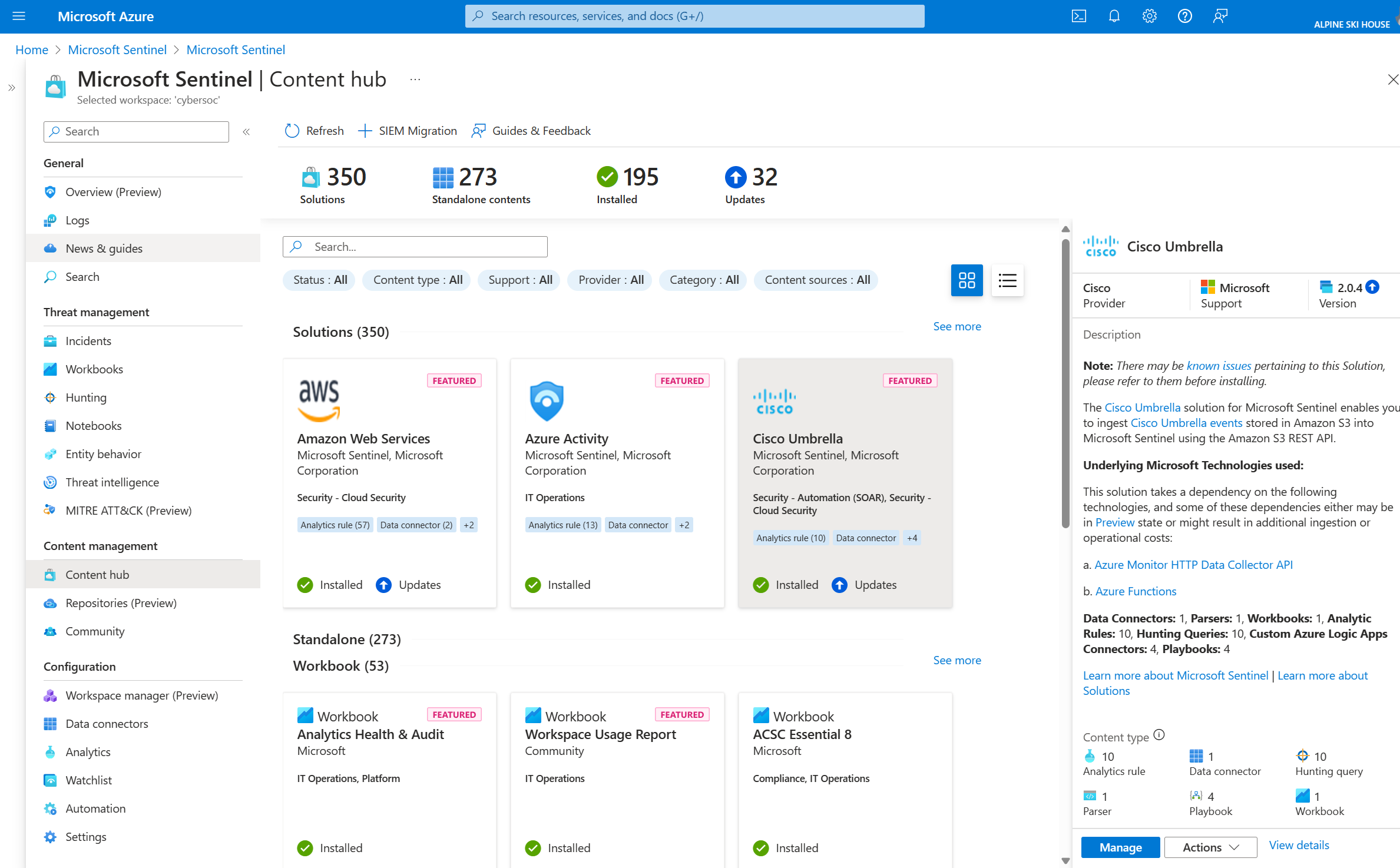
2. Microsoft Sentinel

Best for: Cloud SIEM for organizations standardized on Microsoft Defender
Strengths: Built-in SOAR, UEBA, data lake, Copilot, 400+ connectors.
G2 rating: 4.4/5 (298 reviews)
Things to consider: Ingestion-based pricing can rise quickly as log volume grows
Microsoft Sentinel is a cloud-native SIEM that correlates signals across identities, endpoints, cloud apps, and infrastructure. It includes built-in SOAR, UEBA, threat intelligence, and case management, all unified in the Microsoft Defender experience.
Sentinel includes a built-in data lake for long-term, lower-cost log retention, and Security Copilot assists analysts with incident summaries and query drafting. Pricing is pay-as-you-go based on data ingested, stored, and consumed, with commitment tiers available.
Key features include:
- Cross-domain threat detection: Correlates signals across identities, endpoints, cloud apps, and infrastructure to detect lateral movement, phishing, and insider threats in multi-cloud, multiplatform environments.
- Built-in SOAR: Provides out-of-the-box playbooks and codeless automation to reduce manual triage and execute response actions.
- Built-in UEBA: Baselines normal user and entity activity and flags compromised accounts and insider risk that rule-based detection misses.
- Security Copilot: Summarizes incidents, drafts Kusto Query Language (KQL) queries, and recommends next steps within Sentinel.
- Sentinel data lake: Stores and queries years of security data for hunting, compliance, and AI-powered detection, with flexible tiering to manage costs.
- Connectors and integrations: Ingests data through 400+ connectors and a codeless connector framework for building custom connectors.
- SOC optimization and migration: AI-driven recommendations tune rules and surface high-fidelity alerts, and an AI-assisted migration tool converts Splunk and QRadar detections into native Sentinel rules.
Limitations (as reported by users on G2):
- Cost growth: Users report that costs can increase quickly as log ingestion grows, especially with verbose sources such as firewall logs.
- Rule tuning: Some out-of-the-box analytics rules generate noisy alerts and require tuning before they are useful.
- KQL learning curve: Reviewers note that KQL takes time to learn, which can slow adoption for new teams.
- Third-party integrations: Users mention that connecting legacy systems and non-Microsoft tools can be complex and time-consuming.
- Data collection setup: Some users find that collecting different log types requires separate data collection rules and tables.

Source: Microsoft
3. Google Security Operations

Best for: High-volume telemetry analysis with Gemini agents and Mandiant intel
Strengths: Triage agent, unified SIEM and SOAR, 12-month data retention.
G2 rating: 4.4/5 (170 reviews)
Things to consider: Gemini and applied threat intel features vary by package tier
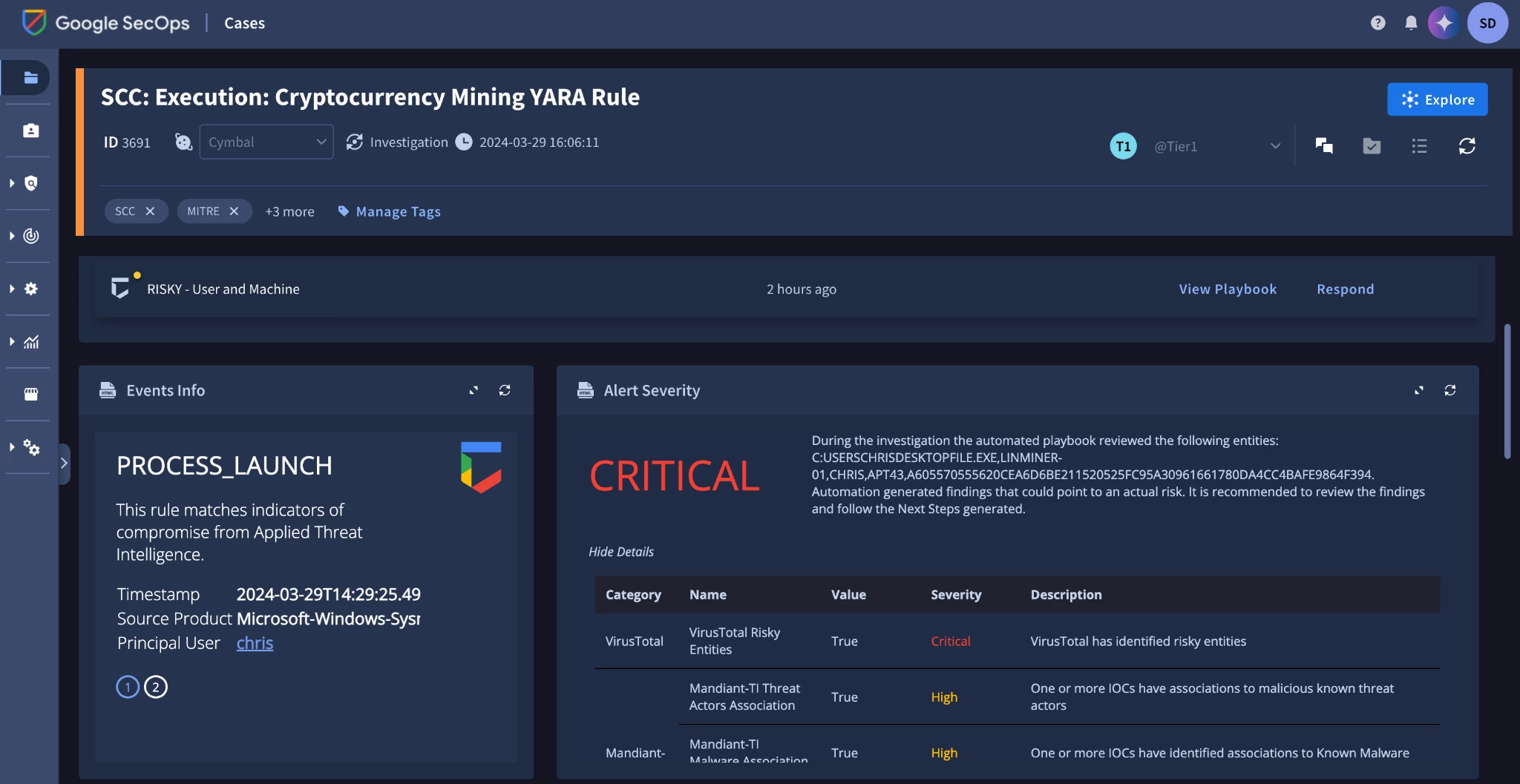
Google Security Operations is a cloud-native platform that combines SIEM, SOAR, and threat intelligence for detection, investigation, and response. It includes curated detections maintained by Google threat researchers and supports custom detection rules written in YARA-L.
The platform adds Gemini-based AI agents for alert triage, threat hunting, and detection engineering. Pricing is package-based and tied to ingestion, with 12 months of telemetry retention included.
Key features include:
- Triage and Investigation agent: Autonomously investigates alerts, enriches them with threat intelligence, and returns a verdict with an explanation. It can support automated alert closure and remediation workflows.
- Detection Engineering agent: Analyzes the organization’s threat profile to create and test detection rules, validating them with synthetic events to close coverage gaps.
- Threat Hunting agent: Searches the environment for novel attack patterns and stealthy behaviors using intelligence from Mandiant, VirusTotal, and Google.
- Agentic automation: Agentic automation, introduced in preview in March 2026, combines AI agents that gather evidence with deterministic playbooks, keeping analysts in control of high-impact actions.
- SOAR and case management: Builds playbooks that orchestrate more than 300 tools, with threat-centric case management, alert graphing, and an auto-documenting case wall.
- Gemini-assisted search and investigation: Analysts can search data in natural language, receive AI-generated case summaries, and get response recommendations.
- Applied threat intelligence and UEBA: Higher tiers add Google Threat Intelligence, including Mandiant and VirusTotal, with ML-based prioritization of IoC matches, plus YARA-L-based UEBA rules and risk dashboards.
Limitations (as reported by users on G2):
- Cost: Users describe ongoing costs as high, particularly for large organizations.
- Learning curve: Reviewers note it takes time to learn the full feature set, especially for teams new to Google Cloud.
- Implementation complexity: Some users find setup and configuration more time-consuming than other tools.
- Customization: A few reviewers mention limited customization options for specific security requirements.
- Support responsiveness: Some users report slower customer support responses for issue resolution.

Source: Google
4. Palo Alto Networks Cortex XSIAM

Best for: Organizations consolidating SOC tools on the Palo Alto Networks stack
Strengths: SIEM, XDR, SOAR in one platform with Cortex AgentiX agents.
G2 rating: 4.4/5 (117 reviews)
Things to consider: Licensing and third-party data onboarding can be complex
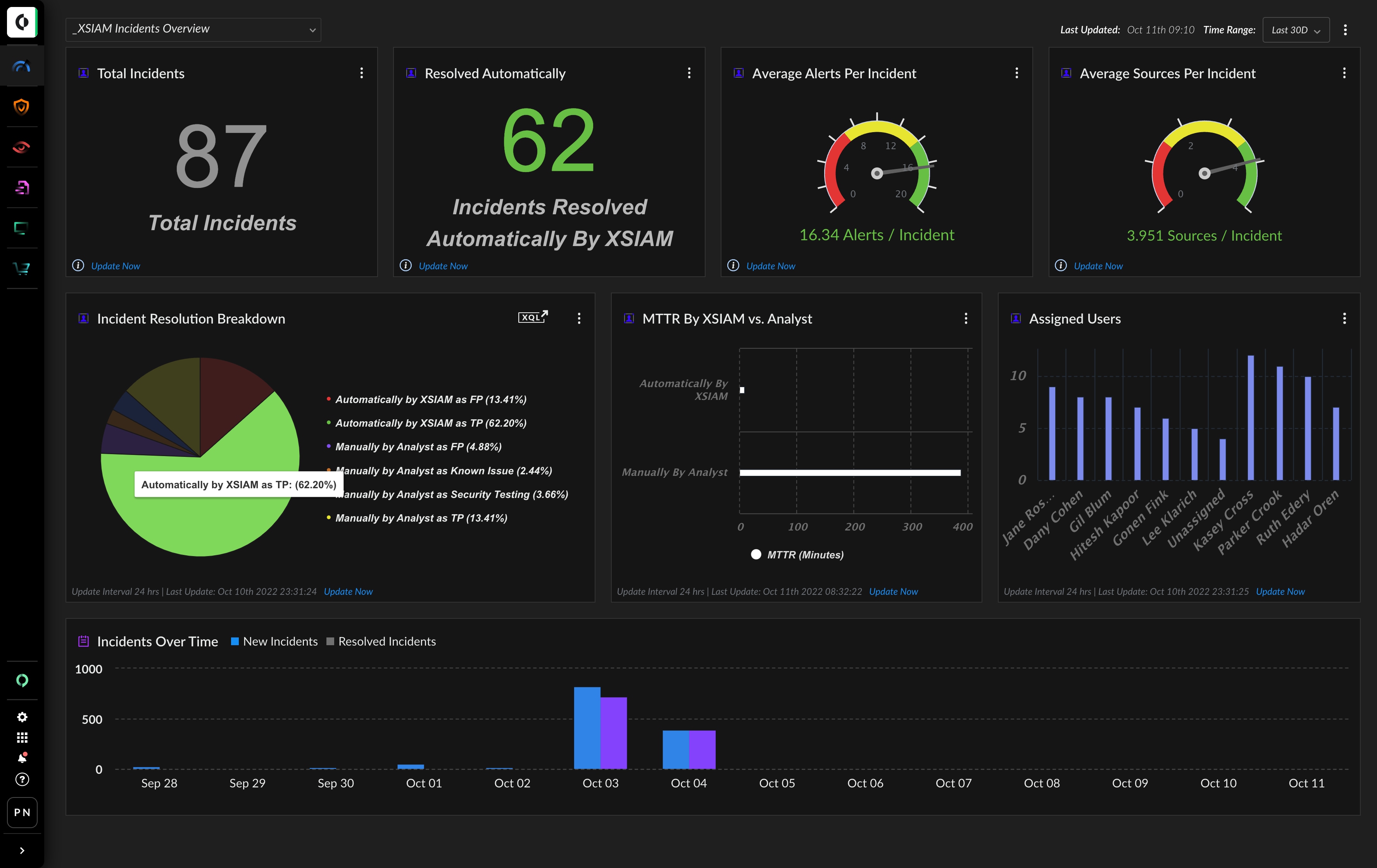
Cortex XSIAM is an AI-driven security operations platform that replaces a traditional SIEM by combining SIEM, SOAR, EDR, NDR, and cloud detection and response on a unified data layer. It prepares and enriches collected data, stitches it together, and applies machine learning detection analytics.
XSIAM groups large volumes of alerts into prioritized cases and uses Cortex AgentiX for agentic automation. For 24/7 coverage, Palo Alto Networks offers Unit 42 managed detection and response and Managed XSIAM services.
Key features include:
- Unified data foundation: Brings telemetry from endpoints, networks, identities, cloud, and third-party sources into the Cortex Extended Data Lake (XDL) for centralized analysis.
- ML-driven detection: Applies thousands of machine learning models and prebuilt detections, using EDR telemetry and enriched firewall logs as data sources.
- Case grouping and attack stories: Turns thousands of alerts into a smaller set of prioritized cases and shows the full attack sequence, including root cause.
- Cortex AgentiX agents: AI agents plan, reason, and act on security tasks within enterprise guardrails, alongside the platform’s automation engine.
- Built-in SOAR: Provides automated triage, guided actions, and playbook-driven response from the same platform.
- Extended capabilities: Adds email security, exposure management, threat intelligence management, and identity threat detection and response to the core platform.
- Managed services option: Unit 42 MDR and Managed XSIAM provide 24/7 expert-led detection, threat hunting, and SOC engineering.
Limitations (as reported by users on PeerSpot):
- Pricing and licensing: Users describe the platform as expensive, with a licensing process that is less straightforward than some alternatives.
- Data onboarding: Reviewers mention room for improvement in data onboarding, parsers, and third-party integration support.
- Interface performance: Some users report slowdowns when many tabs are open.
- Support consistency: Users note that support quality varies, with premium support rated higher than distributor-based support.

Source: Palo Alto Networks
AI SOC Services with 24/7 Human Expert Coverage
5. CrowdStrike Falcon Complete Next-Gen MDR

Best for: 24/7 managed detection and remediation on the CrowdStrike Falcon platform
Strengths: Agentic MDR, expert-owned outcomes, managed remediation.
Gartner Peer Insights rating: 4.7/5 (480 reviews)
Things to consider: Service is built around Falcon platform telemetry and modules
Falcon Complete is CrowdStrike’s managed detection and response service, delivered as agentic MDR. It combines deterministic automation, adaptive AI agents, and human experts who validate decisions and remediation in real time, 24/7.
Falcon Complete analysts correlate Falcon platform telemetry across endpoints, identities, AI agents, cloud, SaaS, and third-party data. The service handles full-cycle remediation on the customer’s behalf and is backed by warranty coverage of up to $2 million.
Key features include:
- Agentic MDR model: Deterministic automation executes proven response actions, adaptive AI agents drive investigation, and human experts own and validate each outcome.
- Cross-domain correlation: Analysts correlate telemetry across endpoints, identities, AI agents, cloud, SaaS, and third-party data to remove persistence and stop lateral movement.
- AI agent threat investigation: Experts use Falcon Guardian runtime telemetry to investigate autonomous agent behavior from prompt to impact across identities and enterprise systems.
- SaaS coverage: Combines Falcon Shield visibility with expert investigation to detect compromised identities and suspicious behavior in SaaS applications.
- Machine-speed containment: Response playbooks execute containment actions quickly and consistently at scale.
- Expert-governed AI: Falcon Complete experts define guardrails for autonomous actions, and analyst decisions feed back into agent improvement.
- 24/7 managed remediation: Analysts perform full-cycle remediation to restore affected environments to a known-good state.
Limitations (as reported by users on PeerSpot):
- Alert noise: Some users report data overload, noise, and false positive alerts that contribute to alert fatigue.
- Application blocking: A reviewer describes a business application being blocked until its URLs were added to the allow list.
- Resource usage: Users mention that resource consumption on endpoints can slow other applications.
- Pricing: Some organizations limit deployment to certain locations because of cost.

Source: CrowdStrike
6. Arctic Wolf Aurora Managed Detection and Response

Best for: Organizations that want concierge-led 24/7 MDR
Strengths: 300+ AI agents, human validation, Concierge Security Team.
G2 rating: 4.7/5 (280 reviews)
Things to consider: Cost and alert volume can grow as monitoring expands
Aurora Managed Detection and Response is Arctic Wolf’s MDR service, delivered through the Aurora Agentic SOC. It covers 24×7 monitoring, security investigations, response actions, and incident response, with humans kept in the loop for decisions that require judgment.
Each customer receives the Concierge Experience, with security experts who learn the organization’s environment and guide posture improvements. The Aurora Superintelligence Platform uses an open XDR architecture with 200+ integrations.
Key features include:
- Aurora Agentic SOC: The Swarm of Experts framework orchestrates 300+ specialized AI agents that investigate in parallel across large event volumes, while human experts validate critical decisions.
- 24×7 detection and response: Integrated telemetry supports round-the-clock threat detection, with agentic response and human oversight used to contain threats.
- Concierge Experience: Security experts deliver Security Posture in-Depth Reviews and guided remediation steps tailored to each organization.
- Open XDR integrations: The platform plugs into existing telemetry through 200+ integrations across attack surfaces.
- Data Explorer and Aurora Security Assistant: Customers can search their own data and get assistance from an AI assistant during investigations.
- Threat intelligence: Provides curated threat reports, intelligence briefings, real-time campaign bulletins, and STIX/TAXII ingestion.
- Incident response and warranty: Includes incident response services for business restoration and forensics, plus a security operations warranty of up to $3 million with qualifying bundles.
Limitations (as reported by users on G2):
- Cost: Users describe the service as expensive, with costs that continue to rise.
- False positives: Some reviewers report alerts that turn out to be false positives, generating tickets to investigate.
- Learning curve: Users mention that it takes time to understand the volume of data and which dashboards to review.
- Agent deployment: A reviewer notes that deploying the agent to macOS devices required manual, device-by-device work.
- Dashboard quirks: Some users report quirks in the dashboards and portals.
Source: Arctic Wolf

7. Expel Managed Detection and Response

Best for: Teams that want vendor-agnostic 24×7 MDR with full transparency
Strengths: Ruxie AI triage, 160+ integrations, real-time Workbench view.
G2 rating: 4.6/5 (74 reviews)
Things to consider: Some integrations offer only partial functionality
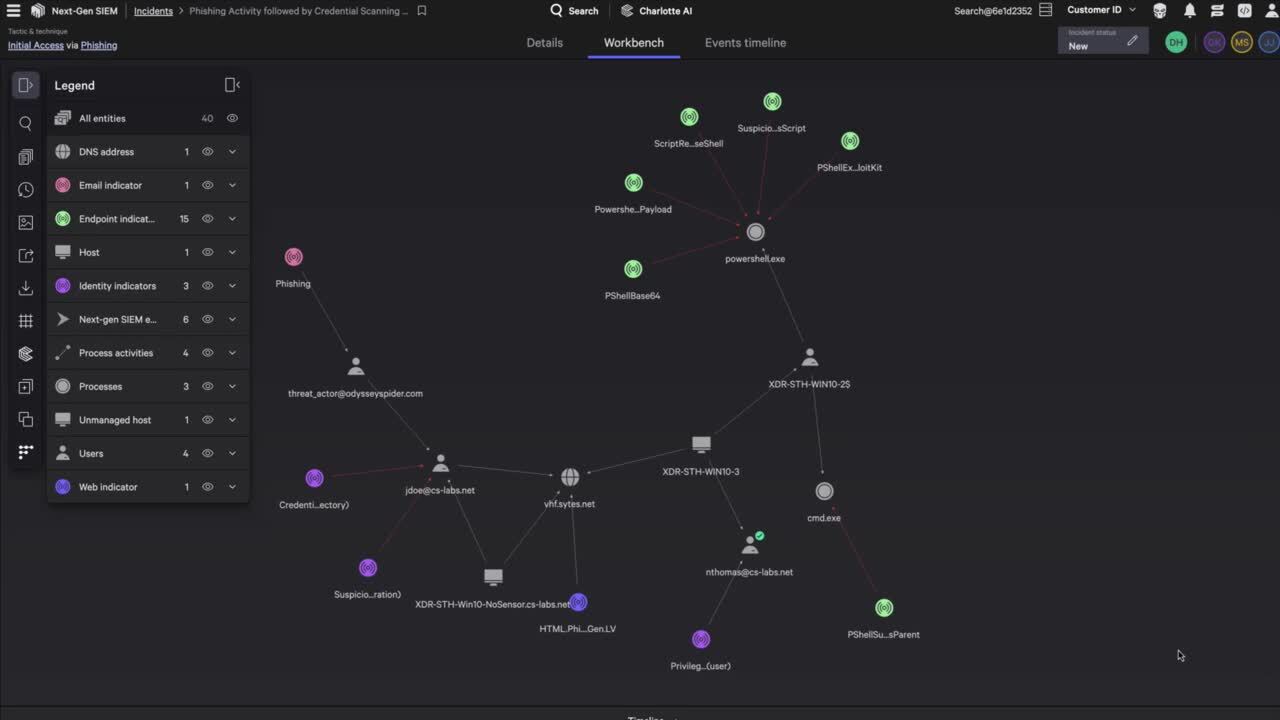
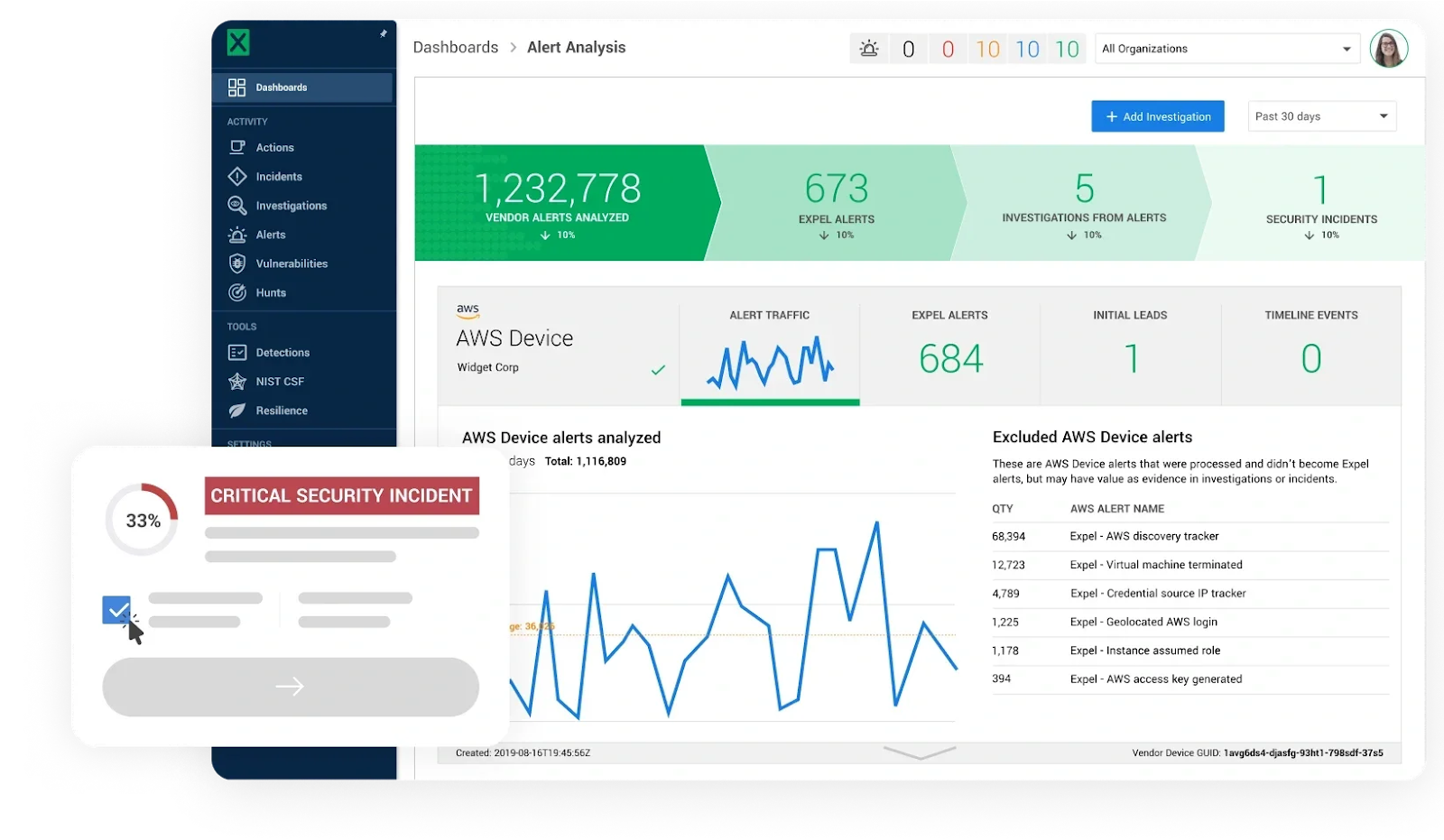
Expel MDR is a 24×7 managed detection and response service that connects to an organization’s existing security tools through Expel Workbench. Ruxie, Expel’s AI and automation engine, gathers evidence, enriches alerts, and triages events, while Expel analysts investigate and make response decisions.
Expel requires no agent deployment and works across endpoint, identity, cloud, network, SaaS, and email. Customers see every investigation and response action in Workbench in real time, with a mean time to remediate of about 15 minutes.
Key features include:
- Vendor-agnostic integrations: Connects to 160+ security tools, many via API, including Microsoft, AWS, Google Cloud, CrowdStrike, Okta, and Wiz.
- Ruxie AI triage and investigation: Uses agentic workflows to extract, evaluate, and classify data, delivering pre-enriched alerts and context to analysts.
- Cross-surface detection engineering: Detection engineers use AI agents to build rules that correlate activity across attack surfaces and close coverage gaps.
- Auto remediation: Executes targeted containment actions on verified threats and generates plain-language audit trails.
- Workbench transparency: Shows every investigation and response in real time, with metrics including MTTD, MTTR, true positive rate, and auto remediation actions.
- SIEM coverage: Pulls SIEM data into Workbench or provides fully managed SIEM services.
- Threat hunting and guidance: Includes hypothesis-driven threat hunts, threat intelligence bulletins, and regular strategic reviews.
Limitations (as reported by users on G2):
- Integration depth: Users report that some integrations lack full functionality and some requested features take time to roll out.
- Ruxie speed: A reviewer notes that Ruxie detections can take longer than expected.
- Onboarding: Some users mention issues when Expel first onboards security tools.
- Pricing: Reviewers describe pricing as premium.
- Reporting flexibility: Users mention limited customization in reporting and tuning transparency.

Source: Expel
8. Prophet Security

Best for: Teams that want AI alert investigation with optional 24/7 experts
Strengths: Investigates every alert, auditable reasoning, Watchtower backup.
Gartner Peer Insights rating: 4.9/5
Things to consider: Watchtower 24/7 human coverage is an optional add-on
Prophet AI SOC Analyst investigates every alert at every severity as it arrives. It plans each investigation dynamically, queries SIEM, EDR, identity, cloud, and email tools, and returns a determination with documented evidence and reasoning.
Prophet AI Watchtower is an optional 24x7x365 human-in-the-loop service. Watchtower analysts engage within 30 minutes on malicious or inconclusive determinations, scope impact, guide or run response, and train Prophet AI on the customer’s environment.
Key features include:
- Dynamic investigations: Summarizes each alert, extracts artifacts, plans investigative questions, and runs them across connected security tools in parallel.
- Auditable evidence trail: Documents every question asked, query run, and reasoning step so analysts can verify how a determination was reached.
- Incident grouping: Groups related investigations into a single incident to present campaigns as one story.
- Scoped auto remediation: Executes permissioned actions, from notifications to quarantining a machine, which are previewed and backtested against historical data before running.
- Plain-language guidance: Teams can teach Prophet AI their playbooks and policies, with changes previewed and backtested before they apply.
- Watchtower human coverage: Analysts handle malicious or inconclusive determinations 24/7, escalate through Slack, Teams, or email, and can execute containment with rollback plans.
- Integrations: Connects with SIEMs, security data lakes, threat intelligence feeds, and case management tools, with notifications in Slack, Teams, or webhooks.
Limitations (based on publicly available sources):
- Limited review base: G2 does not yet have enough reviews to provide buying insight, so independent user feedback is limited.
- Legacy environment support: Integration support for niche or legacy on-premises environments is still expanding.
- Dependence on upstream alerts: Investigations rely on alerts from existing detection tools such as SIEM, EDR, and email security.
- Optional human tier: 24/7 human review requires adding the Watchtower service on top of the AI SOC Analyst.

Source: Prophet Security

Conclusion
Trusted AI SOC solutions provide continuous threat detection, automated alert triage, and faster incident response across endpoints, identities, networks, and cloud environments. Organizations should evaluate solutions based on behavioral analytics, telemetry coverage, investigation accuracy, response automation, and integration with existing security tools. AI agents can reduce repetitive analyst workloads and correlate suspicious activity across multiple systems, but their findings must remain verifiable through supporting evidence. Human oversight is especially important for uncertain investigations and high-impact containment decisions.
Learn More About Exabeam
Learn about the Exabeam platform and expand your knowledge of information security with our collection of white papers, podcasts, webinars, and more.
- Webinar
The Insider Risk Program Just Got Bigger: How Digital Workers Are Changing Identity, Behavior, Ownership, and...
-
 Blog
What Is the Difference Between Exabeam and CrowdStrike for SIEM and Security Operations?
- Show More