Table of Contents
What Is UEBA Software?
UEBA (User and Entity Behavior Analytics) software is a cybersecurity solution that uses machine learning and behavioral analytics to detect threats, including insider threats and account takeovers, by establishing a baseline of normal user and entity behavior and then flagging deviations that indicate risk.
Key benefits include advanced threat detection, reduced alert fatigue through risk-based prioritization, and lower organizational risk by enabling early detection of both known and unknown threats.
How UEBA software works:
- Context and storytelling: UEBA platforms often provide context and build “timelines” of user activities to help security teams understand and articulate threats, improving investigative efficiency.
- Baseline establishment: The software learns and creates a profile of normal behavior for individual users and system entities (e.g., devices, servers).
- Data ingestion and analysis: It collects and analyzes vast amounts of data from various security sources, including logs and events.
- Anomaly detection: It continuously monitors current activities, comparing them against established baselines to identify suspicious or anomalous behaviors.
- Threat prioritization: Alerts are triggered for high-risk activities, reducing false positives and helping security teams focus on critical threats.
Editor’s note: Updated the article to cover recent market trends, updated product information to reflect features and capabilities in 2026, and added 2 new tools.
UEBA Software Market Trends
The user and entity behavior analytics market is valued at approximately USD 0.41 billion and is expected to grow to USD 14.18 billion by 2035. This represents a compound annual growth rate of 38.0% over the forecast period.
This level of growth indicates that UEBA is moving from a niche capability to a core component of modern security architectures. Organizations are allocating more budget to tools that go beyond rule-based detection. Instead, they are investing in systems that can continuously learn and adapt to user behavior. The large increase in market size also suggests that adoption is spreading across industries, not just limited to highly regulated sectors.
Key Growth Drivers
The rise in sophisticated cyber threats is one of the main drivers behind UEBA adoption. Attackers are increasingly using legitimate credentials and subtle techniques, making traditional detection methods less effective. UEBA helps address this by identifying unusual behavior patterns rather than relying only on known attack signatures.
Regulatory pressure is another key factor. Laws and frameworks such as data protection and privacy regulations require organizations to monitor user activity and detect potential misuse of sensitive data. UEBA tools support these requirements by providing visibility into how users interact with systems and data.
The shift to remote and hybrid work has also increased demand. Users now access systems from different locations and devices, which expands the attack surface. UEBA solutions help track this distributed activity and identify suspicious behavior regardless of where it originates. Additionally, insider threats—both malicious and accidental—are becoming a larger concern, further driving adoption.
Technology Trends
Artificial intelligence and machine learning are central to how UEBA solutions are evolving. These technologies allow systems to process large volumes of data from multiple sources and identify patterns that would be difficult to detect manually. As a result, organizations can detect threats earlier and respond faster.
Machine learning models continuously refine behavioral baselines as new data is collected. This improves accuracy over time and reduces false positives. AI-driven analytics also enable more context-aware detection, where user actions are evaluated based on historical behavior, peer groups, and environmental factors.
How UEBA Software Works
Establishing Baselines
The UEBA solution must first establish behavioral baselines for users and entities. These baselines are derived by continuously monitoring activities such as login times, file accesses, resource consumption, and communication patterns over an initial learning period. By analyzing these actions, the system constructs a profile of what is considered typical behavior for each user and device in the environment.
Once these baselines are in place, the software regularly updates them to account for normal changes in behavior, such as job role modifications or seasonal business fluctuations. By keeping the baselines current, UEBA increases detection accuracy and minimizes false positives, ensuring that only genuinely unusual and risky activities trigger investigation or intervention from the security team.
Data Ingestion and Analysis
UEBA relies on ingesting data from a vast range of sources across the organization, including system logs, network traffic, authentication records, and cloud application activity. This data input feeds into the core analytics engine, providing the foundation for comprehensive behavior analysis. Modern UEBA solutions integrate with security information and event management (SIEM) platforms or directly with endpoints and network devices to maximize visibility.
Once the data is collected, the analysis component applies algorithms that sort, correlate, and prepare the information for behavioral analytics. Sophisticated data analysis allows the solution to compare events across different times, departments, and device types, uncovering subtle patterns or interactions that might not be evident from a single dataset.
Anomaly Detection
By referencing established baselines, the system continuously evaluates live data for unusual activity patterns such as off-hour logins, sudden permission changes, or unexpected data movement. These deviations are flagged as anomalies, prompting further investigation by security teams.
Not all anomalies are malicious, so UEBA systems use statistical modeling and machine learning to classify and score the detected anomalies. Contextual factors, such as recent role changes or maintenance activity, are considered to reduce noise and improve detection relevance. Over time, the software refines its anomaly detection models to better distinguish genuine threats from benign outliers, resulting in more actionable alerts.
Threat Prioritization
After anomalies are detected, UEBA assigns risk scores to each suspicious event, prioritizing those that pose the greatest threat. This scoring is based on several factors: the type of anomaly, the criticality of the affected assets, and the potential business impact. The result is a list of prioritized threats, allowing security operations centers (SOCs) to focus resources on the most significant risks rather than sifting through a high volume of alerts.
By correlating incidents and analyzing historical context, UEBA systems can also track the progression of advanced attacks. Prioritization mechanisms often rely on artificial intelligence to recognize escalation patterns, such as lateral movement and privilege escalation. This approach ensures critical events are addressed promptly.
Context and Storytelling
UEBA enhances traditional alerting by providing context and building incident narratives, often referred to as “storytelling.” Rather than sending isolated alerts, the software correlates multiple events over time, such as a series of unusual logins, followed by data exfiltration attempts, to craft a timeline of threat actor behavior. This contextual approach provides security teams with actionable intelligence, making investigations quicker and more efficient.
These incident narratives help differentiate between isolated anomalies and larger coordinated attacks. With a clear story that ties actions together, responders gain a broader view of the attack chain, improving both their understanding and response to threats. Effective storytelling allows analysts to reduce time spent on manual data correlation and prioritize actions based on the complete threat picture.
Notable UEBA Software
1. Exabeam

Exabeam is a behavioral analytics–driven SIEM platform that delivers advanced UEBA capabilities to detect insider threats, credential misuse, and lateral movement across hybrid and cloud environments. It combines scalable data collection, risk-based analytics, and automation to enhance visibility and speed across detection and investigation workflows.
General features:
- Data ingestion and normalization: Collects and standardizes logs from identity systems, endpoints, cloud applications, and network devices for unified visibility and correlation.
- Automated investigation timelines: Builds contextual, time-ordered narratives of user and entity activity to accelerate investigations and reduce manual triage.
- Integrated automation: Uses SOAR-driven playbooks to orchestrate containment and remediation actions, reducing analyst workload and response time.
UEBA features:
- Peer group analysis: Compares user activity against department- or role-based peer groups to surface subtle deviations that indicate compromised or malicious insiders.
- Behavioral analytics engine: Establishes dynamic baselines for users, devices, and service accounts to detect anomalies such as privilege escalation, data exfiltration, or unusual access patterns.
- Risk-based scoring and prioritization: Assigns weighted risk scores to anomalies using contextual signals, enabling analysts to focus on the most relevant and high-impact threats.
- Entity correlation and context building: Links related user, endpoint, and network activities into a single behavioral storyline for more accurate detection of complex threats.
2. Microsoft Sentinel

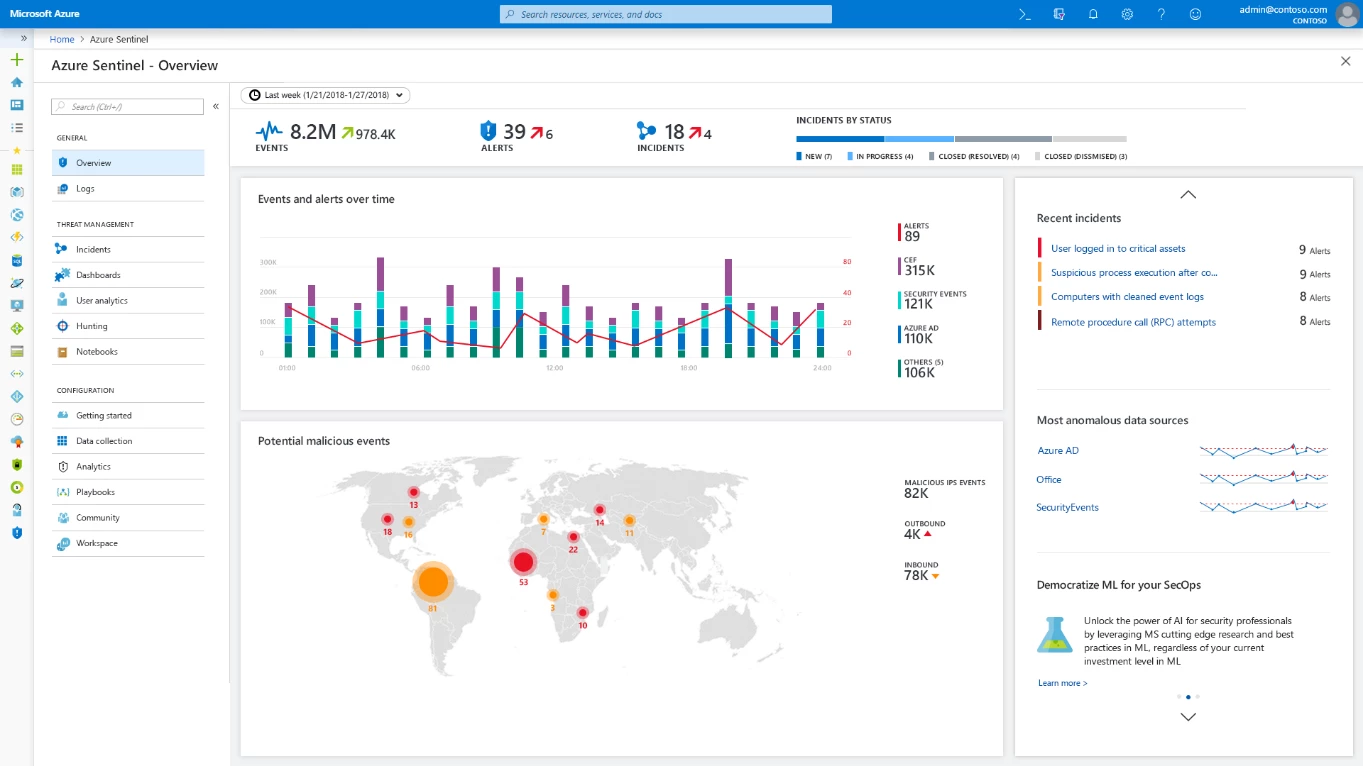
Microsoft Sentinel is a cloud-native SIEM platform that integrates UEBA capabilities with AI-driven analytics, automation, and large-scale data processing. It centralizes telemetry from multiple environments and applies behavioral analysis, correlation, and machine learning to detect anomalies and investigate threats across users, devices, and applications.
General features:
- Cloud-native SIEM architecture: Centralizes security operations using a scalable platform with integrated analytics and automation.
- Unified data lake: Stores and processes large volumes of telemetry data for analysis and detection.
- AI-driven detection and response: Applies machine learning and automation to improve detection accuracy and response speed.
- Broad data integration: Connects to hundreds of data sources across cloud, on-prem, and third-party environments.
- Native XDR integration: Provides unified visibility and control across detection and response workflows.
UEBA features:
- Behavioral analytics integration: Combines UEBA with SIEM to analyze user and entity behavior across environments.
- Anomaly detection with machine learning: Identifies deviations from normal activity using AI-driven analytics.
- Entity-based investigation: Uses graph-based context to explore relationships between users, devices, and activities.
- Threat correlation across signals: Links behavioral anomalies with other security data to improve detection accuracy.
- AI-assisted investigation: Uses generative AI to summarize incidents and guide response actions.

Source: Microsoft
3. Splunk

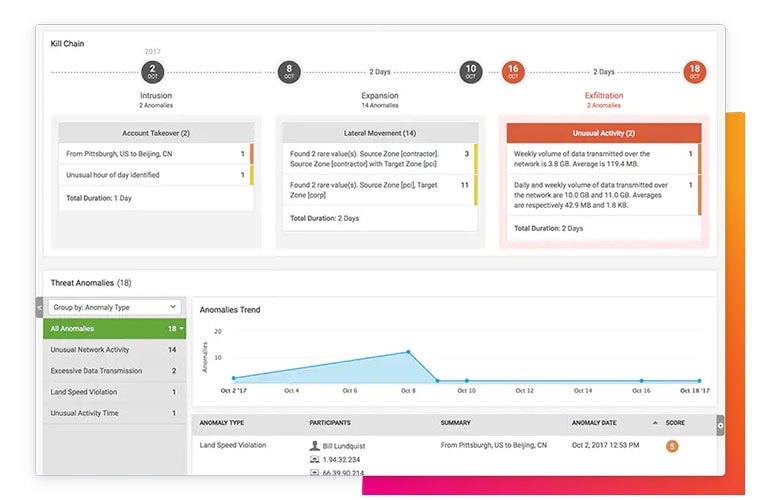
Splunk User Behavior Analytics is a machine learning-based solution that detects insider threats and advanced attacks by analyzing behavior across users, devices, and applications. It builds dynamic behavioral baselines and correlates activity across multiple entities to identify subtle anomalies and prioritize risks within security operations workflows.
General features:
- Unified security operations integration: Works within a broader platform to combine detection, investigation, and response.
- Automated threat detection: Uses machine learning to continuously monitor and identify suspicious activity.
- Noise reduction mechanisms: Filters large volumes of events to highlight the most relevant threats.
- Contextual visibility: Aggregates data across systems to provide a complete view of security events.
- Integrated workflows: Connects detections to centralized investigation and response processes.
UEBA features:
- Behavioral baselining: Learns normal activity patterns for users and entities to detect deviations.
- Entity risk scoring: Aggregates risk signals into a single score to prioritize threats.
- Multi-entity correlation: Identifies complex attack patterns by linking activity across users, devices, and applications.
- Contextual threat intelligence: Enriches alerts with historical behavior, peer comparisons, and metadata.
- Automated prioritization: Ranks threats based on risk level to reduce alert fatigue and improve response efficiency.

Source: Splunk
4. Rapid7

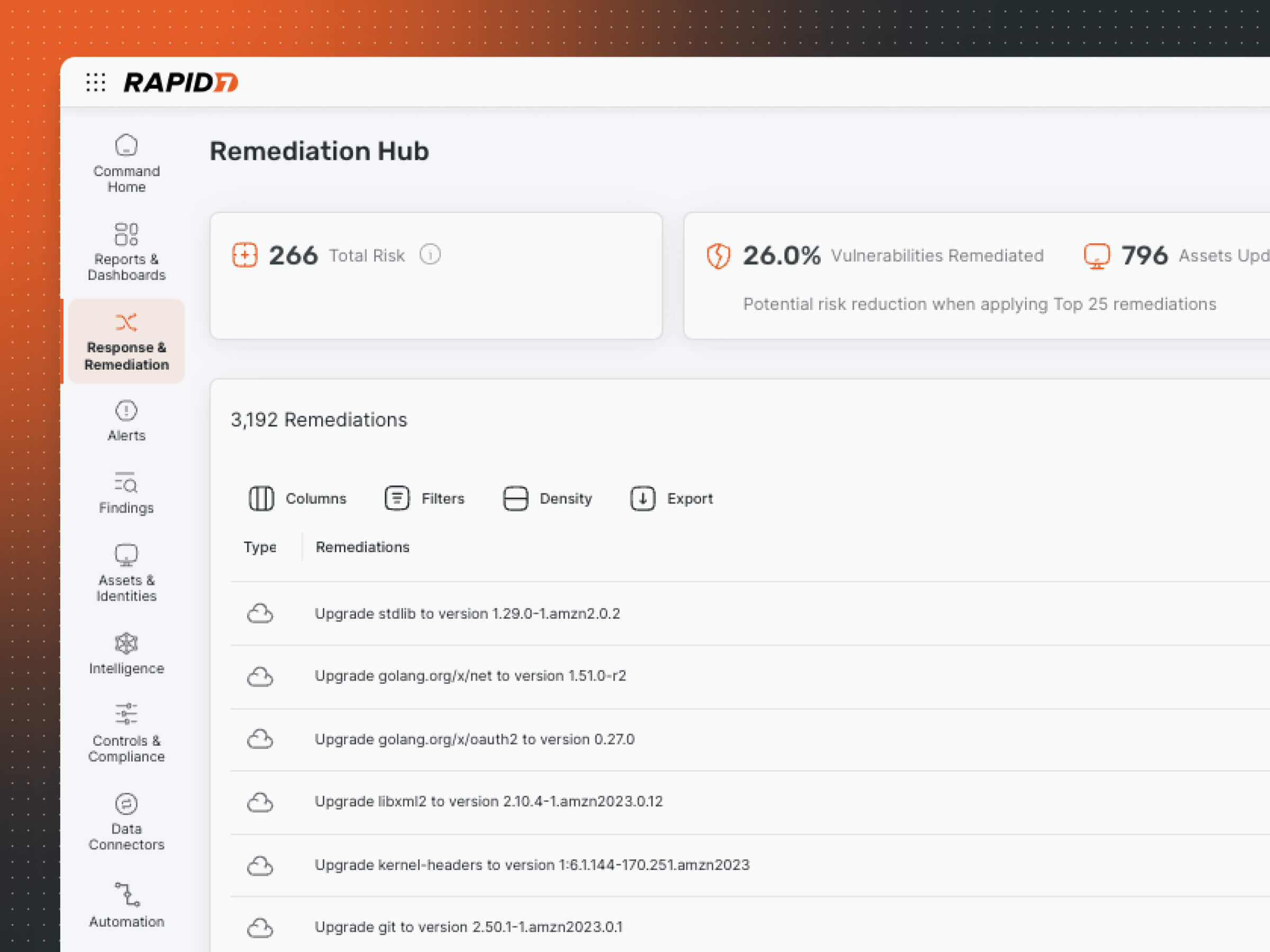
Rapid7 Incident Command is a cloud-based security platform that incorporates UEBA techniques to improve threat detection and response. It focuses on connecting activity to users and assets rather than isolated indicators, enabling more accurate validation and investigation of suspicious behavior across environments.
General features:
- Unified security platform: Provides visibility across endpoints, cloud, and infrastructure within a single system.
- Cloud-native scalability: Processes large volumes of data without requiring on-premises infrastructure.
- Integrated threat intelligence: Uses research and external intelligence to enhance detection and response.
- End-to-end visibility: Tracks activity across the full attack surface to support investigation.
- Continuous monitoring: Enables ongoing detection and response to emerging threats.
UEBA features:
- User and asset correlation: Links activities to specific users and systems for clearer investigation context.
- Behavior-based detection: Identifies suspicious actions associated with attacker techniques.
- Contextual alerting: Provides detailed insight into who performed an action and where it occurred.
- Attack pattern recognition: Detects behaviors such as credential misuse and lateral movement.
- Improved investigation accuracy: Uses behavioral context to reduce false positives and validate threats.

Source: Rapid7
5. ManageEngine Log360

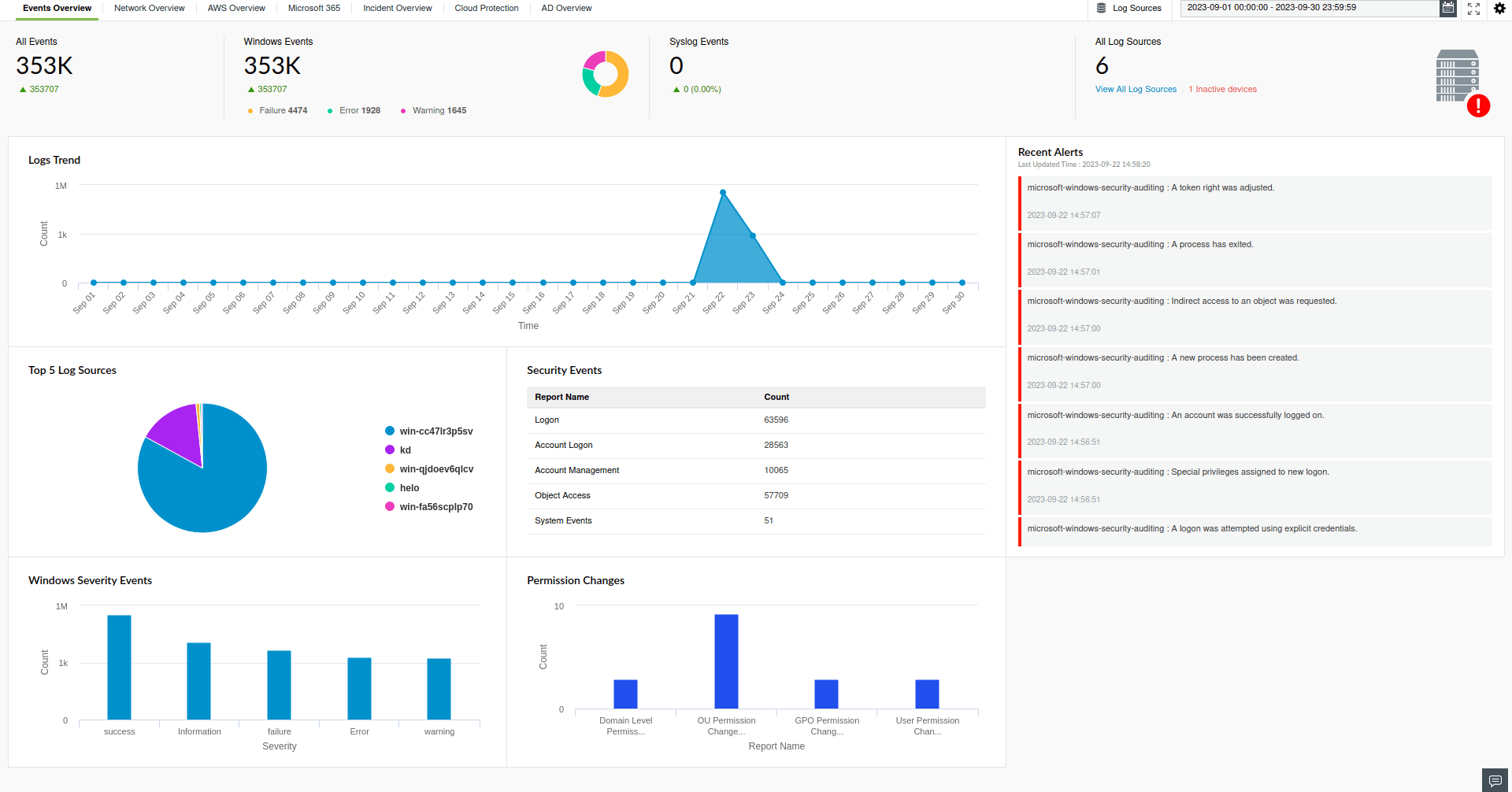
ManageEngine Log360 is a unified SIEM platform that incorporates UEBA to detect insider threats and anomalous behavior across hybrid environments. It combines centralized log management, AI-driven analytics, and automated workflows to improve visibility and simplify security operations.
General features:
- Centralized log management: Collects and analyzes logs from diverse systems through a single interface.
- Integrated incident workbench: Provides contextual investigation tools with visual timelines and correlated data.
- Automated response workflows: Uses predefined playbooks to orchestrate incident response.
- Threat intelligence enrichment: Enhances detection with external threat data and contextual insights.
- Scalable data ingestion: Supports high-volume data processing across complex environments.
UEBA features:
- AI-driven behavioral analytics: Continuously analyzes user activity to detect anomalies and insider threats.
- Dynamic peer grouping: Compares behavior against similar users to improve anomaly detection accuracy.
- User identity mapping: Links activities to identities for better context and investigation.
- Adaptive anomaly detection: Uses machine learning to adjust thresholds based on evolving behavior patterns.
- Risk-based prioritization: Focuses attention on high-risk activities to reduce alert fatigue.

Source: ManageEngine
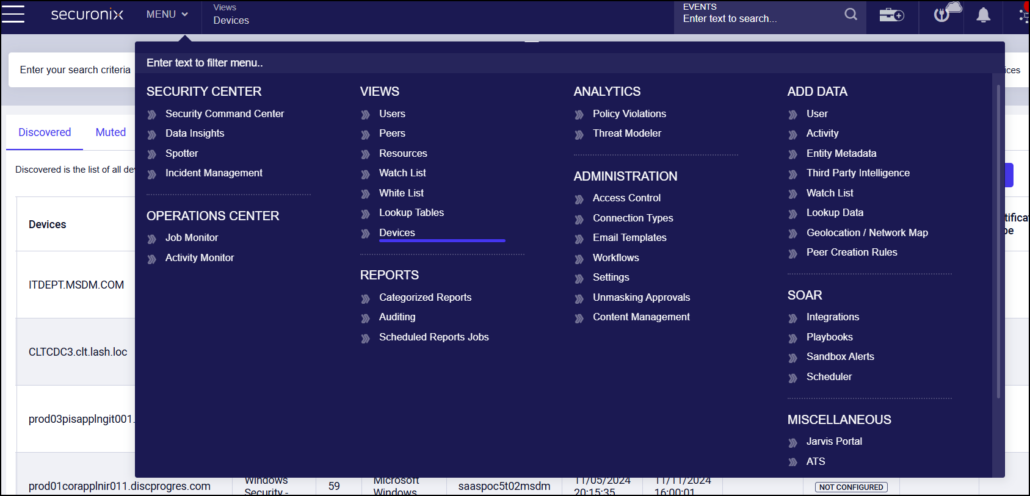
6. Securonix

Securonix is a cloud-native security analytics platform that integrates UEBA with AI-driven detection, investigation, and response. It uses a system of coordinated analytics and automation to process behavioral data, enrich alerts with context, and guide security teams through investigation and remediation workflows.
General features:
- Cloud-native SIEM platform: Unifies analytics, threat intelligence, and response in a scalable architecture.
- Integrated AI-driven workflows: Uses AI to automate detection, investigation, and response processes.
- Unified data processing: Correlates data across multiple sources for comprehensive visibility.
- Automated alert triage: Reduces manual effort by prioritizing and organizing alerts.
- Contextual investigation support: Provides summaries and guidance to accelerate analysis.
UEBA features:
- Behavioral anomaly detection: Identifies deviations in user and entity activity using AI-driven analytics.
- Contextual enrichment: Combines identity, behavior, and threat intelligence data for deeper insights.
- Automated risk prioritization: Highlights high-risk activities to improve response focus.
- Continuous learning models: Adapts detection based on evolving behavior patterns.
- Integrated investigation workflows: Connects behavioral insights directly to response actions.

Source: Securonix
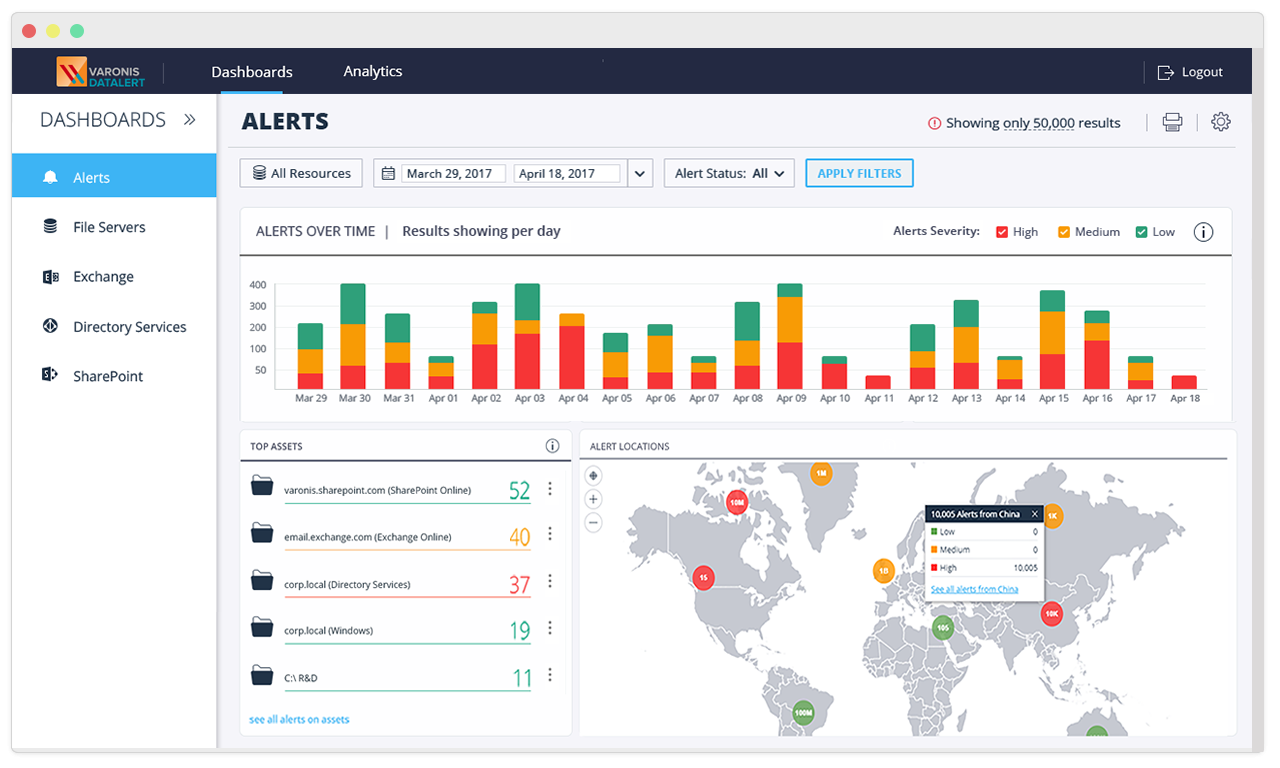
7. Varonis Data Security Platform

Varonis is a data-centric security platform that includes UEBA capabilities to monitor and protect sensitive data. It focuses on analyzing how users interact with data, detecting abnormal access patterns, and automatically reducing risk through enforcement and remediation actions.
General features:
- Data discovery and classification: Identifies and labels sensitive data across environments.
- Centralized data security platform: Provides visibility and control over data access and usage.
- Automated remediation: Applies policies and controls to reduce data exposure and risk.
- Cross-environment coverage: Monitors data across cloud, SaaS, and on-prem systems.
- Continuous monitoring: Tracks data access and usage in real time.
UEBA features:
- Data-centric behavioral analytics: Monitors how users interact with sensitive data to detect anomalies.
- Real-time threat detection: Identifies suspicious access patterns and potential data misuse.
- User activity monitoring: Tracks file access and permission changes to detect insider threats.
- Anomaly-based alerting: Flags unusual data access behavior for investigation.
- Integrated incident response support: Combines detection with automated actions to prevent data loss.

Source: Varonis
Related content: Read our guide to UEBA tools
Conclusion
UEBA software strengthens security operations by focusing on behavior rather than static rules or signatures. By continuously learning what is normal and flagging deviations, UEBA detects insider threats, account compromises, and advanced attacks that bypass traditional defenses. Its ability to prioritize risks and provide contextual timelines allows security teams to respond faster and more accurately, reducing organizational exposure to both known and unknown threats.
Learn More About Exabeam
Learn about the Exabeam platform and expand your knowledge of information security with our collection of white papers, podcasts, webinars, and more.