


Best Cyber Risk Management Solutions: Top 5 in 2026
- 9 minutes to read
Table of Contents
What Are Cyber Risk Management Solutions?
Cyber risk management solutions are platforms and services that help organizations identify, assess, prioritize, and mitigate digital threats by providing visibility into assets, vulnerabilities, and the overall threat landscape, often using automation, AI, and risk quantification for better decision-making, compliance (like NIST/ISO), and strategic planning.
Key features include centralized dashboards, risk scoring, compliance tracking (SOC 2, HIPAA), third-party risk management, and automated reporting for executive insights. Popular solutions include RSA Archer, OneTrust, and MetricStream. Behind the scenes, cyber risk management solutions are powered by SIEM platforms like Exabeam.
Core functions of cyber risk solutions:
- Asset discovery and visibility: Continuously maps your entire attack surface, including unknown or third-party assets.
- Risk assessment and quantification: Identifies vulnerabilities and calculates risk based on asset criticality and threat likelihood, often using financial metrics.
- Prioritization: Highlights the most critical risks and vulnerabilities to focus resources effectively.
- Mitigation and automation: Simplifies workflows for remediation and task assignment, reducing response time.
- Compliance and reporting: Aligns security controls with frameworks (NIST, ISO 27001, GDPR) and automates evidence collection for audits.
- Threat intelligence integration: Pulls in external threat data for a more comprehensive view.
- Third-party risk management (TPRM) : Assesses the security posture of vendors and supply chain partners.
This is part of a series of articles about information security
Benefits of Cyber Risk Management Solutions
Cyber risk management solutions offer tangible advantages that help organizations strengthen their security operations while aligning with business goals. Here are the key benefits:
- Centralized visibility: Consolidate risk-related data across assets, applications, and users, providing a unified view of an organization’s threat landscape.
- Risk prioritization: Use automated scoring and contextual data to rank vulnerabilities and threats by business impact, ensuring teams focus on the most critical issues.
- Regulatory compliance support: Map controls to common frameworks (e.g., NIST, ISO, GDPR) and automate evidence collection for audits, reducing compliance burdens.
- Real-time monitoring: Continuously track risk posture with integrations into threat intelligence feeds, SIEMs, and other security tools to detect and respond to emerging risks quickly.
- Operational efficiency: Replace manual assessments and spreadsheets with automated workflows and dashboards that save time and reduce human error.
- Improved communication: Translate technical risk into business terms through visual reporting and metrics that can be shared with executives and stakeholders.
- Adaptive risk strategies: Enable dynamic risk assessments and automated policy updates as the environment or threat landscape changes.
Related content: Read our guide to cyber risk management framework (coming soon)
Core Functions of Cyber Risk Solutions
Asset Discovery and Visibility
Automated asset discovery tools continuously scan networks to identify both managed and unmanaged devices, providing the security team with accurate maps of the organization’s digital assets. This visibility is especially critical in large or distributed enterprises where shadow IT and unnoticed new assets can introduce significant risks.
With comprehensive asset visibility, organizations can move beyond static asset lists and enable dynamic risk assessments. Continuous tracking of assets allows for the detection of unauthorized devices, unpatched systems, or misconfigurations as soon as they appear.
Risk Assessment and Quantification
Risk assessment and quantification provide the methodologies and tools needed to measure the likelihood and impact of potential cyber threats. These solutions use data from vulnerability scans, threat intelligence feeds, and configuration reviews to identify and categorize risks across the environment. Advanced platforms support both qualitative and quantitative risk analysis, translating technical vulnerabilities into business impact metrics.
Quantification allows organizations to prioritize risks based on potential financial, operational, or reputational consequences. This supports better decision-making by senior management and enables cybersecurity leaders to communicate risk in terms that are understandable to business stakeholders.
Prioritization
Prioritization ensures limited cybersecurity resources are directed at the most pressing threats. Cyber risk management solutions incorporate risk scoring, asset criticality, and exposure analytics to create clear risk rankings. Automated prioritization features help teams focus on vulnerabilities or threats that could have the greatest impact, reducing the likelihood of costly incidents.
Effective prioritization also improves stakeholder alignment by shifting conversations away from a long and overwhelming list of issues to a focused set of actionable items. Security and IT teams can justify why specific risks require immediate action while others can be monitored or deferred.
Mitigation and Automation
Mitigation and automation capabilities enable organizations to respond rapidly to identified cyber risks, reducing the window of opportunity for attackers. Many cyber risk management solutions offer guided mitigation workflows, playbooks, and automated ticketing, ensuring that vulnerabilities or misconfigurations are addressed effectively and in accordance with internal policies.
With automation, repetitive processes such as vulnerability triage, alerting, or compliance checks can be executed with minimal manual intervention. This allows security teams to scale their response to risk across large, complex environments without adding significant headcount.
Compliance and Reporting
Compliance and reporting features help organizations navigate a landscape of evolving regulations and standards. These platforms map technical controls to compliance requirements, automate evidence gathering, and generate detailed reports for audits or executive oversight. Customizable dashboards and reporting templates simplify communication with both technical and non-technical stakeholders.
Automating compliance management reduces the burden on security teams and minimizes the risk of human error. Centralized documentation and continuous compliance monitoring also make it easier for organizations to demonstrate adherence to regulations or industry standards in response to customer inquiries, audits, or regulatory reviews.
Threat Intelligence Integration
Threat intelligence integration enhances cyber risk management by providing context-aware insights into the latest tactics, techniques, and procedures used by threat actors. By ingesting external intelligence feeds, solutions can correlate internal vulnerabilities and exposures with active exploit campaigns, helping organizations anticipate and prepare for targeted attacks.
Effective integration of threat intelligence also allows organizations to adjust risk scores, prioritize patching, and adapt controls based on the most relevant threats. Rather than managing risks in isolation, companies benefit from a global perspective, enabling a more proactive stance against both general and sector-specific risks.
Third-Party Risk Management (TPRM)
Third-party risk management (TPRM) addresses the growing risks associated with vendors, suppliers, and other external partners. Cyber risk management solutions extend visibility and assessments beyond the boundaries of an organization’s own network, evaluating third parties for vulnerabilities, compliance levels, or breaches.
These assessments can include standardized questionnaires, integrations with security ratings platforms, and automated evidence collection. By managing third-party risks within the same platform used for internal assets, organizations gain a unified view of their overall exposure, including supply chain dependencies.
Key Factors to Consider When Selecting a Cyber Risk Management Solution
Selecting the right cyber risk management solution requires evaluating how well it aligns with your organization’s security needs, infrastructure, and regulatory obligations. The right tool should not only address current risks but also scale with your evolving threat landscape and compliance requirements. Below are the key factors to consider:
- Integration with existing tools: Ensure the solution can integrate with your current IT, security, and compliance systems (e.g., SIEMs, vulnerability scanners, ITSM platforms) to provide unified workflows and reduce silos.
- Scalability and flexibility: Choose a platform that can scale with your business growth and adapt to different risk domains, such as operational risk, third-party risk, and cloud security.
- Risk quantification capabilities: Look for solutions that support quantitative risk analysis (e.g., FAIR model) to communicate risk in financial terms and drive business-aligned decision-making.
- Automation and workflow management: Evaluate how well the tool supports automated assessments, alerts, remediation actions, and compliance tasks to reduce manual workload and human error.
- Customization and usability: Ensure the platform allows configurable risk models, dashboards, and reporting views to match your organization’s structure and stakeholder needs.
- Compliance framework support: Verify support for key regulatory frameworks (e.g., NIST, ISO, GDPR, HIPAA) and the ability to automate evidence collection and reporting for audits.
- Third-party risk management: If you depend on external vendors or partners, prioritize solutions that offer strong TPRM features such as automated assessments, risk scoring, and continuous monitoring.
- Real-time threat intelligence: Opt for platforms that incorporate external threat intelligence and correlate it with internal risk data for timely and contextual risk insights.
- User and role-based access control: Ensure the system can enforce granular access controls and role-based permissions to protect sensitive risk data.
- Vendor maturity and support: Consider the vendor’s market experience, customer support quality, and roadmap to ensure long-term reliability and feature evolution.
Notable Cyber Risk Management Solutions
1. RSA Archer

RSA Archer is an integrated risk management platform that helps organizations centralize, automate, and scale their approach to risk and compliance. It enables teams to define and manage risk across multiple domains, such as IT, operational, enterprise, and third-party, using a single, unified system. Archer supports both qualitative and quantitative risk analysis.
Key features include:
- Integrated risk management: Centralized platform for managing IT, operational, enterprise, and third-party risks
- AI-driven risk quantification: Uses analytics to assess financial impact and surface high-priority risks
- Regulatory change monitoring: Tracks global regulatory updates and maps them to internal controls
- Audit management: Enables a risk-based approach to audits with end-to-end workflow automation
- Compliance automation: Consolidates compliance efforts and automates evidence collection for audits
2. OneTrust IT Risk Management

OneTrust IT Risk Management helps organizations identify, assess, and mitigate risks across their entire IT and business ecosystem. It maps risk relationships across systems, data, and third parties, allowing teams to understand how vulnerabilities propagate through their infrastructure.
Key features include:
- Comprehensive risk discovery: Identifies vulnerabilities across systems, assets, processes, and vendors
- Risk relationship mapping: Visualizes how risks interconnect across business and IT environments
- Hybrid risk quantification: Balances qualitative inputs with automated quantitative scoring for informed prioritization
- Workflow automation: Simplifies assessments, control evaluations, and remediation activities across departments
- Business engagement: Drives risk ownership through integrated tools that simplify data collection and response tracking
3. MetricStream Cyber Risk Management

MetricStream Cyber Risk Management helps organizations identify, assess, and mitigate cybersecurity risks while ensuring compliance with industry standards and regulations. As part of the broader CyberGRC platform, it provides visibility into IT risk, threats, vulnerabilities, and vendor posture. The solution integrates risk data across business units and IT domains.
Key features include:
- Centralized risk visibility: Maintains a unified repository of cyber risks, assets, controls, and processes, providing a view across the enterprise
- Threat and vulnerability intelligence: Aggregates and prioritizes vulnerabilities based on severity and asset criticality to guide remediation
- Integrated compliance management: Supports multiple regulatory standards (e.g., ISO 27001, NIST) with harmonized control sets and centralized compliance tracking
- Continuous control monitoring: Enables automated testing of cloud security controls to detect weaknesses and strengthen compliance posture
- Cyber risk quantification: Translates cyber threats into business and financial impact using models like FAIR™ to guide strategic decision-making

Source: MetricStream

4. Riskonnect IT Risk Management Software

Riskonnect IT Risk Management Software helps organizations identify, assess, and manage IT and cyber risks while minimizing financial impact. It provides a consolidated view of IT assets, threats, vulnerabilities, and controls, enabling teams to proactively monitor their technology landscape and prevent security incidents.
Key features include:
- Centralized asset and risk visibility: Maintains a unified view of IT assets, associated risks, controls, and ownership details
- Risk and control mapping: Links assets to risks, controls, and regulatory standards to improve assessment and remediation prioritization
- IT risk assessments: Supports assessments against frameworks such as NIST 800-53 to identify gaps and strengthen security posture
- Financial impact analysis: Quantifies the potential financial impact of security incidents to guide risk mitigation decisions
- Threat and vulnerability integration: Connects with third-party tools to track and correlate threat and vulnerability data
5. Centraleyes

Centraleyes is an AI-powered GRC platform to simplify and automate risk and compliance management across internal operations and third-party ecosystems. It enables organizations to replace manual, spreadsheet-driven processes with smart workflows, automated data collection, and real-time dashboards.
Key features include:
- Automated internal risk management: Uses intelligent workflows and pre-loaded questionnaires to simplify assessments and compliance tracking
- Third-party risk oversight: Centralizes vendor assessments, categorization, and prioritization across hundreds of third parties in a single dashboard
- Rapid framework deployment: Supports over 180 integrated frameworks (e.g., NIST, ISO 27001, SOC 2, HIPAA) with shared control mapping for simplified compliance
- Executive board reporting: Provides “Boardview” reporting with business impact insights to inform strategic decision-making
- Real-time dashboards and insights: Visualizes risk and compliance data instantly with auto-updated, interactive dashboards

Source: CentralEyes
6. CyberSaint

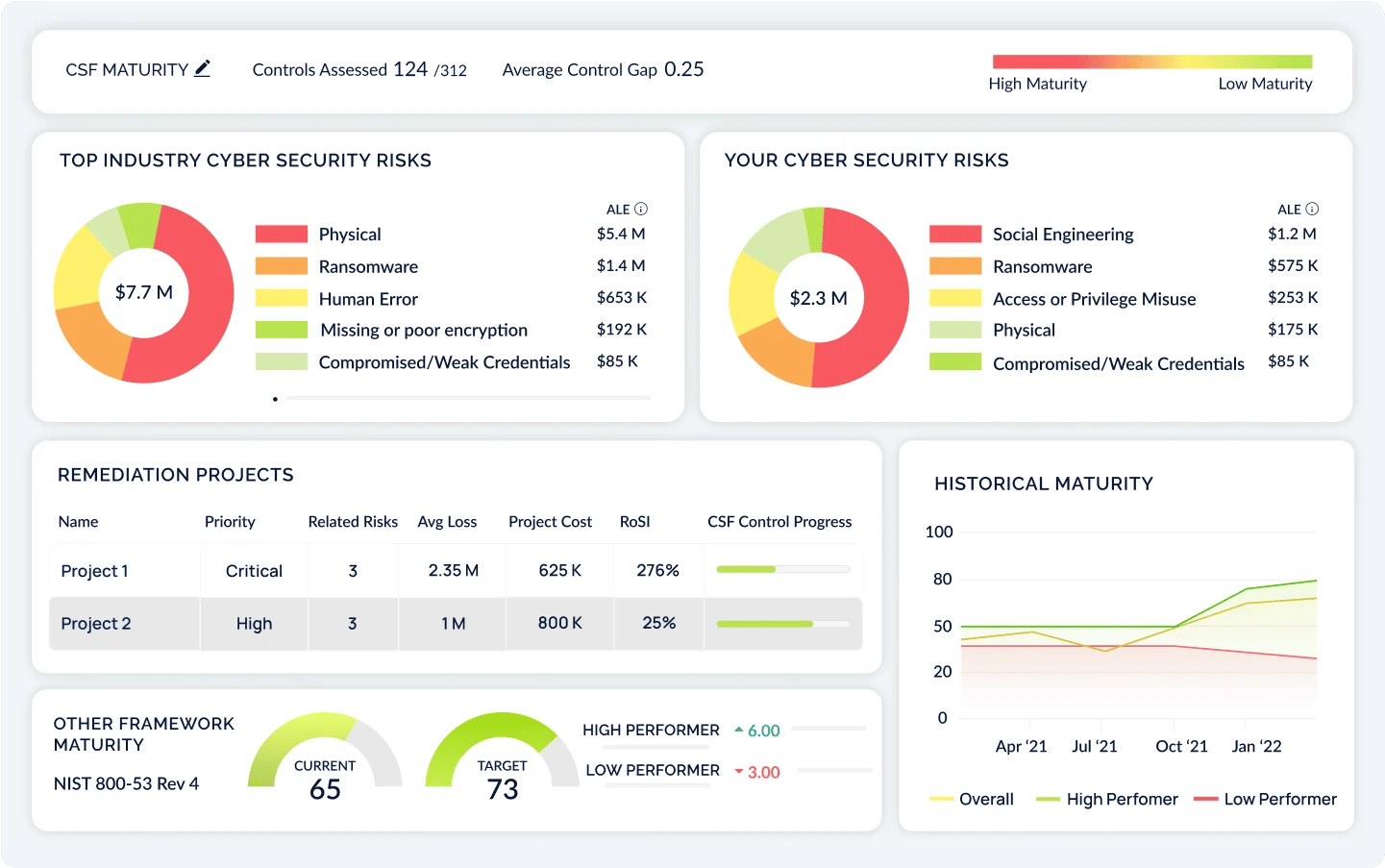
CyberSaint’s CyberStrong platform is an AI-native cyber risk management solution to deliver visibility into an organization’s cyber risk landscape. It integrates with existing tech stacks to automate control monitoring, prioritize findings, and quantify risk using models like FAIR and NIST 800-30.
Key features include:
- AI-powered risk prioritization: Automatically correlates findings with business-critical risks using AI to focus remediation on the most impactful issues
- Industry benchmarking: Uses the largest cyber loss dataset to compare organizational risks against peers by industry, size, and revenue
- Automated control monitoring: Leverages continuous control monitoring and AI agents to assess technical controls and collect evidence, reducing manual effort by over 70%
- Dynamic risk register: Offers heat maps, financial impact visualizations, and risk quantification to support decisions like risk transfer, acceptance, or mitigation
- Cyber risk quantification: Supports transparent, scalable quantification using frameworks like FAIR and NIST, enabling clear understanding of financial exposure

Source: CyberSaint
7. Bitsight

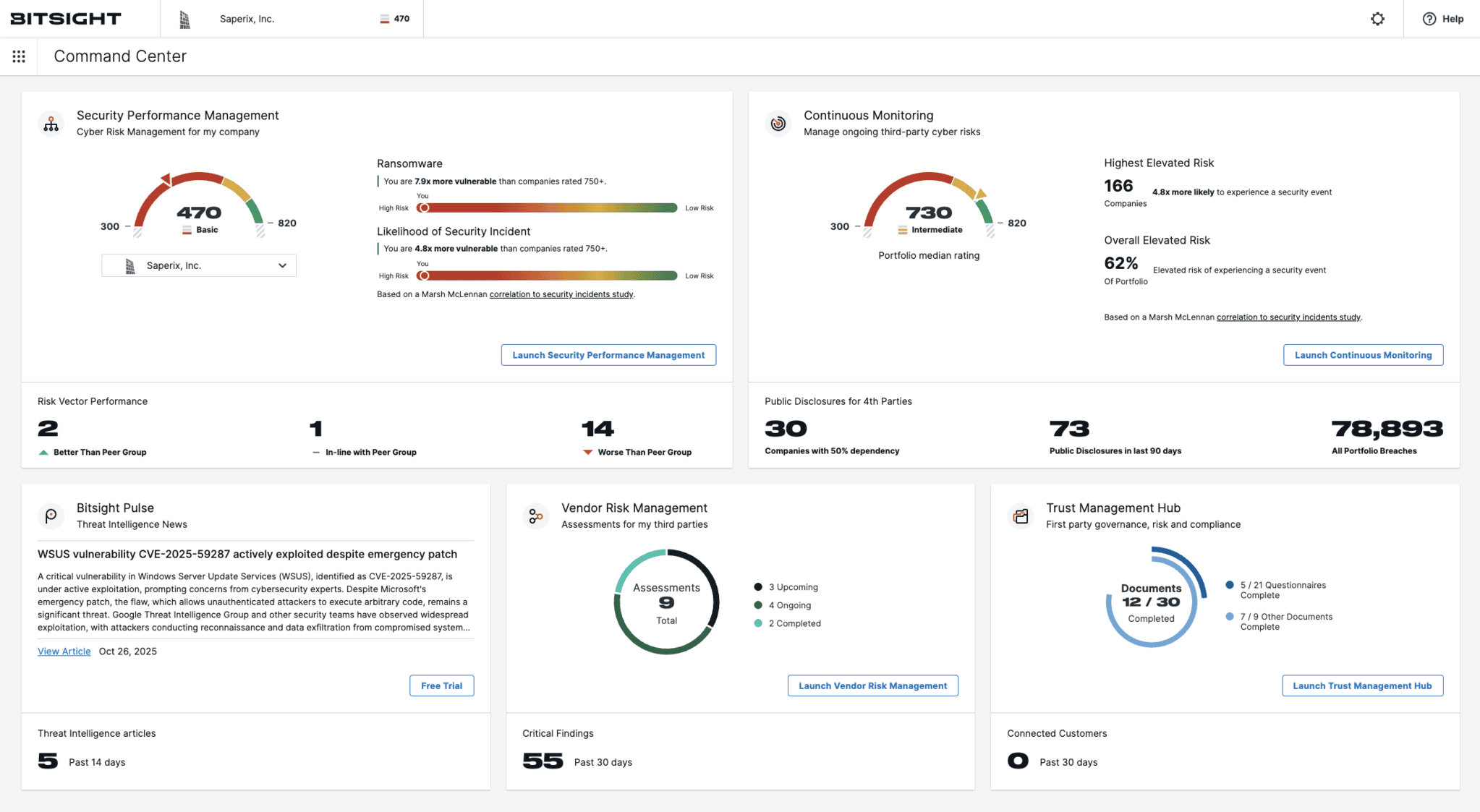
Bitsight is an AI-powered cyber risk intelligence platform that helps organizations detect, prioritize, and mitigate threats across both internal attack surfaces and third-party ecosystems. It combines machine learning with a rich cyber risk dataset to deliver continuous visibility, actionable intelligence, and measurable risk insights.
Key features include:
- Third-party risk management: Continuously monitors vendor security posture, automates evidence mapping to frameworks (e.g., SIG, NIST), and uncovers fourth-party dependencies
- Exposure management: Discovers digital assets, shadow IT, and high-risk areas across the infrastructure to reduce exposure
- Cyber threat intelligence: Analyzes 7 million daily data points from underground sources, delivering insights into threat actors, TTPs, and active campaigns
- Governance & reporting: Provides objective, evidence-based risk metrics to align internal teams and assure stakeholders, with benchmarking against industry peers
- AI-powered threat detection: Uses analytics to prioritize threats and deliver tailored mitigation strategies across the digital ecosystem

Source: Bitsight
How SIEM and Security Analytics Solutions Like Exabeam Power Cyber Risk Management
Security information and event management (SIEM) platforms support cyber risk management by providing real-time visibility into security events across an organization’s infrastructure. SIEMs collect and normalize data from endpoints, servers, firewalls, identity systems, and cloud platforms, enabling centralized detection, correlation, and analysis of suspicious activity.
Exabeam delivers the New-Scale Security Operations Platform, a cloud-native platform that unifies threat detection, investigation, and response (TDIR) with advanced behavioral analytics and machine learning. By ingesting and normalizing security telemetry at scale, the platform identifies anomalous behavior across human users and non-human entities, allowing teams to proactively manage cyber risks before they escalate into breaches.
To help organizations continuously measure and improve their cyber risk posture, the platform includes Outcomes Navigator. This visualization and gap-analysis application shows security teams how well their current log configurations protect them against real-world threats, providing actionable recommendations to optimize detection coverage.
Key capabilities for posture management include:
- Strategic use case mapping: Tracks and visualizes detection coverage across common security use case categories, including compromised credentials, ransomware, data theft, and lateral movement
- MITRE ATT&CK alignment: Measures posture against specific adversary tactics, techniques, and procedures (TTPs) to identify gaps in defense coverage
- OWASP Agentic Top 10 coverage: Evaluates detection preparedness against emerging risks tied to autonomous AI agents, LLM integrations, and modern digital workflows
- Interactive telemetry and log scoring: Analyzes log quality and parsing rules to ensure that enabled detections will actually trigger when a threat occurs
- AI-assisted guidance: Leverages the Exabeam Nova Advisor Agent to provide step-by-step posture improvement recommendations and generate leadership-ready reports
Learn More About Exabeam
Learn about the Exabeam platform and expand your knowledge of information security with our collection of white papers, podcasts, webinars, and more.
-
 Blog
Blog Five Ways Exabeam Delivers Better Detection and Security Outcomes Than Microsoft Sentinel
- Show More