Best Attack Surface Management Tools: Top 10 in 2026
- 9 minutes to read
Table of Contents
What Are Attack Surface Management Tools?
Attack Surface Management (ASM) tools help organizations continuously discover, monitor, and assess all potential entry points (assets, vulnerabilities, misconfigurations) for cyber threats. They include ASM-enhanced SIEM solutions like Exabeam and Rapid7, and dedicated attack surface management solutions like Palo Alto Cortex Xpanse, CrowdStrike Falcon Surface, and CyCognito.
Traditional vulnerability management often focuses on known, internal systems, but ASM tools go beyond by continuously mapping and analyzing the evolving perimeter from an attacker’s viewpoint. As digital environments become more complex and distributed, organizations often lose track of every asset that enters the public domain. ASM tools automate the process of cataloging and monitoring these assets
Key functions of ASM tools:
- Automated discovery: Finds all internet-facing assets (domains, IPs, cloud instances, APIs) and internal systems.
- Continuous monitoring: Scans for new exposures, misconfigurations, and vulnerabilities in real time.
- Risk prioritization: Uses context and threat intelligence to rank risks, helping teams focus on critical issues.
- Attack simulation: Mimics attacker tactics to find weaknesses.
- Remediation guidance: Offers actionable steps to close security gaps.
This is part of a series of articles about information security
Core Functions of Attack Surface Management Tools
Automated Discovery
ASM tools use scanning techniques, asset fingerprinting, and integration with external threat intelligence sources to detect a range of internet-facing assets. This includes domains, subdomains, SSL certificates, APIs, and exposed cloud resources. By automating the detection process, security teams no longer rely on manual, error-prone inventories and can ensure that shadow IT and forgotten assets are uncovered.
Undiscovered assets often represent the weakest link in a security strategy. Automated discovery increases visibility into an organization’s actual attack surface, including those resources that are not formally tracked by IT. With this mapping, organizations can reduce blind spots and stay a step ahead of adversaries who hunt for misconfigured or neglected endpoints.
Continuous Monitoring
Continuous monitoring in ASM solutions provides real-time or near-real-time scrutiny of the organization’s external-facing assets. These tools watch for asset changes, new vulnerabilities, and shifting threats by leveraging automated scanning and monitoring engines. The dynamic nature of modern IT environments, with frequent asset deployments and changes, makes persistent monitoring critical to rapid risk detection and incident response.
This visibility allows organizations to respond quickly to emerging threats, such as accidental data leaks, zero-day exposures, or unauthorized configurations. Continuous monitoring also supports compliance efforts by retaining logs of asset changes and incident alerts, making it easier to generate reports and prove ongoing diligence to auditors and stakeholders.
Risk Prioritization
Risk prioritization is a function of ASM tools, enabling organizations to allocate resources based on the severity and exploitability of vulnerabilities. ASM platforms analyze discovered weaknesses, classify them by risk level, and provide context such as threat likelihood, exposure value, and business impact. This ensures security teams focus efforts on vulnerabilities most likely to be exploited by attackers.
Effective risk prioritization goes beyond basic vulnerability counts. Instead, ASM systems correlate vulnerabilities with real-world threat intelligence, asset criticality, and environmental factors.
Attack Simulation
Attack simulation features in ASM products emulate adversarial tactics and techniques to assess the resilience of external assets against real-world attack methods. These simulations may include automated penetration testing, red teaming exercises, and attempts to exploit discovered vulnerabilities, allowing organizations to gauge the effectiveness of their current security posture without operational disruption.
Through attack simulation, security teams get insights into likely attack paths and the potential impact of successful breaches. The data generated enables them to prioritize defenses, refine incident response plans, and address exploit paths before a threat actor can take advantage.
Remediation Guidance
Remediation guidance bridges the gap between detection and effective risk reduction. Once vulnerabilities or misconfigurations are identified, ASM tools generate clear, prioritized recommendations tailored to the specific asset and risk context. This can include technical steps for patching, configuration changes, or workflow automation for security operations teams to implement fixes efficiently.
By offering contextual remediation information, ASM solutions accelerate vulnerability closure and reduce the potential for recurring issues. Some platforms measure the success of implemented fixes over time and adjust guidance as needed in response to changes in the threat landscape or organizational policy.
Related content: Read our guide to attack surface analysis
Notable Attack Surface Management Solutions
ASM Enhancement with SIEM and Security Analytics Platforms
1. Exabeam

The Exabeam Security Operations Platform combines security log management, SIEM, and behavioral analytics with comprehensive attack surface visibility. Through Attack Surface Insights and Agent Behavior Analytics (ABA), the platform profiles all entities in the environment, including users, devices, applications, and autonomous AI agents, to create holistic resource directories. This behavior intelligence approach ensures that teams can map asset relationships, track complex lateral movement, and uncover hidden risks across their hybrid infrastructure.
ASM features include:
- Attack Surface Insights profiling: Profiles users, devices, applications, and agents automatically by ingesting and parsing logs to identify unique attributes
- Comprehensive entity directories: Maintains an active inventory of all resources in the environment, helping teams track connected assets and map their relationships
- Asset business criticality mapping: Enriches security detections with business context to highlight risk and measure the potential impact of a compromise
- Identity linking and health tracking: Correlates diverse accounts and devices to a single user profile, providing a unified view of exposure across the organization
- Outcomes Navigator gap analysis: Maps log sources against MITRE ATT&CK TTPs to measure threat detection coverage and identify gaps in attack surface visibility
SIEM and security analytics features include:
- Agent Behavior Analytics monitoring: Establishes behavioral baselines for autonomous AI agents, flagging unauthorized queries, shadow AI usage, and suspicious prompt activity
- AI threat detection coverage: Delivers extensive behavioral detections to spot emergent risks like Denial of Wallet attacks and unmanaged autonomous workflows
- Stateful threat timeline creation: Reconstructs lateral movement across users, devices, IP addresses, and automated processes into a single end-to-end attack story
- Context-aware risk scoring: Simplifies triage by prioritizing alerts based on event rarity, behavioral anomalies, and asset business criticality
- Collaborative security workflows: Simplifies investigations by identifying linked incidents and sharing telemetry across multiple team dashboards
2. Rapid7 Attack Surface Management

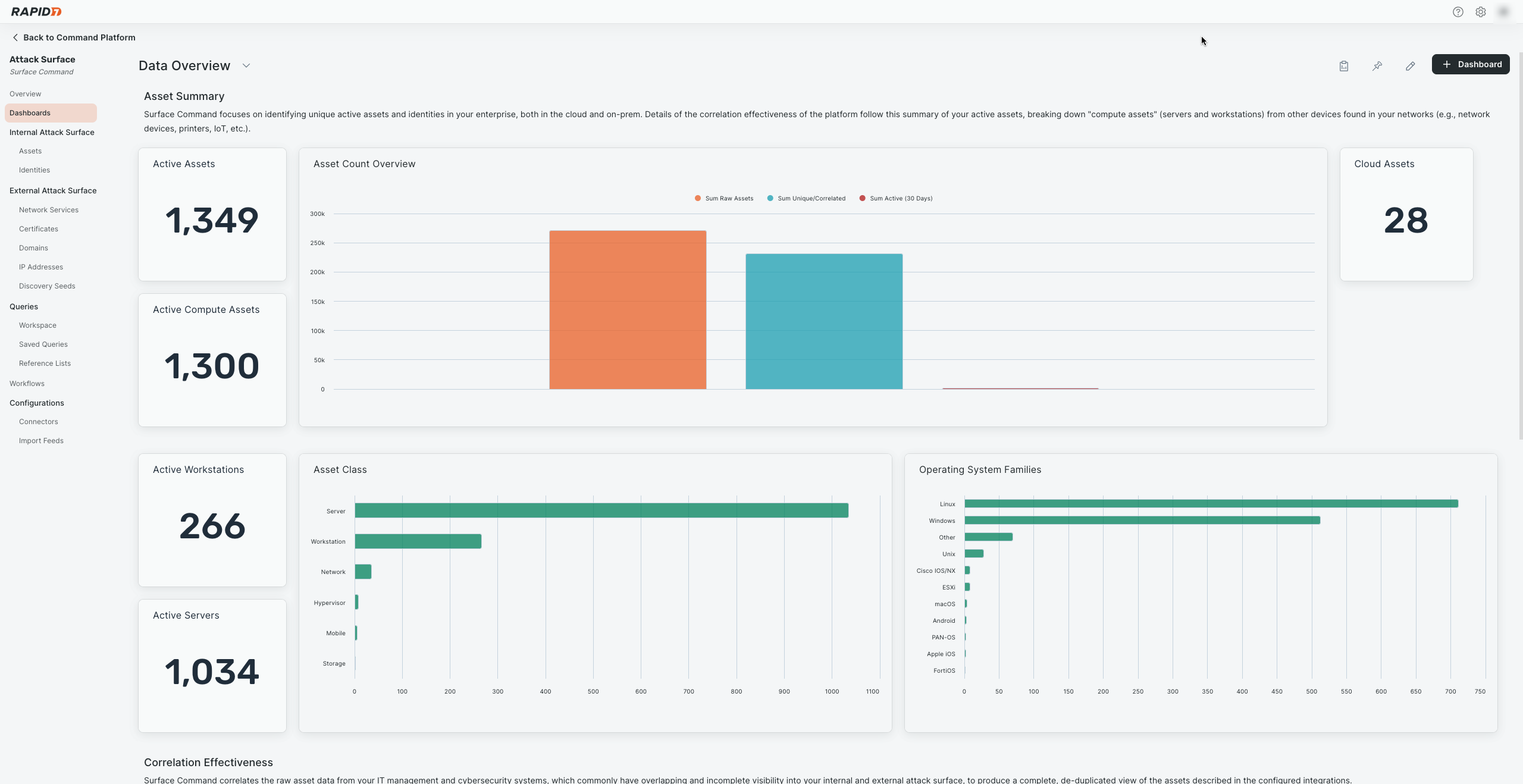
Rapid7’s Surface Command provides a unified view of assets across an organization’s internal and external environments. It continuously monitors endpoints, cloud services, and other digital infrastructure to eliminate visibility gaps and identify exposed assets. The platform enriches discovered assets with contextual data from both native and third-party sources.
ASM features include:
- Continuous asset discovery: Detects internal and external assets across environments to eliminate blind spots
- Contextual risk prioritization: Uses business-critical and third-party data to highlight exploitable exposures
- Attack path visibility: Helps identify how attackers could move laterally or gain access
- Exposure management: Harden systems by proactively mitigating exposures before attackers exploit them
- Unified asset view: Consolidates visibility across endpoint to cloud for full surface coverage
SIEM and security analytics features include:
- Integrated asset and telemetry data: Combines logs, context, and attack surface visibility in one platform
- AI-driven alert triage: Uses AI and behavioral analytics to surface relevant threats and cut alert noise
- Dynamic exposure scoring: Prioritizes incidents involving high-risk or business-critical systems
- Full attack path correlation: Aligns events with MITRE ATT&CK®, showing timeline and recommended actions
- Automated response and playbooks: Enables rapid threat containment and remediation via built-in SOAR capabilities

Source: Rapid7 ASM
3. Microsoft Sentinel

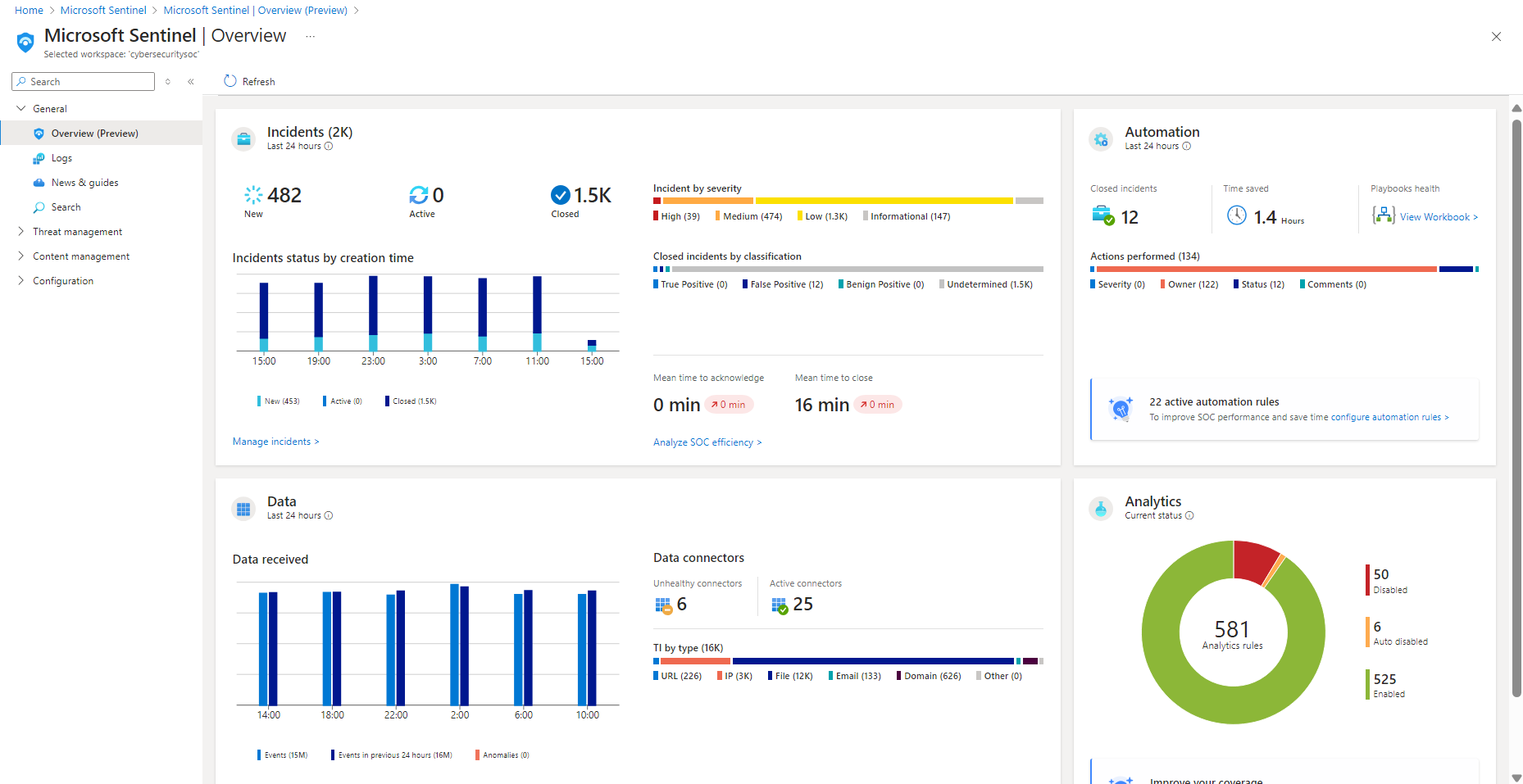
Microsoft Sentinel is a cloud-native SIEM that combines scalable data collection, AI-powered analytics, and automation to detect, investigate, and respond to threats across multicloud and multiplatform environments. Integrated with Microsoft Defender and the Azure ecosystem, it enables unified threat visibility across on-premises, cloud, and hybrid assets.
ASM features include:
- Real-time attack surface visibility: Continuously discovers and tracks external-facing assets across hybrid and multicloud environments
- Shadow IT detection: Identifies unmanaged and unknown assets, including those created outside formal IT processes
- Exposure prioritization: Highlights misconfigurations and vulnerabilities in unmanaged resources for targeted remediation
- Dynamic inventory: Maintains an up-to-date map of external resources, helping reduce blind spots
- AI-driven insights: Uses natural language queries via Azure Copilot to investigate assets and surface risk patterns
SIEM and Security Analytics features include:
- Cloud-native scalability: Collects data across users, devices, applications, and infrastructure in real time
- Prebuilt and custom data connectors: Ingests data from Microsoft services and third-party platforms using out-of-the-box or custom connectors
- Data normalization: Converts diverse data sources into a consistent format using the Advanced Security Information Model (ASIM)
- Integrated threat detection and response: Delivers a unified experience across SIEM and XDR with Microsoft Defender integration
- AI and automation: Enhances detection, investigation, and response with machine learning and playbook-based workflows
Source: Microsoft Sentinel
Attack Surface Management Solutions
4. Palo Alto Networks Cortex Xpanse

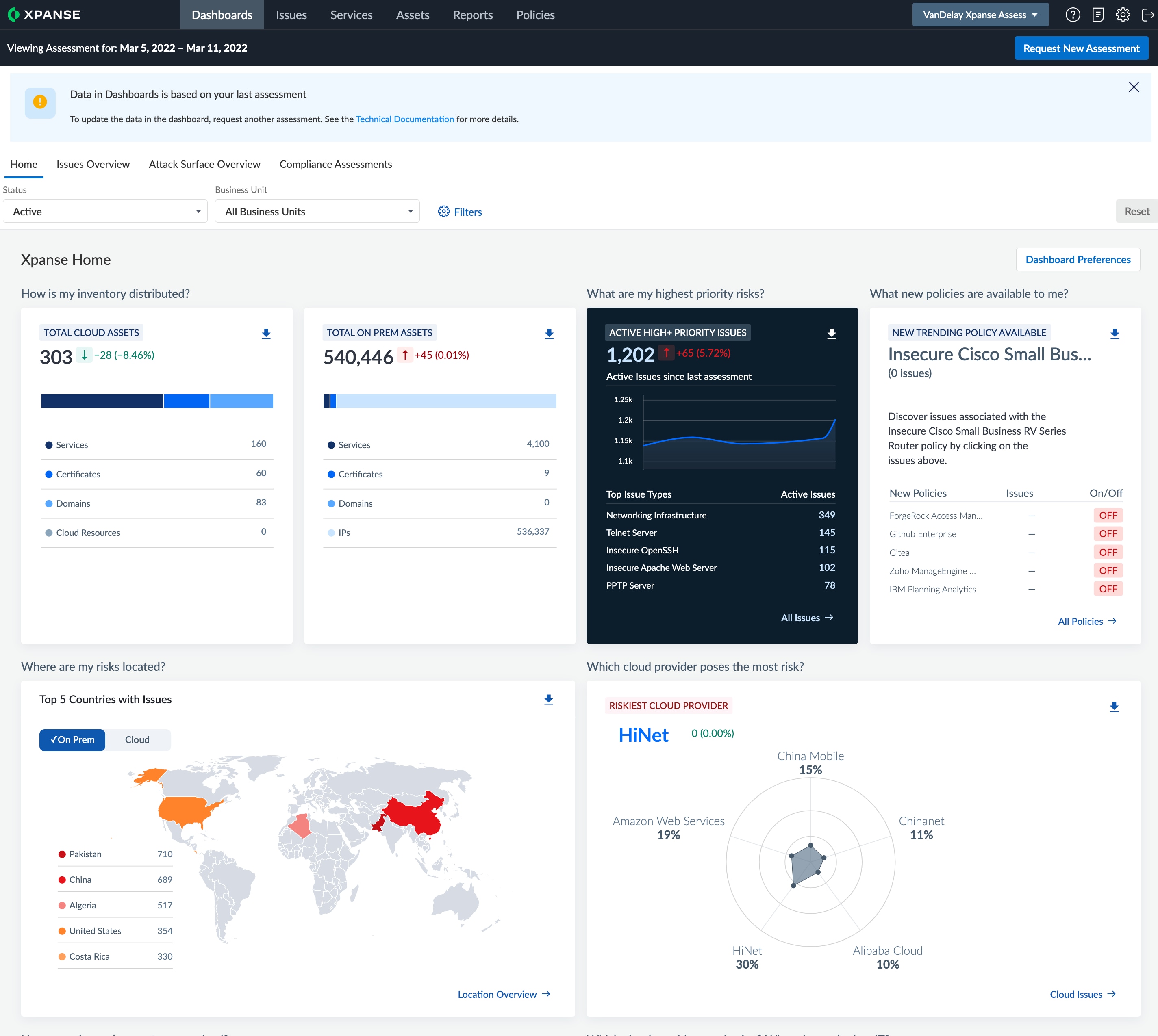
Cortex Xpanse by Palo Alto Networks is an attack surface management solution to continuously scan the internet to uncover and address unknown and unmanaged risks across an organization’s digital footprint. Unlike traditional tools that rely on periodic scanning, Xpanse automates the discovery, analysis, and remediation of exposed assets.
Key features include:
- Active discovery: Continuously scans 4.3 billion IPv4 addresses multiple times a day, indexing exposed assets and services.
- Active learning: Builds contextual awareness around discovered assets, allowing teams to understand ownership, business function, and associated risks.
- Active response: Automates remediation workflows to quickly eliminate exposures, reducing dependency on manual IT ticketing systems.
- Internet-scale coverage: Scans over 500 billion ports daily, enabling visibility into connected systems across enterprise and cloud environments.
- Security use case coverage: Supports use cases like ransomware prevention, zero-day response improvement, shadow cloud elimination, M&A evaluation, and cyber insurance optimization.

Source: Palo Alto Network
5. CrowdStrike Falcon Surface

CrowdStrike Falcon Surface is an external attack surface management (EASM) solution that delivers continuous visibility into internet-facing assets, including unmanaged and unknown systems. Built on the CrowdStrike Falcon® platform, it combines real-time internet mapping, adversary intelligence, and AI-driven prioritization to uncover hidden risks.
Key features include:
- Continuous asset discovery: Automatically maps known and unknown internet-facing assets using internet indexing and association technologies.
- Adversary-driven intelligence: Leverages threat intelligence to understand exposure from an attacker’s viewpoint, enhancing prioritization and response.
- AI-powered risk prioritization: Uses ExPRT.AI to assess and rank vulnerabilities based on exploitability and business impact.
- 24/7 internet monitoring: Continuously scans the internet to detect new exposures and asset changes, ensuring up-to-date visibility and fast detection.
- Complete asset inventory: Tracks all asset lifecycle events (additions, changes, and removals) for a dynamic and current view of the digital footprint.
6. CyCognito ASM

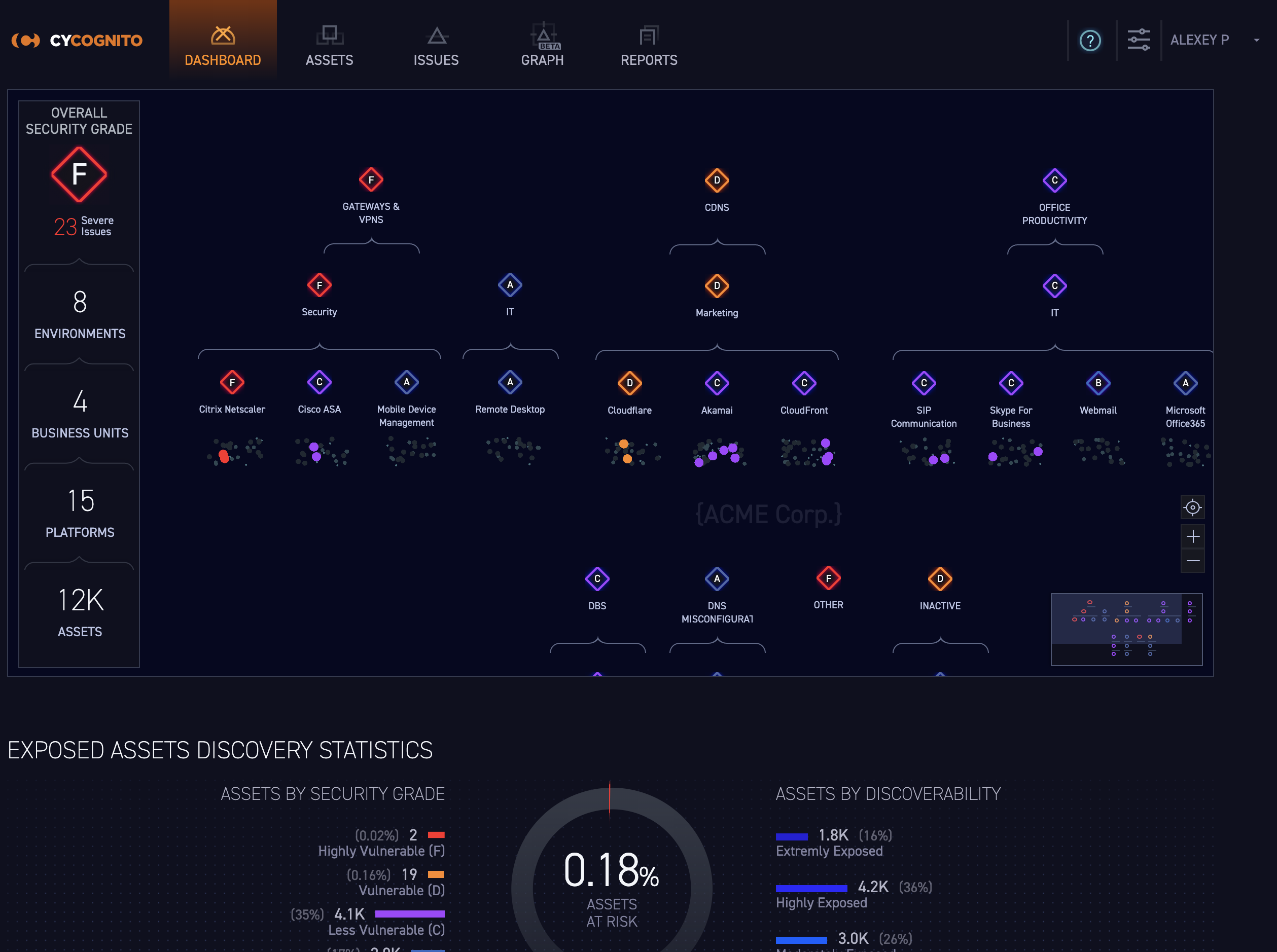
CyCognito’s attack surface management (ASM) solution is built for large, complex enterprises that need automated visibility into their external risk landscape. Using AI-driven discovery and continuous business structure mapping, CyCognito identifies internet-exposed assets across subsidiaries, departments, and brands without requiring any input from the organization.
Key features include:
- Zero-input discovery: Uses AI and machine learning to continuously discover assets and map them to the business structure using only the organization’s name.
- Automated attribution: Connects discovered assets to internal teams, departments, and subsidiaries, providing ownership context to accelerate remediation.
- Continuous business mapping: Maintains a real-time model of the enterprise structure, tracking exposed assets across brands, regions, and cloud environments.
- Attack-based risk prioritization: Identifies and ranks the most critical exposures using active security testing and attacker-centric analysis.
- In-depth asset context: Delivers hundreds of contextual elements per asset, including discoverability, attractiveness, and supporting evidence for issues.

Source: CyCognito ASM
7. Mandiant ASM

Mandiant attack surface management (ASM) provides continuous, adversary-informed visibility into external-facing digital assets across dynamic, distributed, and multicloud environments. It simulates the reconnaissance tactics of real attackers to identify unknown assets, shadow IT, and high-risk exposures.
Key features include:
- Automated asset discovery: Continuously maps external assets using cloud and DNS integrations to uncover unmanaged or unknown systems.
- Flexible scan scheduling: Supports daily, weekly, or on-demand discovery and analysis workflows based on business or security needs.
- Intel-informed active checks: Uses benign payloads based on Mandiant’s threat intelligence to validate asset exposures and identify exploitability.
- Technology and service inventory: Builds an inventory of internet-facing applications and services, helping identify technology stack risks.
- Outcome-based discovery: Customizes discovery workflows to match security goals such as shadow IT detection or zero-day exposure tracking.

Source; Mandiant ASM
8. Tenable ASM

Tenable attack surface management (ASM) delivers continuous visibility into an organization’s internet-facing assets, helping security teams uncover unknown exposures and reduce cyber risk across external environments. By mapping the internet and correlating discovered assets to known infrastructure, it identifies blind spots and provides context for prioritizing remediation.
Key features include:
- Comprehensive asset discovery: Continuously scans over 5 billion internet-connected assets to uncover domains and services linked to the organization, including unknown or shadow assets.
- Business context awareness: Enriches each asset with over 200 metadata fields, enabling informed decisions through tagging, filtering, and classification.
- Continuous monitoring and alerts: Provides notifications on changes to the external attack surface, helping security teams track emerging risks.
- Integration with Tenable One: Combines external asset data with internal vulnerability management tools to close blind spots and drive unified risk reduction.
- Risk-based prioritization: Supports targeted scans of previously unassessed assets to ensure exposure coverage and faster threat remediation.

Source: Tenable ASM
9. Qualys ASM

Qualys attack surface management (ASM) provides unified visibility and risk context for both internal and external assets across cloud, on-premises, IoT/OT, and internet-facing environments. Built on the Enterprise TruRisk™ Platform, Qualys ASM enables continuous asset discovery, contextual risk assessment, and external exposure detection.
Key features include:
- Comprehensive asset discovery: Identifies internal and external assets across IT, cloud, IoT/OT, and web environments using a combination of active scans, passive monitoring, open-source intelligence, and API integrations.
- External attack surface coverage: Uncovers up to 30% more internet-facing assets (particularly from subsidiaries, cloud workloads, and M&A activities) that are typically missed by traditional tools.
- Business context and third-party integration: Enriches asset data with context from systems like CMDB and Active Directory, creating a centralized and accurate inventory.
- Supply chain and software risk insight: Tracks software components and analyzes runtime vulnerabilities to reduce risk from open-source and third-party code, including zero-day threats.
- Web application scanning: Expands visibility into web apps and APIs, identifying misconfigurations, exposed data, and exploitable vulnerabilities across hybrid infrastructure.

Source: Qualys ASM
10. SentinelOne Singularity

SentinelOne Singularity is an AI-based security platform that delivers protection across endpoints, servers, and cloud workloads. It combines prevention, detection, response, and remediation into a single, scalable agent, leveraging behavioral and static AI models. It identifies and stops threats like ransomware and zero-day attacks in real time.
Key features include:
- Unified endpoint and cloud protection: A single lightweight agent protects endpoints, servers, and cloud workloads, offering OS and cloud coverage with advanced telemetry.
- AI-powered threat prevention: Blocks malware and reduces the attack surface using on-device, autonomous AI models operating at machine speed.
- Behavioral detection and threat hunting: Uses behavioral AI to detect zero-day threats and ransomware, enhanced by Purple AI for natural language threat hunting and investigation.
- Automated response and remediation: Offers policy-based automation and manual options like 1-click rollback, network containment, forensic data collection, and remote shell access.
- Visual attack storyline: Correlates telemetry from endpoints, workloads, and identity sources to create a timeline of threat activity for faster investigations.
Learn More About Exabeam
Learn about the Exabeam platform and expand your knowledge of information security with our collection of white papers, podcasts, webinars, and more.