- Home >
- Explainers >
- SIEM Tools
Best SIEM Solutions: Top 11 SIEM systems and How to Choose 2026
- 11 minutes to read
Table of Contents
Understand how SIEM systems can help protect your business and learn about some of the top SIEM solutions. SIEM solutions provide a consolidated view of security events, making them an essential component of SIEM solutions provide a consolidated view of security events, making them an essential component of cybersecurity. This article is relevant for anyone who does not fully understand how SIEM security solutions work and why they are such a crucial component of cybersecurity. We will discuss the main advantages of using SIEM systems as well as some of the top SIEM vendors and why their products are unique.
Editor’s note: Updated the article to cover recent market trends, updated information for SIEM solutions to reflect features and capabilities in 2026.
This content is part of a series about SIEM tools.
What is SIEM and How Does it Work?
Security information and event management (SIEM) is a threat detection system that centralizes security alerts coming from various sources for review and action, and creates compliance reports.
SIEM solutions use data aggregation and data normalization to provide an integrated view of all security events in a single platform. Users can detect threats in real time and security analysts no longer need to waste time searching for all the notifications generated by different threat hunting and monitoring components.
In addition to SIEM, security personnel can define regular and abnormal activity using rules. More advanced solutions, called Next-Gen SIEMs, offer Machine Learning and AI to continuously update user and entity behavior analytics (UEBA) behavioral models to reduce false positives. In Next-Gen SIEMs the data collected by the SIEM system is analyzed relative to the defined rules and identified behavioral patterns. Any time abnormal activity is detected, a notable event is generated for review.
SIEM solutions provide customized cybersecurity protection based on predetermined rules, security event correlations and machine learning. They also store log data over time, making it easy to search for historical information and generate compliance reporting.
Understanding the SIEM Solutions Market
According to recent market research, the global SIEM market is expanding steadily. It is valued at USD 10.67 billion and is projected to reach USD 20.78 billion by 2031, growing at a CAGR of 11.5%. This growth is driven by increasing regulatory pressure, rapid cloud adoption, and the rising scale of security telemetry.
Organizations are modernizing correlation engines and analytics to handle larger data volumes. At the same time, stricter breach disclosure laws in North America, Europe, and Asia-Pacific are forcing faster detection and reporting. These factors are supporting continued investment in SIEM platforms.
Key Market Drivers
One major driver is the sharp increase in log and telemetry data. Large enterprises now ingest more than 10 TB of logs per day from endpoints, cloud services, SaaS platforms, and operational technology. This growth requires scalable storage models such as tiered retention and streaming analytics pipelines.
Regulatory enforcement is another strong factor. Frameworks such as the European NIS2 Directive and the U.S. SEC cybersecurity disclosure rules require timely incident reporting and proper log retention. Financial institutions in Europe must also test SIEM-based response processes regularly under DORA requirements.
Cloud and hybrid adoption are also accelerating SIEM demand. By 2025, 60% of enterprise compute workloads had shifted to public cloud. Cloud-native SIEMs integrate directly with provider APIs, reducing deployment time and enabling centralized visibility across distributed environments.
AI and machine learning are improving alert quality. Vendors are embedding large language models and AI assistants into SIEM workflows to summarize incidents, reduce low-value alerts, and guide response steps. This improves analyst productivity and reduces mean time to respond.
Deployment Trends
On-premises SIEM systems still held 55.27% of the market share in 2025. However, cloud deployments are growing faster, with a projected CAGR of 12.84% through 2031.
Cloud models reduce infrastructure management overhead and support elastic scaling. Hybrid approaches are common in regulated industries, where sensitive logs remain on-premises while analytics run in the cloud.
Legacy platforms accounted for 48.12% of revenue in 2025, but cloud-native architectures are growing steadily. Modern designs separate storage and compute, allowing organizations to store raw logs in low-cost object storage and run queries only when needed.
Top 10 SIEM Solutions
SIEM has become a basic component of cybersecurity. However, not all SIEM solutions are created equal. When deciding on which SIEM to adopt, it is important to keep in mind that SIEM is not an isolated solution but should be part of a larger security strategy. Some of the top SIEM solutions are listed below.
The information on SIEM solution capabilities and drawbacks was sourced from Gartner Peer Insights and other publicly available sources.
1. Exabeam Fusion

As a next-gen SIEM, Exabeam Fusion is a cloud-delivered solution that uses a behavior-based approach for Threat Detection, Investigation, and Response (TDIR). By aggregating all relevant events and weeding out illegitimate events, Fusion SIEM boosts analyst productivity and detects threats missed by other tools. This improves detection rates and response time, and ensures that all alerts are considered — even those coming from “noisy” systems that generate many alerts.
In addition, Fusion SIEM is natively integrated with its security orchestration and automation (SOAR) solution, which provides automated incident response. This enables almost any threat to be dealt with automatically (or semi-automated if preferred) in real time. Prescriptive workflows and pre-packaged use-case content (external threats, compromised insiders, and malicious insiders), enable successful SOC outcomes and response automation. Fusion SIEM also provides the cloud-based log storage, rapid and guided search, and comprehensive compliance reporting expected of any modern SIEM.

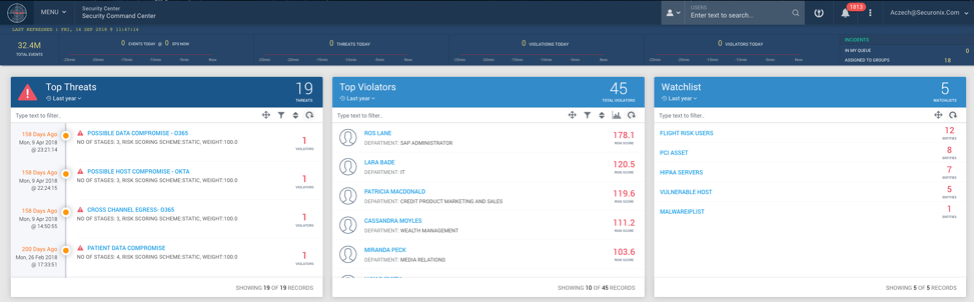
2. Securonix

Securonix delivers a cloud-native SIEM platform that unifies threat detection, investigation, and response. The platform is built around analytics and AI, combining SIEM, UEBA, and SOAR capabilities. It runs on Snowflake’s data cloud and is designed to scale with large data volumes while reducing alert noise through curated threat content and behavioral analytics.
Key features:
- Scalable data lake architecture: Provides access to up to one year of hot data for investigations and threat hunting, supporting large-scale log storage and fast search.
- Prebuilt threat content and analytics: Includes continuously curated detection content and analytics mapped to frameworks such as MITRE ATT&CK to reduce false positives and accelerate time to value.
- Integrated UEBA capabilities: Uses behavior analytics to monitor user and entity activity and detect insider threats and anomalous behavior.
- Embedded SOAR functionality: Supports automated workflows and response actions to reduce manual effort in incident handling.
- Cybersecurity mesh integration: Integrates with security tools, cloud platforms, and data lakes to centralize visibility across heterogeneous environments.

Source: Securonix
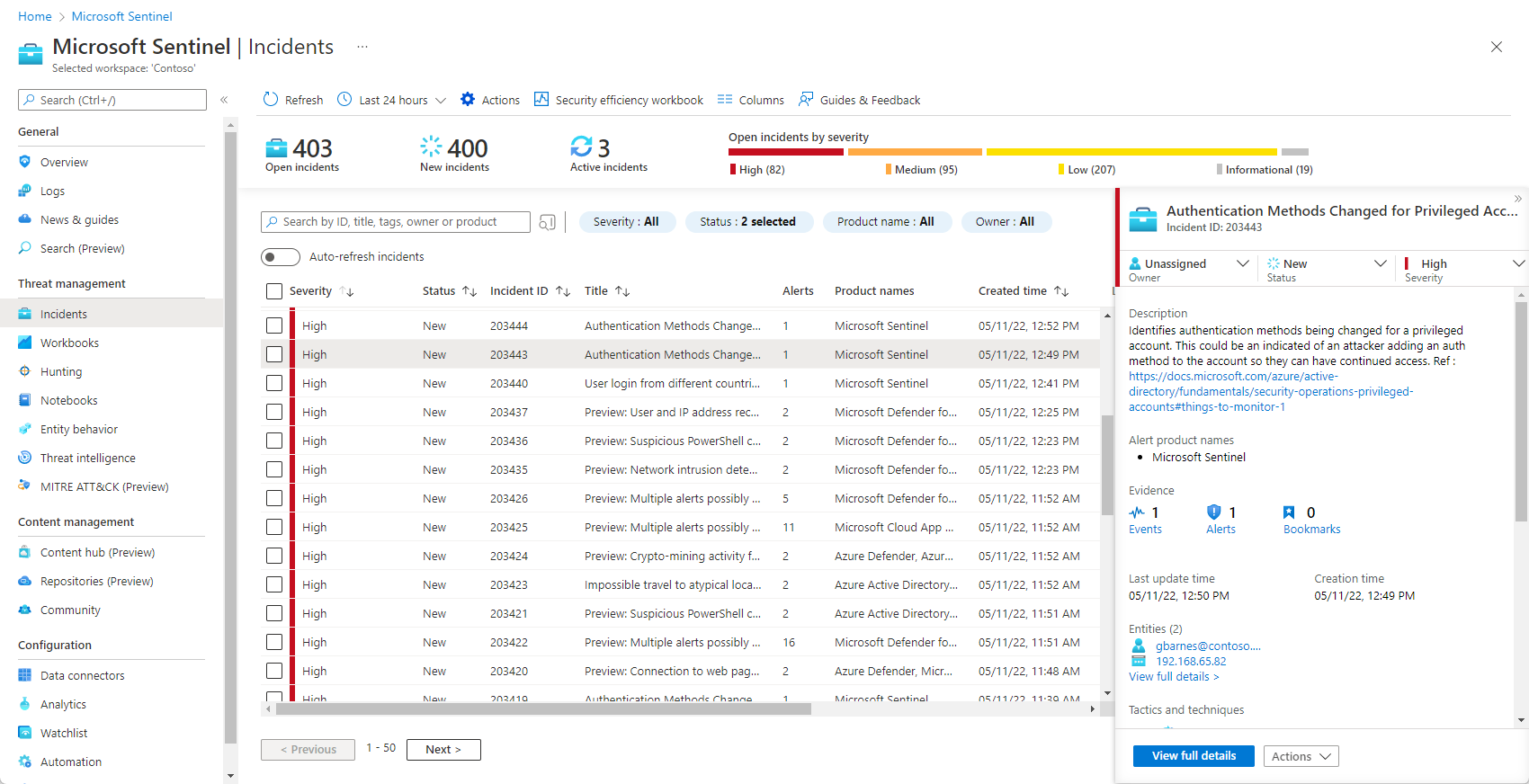
3. Microsoft Sentinel

Microsoft Sentinel is a cloud-native SIEM platform that centralizes security data in a unified data lake and applies AI-driven analytics for detection and response. It integrates SIEM, SOAR, UEBA, and threat intelligence capabilities in a single platform. Sentinel supports multicloud and multiplatform environments through native connectors and built-in integrations.
- Cloud-native SIEM architecture: Combines SIEM capabilities with a scalable data lake for centralized storage and analytics.
- Built-in SOAR and UEBA: Includes native automation, user and entity behavior analytics, and threat intelligence without requiring separate add-ons.
- Extensive data connectors: Supports more than 350 built-in connectors and no-code custom integrations for Microsoft and non-Microsoft data sources.
- AI-powered investigation tools: Uses generative AI assistance to summarize incidents, generate queries, and recommend response actions to reduce investigation time.
- Native XDR integration: Integrates with Microsoft Defender to unify visibility and response across endpoints, identities, email, and cloud workloads.

Source: Microsoft
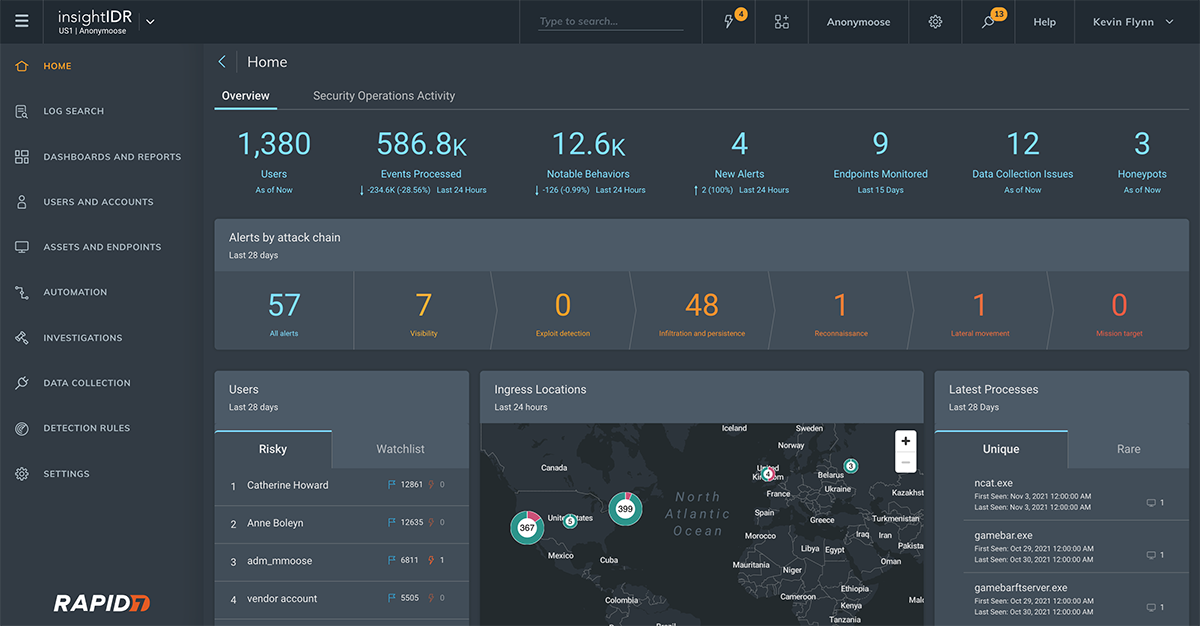
4. InsightIDR

InsightIDR is a cloud-native SIEM and XDR platform delivered as a SaaS solution. It collects log, network, and endpoint data, normalizes it, and correlates user and asset activity to identify suspicious behavior. Data is gathered through on-premises collectors and endpoint agents, then analyzed in the cloud to provide centralized visibility and investigation workflows.
- Cloud-native SaaS deployment: Hosted in AWS with centralized analytics, reducing infrastructure management requirements.
- Integrated XDR capabilities: Combines log management, endpoint visibility, authentication monitoring, and network data for extended detection and response.
- User behavior analytics and correlation: Correlates users, accounts, authentications, and alerts to detect anomalous behavior and indicators of compromise.
- Built-in detection library: Provides vetted detection rules and embedded threat intelligence to accelerate deployment.
- Automated response workflows: Supports automation and response actions to contain threats and simplify investigations.

Source: Rapid7
Traditional SIEM Platforms
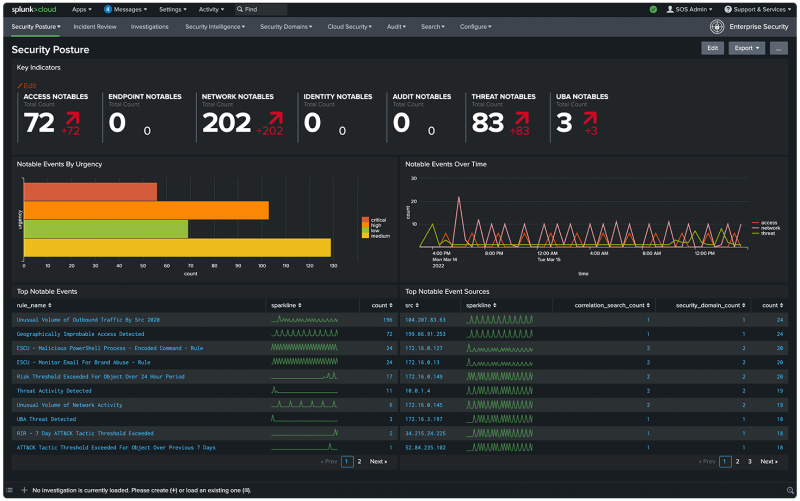
5. Splunk

Splunk Enterprise Security is part of Splunk’s broader data platform, designed to ingest and analyze machine data at scale. It provides unified threat detection, investigation, and response capabilities, along with AI and automation features. The platform supports large-scale data ingestion from diverse sources and integrates with a wide ecosystem of applications and services.
- AI-native data platform: Enables real-time search, analysis, and action on machine data from multiple sources at enterprise scale.
- Unified threat detection and response: Delivers visibility, threat intelligence, and high-fidelity alerts within a consolidated security workflow.
- Extensive integration ecosystem: Supports thousands of integrations and add-ons for ingesting logs, metrics, traces, and events.
- Compliance monitoring capabilities: Automates compliance tracking and reporting for standards such as PCI, HIPAA, and GDPR.
- Built-in AI and machine learning: Uses machine learning and generative AI features to simplify workflows and enhance detection.

Source: Splunk
6. LogRhythm SIEM

LogRhythm SIEM is a self-hosted platform designed for organizations that require control over their deployment environment. It focuses on threat detection, investigation, and response (TDIR) by combining data collection, enrichment, correlation, and automated workflows. The platform contextualizes data at ingestion and provides out-of-the-box detection content mapped to industry frameworks.
- Machine data intelligence fabric: Enriches and translates log data at ingestion to make it usable for security analysis.
- Extensive correlation rules: Includes more than 1,100 prebuilt correlation rules, mapped to frameworks such as MITRE ATT&CK, with support for custom detections.
- Unified TDIR workflows: Provides investigation timelines, dashboards, and reporting within a single interface to simplify analyst workflows.
- Embedded SOAR capabilities: Offers automated response actions through built-in SmartResponse workflows to reduce manual effort.
- Self-hosted deployment model: Supports on-premises or self-managed private cloud deployments to meet data sovereignty and control requirements.
7. IBM QRadar SIEM

IBM QRadar SIEM centralizes security data to provide real-time threat detection and compliance reporting. It is designed to help analysts prioritize incidents, reduce false positives, and investigate threats more efficiently. The platform integrates with a range of security tools and supports analytics use cases such as insider threat detection and threat hunting.
- Real-time threat detection and correlation: Monitors and correlates data across environments to identify threats as they occur.
- User behavior analytics: Detects anomalous user activity and insider threats through built-in UBA capabilities.
- Sigma rule support: Incorporates open-source Sigma rules to strengthen detection coverage.
- Extensive integrations: Connects with numerous third-party tools and partner extensions for broad ecosystem visibility.
- Compliance and reporting support: Helps organizations demonstrate compliance with regulatory requirements through centralized logging and reporting.

Source: IBM
8. Trellix Security Platform

Trellix provides a broad security platform that integrates security operations across endpoint, network, email, data, and cloud environments. The platform uses generative and predictive AI to enhance detection and investigation workflows. It centralizes visibility and management through a single console, supporting hybrid and on-premises deployments.
- Integrated security platform: Unifies endpoint, network, data, email, cloud, and third-party security controls within one architecture.
- GenAI-powered analytics: Uses generative and predictive AI for detection, guided investigations, and alert summarization.
- Platform-wide correlation: Correlates data across security controls to improve threat visibility and prioritization.
- Threat hunting and case management: Provides dashboarding, case management, and hunting capabilities within a centralized console.
- Resilient deployment architecture: Supports on-premises, hybrid, cloud, and air-gapped environments.

Source: Trellix
9. LogPoint

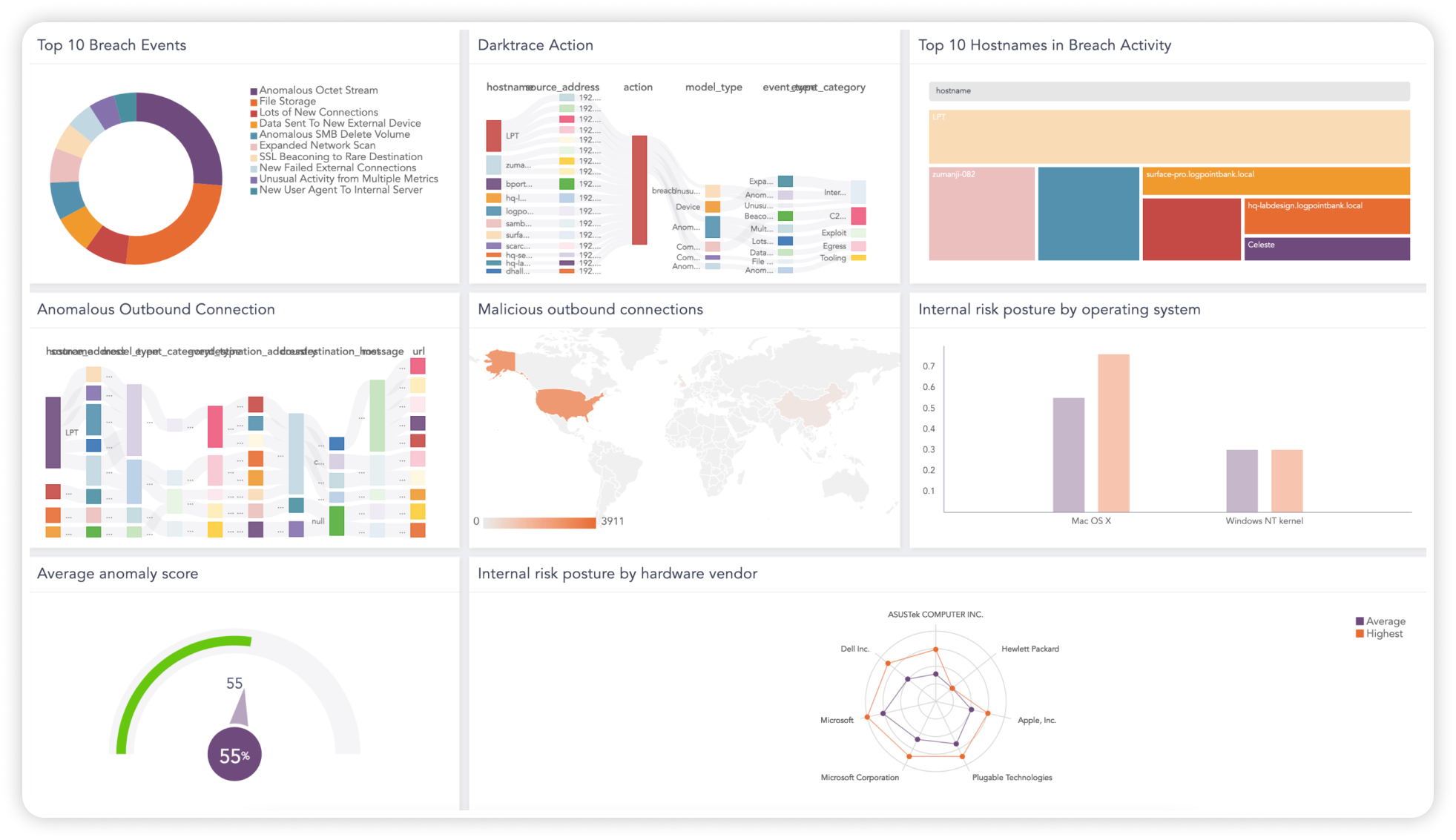
Logpoint delivers a SecOps platform that integrates SIEM, SOAR, and network detection and response capabilities. It is designed to provide centralized visibility and automation while supporting cloud, hybrid, and on-premises deployments. The platform emphasizes built-in detections and integration flexibility to reduce operational overhead.
- Integrated SecOps platform: Combines SIEM, SOAR, NDR, and centralized management in a single solution.
- Extensive built-in detections: Includes more than 1,000 preconfigured detections to reduce manual rule creation.
- Broad integration support: Supports over 100 integrations to connect security tools and data sources.
- Automation and response capabilities: Automates incident response processes to reduce analyst workload.
- Sovereign-ready deployment options: Supports cloud, hybrid, and on-premises environments to meet data residency requirements.

Source: LogPoint
10. Elastic Stack

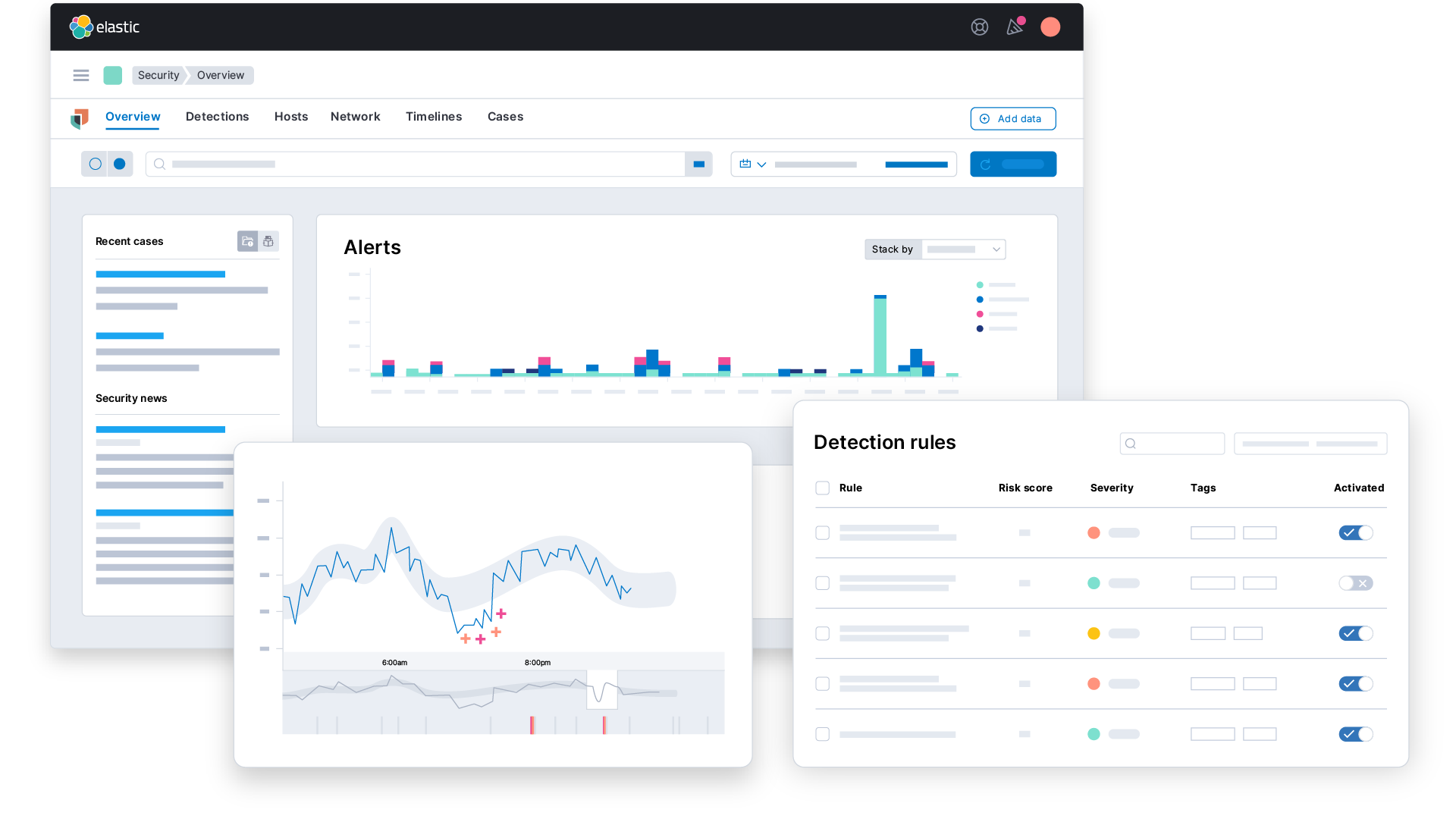
Elastic provides log analytics and observability capabilities built on Elasticsearch. It supports ingestion, indexing, and analysis of large volumes of structured and unstructured log data. The platform includes AI-driven log processing and supports open standards such as OpenTelemetry.
- Scalable log ingestion and storage: Handles large-scale log volumes with indexing, compression, and optimized storage mechanisms.
- AI-driven log parsing and structuring: Automatically parses and structures unstructured logs for easier analysis.
- Query engine (ES|QL): Supports filtering, correlation, aggregation, and transformation of log data.
- Agentic AI and machine learning: Surfaces significant events, generates queries, and assists with investigations using AI-driven capabilities.
- Open-source foundation: Built on Elasticsearch with OpenTelemetry support for standardized data collection and interoperability.

Source: Elastic Stack
11. ArcSight Enterprise Security Manager

OpenText Enterprise Security Manager (ArcSight ESM) is a SIEM platform that provides real-time threat detection, correlation, and automation. It combines comprehensive data collection with a native threat intelligence feed and built-in SOAR capabilities. The platform is designed to reduce alert volume and accelerate incident response.
- Correlation engine: Detects threat-correlated events in real time to reduce time to detect and respond.
- Native SOAR integration: Automates response workflows directly within the SIEM platform.
- Built-in threat intelligence feed: Enhances detection with integrated intelligence data.
- Data collection: Aggregates logs and events from across the environment for centralized analysis.
- Alert reduction capabilities: Minimizes duplicate and false-positive alerts to prioritize meaningful threats.

Source: ArcSight
How to Choose a SIEM Provider
All the SIEM systems we listed above are robust solutions with a broad user base. When selecting a SIEM, evaluate the vendor’s track record and market position, and pay special attention to functionality.
Below we show core capabilities that define a SIEM solution, and next-generation capabilities that add intelligence and automation, to make a SIEM more effective for your organization. The best SIEM solutions cover the core capabilities, and add next generation features that are suitable for your security needs.
Core SIEM Capabilities
- Threat detection – SIEMs provide accurate threat detection with the aid of rules and behavior analytics. They also aggregate threat feeds, backlists and geolocations.
- Threat intelligence and security alerting – many SIEMs connect your security system to a threat intelligence feed. This ensures your business is up to date on the latest cyber threats. SIEMs also aggregate and normalize your security data, cross-checking various sources, assessing your system activity, and alerting you anytime they identify a suspicious event.
- Compliance assessment and reporting – compliance is one of the biggest hurdles for any business, and it is only getting more complex. Regulations such as FFIEC, HIPAA and PCI, define how and what data needs to be stored. Failing to meet regulatory requirements can have catastrophic results for a business. SIEMs provide compliance reporting and can help you identify your business’ effectiveness in meeting regulatory requirements.
- Real-time notifications – where security is concerned, time is of the essence and SIEMs will notify you of any security breaches in real time. This allows your business to respond immediately to a potential threat.
- Data aggregation – centralizing information from many sources and providing a clear picture of all your network activities is the most important feature of SIEM. Without this, it would be easy to lose track of dark corners in your network, especially as your business grows. This lack of visibility is easily exploited by cybercriminals, leaving your network vulnerable to undetected infiltration.
- Data normalization – your security system consists of vast amounts of data from different sources. To identify correlations in security events, all of this data needs to be formatted consistently. SIEM normalizes all your security data, making it easier to analyze and draw meaningful conclusions from it.
Next-Gen SIEM Capabilities
- Data collection and management – next-gen SIEMs can collect and manage data from all available sources, with integration facilitated by built-in connectors. The important types of data sources are cloud resources and services, network data and on-premise log data, and external devices like smartphones.
- Cloud delivery – cloud SIEMs leverage elastic cloud storage and data lakes. This makes them much more scalable than traditional, on-premise SIEMs, which rely on equipment that cannot handle the massive volumes of data generated by large enterprises.
- User and Entity Behavior Analysis (UEBA) – establishes a baseline of typical user behavior and uses ML algorithms to identify behavioral anomalies. This technology enables modern SIEMs to effectively detect zero-day and insider threats, which don’t correspond to known attack signatures.
- Security Orchestration and Automation Response (SOAR) – enables SIEMs to respond to security incidents as they occur, rather than simply monitoring and alerting. Next-gen SIEMs can collaborate directly with IT and security infrastructure, making suggestions for relevant actions. They can also automate threat response using IR playbooks, orchestrate threat detection and response tools used by multiple systems, and manage security systems such as firewalls, email servers and access management.
- Automated attack timelines – traditional SIEMs require analysts to collate data from various sources to make sense of the attack timeline. This can be time-consuming and requires special expertise. Next-gen SIEMs can automatically build an attack timeline and present it visually so that less specialized analysts can understand it. This makes investigation and incident triage much faster.
Conclusion
As cyberattacks become more common and more high profile, it is more important than ever to understand the cybersecurity tools that are available. When it comes to security reporting, there is a conflict between the volume of data and practicality. While you do not want to miss a single security event, managing all the alerts from all the systems in your infrastructure in your security infrastructure is simply impossible.
This is where SIEM comes in. By centralizing all of the notifications in a single platform, you will be notified of any event that needs your attention without wasting time monitoring multiple systems. To further improve your security profile, you can integrate SIEM with solutions like SOAR and UEBA to automate threat detection, reduce false positives and respond to threats, or invest in a Next-Gen SIEM offering.
Tips from the expert

Steve Moore is Vice President and Chief Security Strategist at Exabeam, helping drive solutions for threat detection and advising customers on security programs and breach response. He is the host of the “The New CISO Podcast,” a Forbes Tech Council member, and Co-founder of TEN18 at Exabeam.
In my experience, here are tips that can help you better utilize and maximize the potential of SIEM solutions for your business:
Plan for storage and retention needs upfront
Evaluate your compliance requirements and expected data growth. Ensure your SIEM storage strategy (on-prem or cloud) can handle log retention without performance degradation.
Focus on meaningful correlations, not just alerts
Customize correlation rules to prioritize alerts with real-world impact. Overreliance on out-of-the-box rules can lead to alert fatigue and missed critical events.
Integrate SIEM with IT service management (ITSM) systems
Connecting your SIEM with ITSM platforms like ServiceNow streamlines incident management. This integration ensures alerts are logged as tickets and tracked to resolution.
Leverage advanced threat intelligence feeds
Supplement your SIEM with premium, real-time threat intelligence feeds to enhance detection capabilities against emerging threats and targeted attacks.
Regularly tune and optimize machine learning models in next-gen SIEMs
Ensure that the AI and UEBA features of your next-gen SIEM are fine-tuned to your organization’s behavior. Periodically review model outputs for accuracy and relevance.
Learn More About Exabeam
Learn about the Exabeam platform and expand your knowledge of information security with our collection of white papers, podcasts, webinars, and more.