Table of Contents
What Are SIEM Providers?
SIEM providers are companies or platforms that deliver security information and event management (SIEM) solutions. These solutions aggregate, analyze, and manage security data from disparate sources in an organization. SIEM platforms enable centralized visibility for security teams, allowing them to detect, investigate, and respond to threats.
By consolidating logs, alerts, and contextual information, a SIEM solution acts as the nerve center for security operations. This centralized approach is critical for organizations looking to maintain continuous monitoring and compliance with standards like PCI DSS, HIPAA, or GDPR.
SIEM providers differ by the technology stack they use, their approach to deployment, and the features they offer. Some focus on customizable detection and response, incorporating analytics and machine learning. Others emphasize integration with third-party tools or offer managed services to reduce internal resource requirements.
Choosing the right SIEM provider requires evaluating scalability, deployment model, compliance capabilities, and the specific security challenges the organization faces.
This is part of a series of articles about SIEM Tools
Editor’s note: Updated the article to cover recent market trends, updated product information to reflect features and capabilities in 2026, and added 2 new tools.
The SIEM Market and Trends
Market Size and Growth Outlook
The SIEM market is expanding steadily. It is valued at USD 10.67 billion and is projected to reach USD 20.78 billion by 2031, growing at a CAGR of 11.5%. This growth reflects increasing demand for centralized security monitoring as organizations handle more data and face stricter regulations.
Key Growth Drivers
Several forces are pushing adoption forward. Organizations are generating massive volumes of security telemetry, often exceeding terabytes of log data per day. At the same time, regulations such as NIS2 in Europe and SEC disclosure rules in the United States require faster detection and reporting of incidents.
Cloud adoption is another major factor. As workloads move across public and hybrid environments, SIEM platforms must ingest and correlate data from multiple sources. In parallel, AI and machine learning are improving detection accuracy by reducing false positives and helping analysts focus on real threats.
Rising Demand for Managed Services
A shortage of skilled cybersecurity professionals is driving demand for managed SIEM services. With an estimated global gap of millions of security workers, many organizations rely on external providers to monitor and respond to threats.
Managed services are growing at over 12% CAGR, as they help reduce operational burden and provide access to expertise that may not exist in-house. This trend is especially strong among mid-sized organizations with limited security teams.
Types of SIEM Providers
Traditional On-Premises SIEM
Traditional on-premises SIEM solutions are deployed within an organization’s own infrastructure, managed directly by their internal IT and security teams. This model provides organizations with control over their SIEM data, architectural customization, and integration with legacy systems.
Such setups are often preferred by sectors with stringent regulatory requirements or needs for data sovereignty. Since all data remains on internal servers, organizations can enforce their security and privacy policies without relying on external infrastructure.
However, on-premises SIEM systems require significant investment in hardware, software, and skilled personnel for ongoing maintenance and tuning. Implementation can be complex, particularly as data volumes grow and as new sources are integrated. Scaling up demands additional infrastructure, and updates or upgrades can be cumbersome.
Cloud-Native SIEM (SaaS)
Cloud-native SIEM providers deliver their services via the software-as-a-service (SaaS) model, hosted and managed in the cloud. This architecture removes the need for dedicated on-premises infrastructure, enabling organizations to quickly deploy and scale their security monitoring capabilities.
Cloud SIEMs can aggregate data from distributed environments, including cloud workloads, remote offices, and mobile endpoints. Updates, patches, and feature enhancements are handled by the provider, reducing the burden on internal teams.
While cloud-native SIEMs provide ease of management and scalability, they also raise considerations around data residency and compliance. Organizations must assess whether the SIEM vendor’s hosting regions and certifications satisfy regulatory requirements. Additionally, some organizations may be concerned about entrusting sensitive log data to third-party providers.
Learn more in our detailed guide to SaaS SIEM
Managed SIEM Services
Managed SIEM service providers extend traditional and cloud SIEM platforms by offering expert management, monitoring, and response as an outsourced service. These providers supply both the SIEM technology and a team of security analysts who monitor logs, triage alerts, and escalate verified threats to the customer.
This approach is valuable for organizations with limited in-house security resources or expertise, reducing the overhead of hiring and training specialized staff. Managed SIEM services deliver continuous monitoring, rapid incident response, and regular tuning of detection rules to match evolving threats. They also help with report generation for audits and compliance.
However, success relies on effective communication and a well-defined contract detailing responsibilities on both sides. Some organizations may also have concerns over sharing sensitive data with third parties, necessitating strong governance and data protection agreements.
Tips from the expert

Steve Moore is Vice President and Chief Security Strategist at Exabeam, helping drive solutions for threat detection and advising customers on security programs and breach response. He is the host of the “The New CISO Podcast,” a Forbes Tech Council member, and Co-founder of TEN18 at Exabeam.
In my experience, here are tips that can help you better evaluate and engage with SIEM providers:
Conduct red team vs. SIEM evaluations: Simulate targeted attacks (red team exercises) against your environment to assess how each SIEM provider detects and reports them. This offers a more realistic benchmark than standard feature comparisons.
Demand threat hunting support maturity: Go beyond basic search capabilities; ask how each SIEM supports hypothesis-driven threat hunting, including pivot capabilities, advanced filtering, and threat context enrichment.
Ask for native support for MITRE ATT&CK mapping: Ensure the SIEM provider can map detections and alerts directly to ATT&CK TTPs and allows you to visualize coverage gaps across your kill chain.
Vet how they handle long-term retention and hot-cold data tiering: Many SIEMs claim cost-effective storage, but only some allow fast retrieval and analysis from cold storage. Ask for latency benchmarks and data rehydration options.
Assess alert context fidelity: Not all correlated alerts are created equal. Evaluate how well the SIEM provides contextual details (e.g., identity, behavior history, asset criticality) to reduce mean time to resolution (MTTR).
Notable SIEM Tools
Cloud-Native SIEM Platforms
1. Exabeam

Exabeam is a SIEM provider focused on analytics-driven detection and AI-assisted security operations. Its New-Scale SIEM platform brings together log management, advanced behavioral analytics, and automated investigation to help SOC teams improve efficiency and reduce mean time to respond.
Deployment models:
Exabeam is delivered primarily as a cloud-native SaaS platform, with options for hybrid support to accommodate regulatory and operational requirements.
Key features include:
- Unlimited data ingestion model: Licensing not tied to data volume, allowing organizations to scale log collection without unpredictable costs.
- User and entity behavior analytics (UEBA): Applies behavioral models to detect anomalies, privilege misuse, and insider threats with contextual risk scoring.=
- Agentic AI (Exabeam Nova): A set of specialized AI agents that automate correlation, enrichment, and investigation, helping analysts accelerate threat triage.
- Threat Center and Outcomes Navigator: Unified work surface to track alerts, investigations, and program effectiveness, with benchmarking against peer organizations.
- Automated detection and response: Correlation, risk-based prioritization, and playbooks to reduce alert fatigue and support faster decision-making.
2. Microsoft Sentinel

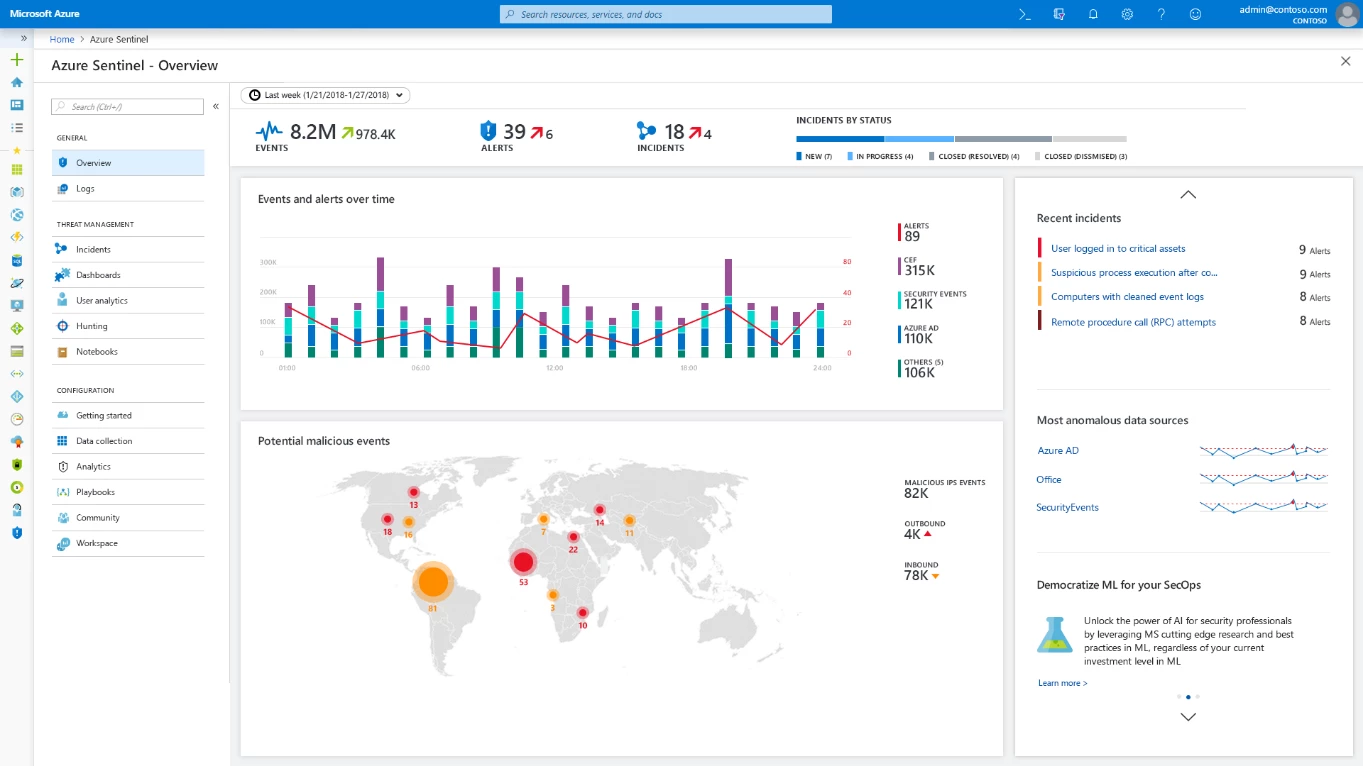
Microsoft Sentinel is a cloud-native SIEM platform that centralizes security data and combines analytics, automation, and AI to support detection and response. It can ingest telemetry from multiple environments and correlate signals using built-in analytics, threat intelligence, and machine learning. The platform also integrates SIEM with SOAR, enabling automated workflows and investigation support within a unified system.
Deployment models:
Delivered as a cloud-native SaaS solution running on Microsoft Azure. Supports multicloud and hybrid environments through native connectors and integrations.
Key features include:
- Centralized data lake: Aggregates and stores large volumes of security data for analytics and threat detection.
- Built-in SIEM and SOAR: Combines detection, investigation, and automated response in a single platform.
- Graph-powered context: Uses a security graph to enrich alerts with relationships and context across entities.
- Native XDR integration: Integrates with extended detection and response tools for unified visibility and control.
- Extensive data connectors: Supports ingestion from hundreds of sources across cloud, on-prem, and third-party tools.
- AI-assisted investigation: Uses generative AI to summarize incidents, generate queries, and recommend response actions.
- Integrated threat intelligence: Enriches detections with external threat data and standardized formats like STIX/TAXII.

Source: Microsoft
3. Elastic Security

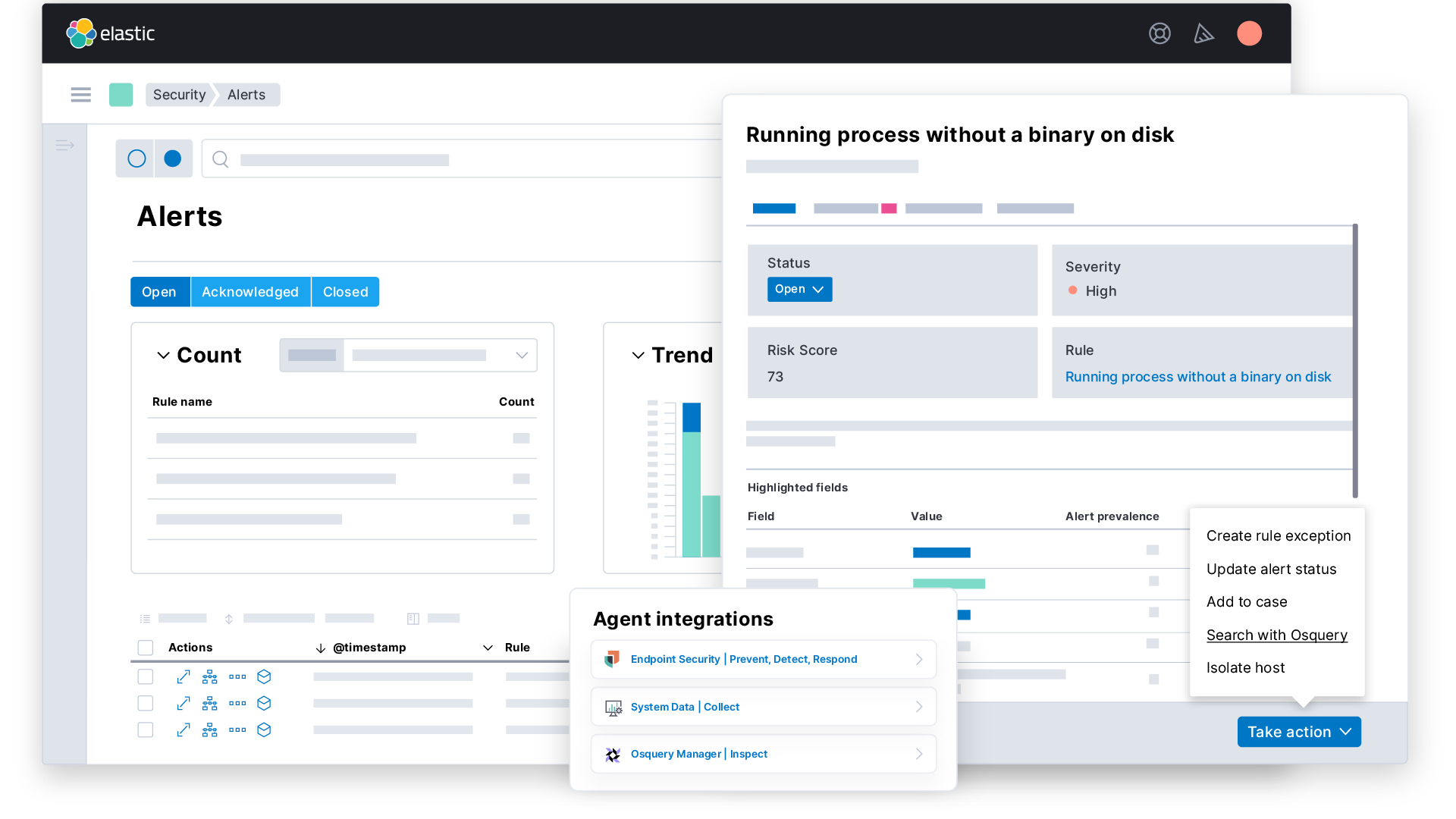
Elastic Security is an open and extensible SIEM platform that combines analytics, search, and AI to detect and respond to threats across distributed environments. It is built on Elasticsearch and can handle large-scale data ingestion and analysis without requiring data movement or duplication. The platform integrates SIEM, XDR, and automation into a single system.
Deployment models:
Can be deployed in cloud, on-premises, or hybrid environments. Supports major cloud providers and self-managed infrastructure.
Key features include:
- Unified SIEM and XDR: Combines endpoint, cloud, and SIEM capabilities in a single platform.
- Open architecture: Allows ingestion of any data source and integration with existing tools and pipelines.
- AI and machine learning: Supports detection, triage, and investigation with contextual and explainable AI.
- Open detection rules: Provides transparent, customizable rules maintained by an active community.
- Federated search: Enables querying across distributed data sources without centralizing all data.
- Built-in automation: Includes native workflows and playbooks without requiring separate SOAR tools.
- Scalable analytics: Processes large volumes of structured and unstructured data in real time.

Source: Elastic
4. Google Chronicle

Google Chronicle (part of Google Security Operations) is a cloud-native SIEM platform focused on large-scale data analysis and intelligence-driven detection. It leverages Google infrastructure to ingest, store, and analyze security telemetry at high speed while integrating threat intelligence and AI into investigation and response workflows.
Deployment models:
Delivered as a cloud-native platform on Google Cloud. Supports ingestion from multicloud and on-premises environments.
Key features include:
- High-scale data ingestion: Processes large volumes of telemetry with fast search and analysis capabilities.
- Curated detections: Provides built-in detection rules maintained by security researchers.
- Custom detection language: Enables rule creation using YARA-L for flexible detection engineering.
- Integrated threat intelligence: Enriches detections with Google and third-party threat data.
- AI-assisted investigation: Uses generative AI for natural language queries, summaries, and response guidance.
- Unified SIEM and SOAR: Combines detection, investigation, and automated response in one platform.
- Case management and context graphing: Links entities and events to provide a structured investigation workflow.

Source: ManageEngine
Hybrid / On-Premise SIEM Platforms
5. ManageEngine Log360

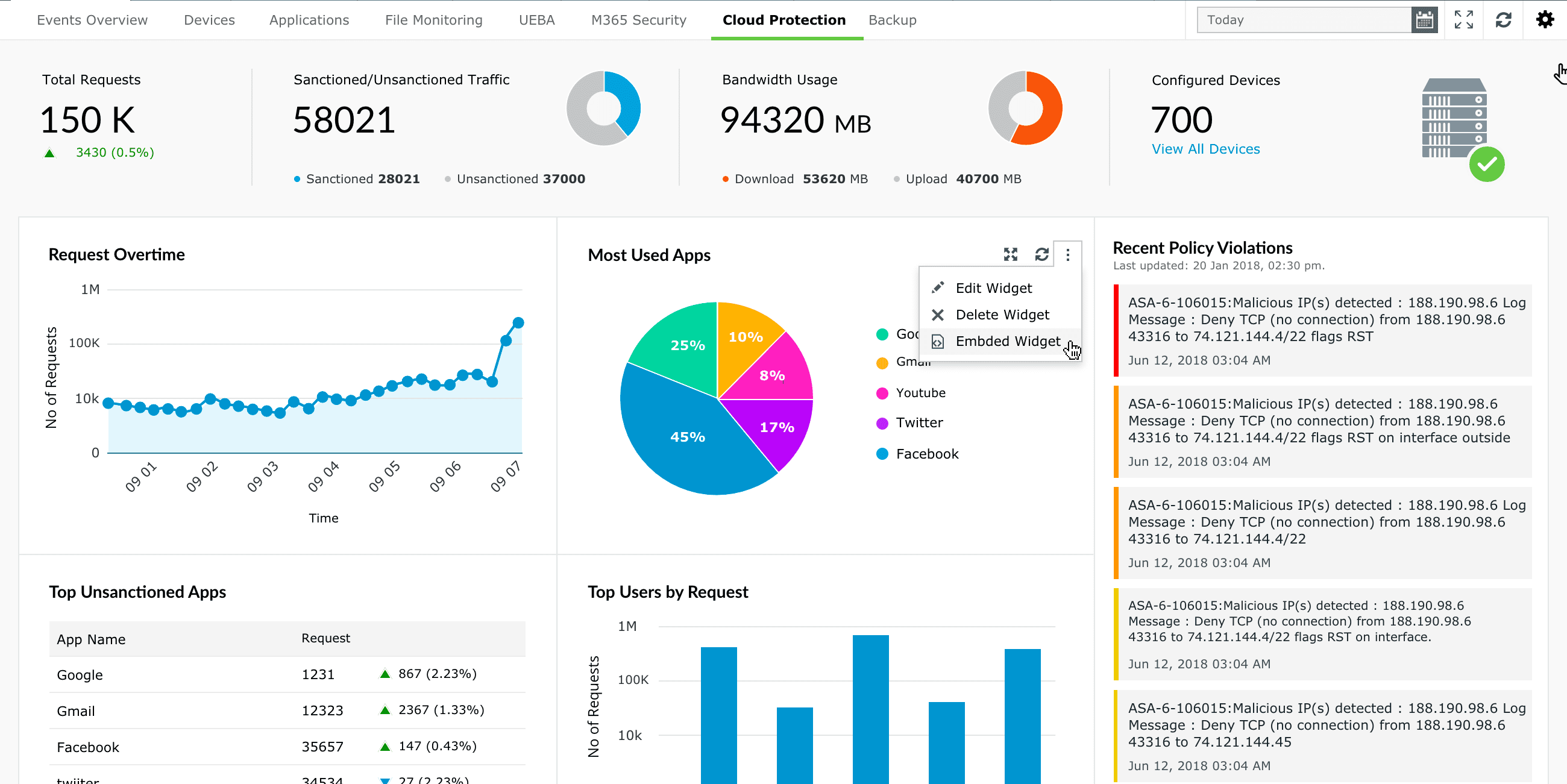
ManageEngine Log360 is a SIEM platform focused on threat detection, log management, and compliance, with strong emphasis on threat intelligence integration. It aggregates logs from multiple sources and enriches alerts with external intelligence to improve detection accuracy and prioritization.
Deployment models:
Primarily deployed on-premises with support for hybrid environments. Integrates with cloud services and external threat intelligence feeds.
Key features include:
- Threat intelligence integration: Ingests and normalizes multiple threat feeds for enriched detection.
- Alert enrichment: Adds context such as IP reputation, geolocation, and known indicators of compromise.
- Event correlation: Matches internal activity with external threat data to detect attack patterns.
- Risk-based prioritization: Scores and categorizes alerts to focus on high-risk incidents.
- MITRE ATT&CK mapping: Maps detections to known tactics and techniques for better analysis.
- Dark web monitoring: Identifies exposed credentials and data leaks with the organization.
- Automated response workflows: Triggers actions like blocking IPs or disabling accounts based on detections.

Source: ManageEngine
6. Splunk Enterprise Security

Splunk Enterprise Security is a SIEM platform that provides centralized visibility, analytics, and automation for security operations. It integrates detection, investigation, and response workflows while using machine learning and behavioral analytics to identify threats across diverse data sources.
Deployment models:
Available as on-premises, cloud-hosted, or hybrid deployment. Supports distributed data ingestion across cloud and on-prem environments.
Key features include:
- Unified TDIR platform: Combines threat detection, investigation, and response in one system.
- Full-spectrum visibility: Collects and analyzes data across endpoints, networks, and cloud environments.
- User and entity behavior analytics: Detects anomalies and insider threats using machine learning.
- Risk-based alerting: Prioritizes alerts based on risk to reduce noise and improve accuracy.
- Integrated SOAR: Automates workflows and standardizes incident response processes.
- AI-driven workflows: Supports natural language queries, summaries, and guided investigations.
- Detection lifecycle management: Provides tools to create, test, and monitor detection rules.

Source: Splunk
7. IBM QRadar

IBM QRadar is a SIEM platform that focuses on centralized visibility, real-time threat detection, and compliance management. It correlates data from across the IT environment to identify suspicious activity and supports analysts with tools for investigation and response.
Deployment models:
Available as on-premises software, cloud-hosted, or hybrid deployment. Integrates with a range of security tools and data sources.
Key features include:
- Centralized log and event management: Aggregates and correlates data from multiple sources.
- Real-time threat detection: Identifies threats using analytics across the full attack chain.
- User behavior analytics: Detects anomalous user activity and insider threats.
- Threat hunting capabilities: Enables near real-time analysis of large datasets.
- Built-in integrations: Connects with numerous security tools for unified visibility.
- Compliance support: Provides reporting and auditing capabilities for regulatory requirements.
- Operational efficiency: Reduces manual tasks in investigation and prioritization.

Source: IBM
Conclusion
Choosing a SIEM provider involves balancing technical capabilities, deployment models, and organizational needs. A suitable SIEM platform should provide real-time threat detection, support efficient investigations, and integrate with existing security infrastructure. Organizations should evaluate SIEM providers based on performance, scalability, cost, and the ability to adapt to evolving threats and compliance demands.
Learn More About Exabeam
Learn about the Exabeam platform and expand your knowledge of information security with our collection of white papers, podcasts, webinars, and more.
- Brief
How Exabeam and Google Security Operations Detect Insider Threats, Credential Misuse, and Agentic AI Risk
- Show More