- Home >
- Explainers >
- IBM Qradar
IBM QRadar: Key Features, Pricing, Limitations and Alternatives
- 8 minutes to read
Table of Contents
What Is IBM QRadar?
IBM QRadar is a security information and event management (SIEM) solution that provides insights into network activities. It helps organizations detect and respond to security threats by collecting and analyzing security data from various sources. QRadar operates across cloud and on-premises environments, allowing for a detailed view of potential security incidents.
IBM QRadar detects behavioral anomalies and assists in compliance management. Its scalability allows it to cater to both small enterprises and large organizations with complex security demands.
This is part of an extensive series of guides about information security.
Editor’s note: Updated the article to cover recent market trends, updated product information to reflect features and capabilities in 2026, and added 1 new tool.
Palo Alto Networks Acquisition of QRadar Cloud Service
In May 2024, IBM and Palo Alto Networks announced a strategic partnership that included the acquisition of IBM’s QRadar Software as a Service (SaaS) assets by Palo Alto Networks. This move positions Palo Alto Networks as the new home for QRadar’s cloud-based capabilities.
Under this agreement, Palo Alto Networks will integrate QRadar SaaS technologies and intellectual property into its Cortex XSIAM platform—a next-generation security operations platform powered by artificial intelligence. The aim is to provide improved threat detection and response through AI automation and a library of over 3,000 pre-built detectors.
Current QRadar SaaS clients will be offered migration pathways to Cortex XSIAM, supported by no-cost migration services provided jointly by IBM and Palo Alto Networks. IBM will also receive incremental payments for on-premises QRadar customers who transition to Cortex XSIAM. Those who choose to stay on QRadar’s on-premises version will continue receiving updates, bug fixes, and support from IBM.
Key Features of IBM QRadar
IBM QRadar offers the following capabilities:
- Compliance Management and Reporting: QRadar simplifies compliance management through automated reporting and audit functionalities. Its compliance features support various regulatory standards, ensuring organizations can meet legal and industry requirements. Automated reports simplify audit processes.
- Threat Detection and Response: IBM QRadar identifies threats by correlating data from multiple sources, improving threat detection. Its analytics engine processes vast amounts of security data, flagging suspicious activities with high accuracy.
- AI and Machine Learning Capabilities: These technologies analyze patterns within large datasets, identifying anomalies that traditional methods might miss. This approach improves detection rates and improves the system’s adaptability to evolving threat landscapes.
- User Behavior Analytics: QRadar’s user behavior analytics (UBA) module provides insights into user activities, flagging any unusual patterns that could signify a security threat. By monitoring changes in normal behavior, UBA helps in identifying threats such as insider attacks. UBA supports a range of actions from triggering alerts to initiating automated responses.
- Integration with Security Tools and Technologies: IBM QRadar integrates with numerous security tools, improving its capabilities and providing comprehensive threat intelligence. This interoperability allows for effective data sharing with a company’s existing security ecosystem.
IBM QRadar Products
Here’s an overview of the security products in the QRadar family.
QRadar SIEM
IBM QRadar SIEM is a platform for detecting and responding to security threats across an organization’s network. It uses AI and automation to improve threat detection, prioritization, and incident management, helping security teams simplify their operations. By integrating with other security tools, QRadar SIEM provides a unified view of potential threats and reduces the time spent on false positives and manual tasks.
Key features include:
- AI-driven threat detection and response
- Risk-based alert prioritization
- Integration with over 700 security tools and data sources
- Automated case creation and threat correlation
- User behavior analytics for insider threat detection

Source: IBM
QRadar SOAR
IBM QRadar SOAR improves incident response by providing security teams with automated workflows, dynamic playbooks, and improved orchestration capabilities. It helps simplify response processes, manage compliance with privacy regulations, and ensure efficient handling of security incidents.
Key features include:
- Dynamic playbooks that adapt to incident conditions
- Automated workflows for faster incident response
- Compliance management for over 200 privacy regulations
- Integration with threat intelligence tools for enriched incident analysis
- Playbook designer for simplified automation

Source: IBM
Understanding the QRadar Architecture
IBM QRadar’s architecture is designed to collect, process, and store security data, providing actionable insights for threat detection and response. Its modular design allows it to scale according to an organization’s needs, with components that can be deployed individually or in combination, depending on the size and complexity of the network.
The architecture consists of three primary layers that work together to collect raw network data, process it for security analysis, and make it available for searches, reporting, and investigation:
- Data collection: Captures events and network flows from log sources using appliances like QRadar Event Collectors and Flow Collectors, normalizing the data for analysis.
- Data processing: Event and flow data is processed through the Custom Rules Engine (CRE) to detect and alert on security offenses, and is stored on local processors or Data Nodes.
- Data search and analysis: Processed data is made available through the QRadar Console for security tasks such as reporting, offense investigation, and alert management.
Additional components include:
- QRadar Console: User interface for managing events, flows, reports, and administrative tasks.
- QRadar Event Collector: Collects and normalizes log events from network sources.
- QRadar Event Processor: Applies custom rules to event data and stores it for analysis.
- QRadar Flow Collector and Processor: Collects and processes network flow data, scaling for high-flow environments.
- QRadar Data Node: Increases storage and processing capacity for large-scale deployments.
- QRadar App Host: Dedicated resource for running apps like User Behavior Analytics, improving performance without impacting the main system.
IBM QRadar Limitations
While IBM QRadar is a SIEM solution with many features, it is not without its limitations. Some of these challenges can impact user experience, ease of management, and overall efficiency. Below are some of the key limitations of IBM QRadar, as reported by users on the G2 platform:
- Complex interface and setup: Users report that some IBM solutions have a complicated structure, making initial setup and navigation difficult, especially for new users.
- Steep learning curve: The platform may require significant time to understand and use effectively, particularly for teams without prior experience in similar enterprise tools.
- Limited modern features in some areas: Some users note that certain components may lack newer capabilities or feel outdated compared to more modern alternatives.
- Usability challenges: While some interfaces are clear, others may not be as intuitive, leading to inefficiencies in day-to-day operations.
- Customization can be difficult: Adjusting the platform to specific organizational needs may require additional effort or expertise, increasing implementation complexity.
Notable IBM QRadar Competitors and Alternatives
In light of IBM’s sale of the QRadar cloud service to Palo Alto, the future of IBM’s on-premise SIEM solution is in question. This has caused many organizations to seek alternatives. Here are some popular options.
AI-Driven and Next-Gen SIEM Platforms
1. Exabeam

Exabeam’s Security Operations Platform provides a cloud-native solution focused on threat detection, investigation, and response (TDIR). It leverages behavioral analytics and automation to identify and address security threats across various environments.
Key features of the Exabeam platform include:
- Behavioral analytics: Utilizes User and Entity Behavior Analytics (UEBA) to establish normal activity patterns and detect deviations, such as insider threats or compromised accounts.
- Automated TDIR workflows: Automates the creation of incident timelines and correlates security events, aiming to reduce manual investigation efforts.
- Cloud-native scalability: Designed to handle high volumes of security data, supporting rapid ingestion and efficient querying for large-scale deployments.
- Extensive integrations: Connects with numerous third-party security tools and data sources, enabling data collection from diverse environments.
- Generative AI assistance: Incorporates generative AI capabilities to assist security analysts with natural language queries and summarizing investigation data.
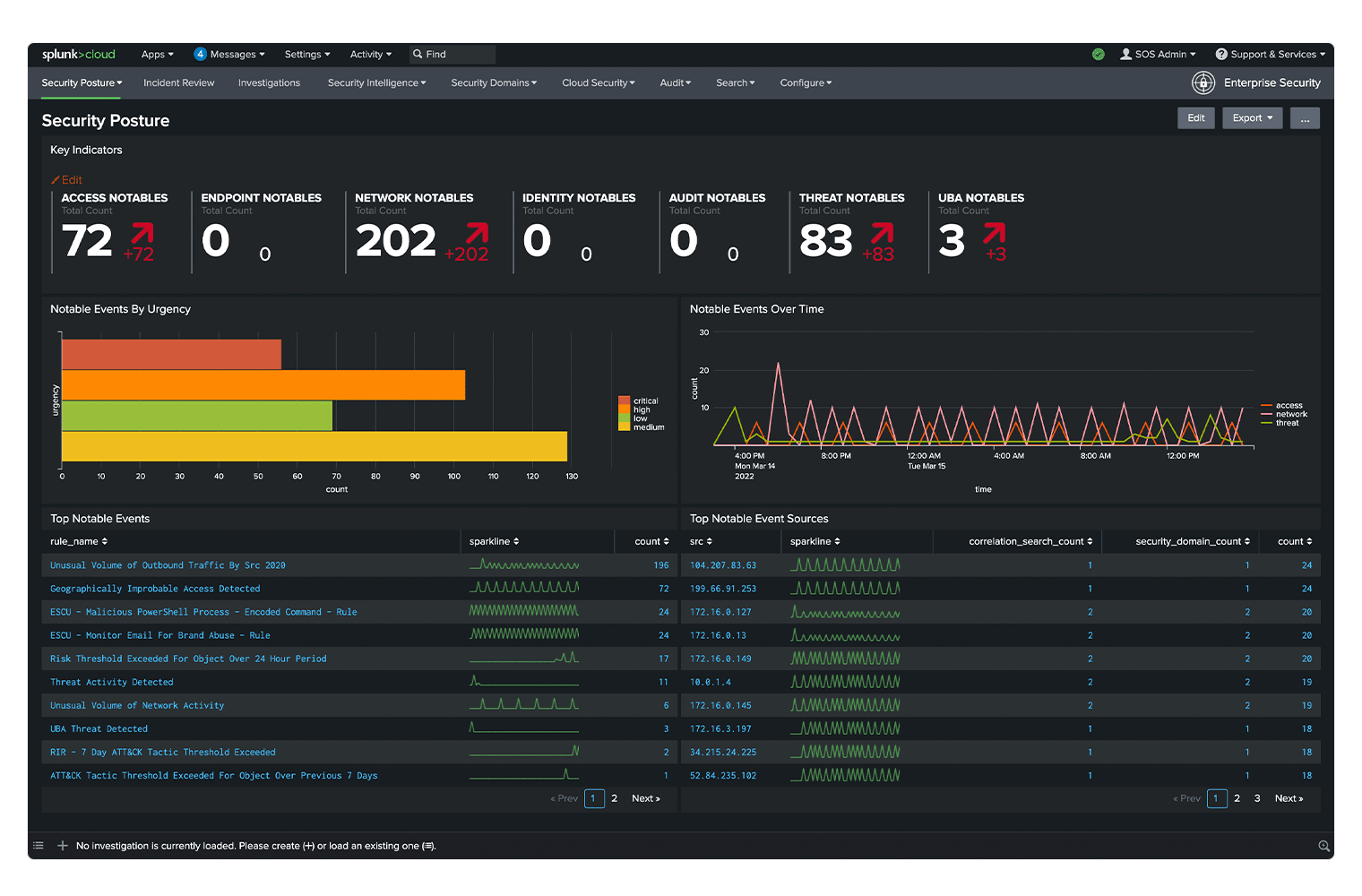
2. Splunk Enterprise Security

Splunk Enterprise Security is a SIEM platform to unify threat detection, investigation, and response within a single system. It builds on Splunk’s data platform to provide visibility across environments and uses AI, automation, and behavioral analytics to help security teams prioritize and respond to threats more efficiently.
Key features of Splunk Enterprise Security include:
- Unified threat detection, investigation, and response: Centralizes security workflows into a single platform, reducing tool fragmentation and improving operational efficiency.
- Data visibility: Enables analysis of data across multiple environments, including cloud, on-premises, and endpoints.
- AI-driven detection and alert prioritization: Uses machine learning and analytics to identify threats and prioritize high-risk alerts.
- User and entity behavior analytics: Detects anomalies in user and system behavior to identify insider threats and compromised accounts.
- Integrated automation and orchestration: Supports automated workflows and response actions to reduce manual effort and speed up incident handling.

Source: Splunk
Learn more in our detailed guide to QRadar vs. Splunk
3. CrowdStrike Falcon

CrowdStrike Falcon is a cloud-native security platform that combines SIEM, XDR, and automation capabilities. It focuses on unifying data across the environment and applying AI-driven analysis to detect and respond to threats. The platform emphasizes automation of repetitive tasks and improved visibility through a centralized data layer.
Key features of CrowdStrike Falcon include:
- Unified data layer with enterprise-wide visibility: Aggregates telemetry from across the environment into a single model for analysis.
- AI-driven threat detection and analysis: Uses AI to identify threats, correlate activity, and support investigation workflows.
- Automated security workflows: Automates repetitive analyst tasks, such as alert triage and investigation processes.
- Natural language query and investigation tools: Enables users to query and interact with security data using natural language.
- No-code automation and agent management: Allows teams to build and manage automated workflows and security agents without coding.

Source: CrowdStrike
Cloud-Native and Hybrid SIEM Solutions
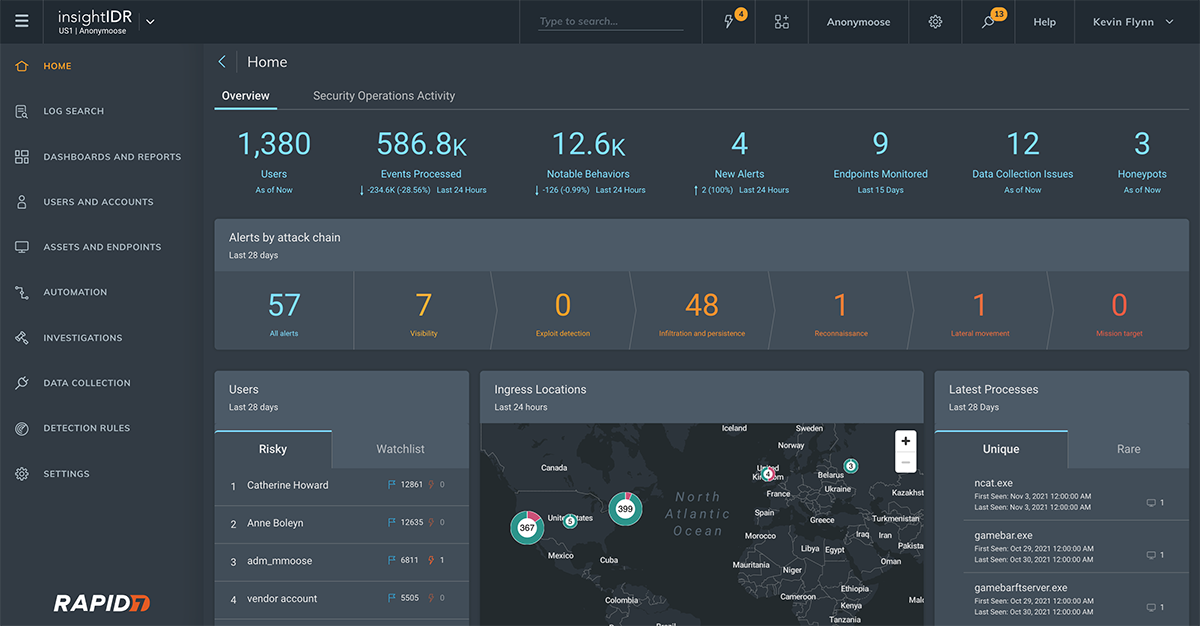
4. Rapid7 InsightIDR

Rapid7 InsightIDR is a cloud-native SIEM and XDR solution that collects and analyzes data from across an organization’s environment. It focuses on providing centralized visibility, behavioral analytics, and automated detection and response capabilities to support modern security operations.
Key features of Rapid7 InsightIDR include:
- Unified data collection and visibility: Aggregates logs, endpoint data, and network traffic into a centralized platform for analysis.
- Behavioral analytics for threat detection: Correlates user activity and system events to identify suspicious behavior and potential compromises.
- Embedded threat intelligence and detections: Uses curated detection rules and threat intelligence to identify known attack patterns.
- Automated alerting and response actions: Generates alerts for suspicious activity and supports automated response workflows.
- Investigation tools with contextual insights: Provides context around incidents to support faster analysis and response.

Source: Rapid7
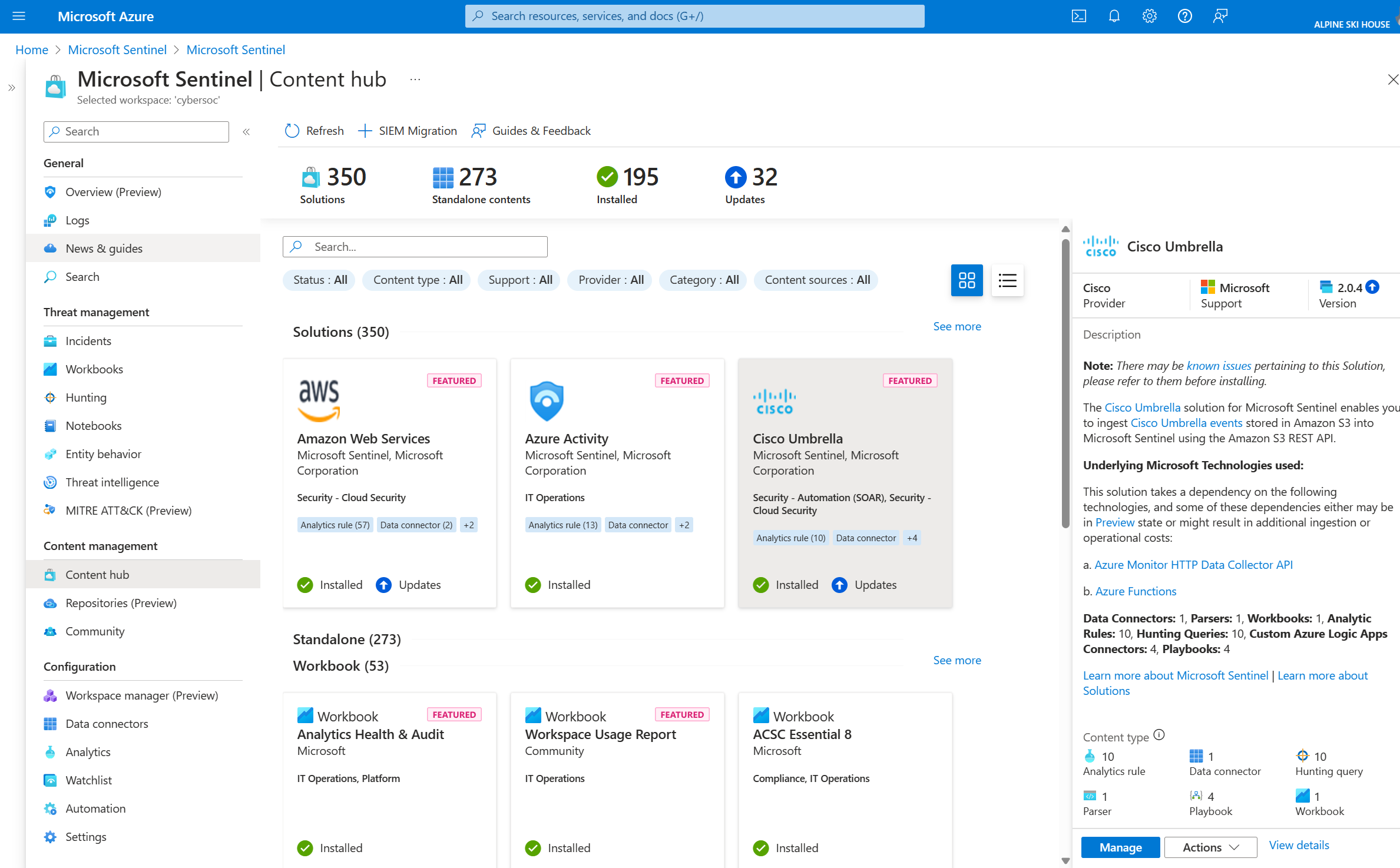
5. Microsoft Sentinel

Microsoft Sentinel is a cloud-native SIEM and SOAR platform that provides centralized security monitoring and analytics across hybrid and multi-cloud environments. It uses AI and integrated data capabilities to support threat detection, investigation, and response at scale.
Key features of Microsoft Sentinel include:
- Cloud-native SIEM and SOAR platform: Combines security analytics and automation within a single, scalable cloud-based solution.
- Centralized data lake and security graph: Aggregates and correlates security data to provide context-rich analysis.
- AI-powered detection and investigation: Uses machine learning and AI to detect threats and reduce false positives.
- Integration ecosystem: Supports hundreds of connectors across cloud services, on-prem systems, and third-party tools.
- Automated response and orchestration: Uses built-in automation to streamline incident response and reduce manual workloads.

Source: Microsoft
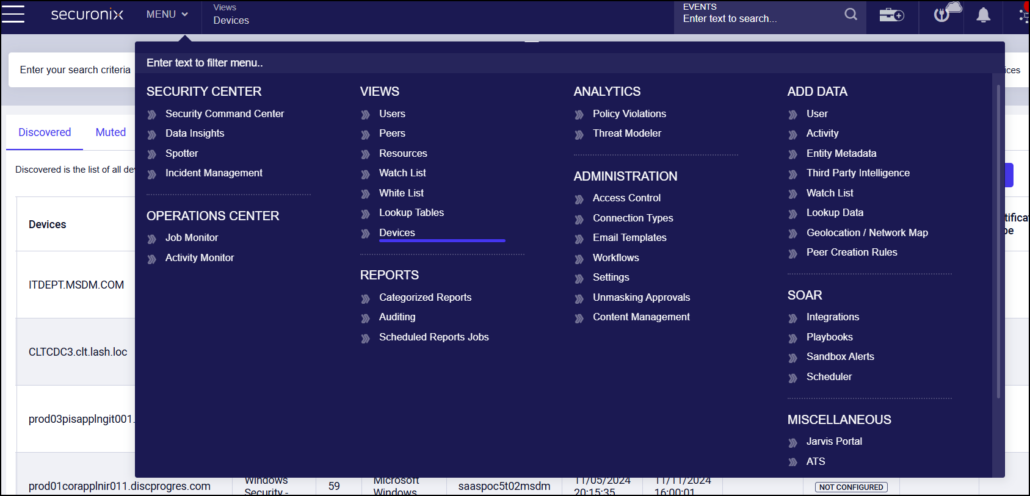
6. Securonix

Securonix is a cloud-native SIEM platform that combines threat detection, analytics, and response capabilities with AI-driven automation. It focuses on improving security operations by reducing alert noise, providing contextual insights, and supporting faster decision-making.
Key features:
- AI-driven threat detection and anomaly analysis: Uses analytics and behavioral models to identify threats and prioritize risks.
- Unified detection, investigation, and response: Integrates multiple security functions into a single platform for streamlined operations.
- Automated alert triage and prioritization: Reduces noise by filtering and prioritizing alerts based on context and risk.
- Integrated threat intelligence enrichment: Enhances detections with contextual data and external intelligence sources.
- Agent-based automation and assistance: Uses AI-driven agents to support investigation, summarization, and response workflows.

Source: Securonix
Conclusion
IBM QRadar remains a popular choice for organizations seeking a comprehensive SIEM solution. Its extensive features, such as AI-driven threat detection, user behavior analytics, and seamless integration with a variety of security tools, make it suitable for diverse environments. However, it’s crucial to weigh these strengths against QRadar’s limitations, including high costs, complexity of implementation, and challenges with customization.
See Additional Guides on Key Information Security Topics
Together with our content partners, we have authored in-depth guides on several other topics that can also be useful as you explore the world of information security.
Insider Threat
Authored by Exabeam
- [Guide] What is an Insider Threat? 4 Defensive Strategies
- [Guide] Best Insider Threat Detection Tools: Top 5 in 2026
- [Blog] Cybersecurity Threats: Everything You Need to Know
- [Product] Exabeam | AI-Driven Security Operations
Secure Remote Access
Authored by Venn
- [Guide] What is Secure Remote Access Control?
- [Guide] Remote Work Solutions: Key Categories & 15 Tools to Know in 2026
- [Whitepaper] How to Secure Contractor Access on Unmanaged Endpoints
- [Product] Venn | The Secure Workspace for Remote Work
SAST
Authored by Checkmarx
Learn More About Exabeam
Learn about the Exabeam platform and expand your knowledge of information security with our collection of white papers, podcasts, webinars, and more.