Best Insider Threat Detection Tools: Top 7 in 2026
- 9 minutes to read
Table of Contents
What Are Insider Threat Tools?
Insider threat tools are security solutions to detect, prevent, and respond to risks posed by individuals within an organization who may compromise sensitive information, systems, or processes. These tools address threats from employees, contractors, trusted partners, or anyone with legitimate access to enterprise resources.
Unlike perimeter-focused security solutions, insider threat tools operate internally, leveraging monitoring and behavioral analysis to identify activities that deviate from norms. While many security frameworks target external attackers, insider threat tools fill a gap by focusing on risks that traditional solutions often overlook.
These tools integrate technologies, such as user and entity behavior analytics (ueba), data loss prevention (DLP), and endpoint monitoring to build a profile of baseline activity. When unusual patterns emerge, such as unauthorized file transfers or privilege escalations, the tools can alert security teams or automatically enforce controls, helping organizations quickly mitigate potential compromises from within.
Editor’s note: Updated the article to cover recent market trends, updated product information to reflect features and capabilities in 2026, and added 2 new tools.
Insider Threats Market Trends
Market Growth and Forecast
The insider threat management market is projected to grow to USD 6.32 billion by 2030, with a CAGR of 15.8%. This growth reflects increasing awareness that internal risks, such as credential misuse and data exfiltration, are not addressed by traditional perimeter defenses.
Several factors are accelerating demand. The rise of hybrid and remote work has expanded the attack surface, making it harder to monitor user activity across devices and networks. At the same time, stricter data privacy regulations are forcing companies to implement stronger monitoring, audit, and access controls.
Cloud and SaaS adoption also play a major role. Sensitive data now resides outside traditional infrastructure, requiring visibility into user actions across distributed environments. In addition, cyber-insurance providers increasingly require insider risk controls, pushing organizations to adopt these tools.
Role of AI and Behavioral Analytics
AI-based behavioral analytics is becoming a core capability in insider threat tools. Machine learning models analyze user activity patterns, such as file access and communication behavior, to detect anomalies earlier than rule-based systems.
These systems improve detection accuracy while reducing false positives and analyst workload. Some platforms also use AI to summarize incidents and recommend actions, helping security teams respond faster and more efficiently.
Market Segmentation Insights
Solutions dominate the market, accounting for the majority of revenue, as organizations prioritize platforms that combine analytics, risk scoring, and data protection in a single system. Services are growing quickly as companies seek external expertise for monitoring and response.
Cloud deployment leads adoption due to scalability and the ability to analyze activity across multiple systems in real time. Large enterprises currently account for most spending, but small and medium-sized businesses are growing faster due to easier deployment models and lower-cost offerings.
Key Challenges in Detecting Insider Threats
Human Risk vs. Non-Human Risk
Distinguishing between human and non-human risks is a challenge in insider threat detection. Human risks originate from employees, contractors, or vendors who could misuse access either maliciously or inadvertently, complicating detection due to the trusted status of these users. Non-human risks, such as automated scripts, bots, or compromised service accounts, further blur the lines between typical and anomalous activity since they can exploit legitimate credentials to mimic workflows.
Insider threat tools must differentiate between these two categories, adapting detection logic accordingly. Automated account behavior might involve excessive data extraction or repetitive actions at odd hours, signaling an automated process rather than genuine user activity. Effective solutions cross-correlate signals from both human and non-human sources to understand intent and rapidly highlight behaviors that are out of character for a given entity.
Credential Misuse and Privilege Abuse
Credential misuse occurs when an individual uses valid account credentials outside of their intended scope, such as accessing sensitive data or systems not covered by their role. Privilege abuse is a subset where users exploit elevated permissions, for example, by copying confidential files or modifying system configurations without proper justification. Tracking such incidents is challenging due to the need to identify subtle deviations from normal access patterns while avoiding false positives that overwhelm analysts.
Insider threat tools address these challenges by baselining typical credential usage and monitoring for anomalies indicative of possible abuse. By correlating activity logs, access control changes, and system alerts, these tools help pinpoint misuse or escalation attempts in real time. Prompt detection enables security teams to step in before credentials are further exploited or damage spreads.
Data Exfiltration and Sabotage
Data exfiltration, the unauthorized transfer of sensitive information outside the organizational perimeter, is a primary concern for insider threat programs. Insiders may use various techniques to evade detection, such as encrypting files, employing external drives, or leveraging cloud storage, making traditional monitoring mechanisms less effective. Effective detection requires closely tracking data movement, analyzing context, and identifying intent.
Sabotage, including the deliberate destruction, alteration, or corruption of critical data and systems, presents a different but equally concerning challenge. Insider threat tools must differentiate between legitimate changes and malicious acts designed to disrupt business operations. They achieve this through continuous monitoring, integrity checking, and correlation of suspicious activities.
Workforce Monitoring in Hybrid Environments
Hybrid work environments complicate insider threat detection by dispersing organizational assets across on-premises and remote infrastructures. Users access sensitive resources from various locations, devices, and networks, increasing the difficulty of enforcing consistent security controls. This dispersion can mask suspicious behavior, as traditional network-centric monitoring is less effective in decentralized setups common to hybrid and remote workforces.
Insider threat tools must therefore provide comprehensive monitoring across all endpoints, cloud services, and network touchpoints. They aggregate data from diverse sources and unify visibility, allowing for behavioral analysis irrespective of physical location. By mapping activity patterns and correlating them across on-site and remote work environments, organizations can minimize blind spots, respond swiftly to emerging risks, and enforce policy adherence outside traditional perimeter defenses.
Core Capabilities of Insider Threat Detection Tools
User and Entity Behavior Analytics (UEBA)
UEBA is central to modern insider threat detection, leveraging machine learning to establish behavioral baselines for each user and entity, such as devices or service accounts. It continuously monitors interactions, looking for anomalies like unauthorized access attempts, unusual login hours, or unexpected file transfers. By comparing new activities against established patterns, ueba surfaces indicators of potential insider threats without relying solely on predefined rules or static policies.
This behavioral approach improves detection accuracy, especially for subtle or evolving attack techniques that traditional alerting would miss. ueba integrates with existing security infrastructure, ingesting logs and events from across the enterprise. It enables security operations teams to prioritize alerts, investigate suspicious activity, and adapt detection models automatically as threats and user behaviors evolve.
Data Loss Prevention (DLP) Integration
DLP solutions prevent sensitive information from leaving the organization, adding a crucial capability to insider threat tools. By monitoring content in motion, such as emails, instant messages, and data uploads, DLP can identify attempts at unauthorized data transfer. Integration with insider threat tools allows for contextual analysis, correlating content-level insights with user behavior and system events to flag risky actions more accurately.
Tight DLP integration also supports automated responses, such as quarantining files, blocking downloads, or alerting security personnel when sensitive data is at risk. By combining content inspection with activity monitoring, insider threat tools increase precision in preventing both inadvertent leaks and deliberate exfiltration.
Security Information and Event Management (SIEM) Correlation
SIEM platforms aggregate and analyze security logs and events across an organization, providing a unified view of potential incidents. When insider threat tools integrate with SIEM , they leverage this centralized data to spot threats that span multiple systems, departments, or workflows. Correlation rules help identify sequences of activity that, while benign in isolation, indicate risk when pieced together, such as accessing a database, copying files, and then attempting external transmission.
Effective SIEM-insider threat tool integrations enrich alerts with context, making investigations more efficient and actionable. Security teams gain visibility into both the granular details of individual user actions and the broader landscape of organizational risk. This enables faster triage, in-depth forensics, and comprehensive reporting.
Endpoint Monitoring and Session Recording
Endpoint monitoring enables organizations to observe user actions on desktops, laptops, and servers in real time. This includes tracking application usage, file operations, login attempts, and USB device connections. By maintaining visibility at the endpoint, insider threat tools can detect early indicators of compromise, such as unusual downloads, software installations, or unauthorized access to restricted folders, and gather evidence for potential investigations.
Session recording strengthens this capability by capturing full video or metadata logs of user sessions, enabling detailed review after an incident. Recorded sessions allow forensic teams to reconstruct the timeline of actions, understand intent, and verify whether data access or modification was in line with organizational policy.
AI-Powered Anomaly Detection
Artificial intelligence enhances insider threat tools by learning from vast streams of data and identifying patterns that might escape human analysts. AI-powered engines analyze contextual information, such as geography, device fingerprinting, recent behavioral trends, and peer-group comparisons, to surface subtle anomalies. For example, an AI model might detect a user accessing files inconsistent with their department or interacting with systems at unusual times, triggering a risk alert.
AI-driven analysis also reduces alert fatigue, flagging only those behaviors most likely to indicate true risk and filtering out irrelevant noise. As AI models adapt over time, they improve their precision based on feedback and evolving organizational behavior. This adaptive intelligence is critical for identifying advanced insider threats, including those using obfuscation tactics or novel attack vectors that bypass signature-based or rule-based detection engines.
Notable Insider Threat Detection Tools
Behavioral Analytics and Activity Monitoring Platforms
1. Exabeam

Exabeam delivers insider threat detection as a core capability within its Security Operations platform. By combining user and entity behavior analytics (UEBA) with SIEM, Exabeam identifies abnormal behavior that signals potential credential misuse, privilege abuse, or data exfiltration before it escalates.
Key features include:
- Behavioral analytics engine: Baselines normal user and entity behavior to detect anomalies such as unusual access patterns, lateral movement, or high-risk data activity.
- Outcomes Navigator: Evaluates coverage against 16 insider and malicious insider threat use cases, identifying log source gaps and guiding teams to strengthen detection capabilities.
- Automated investigation timelines: Correlates activity across users, endpoints, and cloud systems to reconstruct incidents and speed up response.
- Integrated response automation: Connects with SOAR workflows to contain threats, revoke access, and enrich investigations with contextual intelligence.
- Flexible deployment: Available as a cloud-native or self-managed solution, supporting a wide range of operational environments and maturity levels.
2. Forcepoint Insider Threat

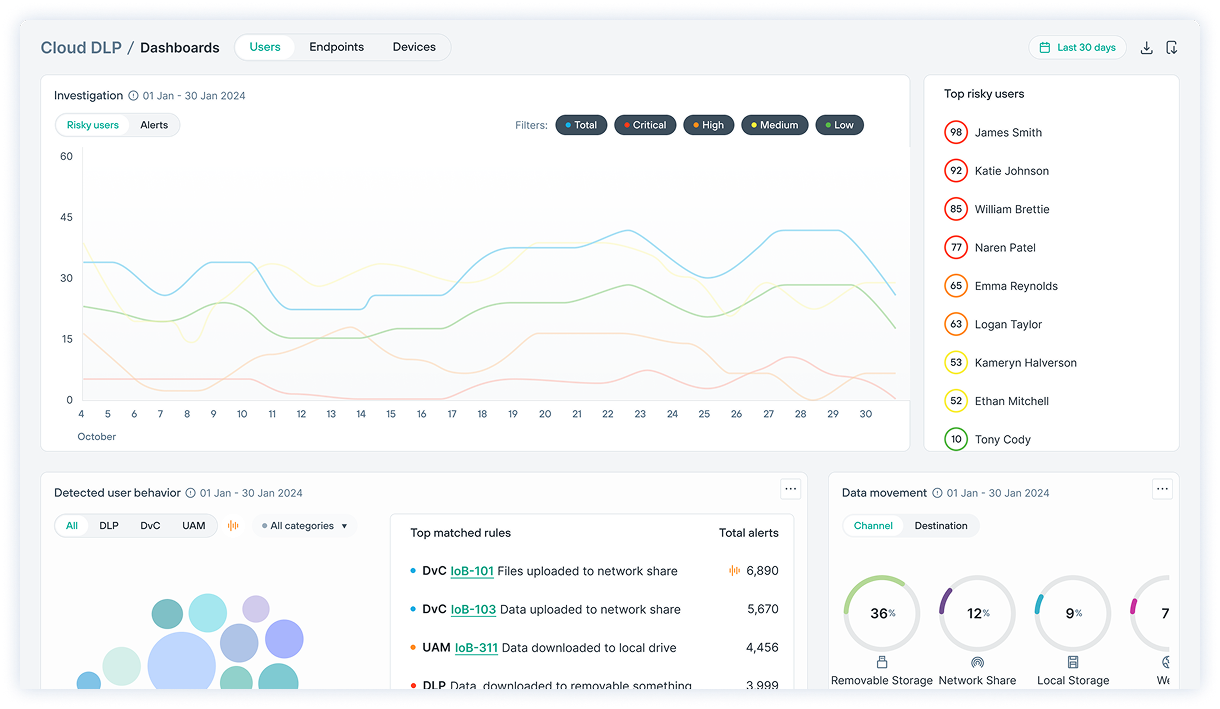
Forcepoint Insider Threat is a user activity monitoring and behavioral analytics solution to detect and mitigate internal risks by analyzing how users interact with sensitive data across systems. It focuses on identifying risky behavior early by combining visibility, behavioral profiling, and automated enforcement to reduce the likelihood of data loss or misuse.
Key features include:
- Behavioral fingerprinting: Builds profiles of user behavior to detect deviations that may signal insider risk.
- Real-time activity monitoring: Tracks user actions across endpoints, applications, and data sources for immediate visibility into behavior changes.
- Automated policy enforcement: Applies adaptive security controls based on user risk levels to prevent data misuse.
- Live video replay: Captures on-screen activity to provide context during investigations and validate intent.
- Sequential activity timelines: Reconstructs user actions in chronological order to support auditing and incident response.

Source: Forcepoint
3. Teramind

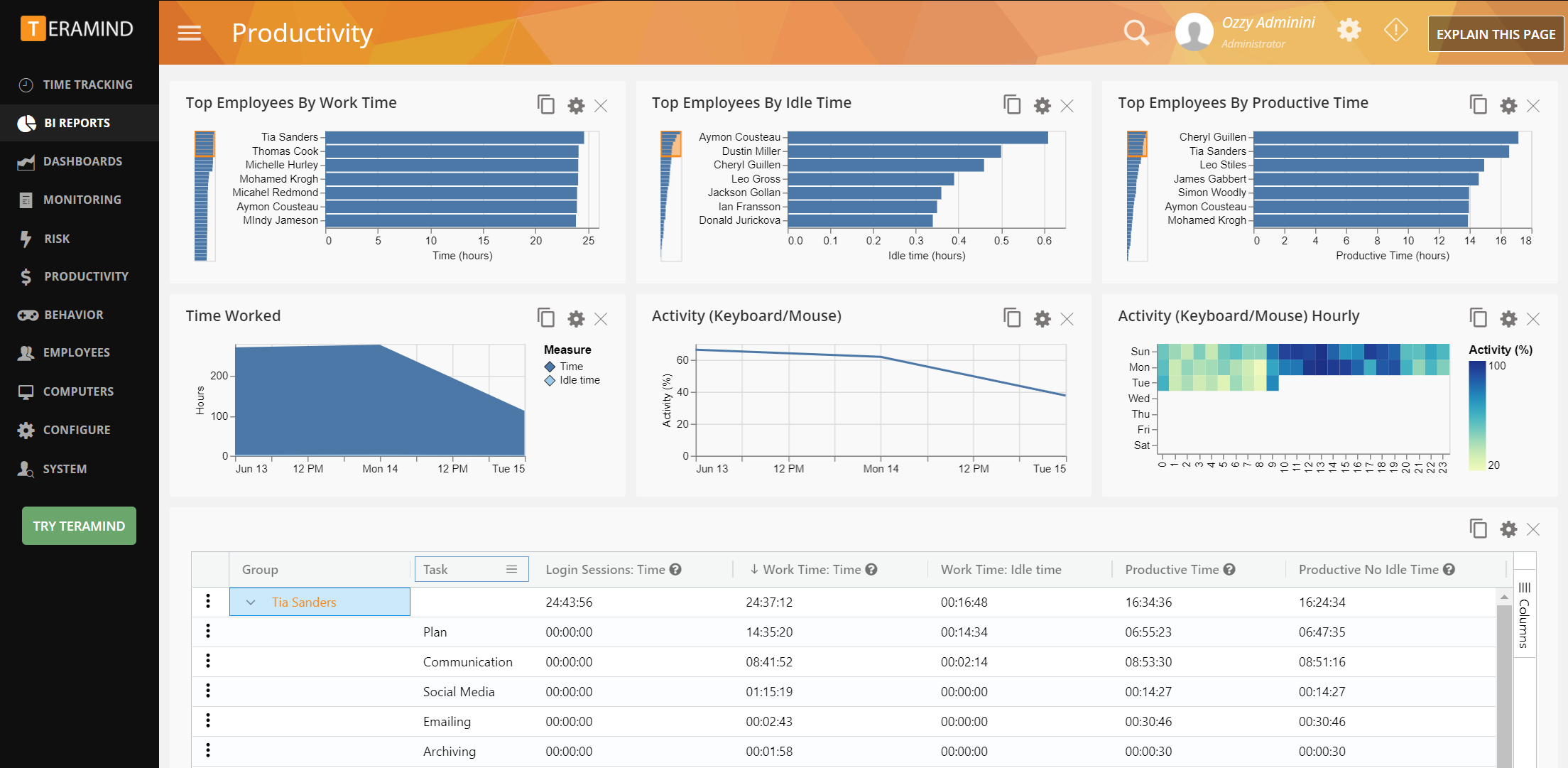
Teramind is an insider threat detection platform that focuses on monitoring and analyzing user activity at the endpoint level to identify suspicious behavior and prevent data loss. It uses behavioral analytics to establish normal activity patterns, detect deviations in real time, and trigger automated responses. The platform also supports incident investigation with detailed forensic data, helping teams understand how events unfolded and take corrective action.
Key features include:
- Behavioral analytics and baselining: Establishes normal user activity patterns to detect deviations and potential insider threats.
- Real-time alerts and detection: Generates alerts for data exfiltration, policy violations, and anomalous behavior as it occurs.
- User activity monitoring: Tracks actions across applications and systems, including file access and data transfers.
- Incident forensics and timelines: Captures detailed evidence such as user activity history and searchable records to support investigations.
- Automated policy enforcement: Applies predefined or customizable controls to block or limit risky actions like unauthorized uploads or transfers.
- SIEM and tool integrations: Sends alerts and data to external SIEM and management tools for centralized analysis.

Source: Teramind
4. Proofpoint Insider Threat Management

Proofpoint Insider Threat Management (ITM) is a solution to detect and respond to insider risks by providing visibility into user behavior across endpoints, email, and cloud applications. It emphasizes evidence collection, contextual analysis, and integrated controls to help organizations investigate and prevent data loss.
Key features include:
- User activity timeline: Provides a view of user actions, including context such as time, location, and activity type.
- Behavioral evidence collection: Captures activity data and optional screenshots to support investigations.
- Prebuilt alert library: Includes ready-to-use detection rules for common insider threat scenarios.
- Multichannel visibility: Correlates data from endpoints, email, and cloud services in a unified interface.
- Risk-based endpoint controls: Applies controls to prevent data exfiltration via channels like USB, web uploads, or cloud sync.

Source: Proofpoint
Data Security and Risk Reduction Platforms
5. Varonis

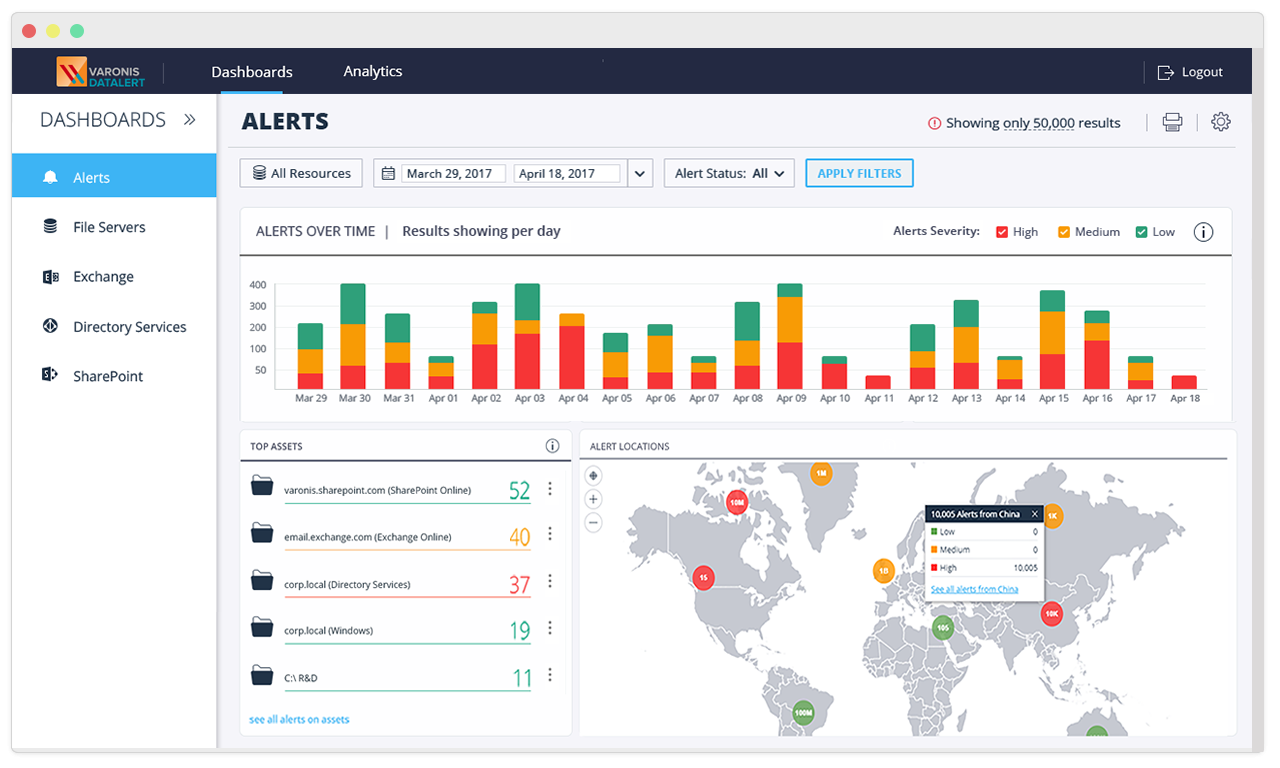
Varonis is a data security platform focused on protecting sensitive information by monitoring data access and user behavior across cloud and on-premises environments. It uses behavior-based threat detection and data-centric analytics to identify abnormal access patterns, reduce excessive permissions, and prevent data exposure.
Key features include:
- Behavior-based threat detection: Uses threat models to identify abnormal data access and user activity that may indicate insider risk.
- Data activity monitoring and auditing: Tracks file access, permission changes, and other data events for visibility and investigation.
- Automated permissions remediation: Identifies over-permissioned users and removes unnecessary access to reduce risk.
- Continuous risk assessment: Evaluates data sensitivity, access, and activity to prioritize remediation efforts.
- Searchable forensics and investigation: Enables analysis of file access events and suspicious behavior for incident response.
- Proactive monitoring and alerts: Continuously monitors for anomalies and generates alerts on unusual data interactions.

Source: Varonis
6. Splunk UBA

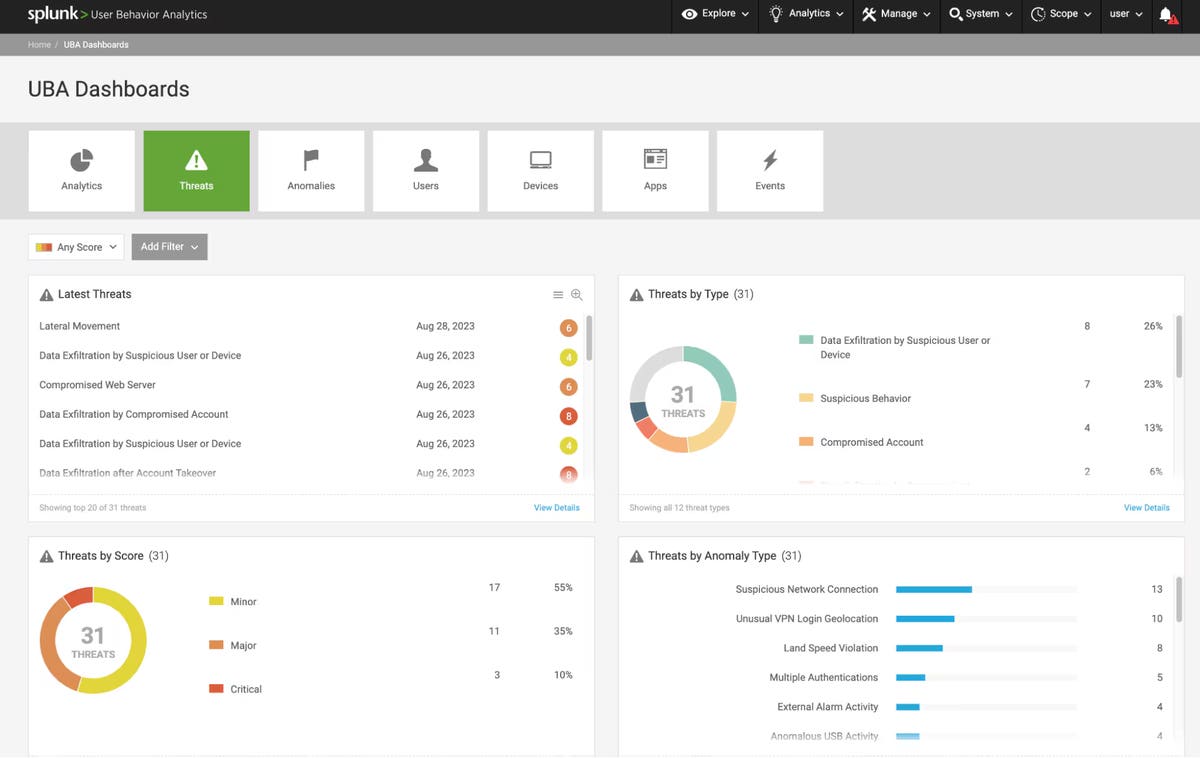
Splunk User and Entity Behavior Analytics (UBA) is part of the Splunk Enterprise Security platform, providing behavioral analytics to detect insider threats and compromised accounts. It uses machine learning and risk scoring to identify anomalies and prioritize threats for faster response.
Key features include:
- Behavioral analytics and machine learning: Learns normal behavior patterns to detect subtle anomalies and insider threats.
- Entity risk scoring: Aggregates risk signals into a unified score to prioritize high-risk users and entities.
- Multi-entity correlation: Correlates activity across users, devices, and applications to uncover complex attack patterns.
- Real-time contextual insights: Enriches alerts with historical context and peer comparisons for better decision-making.
- Automated threat detection and prioritization: Reduces alert fatigue by ranking incidents based on risk and automating analysis.

Source: Splunk
7. Lepide Data Security Platform

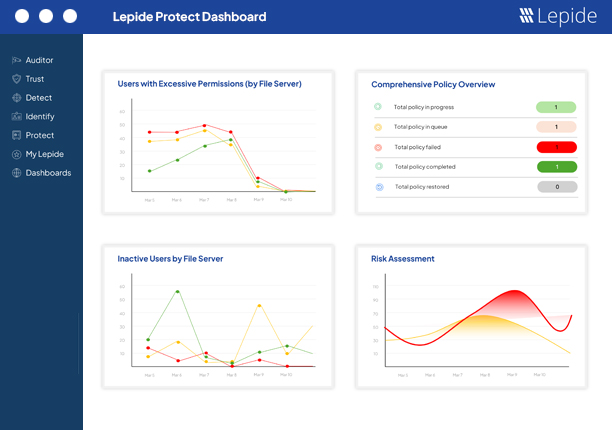
Lepide Data Security Platform is an AI-powered solution that provides visibility and control over data and user activity across on-premises and cloud environments. It focuses on detecting insider threats, managing permissions, and enabling rapid response through unified auditing and analytics.
Key features include:
- Unified auditing and reporting: Provides centralized visibility into identity and data activity with contextual insights.
- Real-time alerts and anomaly detection: Uses AI to highlight unusual behavior and generate actionable alerts.
- Automated remediation: Identifies excessive permissions and automatically revokes unnecessary access.
- Permissions analysis and governance: Offers detailed visibility into access rights and changes to prevent privilege misuse.
- Real-time data classification: Identifies and classifies sensitive data across environments to prioritize protection.

Source: Lepide
Conclusion
Insider threat detection is a critical component of modern cybersecurity strategy, addressing risks that arise from within the organization’s own perimeter. These threats can stem from negligence, compromised credentials, or malicious intent, making them particularly difficult to identify with traditional tools. Effective insider threat detection requires continuous monitoring, behavioral analysis, and the ability to correlate signals across systems and environments.
Learn More About Exabeam
Learn about the Exabeam platform and expand your knowledge of information security with our collection of white papers, podcasts, webinars, and more.