Best Threat Intelligence Solutions: Top 8 Platforms in 2026
- 10 minutes to read
Table of Contents
What Are Threat Intelligence Solutions?
Threat intelligence solutions provide organizations with the knowledge and tools to proactively identify, assess, and mitigate cyber threats. These solutions involve collecting, analyzing, and interpreting data from various sources to understand potential risks and vulnerabilities. By leveraging threat intelligence, organizations can improve their security posture, reduce the impact of attacks, and improve their overall cybersecurity defenses.
There are several important components of threat intelligence solutions, including:
- Data collection and aggregation: Threat intelligence solutions gather data from diverse sources, including open-source intelligence (OSINT), dark web monitoring, threat feeds, and internal security systems.
- Analysis and enrichment: Collected data is analyzed and enriched to provide context, identify patterns, and assess the potential impact of threats.
- Threat detection and response: Threat intelligence helps in detecting potential attacks, identifying malicious actors, and enabling proactive responses to mitigate risks.
- Vulnerability management: Threat intelligence informs vulnerability management processes, helping organizations prioritize and remediate vulnerabilities based on their potential impact.
- Incident response: Threat intelligence provides valuable insights for incident response, enabling faster and more effective remediation of security breaches.
- Attack surface management: Threat intelligence solutions help organizations identify and manage their attack surface, minimizing potential vulnerabilities and exposure points.
The main benefits of threat intelligence include:
- Enhanced incident response: Provides valuable insights for faster and more effective incident response.
- Proactive threat detection: Enables organizations to identify and respond to threats before they cause significant damage.
- Reduced risk and impact of attacks: By understanding and mitigating threats, organizations can minimize the potential impact of cyberattacks.
- Improved security posture: Threat intelligence helps organizations strengthen their overall security posture by addressing vulnerabilities and improving defenses.
- Better decision-making: Enables informed decision-making regarding security investments and resource allocation.
This is part of a series of articles about cyber threat intelligence
Editor’s note: Updated the article to cover recent market trends, updated product information to reflect features and capabilities in 2026.
Threat Intelligence Market Trends
Market Size and Growth Outlook
The global threat intelligence market is expanding rapidly. It is valued at USD 6.87 billion and is expected to grow to USD 31.58 billion by 2034, with a CAGR of 18.30%. North America leads the market, holding 44.70% of the share. This growth reflects increasing demand for centralized platforms that collect and analyze threat data from multiple sources and present it in a usable format.
Key Growth Drivers
The rise in cyberattacks is a primary factor driving adoption. Incidents such as ransomware and large-scale breaches have pushed organizations to invest in threat intelligence to prevent data loss and protect sensitive information. The shift to remote work and distributed environments has increased exposure to threats, making continuous monitoring and analysis essential. As a result, many organizations now use threat intelligence regularly to track global attack patterns and respond faster.
Market Challenges
A major constraint in the market is the shortage of skilled cybersecurity professionals. Organizations often lack trained analysts who can effectively manage and interpret threat intelligence data. This skills gap limits the full use of these solutions and creates operational challenges. Surveys indicate that many organizations struggle to control and operationalize threat intelligence due to this lack of expertise.
Market Segmentation Insights
The market is divided into solutions and services, with solutions holding the largest share due to demand for real-time insights and automation. By type, operational threat intelligence leads, as organizations need detailed information about active threats and attackers. Deployment is dominated by cloud-based solutions, which help reduce attack surfaces and improve scalability. Large enterprises account for a significant share, but small and medium-sized businesses are adopting these tools due to increased exposure to cyber threats.
Key Components of Threat Intelligence Solutions
Data Collection and Aggregation
Threat intelligence solutions gather data from multiple external and internal sources to build a comprehensive picture of the threat landscape. External sources include open-source intelligence (OSINT), commercial threat feeds, dark web forums, and social media.
Internal sources can include logs from firewalls, intrusion detection systems (IDS), and endpoint detection and response (EDR) tools. These solutions use automated crawlers, APIs, and integration connectors to collect large volumes of data in real time. Data normalization and deduplication processes ensure that the collected information is relevant, non-redundant, and ready for analysis.
Analysis and Enrichment
Once data is collected, threat intelligence solutions apply analytics to filter out noise and highlight relevant threat indicators. Machine learning models and correlation engines help identify patterns and relationships between different data points, such as IP addresses, malware signatures, and attacker behavior.
Enrichment involves adding contextual information to raw threat indicators. This could include geolocation data, attack attribution details, historical activity, and links to known threat actors. Enriched data gives security teams a clearer understanding of potential threats and their significance.
Threat Detection and Response
Threat intelligence platforms integrate with security information and event management (SIEM) systems and endpoint security tools to enable real-time threat detection. They provide indicators of compromise (IOCs) and threat signatures that help in identifying malicious activities as they happen.
For response, these solutions offer playbooks, automated response actions, and integration with security orchestration, automation, and response (SOAR) platforms. This allows organizations to contain and mitigate threats quickly, often with minimal manual intervention.
Vulnerability Management
Threat intelligence enhances vulnerability management by providing insights into which vulnerabilities are actively being exploited in the wild. This helps organizations prioritize patching efforts based on real-world threat data rather than theoretical severity scores alone.
Integrating threat intelligence with vulnerability scanners and management tools allows organizations to map vulnerabilities against current threat actor activity. This risk-based approach ensures that resources are focused on addressing the most critical exposures first.
Incident Response
During an incident, threat intelligence provides contextual data to help responders quickly understand the scope and nature of the attack. This includes information on known attacker tactics, associated malware, and common indicators.
Post-incident, threat intelligence supports forensic analysis by linking observed indicators back to known threat campaigns. This helps improve defenses and ensures that similar incidents are identified and mitigated faster in the future.
Attack Surface Management
Threat intelligence platforms help organizations discover and monitor all internet-facing assets, including shadow IT, forgotten domains, and exposed services. This visibility is critical for reducing attack vectors that adversaries could exploit.
By continuously monitoring the external attack surface, these solutions alert security teams to new vulnerabilities, misconfigurations, or leaked credentials that could increase risk. This enables timely remediation and reduces the window of exposure.
Related content: Read our guide to threat intelligence tools (coming soon)
Threat Detection and Response Platforms with Threat Intelligence Features
1. Exabeam

Exabeam is a security operations platform that integrates user and entity behavior analytics (UEBA), SIEM, SOAR, and threat detection, investigation, and response (TDIR) to enhance threat intelligence workflows either with a full platform or augmenting existing SIEMs. Rather than relying solely on static rules, Exabeam applies behavioral analytics and automated event timelines to identify anomalies across logs from on-premises, cloud, and SaaS environments. This approach provides context to potential threats and helps security teams focus on the most critical incidents.
Its threat intelligence value lies in how it correlates internal telemetry with external indicators to surface compromised credentials, lateral movement, and insider threats that traditional SIEMs may overlook. The platform is known for reducing alert fatigue through automated triage and offering rapid investigation capabilities without requiring highly specialized staff.
Key differentiators include:
- Behavioral analytics and smart timelines to detect threats that bypass rule-based systems.
- Integrated TDIR workflows that reduce manual investigation time and consolidate intelligence from multiple sources.
- Open integration model that allows organizations to ingest diverse threat feeds and use intelligence across existing security tools.
Exabeam is designed for organizations seeking to operationalize threat intelligence within their SOC, improving detection and response efficiency while avoiding the lock-in or data silos often seen with single-focus XDR or rule-based SIEM solutions.
2. Rapid7 Threat Command

Rapid7 Threat Command is a digital risk protection platform focused on identifying and mitigating external threats across the clear, deep, and dark web. It provides visibility into an organization’s external exposure and supports investigation and remediation workflows to reduce risks such as phishing and credential leaks.
General features:
- Digital risk protection: Monitors external environments to identify risks targeting the organization.
- Investigation and threat mapping: Maps digital assets and identifies potential attack vectors.
- Rapid remediation and takedown: Supports removal of malicious infrastructure such as phishing sites.
- Automation capabilities: Simplifies workflows and integrates with other security tools.
Threat intelligence features:
- Clear, deep, and dark web monitoring: Collects intelligence from multiple online environments.
- Contextualized alerts: Provides enriched alerts for faster triage and response.
- IOC management and enrichment: Enhances indicators of compromise for detection and analysis.
- Threat library: Maintains a repository of threat data to support investigations.

Source: Rapid7
3. Cyble Vision

Cyble Vision is a unified platform that combines threat intelligence with broader risk monitoring capabilities. It provides visibility across multiple threat surfaces and uses AI-driven analysis to support detection and response.
General features:
- Unified intelligence platform: Combines multiple security capabilities into one system.
- End-to-end visibility: Covers cyber, brand, third-party, and physical risks.
- Integration capabilities: Connects with existing tools to support workflows.
- Attack surface and risk monitoring: Tracks exposures across digital assets.
Threat intelligence features:
- Dark web monitoring: Identifies threats from hidden and underground sources.
- AI-driven threat detection: Uses AI to analyze and detect threats.
- Real-time alerts: Provides immediate notifications for emerging risks.
- Threat investigation and attribution: Supports analysis of threat actors and behavior.
Custom threat alerts: Enables threat alerts based on specified keywords, brand mentions, or industry-specific risk parameters.

Source: Cyble Vision
Dedicated Threat Intelligence Solutions
4. ThreatConnect

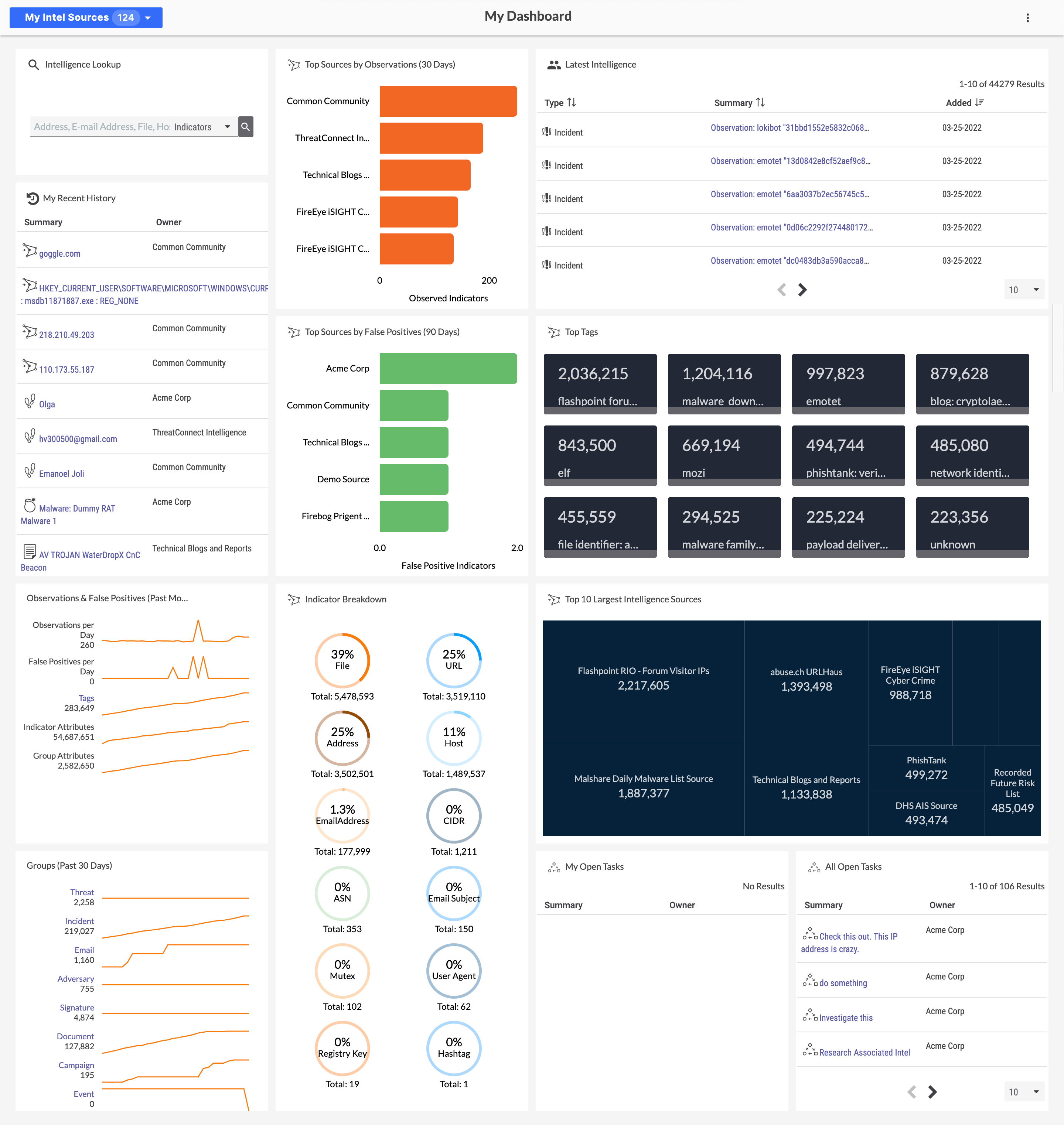
ThreatConnect is a threat intelligence platform focused on operationalizing intelligence across security operations and risk management. It centralizes data from multiple sources and provides tools for analysis, correlation, and decision-making. The platform also links threat intelligence to business risk, helping organizations prioritize actions based on impact.
Key features include:
- Centralized intelligence management: Aggregates open-source, commercial, and internal intelligence into a single platform.
- Federated search and correlation: Enables analysts to search and correlate data across multiple sources in real time.
- Operationalized intelligence workflows: Transforms raw data into actionable intelligence for detection and response.
- Cyber risk quantification: Links threats to financial impact to support prioritization and executive reporting.
- Collaboration and information sharing: Improves communication between teams through shared intelligence and workflows.
- Automation and analysis support: Simplifies analysis and decision-making with integrated tools and workflows.

Source: ThreatConnect
5. MISP

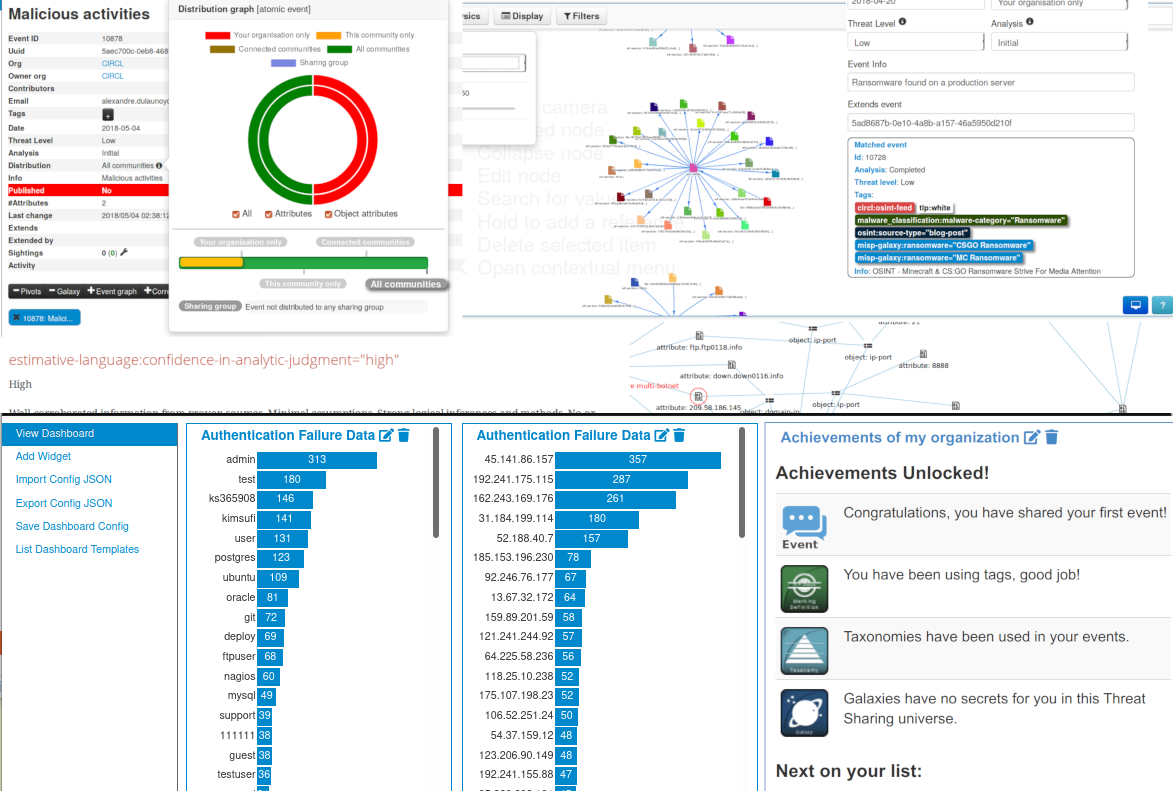
MISP (Malware Information Sharing Platform) is an open-source threat intelligence platform for sharing, storing, and correlating indicators of compromise and related intelligence. It supports collaborative analysis and enables organizations to exchange structured threat data in real time. The platform is widely used for both operational and strategic threat intelligence.
Key features include:
- Threat intelligence sharing: Enables real-time exchange of indicators and intelligence across organizations and communities.
- Flexible data model: Supports structured representation of indicators, tactics, techniques, and related context.
- Correlation engine: Identifies relationships between indicators, campaigns, and threat actors using automated correlation.
- Structured data storage: Stores both technical and non-technical intelligence in a searchable format.
- Import and export support: Integrates with multiple formats such as STIX, CSV, and IDS rules for interoperability.
- Automation and workflows: Provides customizable pipelines for data processing, analysis, and distribution.
- API and integration support: Offers APIs and modules to integrate with external tools and systems.

Source: MISP
6. Recorded Future

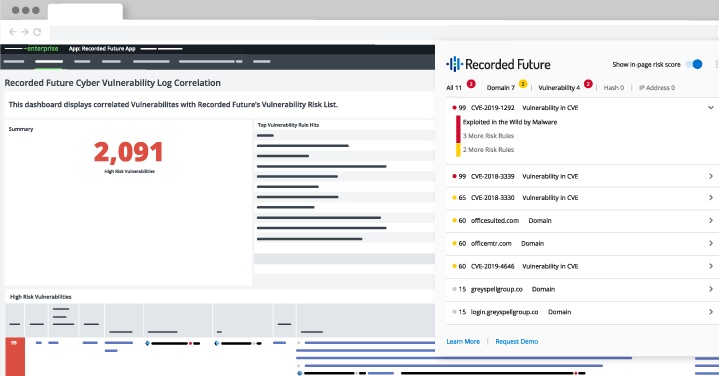
Recorded Future is a threat intelligence platform that focuses on collecting and analyzing large volumes of data to identify relevant threats. It applies automated analysis and pattern matching to prioritize risks and provide actionable intelligence. The platform supports continuous monitoring and helps organizations focus on the most significant threats.
Key features include:
- Large-scale data collection: Aggregates intelligence from a wide range of sources to provide broad visibility into threats.
- Pattern matching and analytics: Uses algorithms to identify threat patterns and correlations across datasets.
- Prioritized intelligence: Filters and ranks threats to highlight those most relevant to the organization.
- Continuous threat monitoring: Tracks evolving threats and attacker activity in real time.
- Actionable insights: Provides intelligence that supports faster decision-making and response.
- Research and intelligence support: Combines automated data analysis with expert-driven insights.

Source: Recorded Future
7. OpenCTI

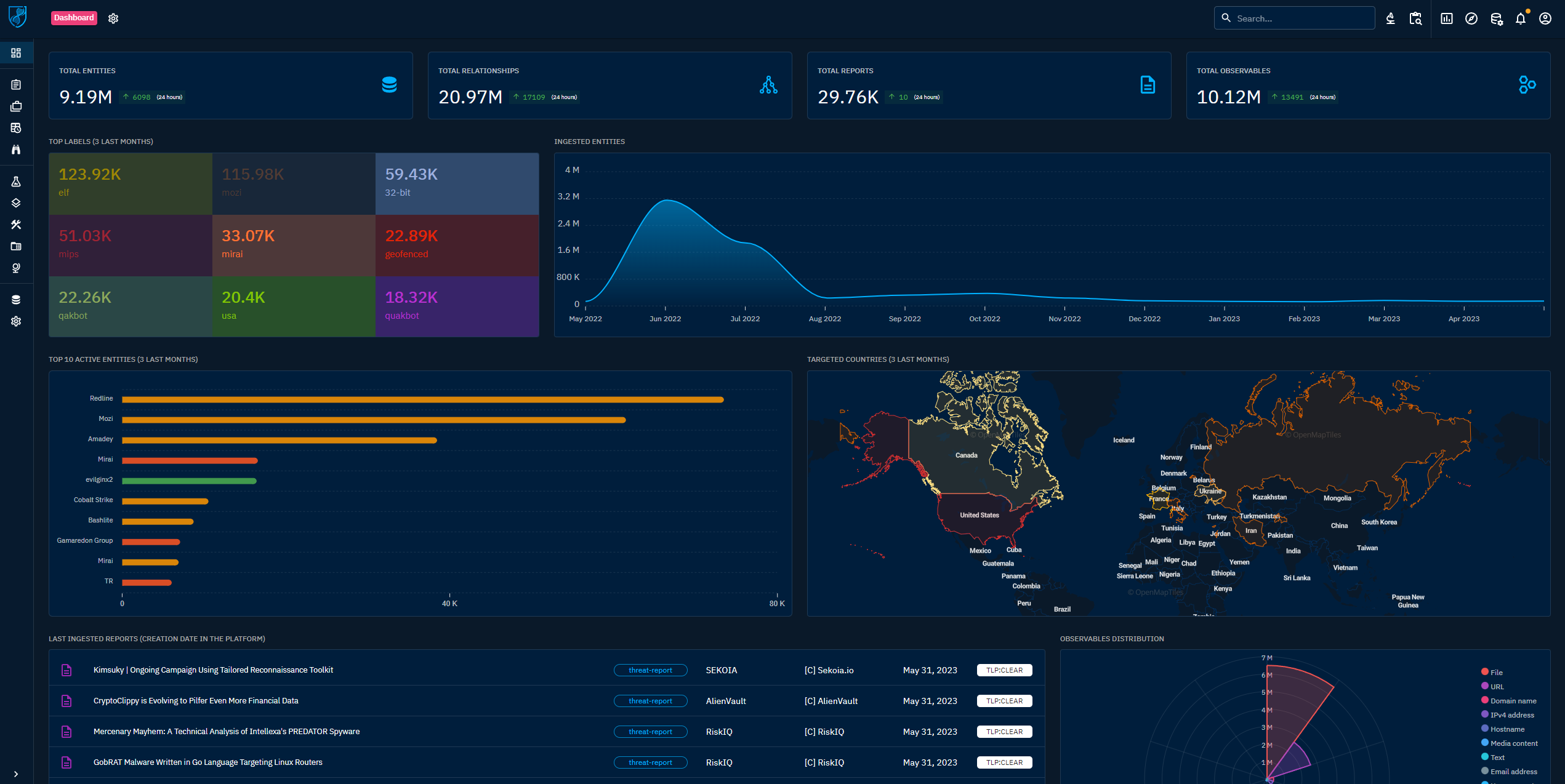
OpenCTI is an open-source threat intelligence platform to centralize, structure, and operationalize threat data. It uses a standardized data model to unify intelligence from multiple sources and provides tools for analysis, visualization, and sharing. The platform supports collaboration and automation across the threat intelligence lifecycle.
Key features include:
- Centralized intelligence platform: Consolidates multiple threat feeds into a unified system using a consistent data model.
- STIX-based data model: Uses structured formats to standardize and organize threat intelligence.
- Visualization and analysis tools: Provides dashboards, graphs, and timelines to explore relationships between threats.
- Automation and AI support: Automates data processing and supports analysis with AI capabilities.
- Case management: Centralizes incident-related data to improve investigation and response workflows.
- Role-based access control: Manages access to intelligence across teams and organizations.
- Integration ecosystem: Connects with external tools and supports large-scale integrations.

Source: OpenCTI
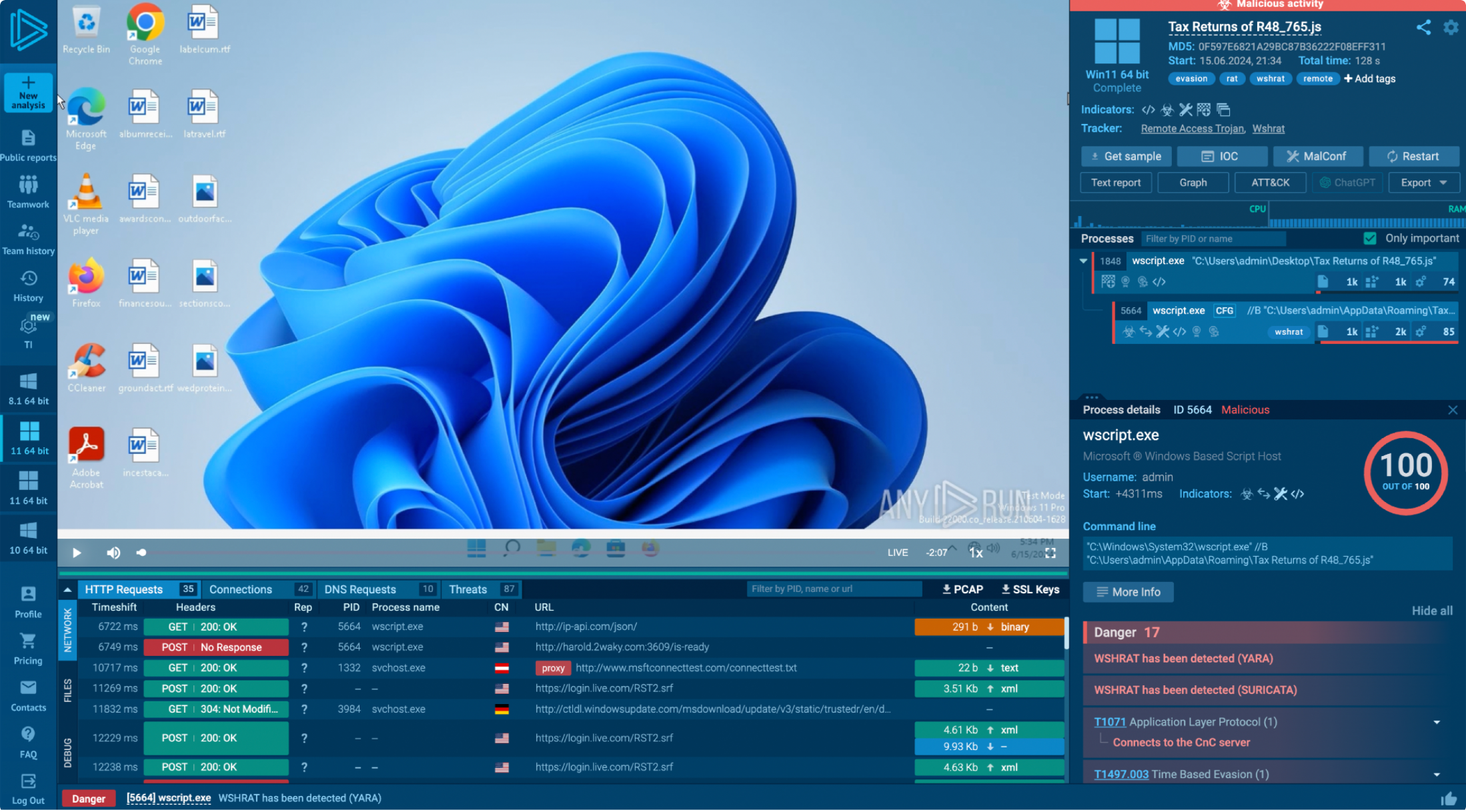
8. ANY.RUN

ANY.RUN is a threat analysis and intelligence platform centered on interactive malware analysis and real-time data collection. It provides a sandbox environment where security teams can observe and investigate threats, while also generating threat intelligence that can be used for detection and response.
Key features include:
- Interactive malware sandbox: Allows analysts to safely execute and observe malware behavior in real time.
- Threat intelligence lookup: Provides access to data from large volumes of analyzed malware and phishing samples.
- Threat intelligence feeds: Supplies continuously updated indicators of compromise for integration with security tools.
- Real-time analysis: Enables fast investigation of threats, reducing time to detection and response.
- Collaboration features: Supports sharing of analysis results and coordination across teams.
- Integration support: Connects with SIEM, TIP, and XDR platforms using APIs and standard formats.
- Access to real-world threat data: Leverages data collected from thousands of organizations to improve detection accuracy.

Source: ANY.RUN
Choosing the Right Threat Intelligence Solution
Here are some of the main considerations when evaluating threat intelligence solutions.
1. Define Your Objectives
Before selecting a threat intelligence solution, it’s crucial to clearly define the organization’s security goals. Identify whether the primary needs include detecting external threats, enriching internal incident data, improving vulnerability prioritization, or improving response workflows. The use case will influence the kind of intelligence required—tactical, operational, or strategic.
Consider organizational size, industry, regulatory obligations, and the maturity of security operations. For example, a financial institution may prioritize fraud indicators and dark web monitoring, while a manufacturing firm might focus on supply chain threats. Defining these objectives ensures alignment between platform capabilities and security outcomes.
2. Assess Data Quality and Sources
The usefulness of threat intelligence is tied to the quality, scope, and timeliness of the data it collects. Evaluate whether the solution gathers information from a broad and diverse set of sources: OSINT, government feeds, dark web forums, malware repositories, and industry-specific threat exchanges. Breadth helps detect a wider range of threats, while relevance ensures the data matches the risk profile.
Also important is how the platform filters, scores, and enriches raw data. Look for capabilities like confidence ratings, contextual tagging, and historical correlation. Platforms that offer enriched, deduplicated intelligence with minimal false positives allow security teams to act faster and more confidently, improving decision-making and reducing alert fatigue.
3. Evaluate Integration Capabilities
A threat intelligence solution should integrate with the existing security ecosystem. This includes SIEMs, SOAR platforms, firewalls, endpoint protection systems, and case management tools. The ability to push and pull data automatically between tools reduces manual effort, shortens response times, and helps teams coordinate actions efficiently.
Assess support for industry standards such as STIX/TAXII, as well as the availability of APIs, SDKs, and built-in connectors. Effective integration ensures that threat indicators are both visible and actionable within existing workflows. Without this, intelligence remains siloed and underutilized, limiting the return on investment.
4. Analyze Reporting and Alerting Features
Timely and actionable alerts are vital for detecting and responding to threats. A strong threat intelligence platform should support real-time alerts with rich context, including indicator attributes, threat actor profiles, and attack timelines. Alerts should be customizable by severity, asset impact, or threat type to reduce noise and help teams focus on critical issues.
Reporting tools are equally important. Look for features such as trend analysis, attack timelines, and executive dashboards. Reports should support both technical and non-technical audiences, providing detail for analysts and summaries for leadership. Export options and compliance-aligned templates can simplify audits and documentation requirements.
5. Ensure Scalability and Customization
Organizations change over time, and the threat intelligence solution should be able to grow with them. Scalability means handling larger data volumes, more users, new data sources, and evolving threat types without sacrificing performance. This is particularly important for multinational organizations or those expanding their digital footprint.
Customization ensures the platform adapts to operational needs. Whether configuring risk scoring models, setting up tailored dashboards, or defining workflow automations, flexible solutions help align intelligence with the threat landscape. Platforms that support user roles, custom tagging, and modular deployments allow security teams to stay agile.
Learn More About Exabeam
Learn about the Exabeam platform and expand your knowledge of information security with our collection of white papers, podcasts, webinars, and more.