Table of Contents
What Are SIEM Systems?
SIEM systems (Security Information and Event Management) are cybersecurity tools that centralize and analyze log and event data from various IT and operational technology (OT) sources to detect, investigate, and respond to security threats in real time.
SIEM systems combine security information management (SIM) and security event management (SEM) to provide unified security visibility, enabling organizations to identify threats, manage incidents, and meet compliance requirements. Modern SIEM solutions incorporate advanced analytics, artificial intelligence (AI), and machine learning to improve threat detection and automate responses.
How SIEM systems work:
- Data collection: SIEM systems collect security-related data, such as logs, security alerts, and events, from various sources across an organization’s IT infrastructure, including firewalls, network devices, servers, and applications.
- Data aggregation and normalization: The collected data is aggregated and normalized into a unified format for easier analysis and correlation.
- Threat detection: SIEM systems use predefined rules, correlation engines, and advanced analytics, including machine learning, to identify patterns and anomalies in the data. This process helps in detecting potential security threats and vulnerabilities.
- Alerting: When an event or pattern matches a threat signature, the SIEM generates a prioritized alert for security teams to review.
- Incident response: The system provides tools and data for security analysts to investigate alerts and manage incident response.
- Reporting: SIEM systems offer reporting and dashboards that help organizations demonstrate compliance with regulations and track historical security events.
This is part of a series of articles about SIEM tools
Editor’s note: Updated the article to cover recent market trends, updated product information to reflect features and capabilities in 2026, and added 1 new tool.
Understanding the SIEM Market Trends
Market Size and Growth
The SIEM market is expanding steadily. It is valued at USD 10.67 billion and is projected to reach USD 20.78 billion by 2031, growing at a CAGR of 11.5%. This growth reflects increasing demand for centralized visibility, faster detection, and scalable analytics as organizations generate more security data.
Key Growth Drivers
Several forces are pushing organizations to adopt or upgrade SIEM platforms:
- Rising volume of security telemetry: Large enterprises are ingesting massive amounts of log data from endpoints, cloud services, and SaaS tools. This makes scalable data processing and storage essential.
- Regulatory pressure: Laws such as NIS2 in Europe and SEC disclosure rules in the US require fast incident reporting and reliable log retention. These regulations force organizations to improve monitoring and auditing capabilities.
- Cloud and hybrid environments: As workloads move across multiple cloud providers, SIEM tools must collect and correlate data from distributed systems. This shift favors platforms that can integrate directly with cloud-native data sources.
- Improving detection quality: AI and machine learning help filter out low-value alerts and assist analysts with investigation and response, reducing fatigue and improving response times.
Deployment and Architecture Trends
On-premises SIEM systems still hold a slight majority, accounting for over 55% of the market in 2025. However, cloud-based SIEM solutions are growing faster, driven by flexible pricing and reduced infrastructure management.
Modern SIEM architectures are moving away from tightly coupled systems. Cloud-native designs separate storage and compute, allowing organizations to store large volumes of data cheaply and run analytics only when needed. This reduces overall costs and improves scalability.
Hybrid deployments are becoming common, especially in regulated industries. These setups keep sensitive data in specific regions while using cloud resources for analysis.
Managed Services and Skills Gap
A shortage of skilled security analysts is shaping how SIEM is consumed. Many organizations struggle to staff 24/7 monitoring teams, leading to increased demand for managed SIEM services.
Managed service providers handle alert triage, monitoring, and response workflows. This allows internal teams to focus on higher-level tasks while maintaining coverage. As a result, managed services are growing faster than traditional software licenses.
Core Features of SIEM Products
Data Collection
SIEM products collect security data from many sources, such as firewalls, intrusion detection systems, servers, and applications. This data arrives in varied formats, creating a challenge for centralized analysis. Data aggregation resolves this by gathering logs and security events from across the network and bringing them into a single repository.
Normalization then translates these different data formats into a standard structure, allowing the SIEM system to process and analyze them uniformly. Normalization simplifies analysis and enables security teams to detect patterns or anomalies that span multiple data sources. By producing a consistent dataset, SIEM solutions provide the foundation for reliable correlation, reporting, and alerting.
Log Management
SIEM products provide centralized log storage that ensures security event data is collected, indexed, and retained in a structured, searchable format. This centralization simplifies data access for monitoring, investigation, and compliance tasks. Logs from multiple sources, such as network devices, servers, applications, and cloud environments, are ingested and stored in accordance with predefined retention policies.
Advanced log management features include data compression, encryption, and tiered storage options to balance performance and cost. These capabilities help organizations maintain compliance with regulatory requirements while enabling rapid retrieval and analysis of historical data during incident response or audits.
Event Correlation and Prioritization
Event correlation in SIEM tools links related security events to reveal larger patterns or incidents. For example, a login attempt followed by access to sensitive files and then a large data transfer might be considered suspicious only when seen together. SIEM products use correlation rules and machine learning to automatically connect such events, identifying multi-stage attacks and minimizing the chances of missing important incidents.
After events are correlated, SIEM systems prioritize them based on their severity and potential impact on the organization. Prioritization ensures that security teams focus their attention and resources on the most critical threats. This automated triage helps reduce alert fatigue and improves response times by guiding analysts to work on true incidents instead of benign or low-risk events.
Alerting and Notifications
SIEM platforms offer configurable alerting mechanisms, which notify security teams of potential threats or policy violations in real time. These alerts can be tailored to the needs of the organization and delivered through various channels, such as email, SMS, or integrations with ticketing systems.
Dashboards and reporting features in SIEM solutions provide both real-time and historical visibility into an organization’s security status. Dashboards offer visual summaries of alerts, event trends, and key performance indicators, while reporting modules generate compliance reports, audit logs, and executive summaries.
Incident Response
SIEM tools simplify the incident response process by integrating with ticketing systems, orchestration platforms, and other security tools. When an alert is triggered, the SIEM can automatically open a case, assign it to the appropriate analyst, and initiate predefined response workflows. These workflows can include tasks like gathering related logs, notifying stakeholders, and escalating based on severity.
Some SIEM platforms also offer playbook automation, which allows common response actions, such as isolating a device, blocking an IP address, or initiating malware scans, to be executed automatically. This reduces manual effort, speeds up containment, and ensures consistent incident handling across the organization.
Reporting and Compliance
Many industries require organizations to maintain detailed records of system and user activities for extended periods. SIEM solutions support compliance by automating the collection, storage, and retrieval of log data according to industry standards and regulatory mandates, such as PCI DSS, HIPAA, and GDPR. Automated compliance reporting simplifies audit processes and reduces manual effort.
Long-term log retention is also vital for forensic investigations and historical trend analysis. SIEM products manage log storage efficiently, applying indexing and compression techniques to preserve older data while keeping storage costs manageable. Secure retention ensures that evidence remains intact and accessible for regulatory needs and internal incident reviews.
Forensic Search and Analysis
SIEM platforms provide search capabilities that enable security teams to investigate incidents after they occur. Operators can search across vast datasets of security logs, filtering by time, user, source, or event type to reconstruct the sequence of activities involved in a breach. Advanced search features such as pattern matching and timeline generation accelerate investigations and provide context necessary for root-cause analysis.
In addition to retrospective analysis, SIEM solutions often integrate with threat intelligence feeds to enrich search results and help analysts identify indicators of compromise. Forensic tools within SIEM platforms support the speedy discovery of evidence and enable security teams to understand the full scope and impact of an incident.
Related content: Read our guide to SaaS SIEM.
Notable SIEM Products
Next-Gen / AI-Driven SIEM Platforms
1. Exabeam

Exabeam delivers a modern SIEM experience with the New-Scale Security Operations Platform, combining log management, machine-learned behavioral analytics, and automation. At the center is Exabeam Nova, a coordinated system of AI agents that accelerate detection, investigation, and response across the SOC.
Key features include:
- Behavioral analytics: Builds baselines of normal user, entity, and AI agent behavior to surface subtle threats like compromised credentials, insider misuse, and lateral movement.
- Risk-based prioritization: Adaptive risk scoring consolidates noisy alerts, highlighting the highest-priority threats and reducing alert fatigue by up to 60%.
- AI-driven investigation: Exabeam Nova automates evidence collection, case creation, and timeline generation, cutting investigation time by up to 80% and enabling faster containment.
- Leadership insights: Daily posture reporting connects SOC activity to measurable outcomes, helping teams track improvement and demonstrate value to executives and auditors.
Exabeam’s open and extensible platform supports cloud-native, hybrid, and self-hosted deployments, giving organizations flexibility while unifying security operations. The result is faster, more consistent detection and response without adding headcount.
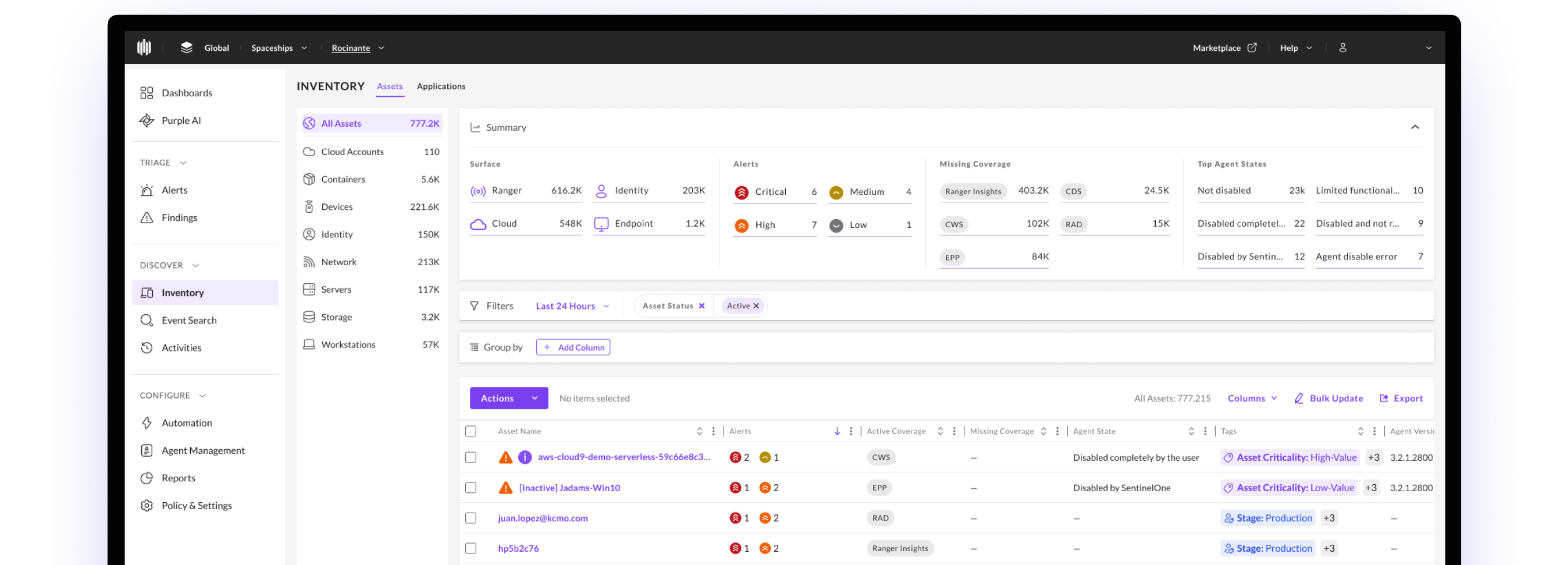
2. SentinelOne SIEM

SentinelOne AI SIEM is built on a scalable data lake that ingests structured and unstructured data from across the environment without relying on indexing. It applies AI-driven analytics and automation to detect threats, correlate signals, and accelerate response, while supporting integration with existing security tools and workflows.
Key features include:
- AI-enhanced detection: Uses machine learning algorithms to identify patterns and anomalies that traditional rule-based systems may miss.
- Real-time visibility: Provides a unified dashboard for monitoring security events and making faster decisions.
- Automated workflows: Automates repetitive tasks and investigation steps to reduce manual effort.
- Threat intelligence integration: Enriches detections with up-to-date threat intelligence for better context.
- Incident response playbooks: Delivers guided response steps to ensure consistent handling of security incidents.
- Scalable data ingestion: Supports large-scale data collection from multiple sources with flexible retention.

Source: SentinelOne
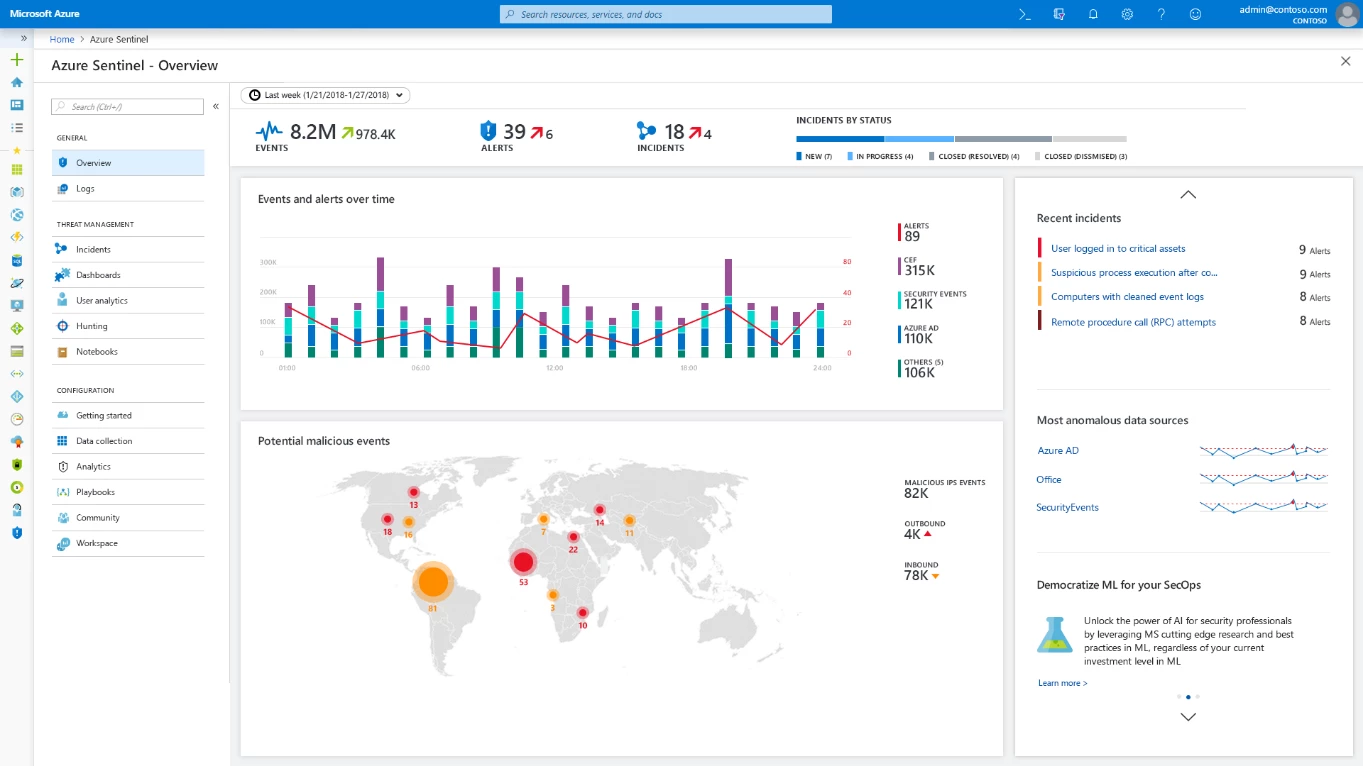
3. Microsoft Sentinel

Microsoft Sentinel is a cloud-native SIEM platform that centralizes security data and applies AI-driven analytics to detect and respond to threats across hybrid and multicloud environments. It combines data lake storage, behavioral analytics, and automation to improve visibility and streamline security operations.
Key features include:
- Cloud-native architecture: Uses a scalable data lake to store and analyze large volumes of security data without infrastructure overhead.
- AI-driven detection and correlation: Applies machine learning to identify threats, reduce false positives, and improve detection accuracy.
- Graph-powered context: Provides contextual insights by mapping relationships between users, devices, and activities.
- Integrated SIEM and SOAR capabilities: Combines detection, investigation, and automated response within a single platform.
- Extensive data connectors: Supports ingestion from hundreds of sources across cloud, on-prem, and third-party environments.
- AI-assisted investigation: Uses generative AI to summarize incidents, generate queries, and recommend next steps.

Source: Microsoft
Established / Traditional SIEM Platforms
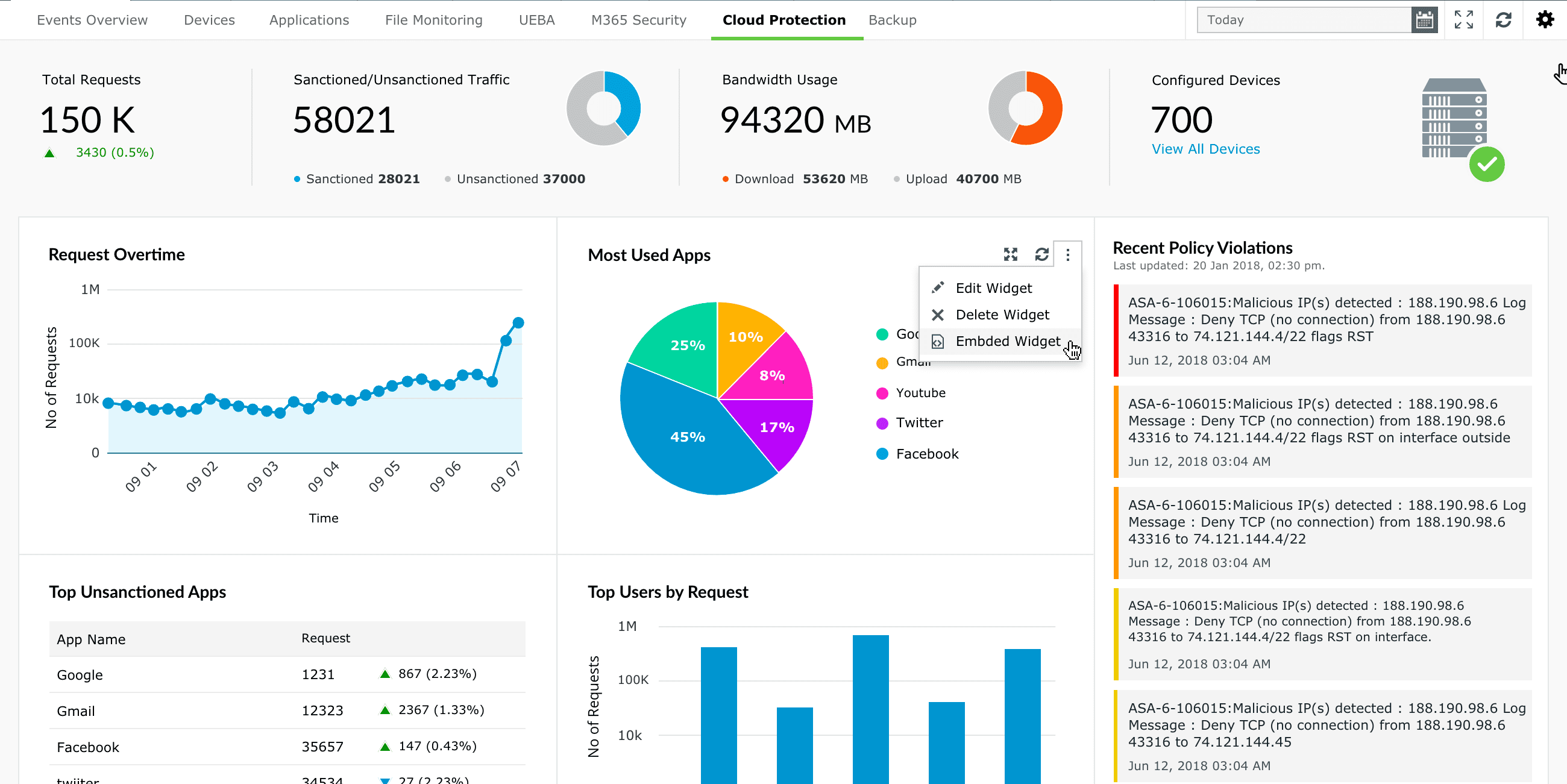
4. MangeEngine Log360

ManageEngine Log360 is a unified SIEM platform that combines log management, threat detection, and threat intelligence to improve visibility and response. It enriches security events with external intelligence and uses correlation and analytics to prioritize real threats over noise.
Key features include:
- Threat intelligence integration: Aggregates and normalizes threat feeds from multiple sources to enrich alerts with context.
- Alert enrichment and prioritization: Adds reputation scores, geolocation, and indicators of compromise to improve triage accuracy.
- Event correlation with threat data: Matches internal events against external threat indicators to detect malicious activity.
- Real-time intelligence updates: Continuously updates threat data to support proactive detection and response.
- MITRE ATT&CK mapping: Aligns detections with known adversary techniques to improve understanding of attack patterns.
- Investigation acceleration: Enriches incidents automatically to reduce manual analysis during response.

Source: ManageEngine
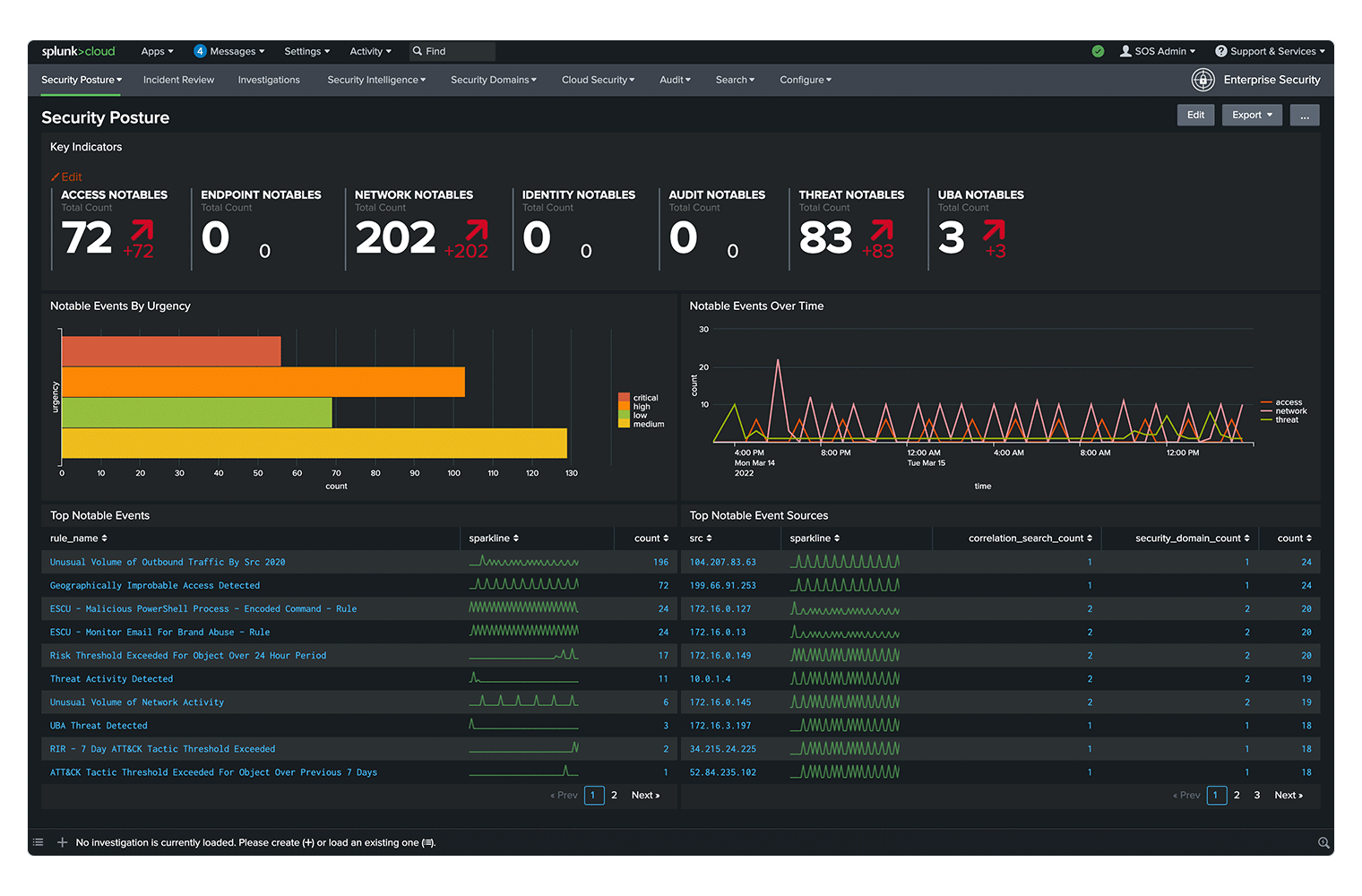
5. Splunk Enterprise Security

Splunk Enterprise Security is a SIEM platform that provides centralized visibility, analytics, and automation for security operations. It integrates SIEM, UEBA, SOAR, and AI-driven workflows to support detection, investigation, and response within a unified environment.
Key features include:
- Unified detection, investigation, and response: Centralizes workflows across the threat lifecycle.
- Risk-based alerting: Aggregates events into risk scores to prioritize high-impact threats and reduce alert volume.
- Behavioral analytics (UEBA): Uses machine learning to detect anomalies such as insider threats and compromised accounts.
- AI-driven workflows: Supports investigation with automation, natural language queries, and guided processes.
- Threat intelligence enrichment: Integrates external intelligence to provide context for detections and alerts.
- Detection lifecycle management: Enables testing, deployment, and monitoring of detection rules aligned with frameworks like MITRE ATT&CK.

Source: Splunk
6. IBM QRadar

IBM QRadar SIEM provides centralized visibility and analytics to detect and respond to threats across an organization’s environment. It correlates data from multiple sources, supports real-time detection, and helps analysts investigate and respond to incidents more efficiently.
Key features include:
- User behavior analytics: Identifies anomalous user activity to detect insider threats and compromised accounts.
- Real-time threat detection: Monitors and analyzes events continuously to identify threats as they occur.
- Data correlation across sources: Combines data from multiple systems to provide a unified view of security events.
- Threat hunting capabilities: Enables analysts to explore datasets and uncover hidden threats in near real time.
- Integration with security tools: Supports interoperability across a wide range of security technologies and data sources.
- Compliance and reporting support: Helps organizations meet regulatory requirements with monitoring and audit capabilities.

Source: IBM
Considerations for Choosing SIEM Products
Selecting the right SIEM product requires careful evaluation of technical capabilities, organizational needs, and long-term scalability. Not all SIEMs are built the same, and what works for one environment may not suit another. Below are key considerations that can guide the decision-making process:
- Data ingestion and scalability: Evaluate how well the SIEM can handle current and projected log volumes. Scalable architecture is critical for high-throughput environments. Look for efficient ingestion models, such as schema-less designs or decoupled storage and compute.
- Integration and data coverage: Ensure the SIEM supports integration with existing infrastructure, including cloud platforms, on-prem systems, endpoints, and third-party tools. Broad native connector support reduces customization overhead.
- Features and detection capabilities
Check for built-in analytics, correlation rules, and support for advanced threat detection techniques like UEBA or ML-based models. Rich detection capabilities improve response accuracy and reduce false positives. - Cost structure and licensing: Understand the pricing model, whether it’s based on data volume, user count, or infrastructure usage. Cloud-native SIEMs may offer more flexible cost structures but can become expensive with unoptimized data retention.
- Usability and analyst experience: A clean, intuitive interface with customizable dashboards and guided investigation tools can significantly enhance analyst productivity. Features like natural language queries or AI assistants can lower the barrier to entry.
- Vendor support and ecosystem: Assess the vendor’s support options, community resources, and ecosystem maturity. A robust support model and access to updated detection content or threat intelligence feeds add long-term value.
- Alert management and automation: Look for support for risk-based alerting, automated triage, and incident response workflows. Integration with SOAR platforms or built-in automation features can greatly reduce manual effort and response time.
- Compliance support: Consider regulatory requirements specific to the industry. Choose a SIEM that offers out-of-the-box compliance reports and long-term log retention policies aligned with standards like HIPAA, PCI DSS, or GDPR.
Conclusion
SIEM products are essential for modern security operations, providing the centralized visibility, automation, and intelligence needed to defend against today’s complex threats. An effective SIEM enables organizations to detect incidents earlier, respond faster, and maintain compliance with regulatory mandates. Whether deployed in the cloud or on-premises, the right SIEM solution enhances operational resilience by consolidating security data, improving alert fidelity, and empowering analysts with actionable insights across the entire attack surface.
Learn More About Exabeam
Learn about the Exabeam platform and expand your knowledge of information security with our collection of white papers, podcasts, webinars, and more.