-
- Home
>
-
- Blog
>
-
- InfoSec Trends
Shadow IT Was Just the Beginning. Meet Shadow Automation.
- Oct 14, 2026
- Heidi Willbanks
- 5 minutes to read
Table of Contents
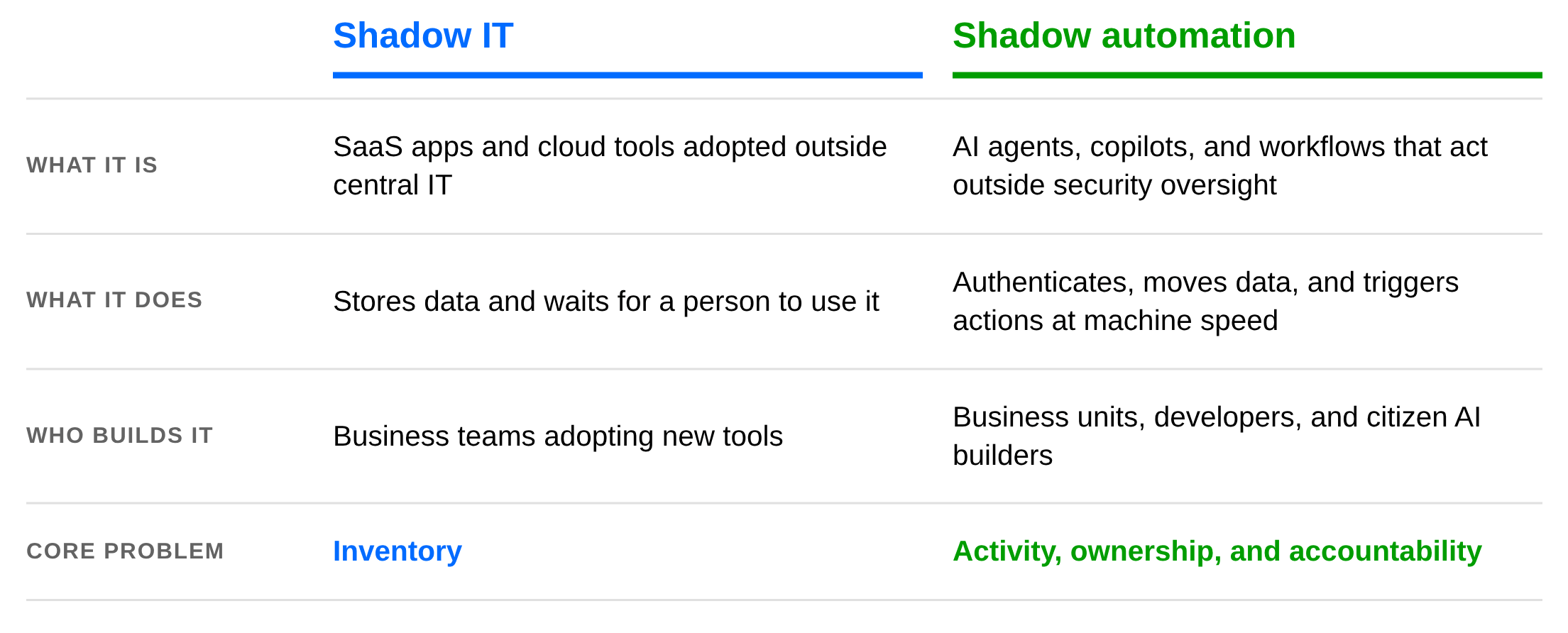
Most security leaders remember the first time they discovered shadow IT inside their own organization. A business team had adopted a SaaS application, connected it to company data, and built a workflow around it before anyone in security knew it existed. The tool was useful, and the team was productive. The governance conversation simply started months late.
The agentic enterprise is creating a more consequential version of that problem. Employees can now build outside the approved technology stack, and they can also build outside the approved operating model. They can create agents, connect copilots to enterprise data, and assemble workflows that authenticate, call tools, move data, and trigger actions in other systems.
What Is Shadow Automation?
Shadow automation is the growing set of AI agents, automated workflows, and machine-driven actions that operate beyond consistent security visibility, ownership, and behavioral oversight.
How Shadow IT Changed Enterprise Security
SaaS and cloud services decentralized technology acquisition. Business teams no longer needed a procurement cycle or an infrastructure project to adopt a new tool. They gained speed, flexibility, and independence, and in many cases the business benefited.
Security teams adapted, but often after the fact. They learned about an application once it already held company data or had become embedded in a critical workflow. The governance questions that followed were reasonably contained. What tool is being used? What data does it hold? Who has access to it?
Those questions were hard to answer at scale, but they described a relatively static problem. A shadow application stored information and waited for a person to use it. AI agents change the stakes because they do not simply hold information. They do work.
How Shadow Automation Differs From Shadow IT
Shadow automation includes any automated capability that acts inside the enterprise without centralized security oversight. It shows up in several forms:
- Business units create or adopt AI agents on their own.
- Teams connect copilots to enterprise data and tools.
- Low-code and no-code workflows invoke other systems on a schedule or a trigger.
- Developers build custom agents for a specific team or project.
- Multi-step and agent-to-agent automations hand work from one system to the next.
- Existing automations accumulate permissions or take on new roles over time.
Citizen AI development connects all of these examples. More teams can build automation, deploy agents, and create workflows without waiting for a central team. That accessibility is a big part of why AI adoption is moving so quickly. It also increases the likelihood of shadow agents, excessive permissions, and unmanaged behavior.
AI agents act as autonomous participants in enterprise workflows. They request access, move data, make decisions, and trigger downstream actions at machine speed.
IT creates an inventory problem. Shadow automation creates an activity, ownership, and accountability problem.
Why Shadow Automation Is Hard to Inventory
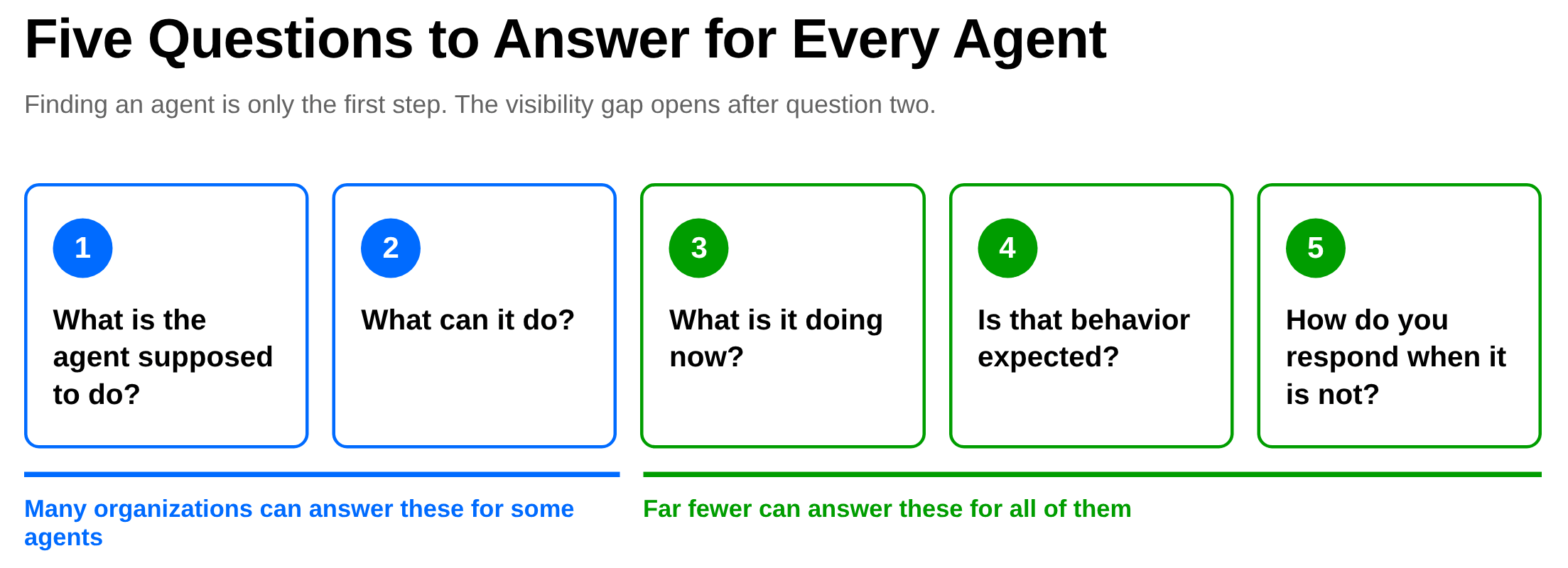
Shadow automation is hard to inventory because finding an agent is only the first step. Discovery tools can locate applications, but the harder questions come after:
- Who created the agent?
- Who is accountable for its actions?
- Which identity does it use?
- What permissions has it inherited or accumulated?
- Which tools, APIs, data sets, and other agents can it reach?
- What does normal behavior look like for this agent?
- Who can suspend it without disrupting a critical workflow?
A simpler framework sits underneath these inventory questions. For any agent, security teams need to know what it is supposed to do, what it can do, what it is doing now, whether that behavior is expected, and how to respond when it is not. Many organizations can answer the first two questions for some of their agents. Far fewer can answer the last three for all of them.
Is AI Governance Enough to Control Shadow Automation?
AI governance is necessary, but it is not enough on its own to control shadow automation. Inventories, permission reviews, development standards, and model governance all define what should happen.
Governance controls do not always reveal what actually happens. An authorized agent can begin behaving outside its expected role while every individual action still uses valid credentials, approved tools, and permitted workflows. Nothing breaks, and no rule fires. The risk stays hidden inside activity that looks legitimate.
Exabeam research, published in The Agentic Insider: From Monitoring to Understanding, found that organizations are expanding AI agent monitoring, but behavioral context and correlation remain major limitations. Security leaders reported the least visibility into cross-system activity and behavioral sequences, which is exactly where autonomous workflows operate.
Why Shadow Automation Is a Business Issue as Well as a SOC Issue
Shadow automation is a business operating model issue because its effects reach well beyond the SOC. Business teams can deploy automated work faster than centralized governance can evaluate it. Ownership fragments across the builder, the business sponsor, the identity team, the application owner, and security. A workflow can keep running after the person who built it changes roles or leaves the company. One agent’s output can initiate actions by other agents or systems, and pausing a single agent could interrupt a revenue, customer, finance, or engineering process.
Shadow automation raises questions that belong in executive conversations as well as SOC runbooks:
- Does the organization know which automated decisions are business-critical?
- Has it assigned an accountable human owner to each autonomous workflow?
- Can security reconstruct an agent’s sequence of actions across systems?
- Can the team contain risky activity without stopping unrelated work?
How Organizations Can Move From Shadow Automation to Accountable Automation
Organizations can make automated work accountable without slowing AI adoption. Five principles give leaders a place to start.
- Establish accountable ownership. Every agent and autonomous workflow needs a named business owner and a named security owner.
- Map identity and access. Understand the credentials, permissions, tools, and systems each agent can use.
- Define intended behavior. Document the agent’s role, expected workflows, normal data access, and acceptable outcomes.
- Observe behavior across systems. Evaluate sequences of activity in context rather than treating each action as an isolated event.
- Prepare for targeted intervention. Decide in advance how to restrict, pause, or investigate one automation without stopping the larger business process.
The five principles work best as a continuing cycle rather than a one-time review. The Exabeam white paper Securing the Agentic Enterprise describes this as a lifecycle of verifying, observing, analyzing, and improving agent security as agents, tools, and workflows change.
The Next Shadow Environment Can Act on Its Own
Shadow IT made the technology estate harder to govern. Shadow automation makes the operating environment harder to understand. Organizations cannot manage shadow automation through inventory alone. The deeper challenge sits underneath it. Most security models were built for a world in which people initiated work and machines followed predictable instructions. The next article in this three-part series looks at what changes when the enterprise no longer runs on humans alone.
Frequently Asked Questions About Shadow Automation
What is shadow automation?
Shadow automation is the set of AI agents, automated workflows, and machine-driven actions that operate outside consistent security visibility, ownership, and behavioral oversight. It includes agents built by business teams, copilots connected to enterprise data, and low-code workflows that can authenticate, move data, and trigger actions in other systems.
Is shadow automation the same as shadow IT?
No. Shadow IT gave employees tools outside central control, while shadow automation gives those tools the ability to act. Shadow IT mainly creates an inventory problem, while shadow automation creates an activity, ownership, and accountability problem because agents can make decisions and trigger downstream actions at machine speed.
What causes shadow automation?
Shadow automation grows from citizen AI development. More teams can now build agents and automated workflows without waiting for a central IT or security team, which increases the likelihood of shadow agents, excessive permissions, and unmanaged behavior.
How can organizations reduce shadow automation risk?
Organizations can reduce shadow automation risk with five principles: assign accountable ownership, map identity and access, define intended behavior, observe behavior across systems, and prepare for targeted intervention. These steps work best as a continuing lifecycle rather than a one-time review.
Read the Research
Download The Agentic Insider: From Monitoring to Understanding to see how security leaders are moving from monitoring AI agent activity to understanding it.

Heidi Willbanks
Heidi Willbanks | Senior Product Marketing Manager, Content | Exabeam | Heidi Willbanks leads content strategy and go-to-market execution at Exabeam, focusing on product launches, cybersecurity solutions marketing, and technical alliances. She has 20+ years of marketing experience, including over a decade in information security and data privacy, and holds a Level IV certification from Pragmatic Institute. Heidi specializes in creating clear, technically accurate content for security practitioners and decision-makers.
More posts by Heidi WillbanksLearn More About Exabeam
Learn about the Exabeam platform and expand your knowledge of information security with our collection of white papers, podcasts, webinars, and more.