Microsoft Sentinel: 5 Key Features, Limitations and Alternatives
- 9 minutes to read
Table of Contents
What is Microsoft Sentinel?
Microsoft Sentinel (formerly Azure Sentinel) is a cloud-native security information and event management (SIEM) and security orchestration automated response (SOAR) solution. It integrates with Azure cloud services, providing security analytics and supporting incident response. It helps security analysts detect, investigate, and respond to threats.
The platform uses AI and machine learning to analyze data. This aids in identifying potential threats and vulnerabilities more accurately. Like with others, users can correlate data from multiple sources, including cloud services, on-premises systems, and third-party providers.
Key Features and Capabilities of Microsoft Sentinel
Microsoft Sentinel provides the following features that support security operations.
This is part of a series of articles about information security.
Key Features and Capabilities of Microsoft Sentinel
1. Data Collection and Integration
Microsoft Sentinel supports numerous connectors, enabling integration across cloud platforms such as Azure, AWS, and GCP, as well as on-premises environments. This capability intends to provide visibility into potential threats. Sentinel’s ability to integrate logs and signals without additional infrastructure investment may be useful for security monitoring within diverse IT environments.
Data collected by Sentinel is normalized and enriched to enhance threat detection and incident analysis. This process involves tagging, parsing, and correlating data automatically, which streamlines security operations.
2. Threat Detection and Analytics
Threat detection within Microsoft Sentinel intends to identify complex threats. By using behavioral analytics and anomaly detection, the platform identifies unusual activities and potential threats that traditional methods may overlook.
Sentinel’s analytics capabilities can enable custom rule creation and alerting, in the hopes that organizations receive timely notifications of suspicious activities.
3. AI-Powered Investigation
Sentinel’s AI-powered investigation tools simplify the process of threat exploration and resolution. The use of AI accelerates the investigation phase by providing potential insights into attack patterns and possible threat actors. It offers hunting capabilities that intend to allow analysts to search deeper into alerts and related incidents.
Additionally, artificial intelligence is used to automate repetitive tasks, construct incident timelines, and visualize attack vectors.
4. Automated Incident Response with Playbooks
Automated incident response in Microsoft Sentinel is powered by playbooks that standardize response efforts. These playbooks are collections of procedures executed automatically in response to specific incidents. Like all playbooks from other vendors, they are intended to reduce response times and minimize human intervention needed during critical periods.
Automation intends to allow organizations to handle a higher volume of alerts. By utilizing pre-defined workflows, Sentinel intends that each incident is managed consistently while reducing human error.
5. Behavior Analytics and User Entity Behavior Analytics (UEBA)
Behavior analytics and UEBA within Microsoft Sentinel focus on identifying deviations from typical user behaviors. Sentinel leverages these analytics to potentially detect insider threats, compromised identities, and advanced persistent threats by assessing patterns in user activities and flagging anomalies.
UEBA provides context around user actions by analyzing baseline activities alongside current behavior metrics. This approach identifies irregularities, enabling security teams to quickly respond to potential breaches.
What’s New in Microsoft Sentinel in 2026
In February 2026, Microsoft introduced updates focused on how security teams ingest, manage, and operationalize content across their SOC. The changes expand connector coverage, improve multi-tenant management, enhance UEBA capabilities, and introduce new AI-driven partner integrations.
Expanded Out-of-the-Box Connectors
Sentinel expanded its ecosystem of built-in connectors, now generally available for services such as Mimecast Audit Logs, CrowdStrike Falcon Endpoint Protection, Vectra XDR, Palo Alto Networks Cloud NGFW, SocPrime, Proofpoint on Demand Email Security, Pathlock, MongoDB, and Contrast ADR.
These connectors simplify onboarding of data from cloud, SaaS, and on-premises systems. Faster onboarding improves unified visibility and strengthens analytics by providing broader context across the security stack.
A new Microsoft 365 Copilot data connector (public preview) allows teams to ingest Copilot audit logs and activity data. Once collected, this data can be used in analytics rules, detections, automation, and investigations. Organizations can also route it to the Sentinel data lake for advanced scenarios with flexible retention and lower-cost ingestion.
Transition to the Codeless Connector Framework
Microsoft is shifting from Azure Function-based connectors to the Codeless Connector Framework (CCF). CCF provides a SaaS-managed approach for building and operating connectors. It includes built-in health monitoring, centralized credential management, and improved performance.
Customers are encouraged to migrate existing connectors to CCF to maintain uninterrupted data collection and access to new features. The legacy custom data collection API will be retired in September 2026.
Multi-Tenant Content Distribution
A new public preview capability enables centralized management and distribution of Sentinel content across multiple tenants from the Microsoft Defender portal. Security teams can replicate analytics rules, automation rules, workbooks, and alert tuning rules across environments.
This reduces the need to rebuild detections and dashboards for each tenant. It helps maintain a consistent security baseline, reduces configuration drift, and accelerates onboarding of new tenants, while execution remains local to each target tenant.
Enhanced UEBA Essentials
The updated UEBA Essentials solution (public preview) improves detection of high-risk anomalous behavior across Azure, AWS, GCP, and Okta. It introduces expanded multi-cloud anomaly detection and new queries powered by the anomalies table.
The solution aligns activity with MITRE ATT&CK, highlights complex malicious IP patterns, and builds anomaly profiles for users. More than 30 prebuilt UEBA queries are available through the Sentinel content hub. Behavior analytics can also be enabled automatically when new data sources are connected.
Partner-Built Security Copilot Agents
Sentinel can now be extended with partner-built Security Copilot agents available through the Microsoft Security Store in the Defender portal. These AI-powered agents integrate directly with Sentinel analytics and incidents.
They assist with triage, investigation, and response. Some agents review configurations, map attacker activity, automate forensic analysis, or generate SOC reports. This allows organizations to use prebuilt expertise without developing custom agent workflows.
Enhanced Threat Intelligence and Data Investigation
The Threat Intelligence Briefing Agent now uses a structured knowledge graph within Microsoft Defender for Threat Intelligence. It delivers more relevant threat insights tailored to industry and region, with embedded Microsoft Threat Intelligence citations for context.
Sentinel also integrates Microsoft Purview Data Security Investigations (DSI) with the Sentinel graph. This combines AI-driven content analysis with activity-based graph analytics. Security teams can correlate sensitive data exposure with user and activity context in a single investigation flow.
Extended Migration Timeline
The deadline to migrate Sentinel management from the Azure portal to the Defender portal has been extended to March 31, 2027. This gives organizations more time to transition while adopting new Defender-based capabilities.
Microsoft Sentinel Limitations
While Microsoft Sentinel is a respected solution, it has several limitations that organizations should consider before implementation. These limitations were reported by users on the G2 platform:
- High cost at scale: Sentinel uses a pay-as-you-go pricing model based on data ingestion and retention. As log volumes increase, costs can rise quickly, which may be challenging for organizations with large data environments.
- Steep learning curve for KQL: Sentinel relies heavily on Kusto Query Language (KQL) for threat hunting, reporting, and analysis. Although powerful, KQL can be difficult for new users and may require training before analysts can use it effectively.
- Complex configuration and customization: Implementing advanced automation or SOAR workflows often requires building and managing Azure Logic Apps. These configurations can become complex and require specialized expertise.
- Integration challenges with non-Microsoft tools: While integration with Microsoft services is strong, connecting legacy systems or third-party security tools can require additional configuration and time.
- User interface and feature complexity: Some users report that the interface and feature set can be difficult to navigate initially, especially for teams unfamiliar with Microsoft security platforms.
- Query performance and resource usage: Running large or complex queries can take time and may consume significant compute resources, particularly in large environments.
- Vendor ecosystem dependency: Sentinel tends to work best within the Microsoft ecosystem. Organizations heavily using non-Microsoft security tools may experience limitations or require additional integration work.
Notable Microsoft Sentinel Alternatives
1. Exabeam

Exabeam is a leading provider of security information and event management (SIEM) solutions, combining UEBA, SIEM, SOAR, and TDIR to accelerate security operations. Its Security Operations platforms enables security teams to quickly detect, investigate, and respond to threats while enhancing operational efficiency.
Key Features:
- Scalable log collection and management: The open platform accelerates log onboarding by 70%, eliminating the need for advanced engineering skills while ensuring seamless log aggregation across hybrid environments.
- Behavioral analytics: Uses advanced analytics to baseline normal vs. abnormal behavior, detecting insider threats, lateral movement, and advanced attacks missed by signature-based systems. Customers report that Exabeam helps detect and respond to 90% of attacks before other vendors can catch them.
- Automated threat response: Simplifies security operations by automating incident timelines, reducing manual effort by 30%, and accelerating investigation times by 80%.
- Contextual incident investigation: Since Exabeam automates timeline creation and reduces time spent on menial tasks, it cuts the time to detect and respond to threats by over 50%. Pre-built correlation rules, anomaly detection models, and vendor integrations reduce alerts by 60%, minimizing false positives.
- SaaS and cloud-native options: Flexible deployment options provide scalability for cloud-first and hybrid environments, ensuring rapid time to value for customers. For organizations who can’t, or won’t move their SIEM to the cloud, Exabeam provides a market-leading, full featured, and self-hosted SIEM.
- Network visibility with NetMon: Delivers deep insight beyond firewalls and IDS/IPS, detecting threats like data theft and botnet activity while making investigation easier with flexible searching. Deep Packet Analytics (DPA) also builds on the NetMon Deep Packet Inspection (DPI) engine to interpret key indicators of compromise (IOCs).
Exabeam customers consistently highlight how its real-time visibility, automation, and productivity tools powered by AI, uplevel security talent, transforming overwhelmed analysts into proactive defenders while reducing costs and maintaining industry-leading support.

2. Splunk Enterprise

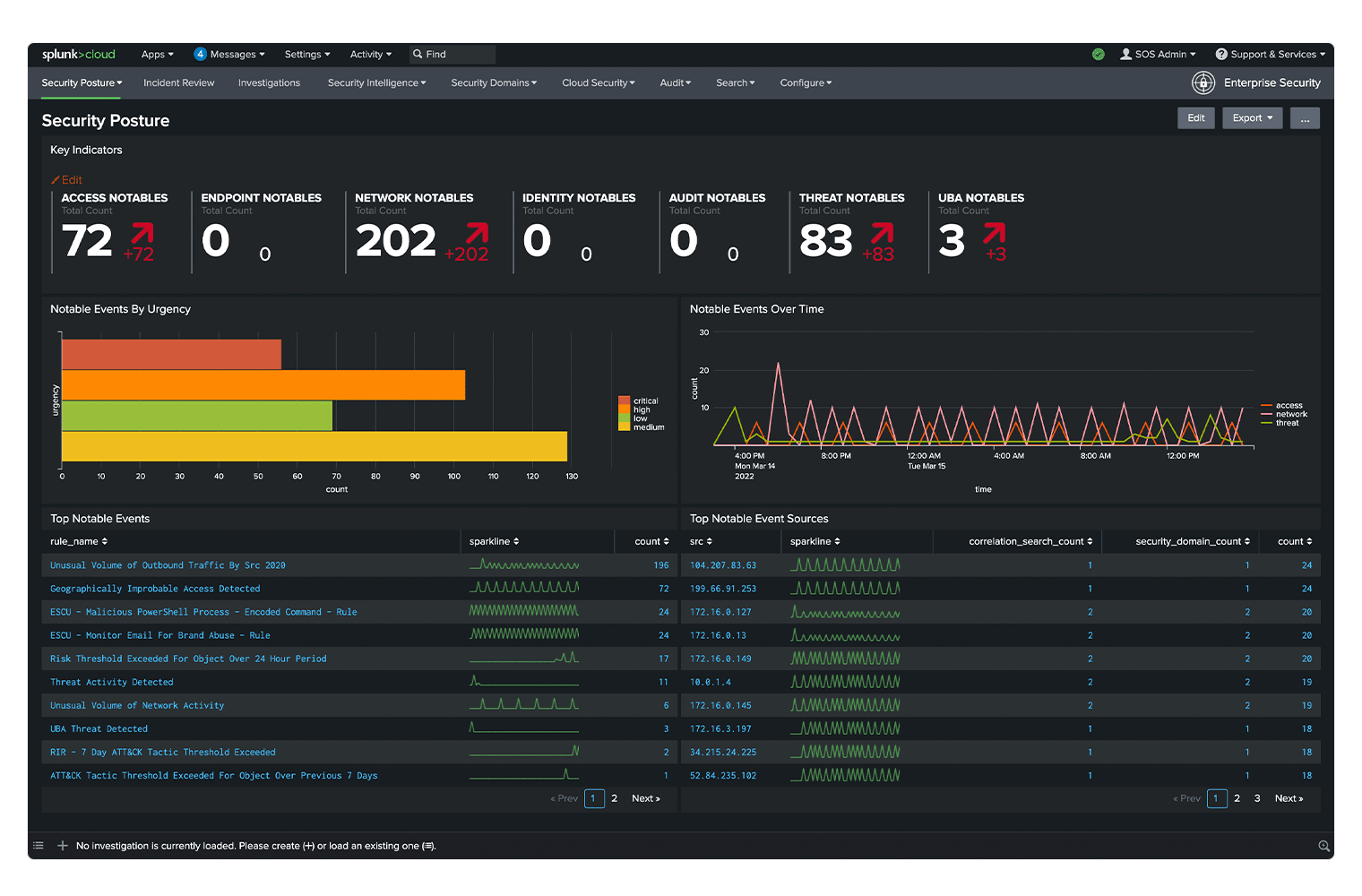
Splunk Enterprise Security is a security platform to support threat detection, investigation, and response across complex environments. It aggregates and analyzes security data from multiple sources, including cloud services, devices, and applications, enabling security teams to identify and investigate threats. The platform integrates SIEM, SOAR, and user and entity behavior analytics (UEBA) capabilities to provide visibility across security operations.
Key features of Splunk Enterprise:
- Unified threat detection, investigation, and response platform: Centralizes security operations workflows to manage detection, investigation, and remediation activities within a single platform.
- Data visibility: Enables teams to manage, search, and analyze data from various environments, including cloud infrastructure, networks, and endpoints.
- User and entity behavior analytics (UEBA): Uses machine learning to detect behavioral anomalies that may indicate insider threats, compromised credentials, or lateral movement.
- Security automation with SOAR: Supports automated workflows and response plans to reduce manual investigation effort and improve response consistency.
- Detection lifecycle management: Provides tools for developing, testing, deploying, and monitoring detection rules, with coverage mapped to frameworks such as MITRE ATT&CK.

Learn more in our detailed guide to Microsoft Sentinel vs Splunk
3. IBM Security QRadar SIEM

IBM Security QRadar SIEM is a security information and event management platform to centralize security monitoring and enable real-time threat detection. It collects and correlates security data from multiple systems to provide visibility into potential threats across an organization’s environment.
Key features of IBM Security QRadar SIEM:
- Centralized security visibility: Aggregates and analyzes data from multiple security tools and systems to provide a unified view of security events.
- Real-time threat detection: Monitors activity across the environment to identify potential security threats and suspicious behaviors.
- User behavior analytics: Identifies anomalies and risky user activities to help detect insider threats and compromised accounts.
- Threat hunting capabilities: Enables analysts to investigate threats by analyzing correlated datasets and monitoring attack paths.
- Integration across security ecosystems: Supports integrations with various security tools and data sources to improve visibility and operational coordination.

4. SentinelOne

SentinelOne AI SIEM is part of the SentinelOne Singularity platform and provides centralized visibility and threat detection across enterprise environments. The platform is designed to collect and analyze security telemetry from endpoints, cloud environments, identities, and networks. Using artificial intelligence and automation, it helps security teams detect threats, investigate incidents, and manage security operations across distributed infrastructures.
Key features of SentinelOne AI SIEM:
- AI-driven threat detection: Uses artificial intelligence to analyze security telemetry and identify suspicious activity across environments.
- Unified security platform: Consolidates security monitoring across endpoints, cloud environments, and identities within a single platform.
- Autonomous security operations: Supports automated detection and response processes to reduce manual workloads for analysts.
- Real-time threat visibility: Provides centralized monitoring and insight into security events across the organization.
- Integrated security ecosystem: Operates within the SentinelOne Singularity platform alongside other security capabilities such as endpoint and cloud protection.

5. Rapid7 InsightIDR

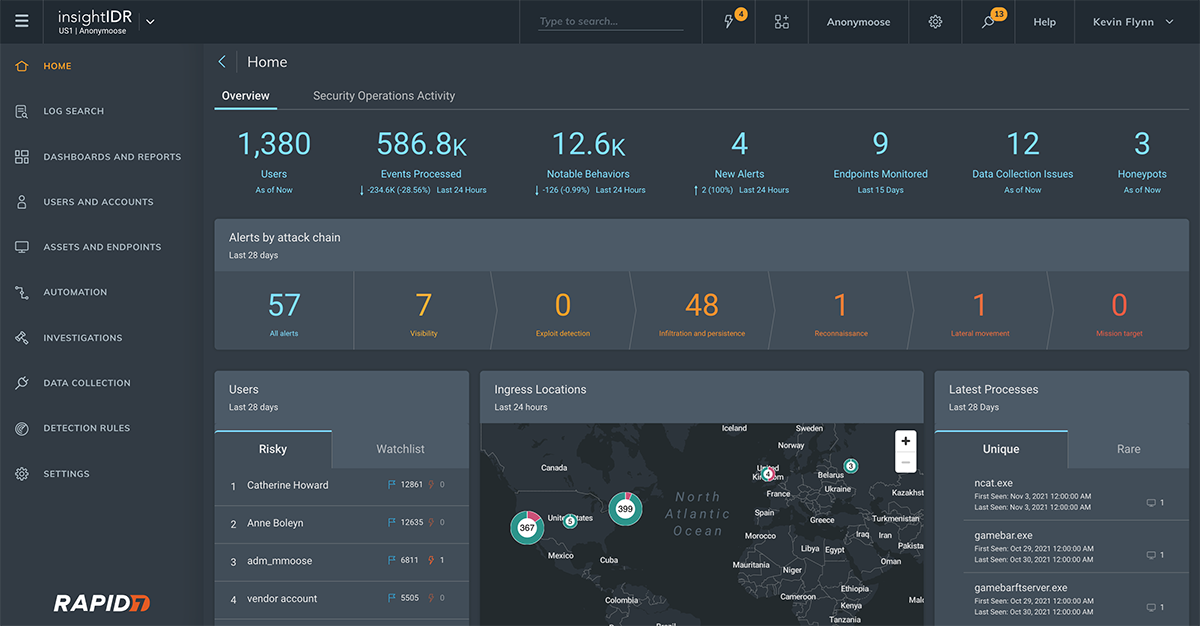
Rapid7 InsightIDR is a cloud-native SIEM and extended detection and response (XDR) solution to detect suspicious activity across IT environments. The platform collects telemetry from endpoints, authentication systems, and network infrastructure, then analyzes the data to identify potential indicators of compromise. InsightIDR combines log analysis, endpoint visibility, and behavioral analytics to support security teams during threat detection and investigation.
Key features of Rapid7 InsightIDR:
- Cloud-native SIEM architecture: Operates as a SaaS-based platform that collects and analyzes security data across hybrid and cloud environments.
- Unified security data analysis: Aggregates logs, endpoint telemetry, authentication activity, and network traffic into a centralized security view.
- User behavior analysis: Correlates user actions and authentication events to identify suspicious activity and potential account compromise.
- Threat detection and alerting: Uses detection rules and analytics to identify indicators of compromise and highlight suspicious activity.
- Investigation and response tools: Provides dashboards, log search capabilities, and investigation workflows to help analysts examine incidents and respond to threats.

Conclusion
Microsoft Sentinel provides a cloud-native SIEM and SOAR solution that integrates with diverse data sources while enhancing threat detection and supporting automated response through playbooks. Its limitations include high costs for large data ingestion and challenges integrating with non-Microsoft systems, while its advantages include flexibility and scalability. When choosing a security management solution, organizations should consider their needs, data environment complexity, and integration requirements.
See Additional Guides on Key Information Security Topics
Together with our content partners, we have authored in-depth guides on several other topics that can also be useful as you explore the world of information security.
SIEM Tools
Authored by Exabeam
- [Guide[ SIEM Tools: Top 5 SIEM Platforms, Features, Use Cases and TCO
- [Guide] Top 5 Free Open Source SIEM Tools [Updated 2025]
- [Guide] Best SIEM Solutions: Top 10 SIEM systems and How to Choose 2025
Bot Protection
Authored by Radware
- [Guide] Bot Protection: Attack Examples & 8 Ways to Defend Your Network
- [Guide] What Is a Botnet? Types, Examples, and 7 Defensive Measures
- [Product] Radware AI-Powered Bot Protection | Comprehensive Bot Management
Application Security
Authored by Oligo
- [Guide] What is Application Detection and Response (ADR)? 2025 Guide
- [Guide] Application Security in 2025: Threats, Solutions & Best Practices
- [Blog] Critical RCE Vulnerabilities in OpenSSH (CVE-2024-6387, CVE-2024-6409) – How to Detect and Mitigate
- [Product] Oligo | Real-Time Application Security & Risk Detection
Learn More About Exabeam
Learn about the Exabeam platform and expand your knowledge of information security with our collection of white papers, podcasts, webinars, and more.