- Home >
- Explainers >
- Sumo Logic
Sumo Logic: Solution Overview, Limitations and Alternatives
- 7 minutes to read
Table of Contents
What Is Sumo Logic?
Sumo Logic is a cloud-native platform providing intelligence to help organizations monitor, manage, and secure their applications and infrastructure. It aggregates data from a number of sources, including logs, metrics, and events, allowing users to derive insights in real time.
By transforming raw data into actionable intelligence, Sumo Logic supports operations, security, and compliance use cases. It uses analytics and machine learning to automate the detection of anomalies and predict potential issues. This should improve the efficiency of IT operations and strengthens security postures by identifying threats early, enabling faster troubleshooting and incident response.
Sumo Logic Platform Overview
Sumo Logic is a cloud-native, distributed platform providing a unified approach to log analytics, observability, and security. It supports collaboration among development, security, and operations teams.
The platform’s architecture emphasizes scalability in a multi-tenant design.
With machine learning and analytics capabilities, Sumo Logic intends to improve issue detection and resolution with features that enable the platform to identify patterns, investigate anomalies, and provide actionable insights faster.
Solutions provided by Sumo Logic:
- Cloud SIEM: Integrates threat intelligence and automates detection and response to security incidents, enabling teams to address threats.
- Cloud infrastructure security: Provides tools to secure cloud infrastructure, ensuring continuous monitoring and protection of cloud-native services.
- Compliance and audit: It offers logs, audit trails, and customizable reports. Organizations can demonstrate adherence to standards like GDPR, HIPAA, and PCI DSS through automated compliance checks.
- Log analytics: Aggregates logs from diverse sources, providing centralized visibility into system activities. This helps teams to investigate and resolve operational or security issues.
- Infrastructure monitoring: Supports infrastructure monitoring, allowing teams to track system performance, detect anomalies, and resource utilization. By correlating logs and metrics, the platform provides insights into system health.
- Application observability: By integrating application-level metrics, traces, and logs, it provides deep insights into application performance. This observability helps teams diagnose issues and ensure optimal user experiences.
This is part of a series of articles about information security.
Editor’s note: Updated the article to cover recent market trends, updated product information to reflect features and capabilities in 2026, and added 1 new tool.
Sumo Logic Pricing Model
Sumo Logic’s pricing model offers the following four tiers. Pricing for the Free, Essentials, and Enterprise plans is available upon request.
Free Plan
- Log capacity: Limited to 1 GB/day
- Metrics capacity: Up to 3,000 data points per minute (DPM)
- Tracing capacity: Up to 1.5 GB/day
- Log data retention: 7 days
- Support: Community support
Essentials Plan
- Log capacity: Unlimited
- Metrics capacity: Up to 50,000 DPM/day
- Tracing capacity: Up to 5 GB/day
- Log data retention: Up to 365 days
- Support: Standard (8×5) support
Enterprise Suite
- Log, metrics, and tracing capacity: Unlimited
- Log data retention: Customer-defined, based on business requirements
- Real-time alerts: 1,000 monitors for logs and 500 for metrics
- Support: Enterprise-grade 24/7 support (P1 incidents)
Flex Plan
- Log, metrics, and tracing capacity: Unlimited
- Log data retention: Customer-defined
- $0 data ingestion: Decouples ingestion from budget limits to eliminate data gaps
- Support: Enterprise-grade 24/7 support (P1 incidents)
- Allows flexible usage and pricing based on actual data scanned, starting at $2.05 per TB for high-scale use cases.
Flex pricing estimate:
The Flex Plan provides customized pricing based on the organization’s analytics usage profile. The following estimated pricing is quoted on the official pricing page:
- Low usage ($3.14 per TB scanned): Suitable for organizations focusing on ad-hoc troubleshooting, compliance, and DevOps teams.
- Medium usage ($2.57 per TB scanned): Suitable for cloud-wide application reliability and real-time infrastructure monitoring.
- High usage ($2.05 per TB scanned): Suitable for enterprise-wide analytics with AI-driven diagnostics, 100% visibility, and DevSecOps workflows.
Sumo Logic Limitations
Sumo Logic is useful for log analytics, observability, and security, but it also has some limitations. The following limitations were reported by users on the G2 platform:
- Steep learning curve for queries and dashboards: Users frequently report that the query language requires time to learn, especially for those unfamiliar with its syntax or coming from other tools.
- Complex and sometimes unintuitive user interface: The interface is often described as clunky or less intuitive, with navigation and workflows requiring extra steps in some cases.
- Performance issues with large datasets: During heavy data ingestion or when running complex queries, dashboards and search functions can slow down.
- Pricing can become expensive and unpredictable: Some users note that costs can increase quickly, particularly with usage-based pricing models or high data volumes.
- Limited flexibility in dashboards and UI customization: Certain dashboard elements have fixed layouts or limited adaptability, making customization more difficult.
- Alerting delays in some cases: Alerts may not trigger as quickly as expected compared to other monitoring platforms.
- Integration gaps with some tools: While integrations exist, users report that certain services require manual setup or lack tight integration, leading to fragmented workflows.
Notable Sumo Logic Alternatives and Competitors
Security-Focused SIEM and Threat Detection Tools
1. Exabeam

Exabeam is a leading provider of security information and event management (SIEM) solutions, combining UEBA, SIEM, SOAR, and TDIR to accelerate security operations. Its Security Operations platforms enables security teams to quickly detect, investigate, and respond to threats while enhancing operational efficiency.
Key Features:
- Scalable log collection and management: The open platform accelerates log onboarding by 70%, eliminating the need for advanced engineering skills while ensuring seamless log aggregation across hybrid environments.
- Behavioral analytics: Uses advanced analytics to baseline normal vs. abnormal behavior, detecting insider threats, lateral movement, and advanced attacks missed by signature-based systems. Customers report that Exabeam helps detect and respond to 90% of attacks before other vendors can catch them.
- Automated threat response: Simplifies security operations by automating incident timelines, reducing manual effort by 30%, and accelerating investigation times by 80%.
- Contextual incident investigation: Since Exabeam automates timeline creation and reduces time spent on menial tasks, it cuts the time to detect and respond to threats by over 50%. Pre-built correlation rules, anomaly detection models, and vendor integrations reduce alerts by 60%, minimizing false positives.
- SaaS and cloud-native options: Flexible deployment options provide scalability for cloud-first and hybrid environments, ensuring rapid time to value for customers. For organizations who can’t, or won’t move their SIEM to the cloud, Exabeam provides a market-leading, full featured, and self-hosted SIEM.
- Network visibility with NetMon: Delivers deep insight beyond firewalls and IDS/IPS, detecting threats like data theft and botnet activity while making investigation easier with flexible searching. Deep Packet Analytics (DPA) also builds on the NetMon Deep Packet Inspection (DPI) engine to interpret key indicators of compromise (IOCs).
Exabeam customers consistently highlight how its real-time visibility, automation, and productivity tools powered by AI, uplevel security talent, transforming overwhelmed analysts into proactive defenders while reducing costs and maintaining industry-leading support.
2. Splunk

Splunk is a data platform to collect, analyze, and act on machine data from multiple sources. It supports security and observability use cases by providing visibility across systems, applications, and infrastructure. The platform can operate at scale across hybrid environments, enabling teams to investigate incidents, monitor performance, and manage data pipelines.
Key features of Splunk:
- AI-native data platform: Enables ingestion, search, and analysis of machine data from various sources, supporting real-time insights and large-scale data processing.
- Unified security operations: Combines threat detection, investigation, and response with visibility, automation, and threat intelligence in one platform.
- End-to-end observability: Provides monitoring and troubleshooting across infrastructure, applications, and networks, including complex and distributed environments.
- AI and machine learning capabilities: Supports natural language interaction, workflow automation, and advanced analytics to identify patterns and anomalies.
- Extensive integration ecosystem: Supports thousands of integrations and data sources, including logs, metrics, traces, and events using open standards like Opentelemetry.

Learn more in our detailed guide to Sumo Logic vs Splunk
5. Graylog

Graylog is a platform focused on log management, security analytics, and incident response. It provides centralized visibility into logs and events, helping teams detect threats and investigate issues across environments. The platform supports flexible deployment options and emphasizes efficient data handling, cost control, and simplified security operations.
Key features of Graylog:
- Centralized log management and analysis: Collects, processes, and analyzes logs from multiple sources, enabling visibility across systems and applications.
- Automated threat detection and response: Supports detection of high-risk threats and automates investigation and remediation workflows.
- Flexible deployment options: Can be deployed in cloud, hybrid, or on-premises environments while maintaining consistent functionality.
- Built-in data routing and pipeline management: Allows teams to control log flows, manage data pipelines, and optimize storage without additional tools.
- Integrated dashboards and search capabilities: Provides tools for visualization, investigation, and reporting to support security and operational use cases.

Observability, Monitoring and Hybrid Operations Tools
4. LogicMonitor

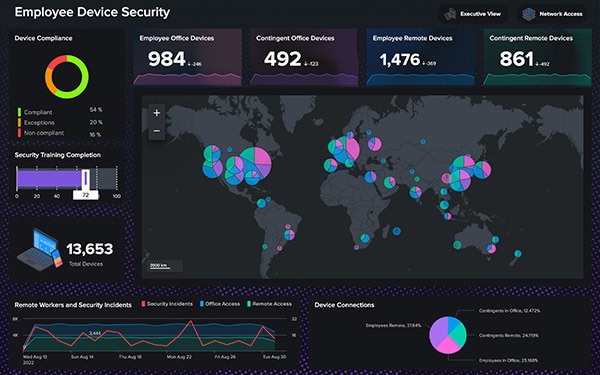
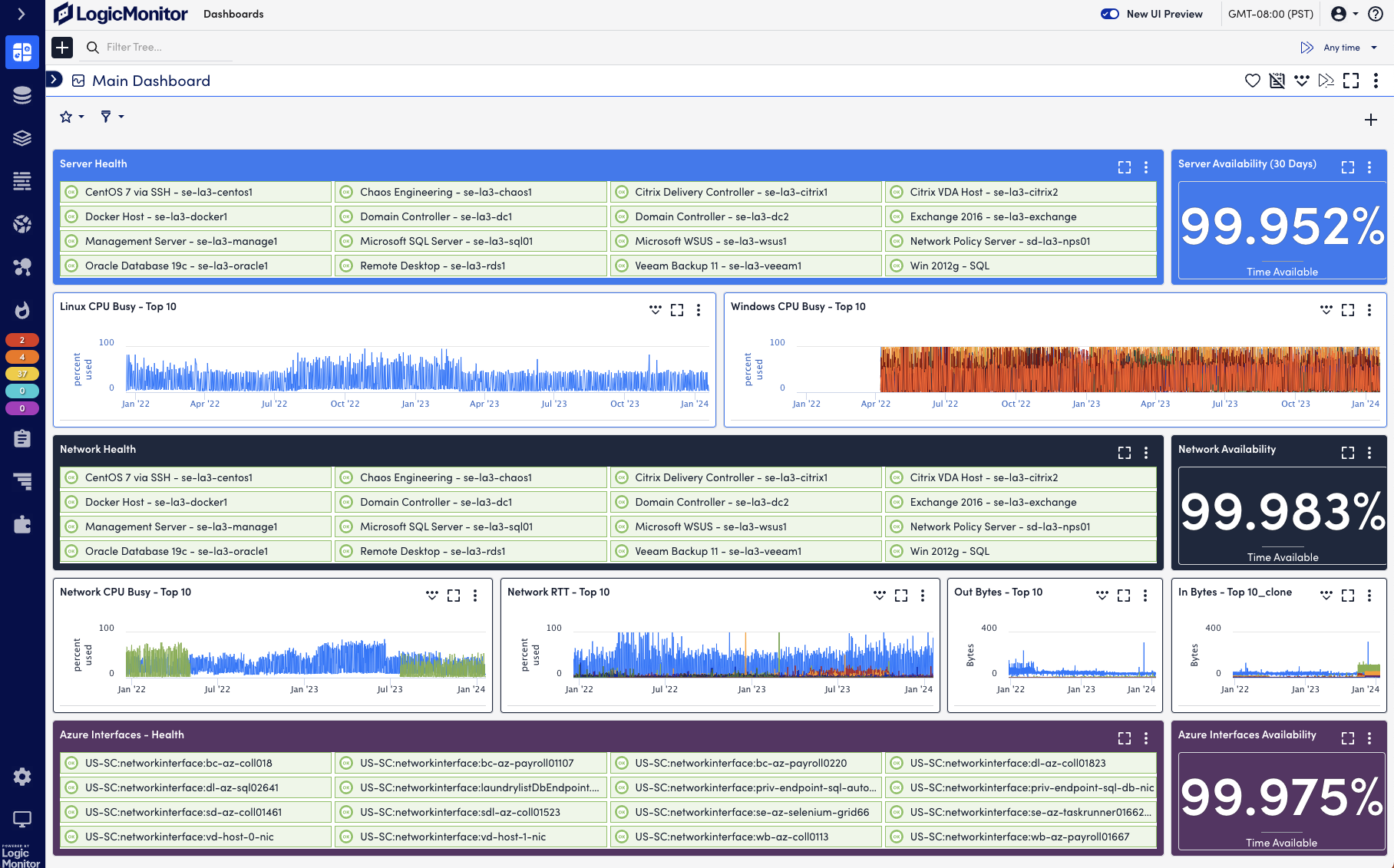
LogicMonitor is an observability platform that monitors hybrid IT environments, including on-premises infrastructure and cloud services. It focuses on providing unified visibility and uses AI-driven capabilities to detect issues early, correlate events, and support faster troubleshooting across systems.
Key features of LogicMonitor:
- Unified hybrid observability: Delivers visibility across data centers, cloud platforms, and infrastructure components within a single platform.
- AI-driven anomaly detection and root cause analysis: Uses AI to identify issues, correlate events, and reduce alert noise.
- Log and metric correlation: Combines logs, metrics, alerts, and resource data to provide context for troubleshooting.
- Extensive integration coverage: Supports thousands of integrations across on-premises and multi-cloud environments.
- Rapid deployment with collector-based monitoring: Enables quick setup and visibility into environments with minimal configuration.

5. Datadog

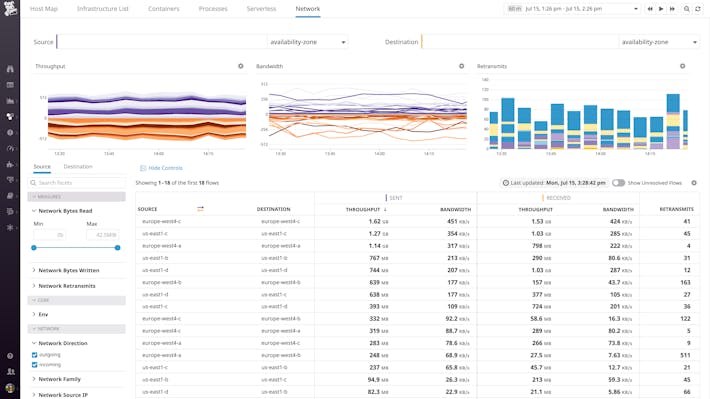
Datadog is a cloud-native platform that combines monitoring, observability, and security capabilities. It enables teams to track system performance, analyze logs, and detect security issues across distributed environments. The platform aims to provide visibility into modern applications, infrastructure, and services at scale.
Key features of Datadog:
- Full-stack observability: Monitors infrastructure, applications, logs, and user activity across cloud and hybrid environments.
- Integrated security monitoring: Includes capabilities such as cloud SIEM, vulnerability management, and application security.
- Wide range of integrations: Supports hundreds of integrations with cloud providers, services, and tools for unified visibility.
- Real-time monitoring and alerting: Provides alerts, dashboards, and analytics for tracking system behavior and incidents.
- Support for modern architectures: Covers containers, serverless environments, and distributed systems with specialized monitoring tools.

6. New Relic

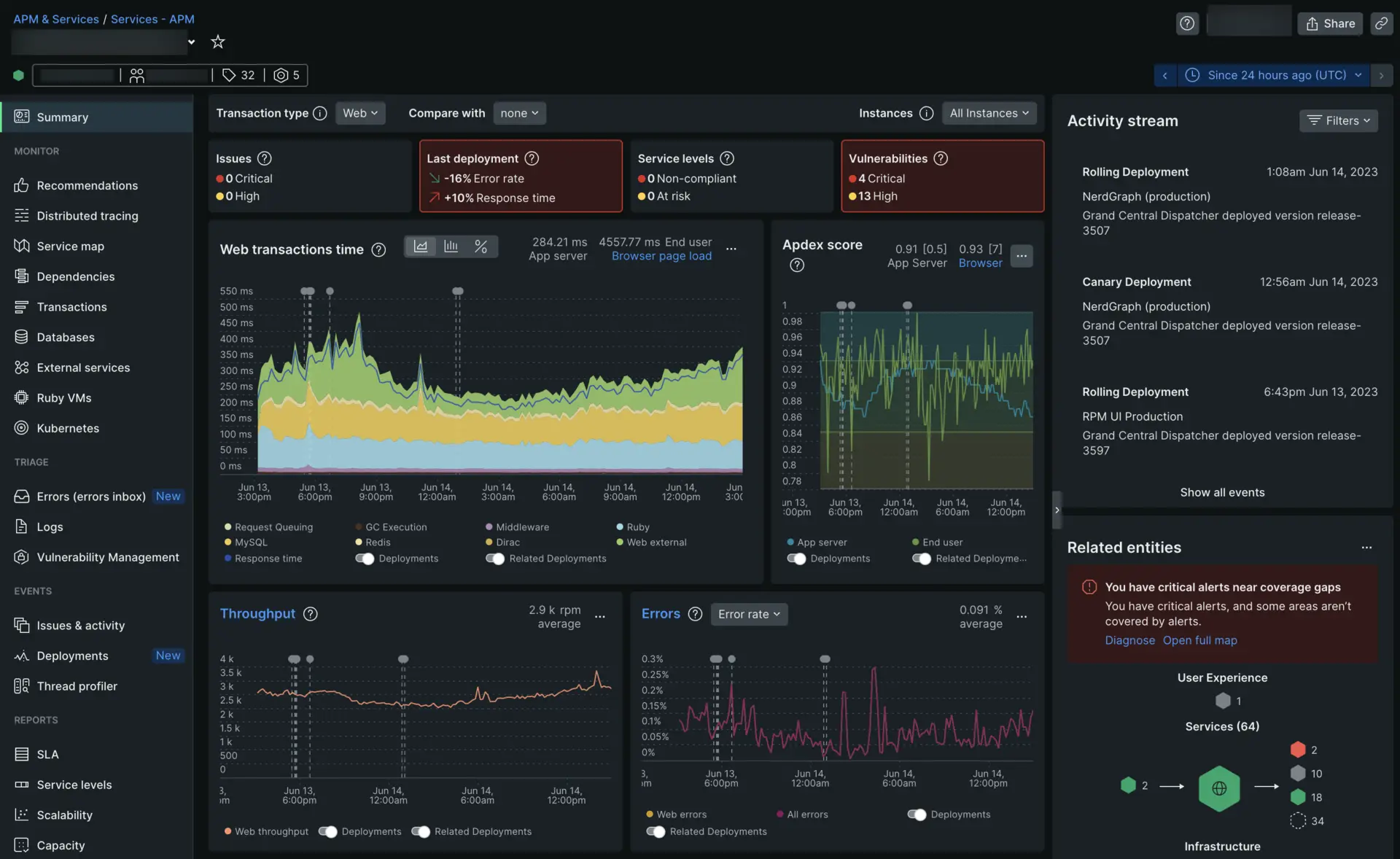
New Relic is an observability platform that provides visibility into applications, infrastructure, and user experiences. It aggregates telemetry data from across the stack and presents it through dashboards and analytics tools. The platform supports real-time monitoring and troubleshooting, helping teams identify and resolve issues across distributed systems.
Key features:
- End-to-end stack monitoring: Provides visibility into applications, infrastructure, networks, and user interactions from a single platform.
- Real-time data collection and analysis: Ingests and analyzes telemetry data continuously to support fast issue detection and resolution.
- Integrated dashboards and alerting: Combines visualization, alerting, and analytics tools for monitoring system performance.
- Extensive integration support: Offers hundreds of integrations and supports open standards like Opentelemetry for data ingestion.
- Usage-based pricing model: Allows organizations to scale monitoring based on actual usage without fixed licensing constraints.
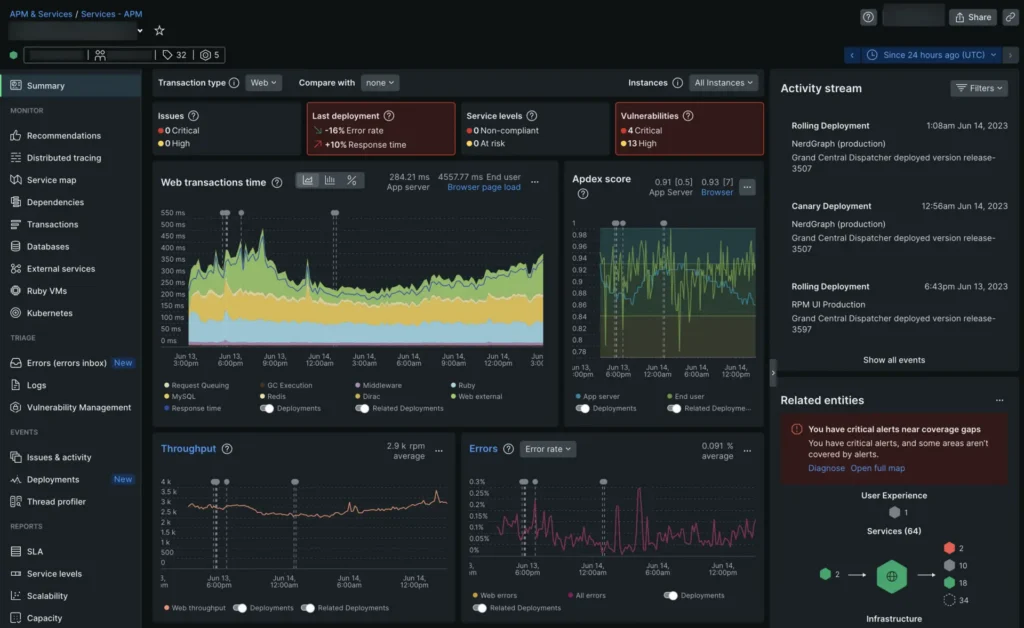
Source: New Relic
Conclusion
Sumo Logic provides a platform for log analytics, observability, and security, offering tools to enhance operational efficiency, security postures, and compliance. While it offers scalability, machine learning-driven insights, and flexibility, potential users should consider its learning curve, integration gaps, and cost complexities. By comparing Sumo Logic against alternatives, organizations can make an informed decision in accordance with their needs and goals.
See Additional Guides on Key Information Security Topics
Together with our content partners, we have authored in-depth guides on several other topics that can also be useful as you explore the world of information security.
SIEM Tools
Authored by Exabeam
- [Guide[ SIEM Tools: Top 5 SIEM Platforms, Features, Use Cases and TCO
- [Guide] Top 5 Free Open Source SIEM Tools [Updated 2025]
- [Guide] Best SIEM Solutions: Top 10 SIEM systems and How to Choose 2025
Bot Protection
Authored by Radware
- [Guide] Bot Protection: Attack Examples & 8 Ways to Defend Your Network
- [Guide] What Is a Botnet? Types, Examples, and 7 Defensive Measures
- [Product] Radware AI-Powered Bot Protection | Comprehensive Bot Management
Application Security
Authored by Oligo
- [Guide] What is Application Detection and Response (ADR)? 2025 Guide
- [Guide] Application Security in 2025: Threats, Solutions & Best Practices
- [Blog] Critical RCE Vulnerabilities in OpenSSH (CVE-2024-6387, CVE-2024-6409) – How to Detect and Mitigate
- [Product] Oligo | Real-Time Application Security & Risk Detection
Learn More About Exabeam
Learn about the Exabeam platform and expand your knowledge of information security with our collection of white papers, podcasts, webinars, and more.
-
 Blog
Blog
What Is the Difference Between Exabeam and CrowdStrike for SIEM and Security Operations?
- Show More