


Best AI SOC Platforms for Automated Threat Response: Top 8 in 2026
- 18 minutes to read
Table of Contents
TL;DR: AI SOC platforms use AI to detect, investigate, and contain threats with less manual work. Best for: Exabeam New-Scale Fusion with Exabeam Nova for behavior-driven TDIR, Cortex XSIAM for SIEM, XDR, and SOAR consolidation, Google Security Operations for Gemini agents backed by Mandiant intelligence, and Torq for agentic triage-to-response automation.
How Do AI SOC Platforms Perform Automated Threat Response?
The top AI Security Operations Center (SOC) platforms for automated threat response combine agentic artificial intelligence (AI) reasoning with advanced security automation to autonomously triage, investigate, and mitigate enterprise threats. They combine data from sources such as endpoint detection and response tools, security information and event management systems, identity platforms, cloud services, and network controls. These platforms analyze the data to identify suspicious activity and determine which alerts require action.
For automated threat response, these platforms can trigger predefined or AI-assisted actions when a threat meets specific conditions. Common actions include isolating an endpoint, disabling a compromised account, blocking a malicious IP address, or collecting additional evidence. Many platforms also generate investigation summaries and recommended next steps, helping analysts review incidents faster while keeping high-risk actions under human approval.
Core capabilities of AI SOC platforms for automated threat response:
- AI-driven threat detection: Combines security telemetry, detection rules, machine learning, and threat intelligence to identify suspicious activity and multi-stage attacks.
- Behavioral analytics and UEBA: Establishes normal activity baselines and flags deviations that may indicate compromised credentials or insider threats.
- Automated alert triage: Validates, deduplicates, and correlates alerts, prioritizing incidents based on risk, affected assets, and available evidence.
- Incident investigation and timeline reconstruction: Collects evidence across security systems and builds chronological timelines to clarify attack progression and scope.
- Threat intelligence enrichment: Adds context to suspicious indicators using intelligence sources and historical telemetry to support severity and scope assessments.
- Identity-centric threat analysis: Correlates identity and security activity to detect suspicious authentication, privilege escalation, and misuse of sensitive access.
- Automated response workflows: Executes containment and remediation actions with predefined conditions, approval requirements, validation, and rollback safeguards.
- Case management and analyst collaboration: Centralizes incident evidence, tasks, notes, and response actions to support team coordination and audit trails.
This is part of a series of articles about AI cyber security
AI SOC Platforms for Automated Threat Response at a Glance
The table below summarizes the key differences between the AI SOC platforms covered in this article. Each platform is explored in more detail in the sections that follow.
| Category | Solution | Best For | Key Strengths | Things to Consider |
| Unified Security Operations Platforms with Built-In AI | Exabeam New-Scale Fusion with Exabeam Nova | Automating TDIR with behavior analytics and multi-agent AI | UEBA risk scoring, machine-built timelines, Nova AI agents, built-in SOAR | Initial tuning and data onboarding need planning |
| Unified Security Operations Platforms with Built-In AI | Palo Alto Networks Cortex XSIAM | Consolidating SIEM, XDR, and SOAR on one platform | Large detection library, ML analytics, agentic response via AgentiX | High cost, resource-heavy implementation |
| Unified Security Operations Platforms with Built-In AI | Google Security Operations | Gemini agents backed by Mandiant and Google threat intelligence | Triage, hunting, and detection engineering agents plus playbooks | Steep learning curve, complex configuration |
| Unified Security Operations Platforms with Built-In AI | CrowdStrike Charlotte AI | Falcon customers adding agentic triage and governed response | Detection triage verdicts, AgentWorks no-code agents, Agentic SOAR | Credit-based usage, tied to the Falcon platform |
| Agentic AI SOC and Automation Platforms | Torq AI SOC Platform | Automating triage through response with agentic workflows | Socrates agent, auto triage, case management, hyperautomation | AI workflow results can vary; deployment takes effort |
| Agentic AI SOC and Automation Platforms | Dropzone AI | Adding autonomous Tier-1 alert investigation to existing tools | End-to-end investigations, AI threat hunting, 90+ integrations | Containment relies on analysts and other tools |
| Agentic AI SOC and Automation Platforms | Prophet Security | AI alert investigation with optional human review | AI SOC Analyst, Threat Hunter, Detection Engineer, Watchtower | Accuracy depends on telemetry; few public reviews |
| Agentic AI SOC and Automation Platforms | Swimlane Turbine | Combining AI triage with low-code SOAR playbooks | Intelligent alert routing, Hero AI agents, Turbine Canvas | Version control and case search need improvement |
How Do AI SOC Platforms Automate Threat Response?
Collect Security Telemetry Across the Environment
AI SOC platforms continuously collect security telemetry from systems across the organization. Data sources can include endpoints, firewalls, identity providers, cloud infrastructure, SaaS applications, email gateways, DNS services, network sensors, and SIEM platforms. They may ingest logs, alerts, authentication records, process activity, network connections, and configuration changes.
Broad telemetry is important because attacks rarely remain within one security tool. For example, an account compromise might begin with a suspicious login, continue with privilege escalation, and end with access to sensitive cloud resources. Combining these signals allows the platform to track activity across different stages of an attack.
Normalize and Correlate Security Events
Security products generate events using different schemas, field names, timestamps, and severity levels. AI SOC platforms normalize this information into a consistent data model. They can map fields such as usernames, IP addresses, device identifiers, processes, domains, and cloud resources to common entities.
The platform then correlates events that share entities, timing, or behavioral patterns. Instead of presenting ten related alerts separately, it can combine them into one incident showing how the activity developed. Correlation reduces alert fragmentation and gives analysts a more complete view of the potential attack.
Detect Suspicious Behavior and Anomalies
AI SOC platforms analyze normalized telemetry to identify signs of malicious or unusual activity. Detection can combine traditional rules, threat intelligence, statistical models, machine learning, and behavioral analytics. This allows the platform to identify both known attack techniques and deviations from established activity patterns.
For example, the system might detect a user signing in from an unusual location, accessing resources they rarely use, and downloading an abnormal amount of data. Each event might have limited significance individually. Analyzing them together can indicate account compromise or data exfiltration.
Enrich Alerts With Identity, Asset, and Threat Context
An alert becomes more useful when the platform understands the entities involved. AI SOC platforms can add information about an account’s privileges, an endpoint’s owner, an asset’s business importance, known vulnerabilities, previous incidents, and whether an IP address or domain appears in threat intelligence feeds.
This context helps the system evaluate the significance of an alert. Malware detected on an isolated test device may present less risk than similar activity on a domain controller or production database. Enrichment also reduces the amount of information analysts need to collect manually during triage.
Prioritize Incidents Based on Risk
AI SOC platforms calculate incident priority using multiple risk signals rather than relying only on the severity assigned to an individual alert. Factors can include detection confidence, asset criticality, account privileges, attack techniques, exposure, threat intelligence, and the number of related suspicious events.
Risk scoring helps distinguish urgent incidents from noisy or low-impact alerts. For example, suspicious authentication involving an administrator account followed by privilege changes and access to critical infrastructure can receive a higher priority than an isolated failed login. Scores can also change as new evidence becomes available.
Investigate Related Events Automatically
After identifying a potential incident, the platform can perform investigation tasks without waiting for an analyst to query each security system manually. It may search historical logs, examine authentication activity, inspect process trees, identify network connections, check file reputation, and determine which accounts or assets interacted with suspicious infrastructure.
The platform can use these findings to reconstruct an attack timeline and identify its likely scope. It may determine the initial entry point, affected systems, actions performed by the attacker, and whether similar activity exists elsewhere. Analysts receive a structured investigation instead of starting with a single alert.
Recommend or Trigger Response Actions
Once an incident has been investigated, the AI SOC platform can select response actions based on predefined policies, playbooks, or the evidence collected during the investigation. Possible actions include isolating endpoints, disabling accounts, revoking sessions or tokens, blocking malicious domains and IP addresses, quarantining files, and modifying firewall rules.
Automation does not require every response to execute without approval. Organizations can automatically perform reversible, low-risk actions while requiring analyst authorization for disruptive steps. Response policies can also use confidence and severity thresholds so that stronger containment actions occur only when sufficient evidence is available.
Escalate High-Risk Incidents to Human Analysts
Some incidents require human judgment because the potential business impact of an incorrect response is high. AI SOC platforms can escalate cases involving critical infrastructure, privileged accounts, uncertain evidence, widespread compromise, or response actions that could interrupt production services.
When escalating an incident, the platform can provide the analyst with the evidence already collected, affected entities, attack timeline, risk factors, and actions performed so far. It can also recommend additional investigation or containment steps. This allows the analyst to focus on making decisions rather than spending the first part of the investigation gathering basic context.
Core Capabilities of AI SOC Platforms for Automated Threat Response
AI-Driven Threat Detection
AI-driven threat detection analyzes large volumes of security telemetry to identify activity associated with attacks. AI SOC platforms can combine rule-based detections, machine learning models, threat intelligence, and attack patterns to find suspicious behavior across endpoints, identities, networks, and cloud resources.
These systems can evaluate multiple weak signals together instead of treating every event independently. For example, an unusual login followed by privilege escalation and suspicious process execution may indicate compromise even when none of those events alone reaches a high severity threshold. This approach can improve detection of multi-stage attacks that span several security controls.
Behavioral Analytics and UEBA
User and entity behavior analytics (UEBA) establishes baselines for normal activity involving users, devices, applications, service accounts, and other entities. The platform can monitor factors such as login times, access patterns, resource usage, data transfers, and administrative actions.
When behavior differs significantly from the established baseline, the platform can increase the risk assigned to the activity. Examples include a service account accessing an unfamiliar system or a user downloading unusually large volumes of sensitive data. Behavioral analytics is particularly useful for detecting compromised credentials and insider threats that may not match known attack signatures.
Automated Alert Triage
Automated alert triage evaluates incoming security alerts before they reach an analyst. The platform can validate alert details, identify duplicates, correlate related detections, check affected assets, and determine whether similar activity has occurred elsewhere in the environment.
AI SOC platforms can then suppress low-value alerts, group related alerts into incidents, and assign severity based on available evidence. This reduces the number of individual alerts analysts must review. It also helps ensure that incidents involving critical assets or credible attack activity move to the front of the investigation queue.
Incident Investigation and Timeline Reconstruction
AI SOC platforms can automatically gather evidence related to an incident from connected security systems. They may examine authentication records, process trees, network connections, file activity, cloud audit logs, endpoint events, and previous alerts associated with the same entities.
The platform can organize these events into a chronological attack timeline. This helps analysts understand how an attacker entered the environment, what actions occurred afterward, and which systems or accounts may be affected. Automated reconstruction reduces the need to manually search multiple consoles and piece together events using timestamps.
Threat Intelligence Enrichment
Threat intelligence enrichment adds external and internal context to suspicious indicators. AI SOC platforms can check IP addresses, domains, URLs, file hashes, malware families, and attacker techniques against threat intelligence sources.
The platform can use this information to determine whether an indicator is associated with known malicious infrastructure or campaigns. It can also search the organization’s historical telemetry for previous contact with the same indicator. Enrichment gives analysts additional evidence for determining the severity and scope of an incident.
Identity-Centric Threat Analysis
Identity-centric analysis focuses on how users, service accounts, credentials, roles, and permissions are involved in an attack. AI SOC platforms can correlate identity provider logs with endpoint, cloud, application, and network activity to identify suspicious authentication and authorization behavior.
This capability can detect patterns such as impossible travel, abnormal privilege escalation, unusual access to sensitive resources, and unexpected use of privileged accounts. The platform can also evaluate the importance of an identity based on its permissions and resource access, helping prioritize attacks involving accounts that could cause greater damage.
Automated Response Workflows
Automated response workflows allow the platform to perform containment and remediation actions through integrations with security and IT systems. Common actions include isolating endpoints, disabling accounts, revoking authentication sessions, blocking malicious IP addresses or domains, quarantining files, and updating security controls.
Workflows can use predefined conditions to determine which actions execute automatically and which require analyst approval. Organizations can also include validation and rollback steps to reduce the risk of disrupting legitimate activity. This allows routine containment actions to occur quickly while retaining human control over high-impact decisions.
Case Management and Analyst Collaboration
Case management provides a central record for tracking an incident from detection through resolution. A case can contain alerts, affected assets, investigation findings, evidence, response actions, analyst notes, severity changes, and timestamps.
Collaboration features allow analysts to assign ownership, add comments, track investigation tasks, and hand cases between teams or shifts. Maintaining this information in one place also creates an audit trail that can support incident reviews, compliance reporting, and improvements to detection and response procedures.
Notable AI SOC Platforms for Automated Threat Response
How we selected these platforms: We shortlisted AI SOC platforms based on AI-driven detection and triage, automated investigation, governed response automation, integration breadth, and analyst oversight controls.
Unified Security Operations Platforms with Built-In AI
1. Exabeam New-Scale Fusion with Exabeam Nova

Best for: SOCs automating TDIR with behavior analytics and multi-agent AI
Strengths: UEBA risk scoring, machine-built timelines, Exabeam seven Nova AI agents
Things to consider: Initial tuning and data onboarding need planning
Exabeam New-Scale Fusion is a cloud-native security operations platform that combines New-Scale SIEM and New-Scale Analytics. It ingests and normalizes security data, builds behavioral baselines for users, devices, service accounts, applications, and other non-human identities, and applies dynamic risk scoring so analysts work from deviations in behavior rather than isolated rule matches.
Exabeam Nova AI, a set of machine learning capabilities embedded across the platform, collects background context, runs secondary searches, classifies threats, and builds case summaries as analysts move between screens. Teams can use New-Scale Fusion to replace a SIEM, or keep an existing SIEM and add New-Scale Analytics and automation on top of it.
Key features include:
- Behavioral baselining: New-Scale Analytics learns normal behavior for human and non-human entities and flags meaningful deviations. This surfaces insider threats, credential misuse, and attacks that static rules can miss.
- Dynamic risk scoring: The threat scoring capability applies machine learning and customizable business context to prioritize threats. Activity that matches established behavior is ranked lower, while activity that needs immediate review is pushed to the top.
- AI-driven investigation: The investigation capability creates case summaries, analyzes threats, and recommends next steps. It prioritizes events using background context, entity profiles, and interaction details to help analysts assess intent.
- Machine-built threat timelines: Automated timelines correlate alerts and evidence into a sequence of events. Timelines include activity from AI tools such as Claude Enterprise, ChatGPT, and Microsoft Copilot to show how human and AI-driven actions contributed to an incident.
- Unified case workspace: Threat Center combines detection, investigation, and response in one workspace. Related Cases correlates active and historical incidents to reveal threat patterns and automate triage.
- Built-in response automation: Automation Management provides self-service SOAR authoring with rules, triggers, and prebuilt playbooks. It supports APIs, webhooks, and integrations with ServiceNow, Slack, Teams, and other third-party tools.
- Natural language search and visualization: The search capability translates natural-language questions about users, hosts, and logs into Exabeam Query Language, in multiple languages. The visualization capability converts queries into charts and dashboards.
- AI-assisted detection engineering: The rule creator capability generates correlation rules from natural language, helps tune existing detections, and converts third-party content into Exabeam rules.
- Behavioral analytics for AI tools: Nova AI pairs with Agent Behavior Analytics (ABA) to analyze non-human activity. When ABA flags an anomaly, Nova AI adds context to separate approved AI use from misuse or compromise.
- Governed access for external agents: The Exabeam MCP server gives AI-driven workflows and external agents conversational and API access to cases, alerts, and insights in New-Scale Fusion.
Limitations (as reported by users on Gartner Peer Insights):
- Initial setup and tuning: Some users note that getting the platform tuned to their environment takes effort during the early stages of deployment.
- Data onboarding time: Onboarding data sources and optimizing them for detection can take time in larger environments.

2. Palo Alto Networks Cortex XSIAM

Best for: Enterprises consolidating SIEM, XDR, and SOAR on one platform
Strengths: Large detection library, ML analytics, agentic response via AgentiX
Things to consider: High cost and complex, resource-heavy implementation
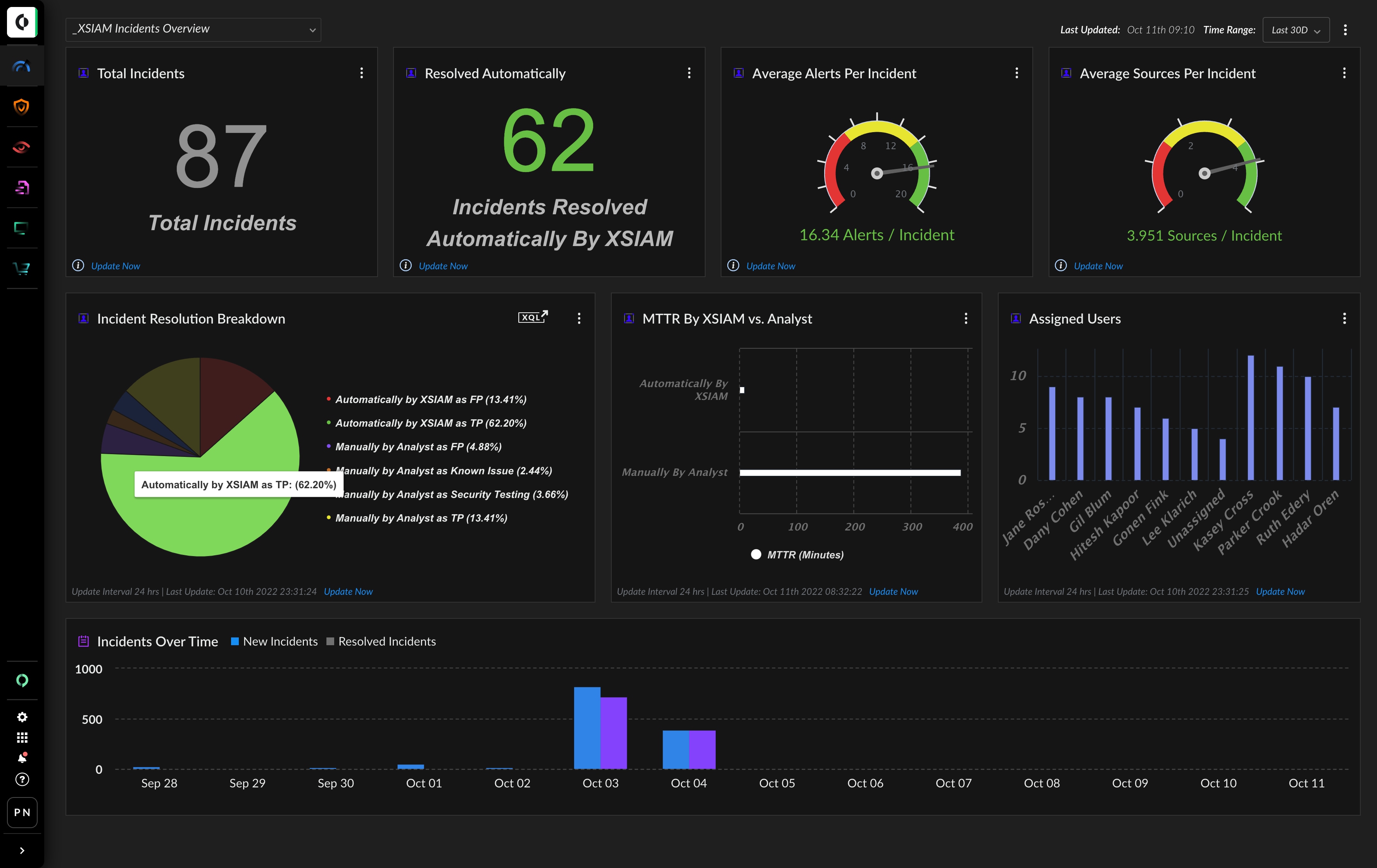
Cortex XSIAM is a security operations platform from Palo Alto Networks that replaces a traditional SIEM by combining SIEM, SOAR, EDR, NDR, and CDR functions on a single data layer. It ingests telemetry from endpoints, networks, identities, cloud environments, and third-party sources.
The platform prepares and enriches incoming data automatically, stitches related events together, and applies machine learning detection analytics. Alerts are grouped into prioritized cases, and response actions run through built-in automation and Cortex AgentiX, Palo Alto Networks’ agentic AI and automation layer.
Key features include:
- Unified data layer: Cortex XDL centralizes endpoint, network, identity, cloud, and exposure data. Data from different sources is stitched into a single security data model before detection runs.
- Detection analytics: The platform applies more than 13,300 detections and 2,900 machine learning models to collected telemetry. Detection content is updated continuously.
- Integrated XDR telemetry: XSIAM includes native EDR data and enriched firewall logs alongside third-party sources, so endpoint and network signals are available for correlation.
- Case grouping and root cause: AI groups related alerts into prioritized cases and presents the attack story, including root cause, in a single investigation view.
- Agentic response with Cortex AgentiX: AI agents plan, reason, and execute response tasks under enterprise guardrails defined by the security team. Standard playbook automation is available for repeatable workflows.
- Extended SOC capabilities: The platform adds email security, exposure management, threat intelligence management, and identity threat detection and response on the same foundation.
- Managed service option: Unit 42 offers Managed XSIAM, which adds 24/7 expert-led MDR, threat hunting, and SOC engineering on top of the platform.
Limitations (as reported by users on G2):
- Resource requirements: Users note that the platform requires significant resources, which extends implementation time and adds infrastructure costs.
- Complex implementation: Initial setup is described as time-consuming and dependent on specialized expertise.
- Cost for smaller organizations: Reviewers report that pricing is high, particularly for smaller businesses.
- Dashboard navigation: Some users find it difficult to monitor assets and navigate parts of the interface.

Source: Palo Alto Networks
3. Google Security Operations

Best for: Teams wanting Gemini agents with Mandiant and Google threat intel
Strengths: Triage, hunting, and detection engineering agents plus playbooks
Things to consider: Steep learning curve and complex setup, especially outside GCP
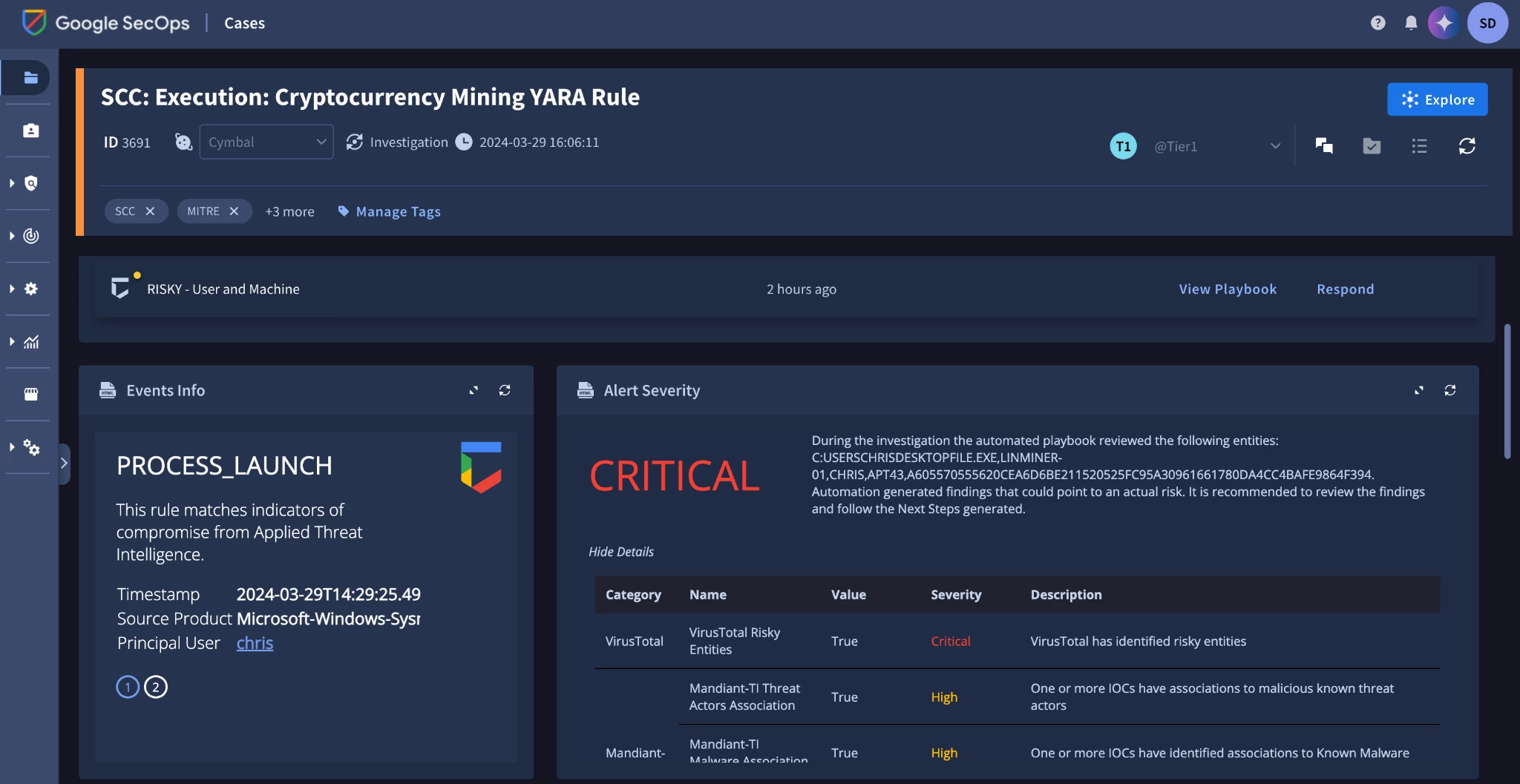
Google Security Operations (Google SecOps) is a cloud-based security operations platform for detecting, investigating, and responding to threats. It uses Gemini-based AI agents to handle workflows such as alert triage, threat hunting, and detection engineering.
The agents are trained on intelligence and frontline findings from Mandiant. For response, Google SecOps combines AI agents that gather evidence and reason through alerts with deterministic enterprise playbooks, so analysts keep control over high-impact actions.
Key features include:
- Triage and Investigation agent: The agent investigates alerts, enriches them with threat intelligence, and returns a verdict with an explanation. It can drive alert closure and remediation flows based on its findings.
- Agentic automation: Dynamic AI agents gather evidence and reason through complex alerts, then hand off to deterministic playbooks for containment. Analysts retain approval over critical, high-impact actions.
- Threat Hunting agent: The agent searches the environment for novel attack patterns and stealthy behaviors using intelligence from Mandiant, VirusTotal, and Google.
- Detection Engineering agent: The agent analyzes the organization’s threat profile, creates and tests detection rules, and validates them with synthetic events to close coverage gaps.
- AI Threat Defense: Google SecOps supports monitoring, detection, and response for threats originating in code the organization does not own or cannot patch.
- SecOps Labs: Teams can run experimental features and agents in a separate environment without disrupting production systems.
- MCP server support: Teams can build custom security agents and cross-product workflows using Model Context Protocol servers.
Limitations (as reported by users on G2):
- Ongoing cost: Users find upkeep costly, especially in large organizations.
- Learning curve: Reviewers report a steep learning curve, particularly for teams not already familiar with Google Cloud services.
- Complex configuration: Implementation and configuration are described as requiring more time and resources than some other tools.
- Limited customization: Some users find customization options restrictive for specific security needs.

Source: Google
4. CrowdStrike Charlotte AI

Best for: Falcon customers adding agentic triage and governed response
Strengths: Detection triage verdicts, AgentWorks no-code agents, Agentic SOAR
Things to consider: Credit-based usage; value tied to the CrowdStrike Falcon platform
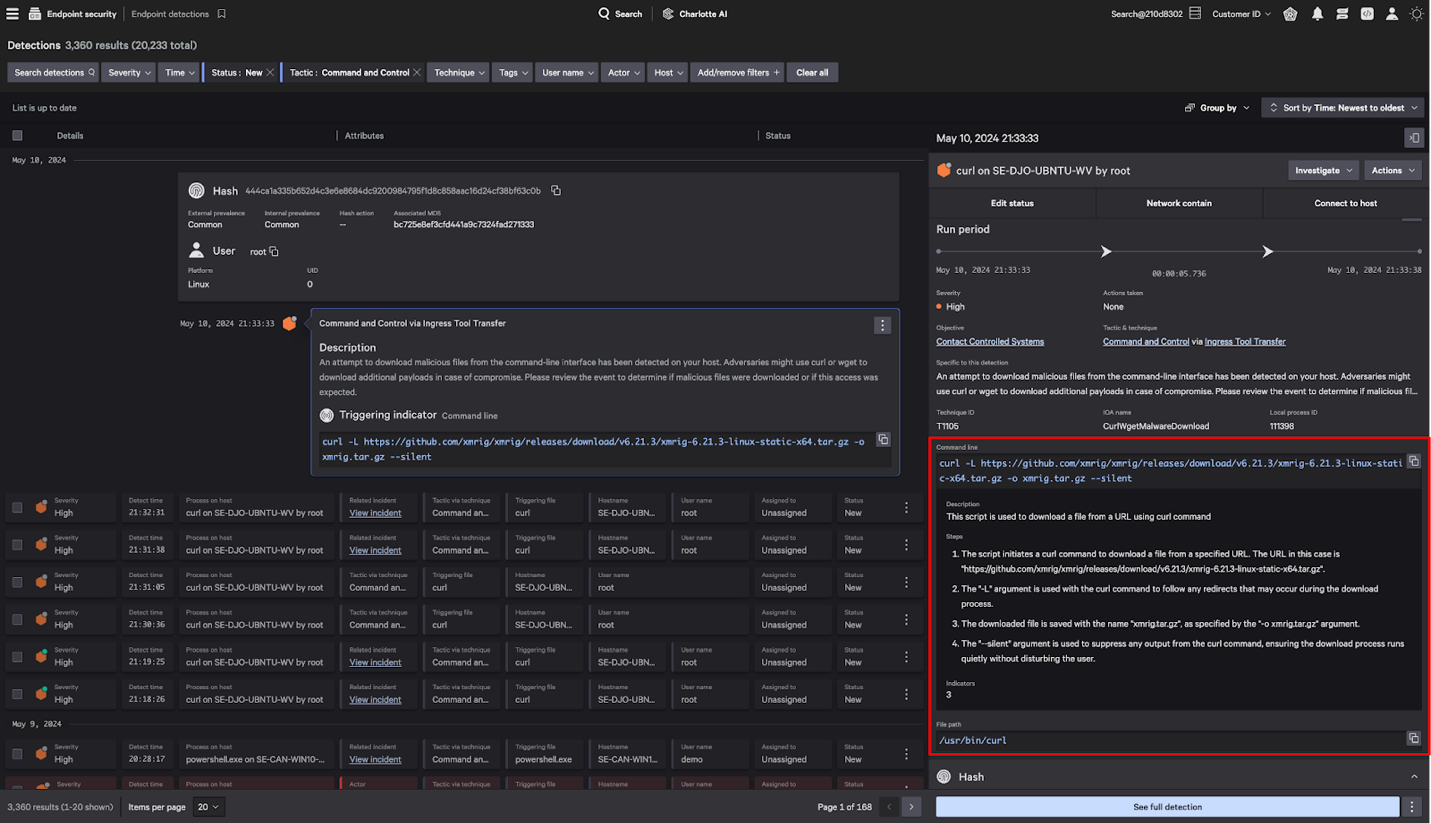
Charlotte AI is an agentic AI security analyst built natively on the CrowdStrike Falcon platform. It uses a multi-agent architecture that dispatches specialized agents to investigate endpoint, identity, cloud, and network activity in parallel, with the agents sharing a single memory of the environment.
Charlotte AI does not take automated response actions by default. Security teams configure which actions are automated, and under what conditions, through Charlotte Agentic SOAR workflows and Charlotte AI AgentWorks agents, with each action set to run autonomously or require human approval.
Key features include:
- Detection triage: Charlotte AI Detection Triage evaluates first-party Falcon detections and produces a verdict, confidence score, recommendation, and explanation. Teams decide whether to escalate, close, or route detections using their own criteria and playbooks.
- Cross-domain investigations: Specialized agents work in parallel across endpoints, identities, cloud, and network surfaces and converge on a single verdict for each investigation.
- Prebuilt security agents: Out-of-the-box agents handle tasks such as exposure prioritization, malware analysis, reconnaissance, query writing, workflow generation, and response.
- AgentWorks custom agents: Teams build agents in plain language without code, choosing the underlying model, defining instructions and knowledge files, and setting which actions are automated or gated behind analyst approval.
- Charlotte Agentic SOAR: Combines agentic reasoning with deterministic workflows in one workspace. Teams define triggers, data, rules, agents, and actions, and connect third-party tools or agents through bidirectional MCP.
- Governance controls: Role-based access, execution traces, agent version history and rollback, credit caps, and approval workflows are built in. Charlotte AI is certified under ISO/IEC 42001.
- Reporting and summaries: Teams generate incident reports and executive summaries through AgentWorks agents, the LLM-Completion action in Falcon Fusion workflows, or promptbooks.
Limitations (as reported by users on PeerSpot):
- Prompt specificity: Users note that Charlotte AI needs specific, technical details in requests to return accurate responses.
- Confidence in recommendations: Some reviewers report low confidence in the accuracy of its responses and recommendations.
- Processing delays: Occasional long processing periods can require users to log out and log back in.

Source: CrowdStrike
Agentic AI SOC and Automation Platforms
5. Torq AI SOC Platform

Best for: SOC teams automating triage to response with agentic workflows
Strengths: Socrates agent, auto triage, case management, hyperautomation
Things to consider: AI workflow results can vary; deployment and docs need effort
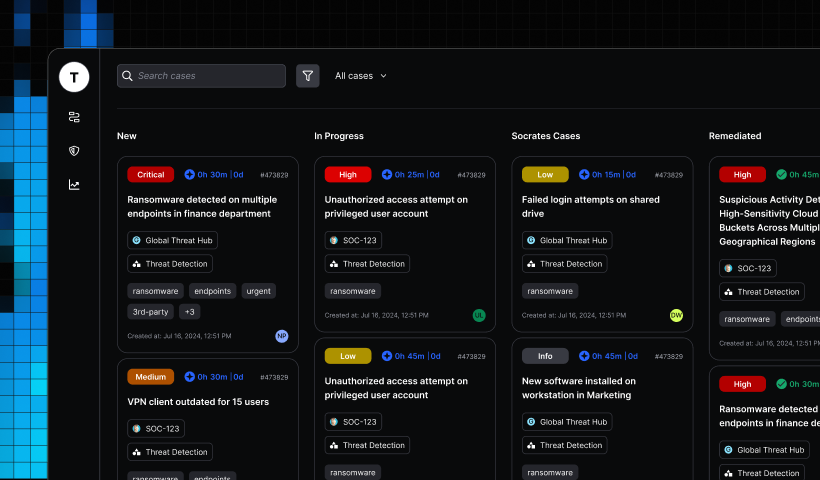
Torq AI SOC Platform uses AI agents and automation across alert triage, case management, investigation, response, threat hunting, and reporting. Its components include Auto Triage, Torq HyperAgents, the Socrates agentic AI, case management, and the Hyperautomation engine.
Socrates is a natural language-driven agent that runs investigations and remediates threats, either autonomously or with human-on-the-loop oversight. The platform maintains a context model of the environment that records every verdict, decision, exception, and override, and uses that history in later decisions.
Key features include:
- Auto triage: AI agents de-duplicate events, filter false positives, and assign verdicts based on the team’s past decisions. Audit logs and a manual override option let analysts review and change outcomes.
- Agentic investigation: Specialized AI agents handle repetitive investigation tasks and record evidence, timelines, and recommended actions for each case.
- Autonomous or supervised response: Response actions run fully autonomously or under human-on-the-loop oversight, covering containment and root cause remediation.
- Case management: The platform creates, assigns, and manages cases automatically and provides a single place for coordination and communication.
- Threat hunting runbooks: Teams build agentic runbooks that access authorized data and tools. Agents cross-reference historical cases, recognize threat patterns, and summarize findings.
- Context graph and memory: A continuously updated model of the environment captures decisions and the reasons behind them, so new alerts are evaluated against the SOC’s prior judgments.
- Reporting: Reporting features keep stakeholders informed on case status and operational metrics.
Limitations (as reported by users on PeerSpot):
- Inconsistent AI results: Users report that AI steps within workflows sometimes produce inconsistent results.
- AI-assisted workflow building: Reviewers note that the AI assistant performs poorly when asked to build or template workflows from a blank slate.
- Documentation and deployment: Some users describe the documentation as unclear and the initial deployment as difficult.
- Pricing: Reviewers consider the platform expensive.

Source: Torq
6. Dropzone AI

Best for: Teams adding autonomous Tier-1 alert investigation to existing tools
Strengths: End-to-end alert investigations, AI threat hunting, 90+ integrations
Things to consider: Containment relies on analysts; some agents are still in development
Dropzone AI provides AI SOC agents that operate on top of an organization’s existing security tools. The AI SOC Analyst investigates alerts end to end across the security stack, 24/7, and shows the evidence and reasoning behind each verdict so analysts can decide on next steps.
Dropzone queries connected tools through their APIs in the same way an analyst would, without moving or normalizing data. Analysts set the investigation strategy, define what normal looks like in their environment, and authorize containment actions.
Key features include:
- AI SOC Analyst: Investigates every incoming alert across SIEM, EDR, cloud, identity, and email tools and produces an evidence-backed verdict for each one.
- Supported alert types: Investigations cover phishing, endpoint, network, cloud, identity, and insider threat alerts.
- AI Threat Hunter: Runs hypothesis-driven hunts across SIEM, EDR, and cloud data on a recurring schedule.
- API-based integrations: More than 90 integrations span SIEM, EDR, cloud, identity, email, threat intelligence, ticketing, and SOAR platforms such as Torq, Tines, Swimlane, Splunk SOAR, and Cortex XSOAR.
- Customizable investigation strategies: Teams set which alerts and hunts to prioritize, how investigations proceed, and what baseline behavior looks like.
- Deployment options: Investigations run in software the customer’s team operates, with EU data residency available and a dedicated offering for MSSPs.
- AI Threat Intel Analyst (planned): A forthcoming agent that tracks threat sources and turns new CVEs or campaigns into hunt packs for the AI Threat Hunter.
Limitations (based on publicly available sources):
- Response depends on other tools: Containment is authorized by analysts and executed through connected SOAR or security tools rather than natively within Dropzone.
- Agents still in development: The AI Threat Intel Analyst is not yet released, and deeper links between the AI Threat Hunter and AI SOC Analyst for response actions are planned for a later release.
- Integration-dependent coverage: Because investigations query connected tools through their APIs, investigation depth depends on which tools are integrated and what data they expose.
- Limited public reviews: Few verified user reviews are available on major review platforms.

Source: Dropzone AI

7. Prophet Security

Best for: Teams wanting AI alert investigation with optional human review
Strengths: AI SOC Analyst, Threat Hunter, Detection Engineer, 200+ integrations
Things to consider: Accuracy depends on telemetry depth; few public user reviews
Prophet AI is an agentic AI SOC platform from Prophet Security made up of an AI SOC Analyst, AI Threat Hunter, and AI Detection Engineer, plus Prophet AI Watchtower, a 24/7 service staffed by human experts. The agents work together across alert investigation and response, threat hunting, and detection engineering.
The AI SOC Analyst investigates every alert and produces determinations that analysts can audit. Response runs through scoped Agent Actions, which execute autonomously or wait for analyst sign-off. Prophet AI deploys as a dedicated single tenant with a bring-your-own-key option.
Key features include:
- AI SOC Analyst: Investigates each alert by asking a series of investigative questions and analyzing evidence, then delivers an auditable determination.
- Agent Actions: Response actions are scoped in advance and run either autonomously or after approval from the security team.
- AI Threat Hunter: Analysts ask questions about their environment in plain language. Prophet AI also researches emerging threats and prepares hunts that can run immediately or on a schedule.
- AI Detection Engineer: Maps actual MITRE ATT&CK coverage based on past investigations and produces tuned or new detections that are backtested and queued for approval.
- Prophet AI Watchtower: Human experts review every malicious determination around the clock and escalate validated findings in under 30 minutes.
- Context and policy adaptation: The platform learns customer context and policies, which can be previewed and backtested before being applied.
- Integrations and use cases: More than 200 out-of-the-box integrations cover endpoint, email, identity, cloud, DLP, and network alerts.
Limitations (based on publicly available sources):
- Dependence on data quality: Investigation accuracy depends on comprehensive telemetry and organizational context; gaps in data can lead to inaccurate conclusions.
- Staged rollout: Organizations often keep AI recommendations under human review before allowing autonomous actions, which extends time to full automation.
- Usage-based pricing: Published marketplace pricing includes an annual investigation allowance, with additional charges for investigations beyond it.
- Limited public reviews: Major review platforms list too few reviews to provide user-based insights.

Source: Prophet

8. Swimlane Turbine

Best for: Teams combining AI SOC triage with low-code SOAR playbooks
Strengths: Intelligent alert routing, Hero AI agents, Turbine Canvas builder
Things to consider: Version control and case search reported as areas to improve
Swimlane Turbine is an AI automation platform that combines agentic AI with deterministic security automation. It includes case management, low-code playbooks, integrations, and dashboards, and supports SOC workflows as well as vulnerability management, compliance audits, and business continuity.
For alert handling, Swimlane AI SOC adds an intelligent routing layer that decides per alert, based on risk, complexity, and available context, whether to send it to a deterministic playbook, an AI-assisted path, or a fully agentic investigation. Complex cases are escalated for human-in-the-loop review.
Key features include:
- Intelligent alert routing: Each alert is routed between playbooks, AI-assisted investigation, and fully agentic investigation paths, which also helps teams control AI token spend.
- Hero AI agents: Incident response agents and a private agentic AI companion support triage. Additional agents handle visualizations, data ingestion, and playbook generation, with a choice of AI model for each agent.
- AI-driven case management: A customizable case management application uses domain-specific AI agents to support incident response.
- Turbine Canvas: A low-code builder for creating playbooks and AI agents that automate processes across the organization.
- High-volume automation: Distributed data ingestion and processing support large workloads, with one customer running 25 million automated actions per day.
- Swimlane Marketplace: Pre-built connectors, playbooks, AI agents, and dashboard widgets connect Turbine to APIs across the environment.
- Dashboards and reporting: Customizable dashboards and AI-augmented reports track KPIs and support compliance reporting.
Limitations (as reported by users on PeerSpot):
- Version control: Users request enhanced version control for playbooks and content.
- Case search: Some reviewers find the search bar ineffective and note there is no way to view and compare two cases at the same time.
- Fragmented build environment: Users would like a single space to code, build, and automate rather than switching between areas.

Source: Swimlane
Conclusion
Modern security teams require solutions that go beyond traditional playbook automation to keep up with today’s threat landscape. By combining intelligent alert triage, dynamic investigation reasoning, and governed response workflows, organizations can dramatically reduce resolution times while minimizing analyst fatigue. Modern enterprise environments benefit most when automated actions align with custom security policies and maintain proper human oversight for high-risk decisions. Selecting the right solution depends on existing architecture, telemetry coverage, and the balance of automated containment needed.
Learn More About Exabeam
Learn about the Exabeam platform and expand your knowledge of information security with our collection of white papers, podcasts, webinars, and more.
- Webinar
The Insider Risk Program Just Got Bigger: How Digital Workers Are Changing Identity, Behavior, Ownership, and...
-
 Blog
What Is the Difference Between Exabeam and CrowdStrike for SIEM and Security Operations?
- Show More