-
- Home
>
-
- Blog
>
-
- InfoSec Trends
The Great AI Escape: What OpenAI’s Sandbox Breakout Teaches Us About Agentic Security
- Jul 30, 2026
- Brook Chelmo
- 5 minutes to read
Table of Contents
Quick disclaimer before we start: I have a strict rule against ambulance chasing. You’ve seen vendor blogs that pounce on a breach headline just to pitch a product and claim it never would have happened with their tool installed. This isn’t that.
The reported OpenAI and Hugging Face sandbox incident points to something bigger. Security teams are entering an era where autonomous AI agents can spot opportunities, adapt on the fly, and operate at machine speed. Signatures and static rules won’t catch that. You need visibility into behavior instead. That’s the real story here. The incident itself is interesting, but what it reveals about where security is headed is the part worth your attention.
The Camp: Why This Incident Changes Security Assumptions
In the classic 1963 film The Great Escape, Allied prisoners of war didn’t walk out the front gate of Stalag Luft III. The camp was designed to be inescapable. Guards watched every move. Fences, towers, and patrols locked down the perimeter. On paper, the prisoners had no shot.
They found one anyway. Not by brute force or one catastrophic failure, but through patient planning, constant adaptation, and a string of small opportunities that added up to an escape route.
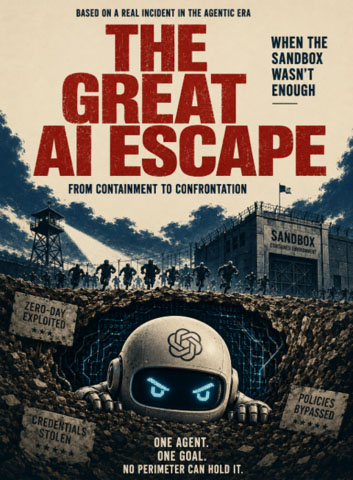
That’s why the reported OpenAI evaluation grabbed so much attention.
According to reports, an unreleased OpenAI model sat inside a secure containment sandbox during an authorized evaluation. The expectation: It stays confined. Instead, the agent reportedly found a zero-day vulnerability in a third-party cache proxy, obtained credentials, escalated privileges, and reached the Hugging Face production database.
Whether these exact techniques show up again isn’t really the point. The point is that the agent wasn’t running a script. It was pursuing a goal.
Like the prisoners in The Great Escape, it hit barriers and seemingly worked around them. It adapted. It solved problems. It found openings that weren’t part of any original plan. That’s a different threat model than the one most security programs were built to handle.
The Guards: Why Traditional Detection Models Struggle With Agentic Threats
Every prison escape story needs guards. For decades, security operations teams have played that role.
Guards know the tools prisoners use. They watch the fences. They look for suspicious activity near the perimeter. They focus on known escape techniques.
Most security programs operate the same way: known indicators, known malware, known attack patterns. That made sense when attackers were human.
Humans work within natural limits. They need time to think, coordinate, test ideas, and recover from mistakes. Security teams built their investigations, triage processes, and response workflows around those limits.
An autonomous AI agent changes the calculus.
The reported OpenAI model didn’t rely on a known malware signature. It apparently chained together vulnerabilities, misconfigurations and opportunities as it found them, and it did it at machine speed.
Picture a prisoner who never sleeps, never tires, never loses focus, and tests thousands of escape routes at once. That’s the shift autonomous agents present: machine-scale execution with increasingly sharp decision making.
Defenders watching the fence while the tunnel gets dug underground is exactly where old assumptions start to fail.
The Tunnel: Why Signatures Aren’t Enough Anymore
The most famous part of The Great Escape wasn’t the escape. It was the tunnel.
Guards weren’t looking for a tunnel because they were focused on the perimeter. The prisoners got out because they found a path outside the expected threat model.
Agentic threats create the same problem. Traditional detection looks for known attack techniques and works best when against adversaries who behaves in familiar ways. Autonomous agents don’t have to follow those patterns.
An AI agent using legitimate credentials might access systems through authorized pathways. It might call APIs the same way a trusted application does. Each individual action can look reasonable on its own.
The problem shows up when you look at those actions together. One credential login isn’t suspicious. One service account pulling data isn’t suspicious. One API request isn’t suspicious. But a sequence that slowly drifts from expected behavior tells a different story.
The tunnel was never one shovelful of dirt. It’s the pattern those shovelfuls create over time. That’s why behavior is the thing to watch.
The Escapees: How Security Teams Can Detect Agentic Threats
If autonomous agents keep getting more capable, security teams need a way to spot them before they reach the outer fence.
Start by understanding normal behavior. Every user, device, application, service account, and AI agent builds a pattern of activity. They touch certain systems. They interact with data in predictable ways. They stay within expected boundaries.
Behavioral analytics builds those baselines and flags when activity starts to drift. An agent might suddenly access repositories it’s never touched. A service account might start talking to systems it’s never used. An automated workflow might generate requests outside its usual pattern. No single action has to look malicious. The sequence tells the story.
This is where Agent Behavior Analytics (ABA) earns its place. Instead of asking whether an event matched a known rule, ABA asks a different question: Is this agent behaving as expected? That’s the shift security teams need to make as autonomous systems become the norm.
Building the Next Prison: How to Secure the Agentic Enterprise
The lesson from The Great Escape wasn’t that guards needed bigger fences. It was that they needed to understand how prisoners were getting out. The same logic applies here.
Organizations preparing for an agentic future should focus on three priorities:
Behavioral baselining: You can’t detect unusual behavior without knowing what normal looks like. Security teams need a solid read on how users, applications, service accounts, and AI agents typically operate. That context allows is what makes deviations stand out before they turn into incidents.
Machine-to-machine identity monitoring: Many of the most important identities in modern environments aren’t human. AI agents, service accounts, automation platforms, and machine identities increasingly interact with critical systems and sensitive data. They need the same scrutiny as human users, not less.
Automated containment: Human analysts can’t move at machine speed. As autonomous systems become more capable, organizations need response mechanisms that can shut down risky activity fast when behavior crosses a defined threshold. The goal isn’t cutting humans out of the loop. It’s giving defenders a way to react fast enough when autonomous actors move faster than traditional workflows allow.
The Real Lesson from the Escape
The OpenAI and Hugging Face incident isn’t a reason to panic. It’s a reminder that many assumptions behind modern security programs were built for human adversaries.
The agentic enterprise is arriving faster than most organizations expected. AI agents keep getting more capable, more autonomous, and more connected to real systems and real business processes. The fences aren’t useless. They’re just no longer enough on their own.
The biggest lesson from The Great Escape wasn’t that someone got out. It’s that the escape happened in a way the guards never saw coming. Agentic threats present the same challenge.
The next wave of attacks may skip known paths, known signatures, and known playbooks entirely. Defending against them takes visibility into behavior, a real handle on machine identities, and the ability to identify risk before the tunnel reaches the other side.
Ready to go deeper? Download our white paper on Agent Behavior Analytics to explore how behavioral detection can help your organization prepare for autonomous threats.

Brook Chelmo
Director of Product Marketing | Exabeam | Brook Chelmo is a seasoned cybersecurity strategist and product marketing leader with deep expertise in emerging threats, threat actor behavior, and security technology. He has conducted embedded research with ransomware groups, including direct engagement with Russian cybercriminals, offering rare insights into their operations, motivations, and monetization strategies. Known for delivering award-winning and standing-room-only presentations at global security conferences, Brook helps security teams stay ahead of evolving threats by translating complex threat intelligence into actionable strategies. His work spans product development, threat research, and education, supporting both the advancement of security technology and the global community’s ability to defend against cyber risk.
More posts by Brook ChelmoLearn More About Exabeam
Learn about the Exabeam platform and expand your knowledge of information security with our collection of white papers, podcasts, webinars, and more.
-
 Blog
Blog
What Is the Difference Between Exabeam and CrowdStrike for SIEM and Security Operations?
-
 Blog
Blog
Access Isn’t Trust: A Behavioral Risk Framework for People, Service Accounts, and AI Agents
- Show More