Microsoft Sentinel: 5 Hauptfunktionen, Einschränkungen und Alternativen
- 9 minutes to read
Inhaltsverzeichnis
Was ist Microsoft Sentinel?
Microsoft Sentinel (ehemals Azure Sentinel) ist eine Cloud-native SIEM- (Security Information and Event Management) und SOAR-Lösung (Security Orchestration Automated Response). Sie integriert sich in Azure-Cloud-Dienste, bietet Sicherheitsanalysen und unterstützt die Reaktion auf Sicherheitsvorfälle. Sie hilft Sicherheitsanalysten, Bedrohungen zu erkennen, zu untersuchen und darauf zu reagieren.
Die Plattform nutzt KI und maschinelles Lernen zur Datenanalyse. Dies hilft, potenzielle Bedrohungen und Schwachstellen genauer zu identifizieren. Wie bei anderen Plattformen können Nutzer Daten aus verschiedenen Quellen korrelieren, darunter Cloud-Dienste, lokale Systeme und Drittanbieter.
Hauptfunktionen und Fähigkeiten von Microsoft Sentinel
Microsoft Sentinel bietet die folgenden Funktionen zur Unterstützung von Sicherheitsvorgängen.
Dies ist Teil einer Artikelserie zum Thema Informationssicherheit.
Hauptfunktionen und Fähigkeiten von Microsoft Sentinel
1. Datenerfassung und -integration
Microsoft Sentinel unterstützt zahlreiche Konnektoren und ermöglicht die Integration über Cloud-Plattformen wie Azure, AWS und GCP sowie lokale Umgebungen. Diese Funktion soll Transparenz über potenzielle Bedrohungen schaffen. Die Fähigkeit von Sentinel, Protokolle und Signale ohne zusätzliche Infrastrukturinvestitionen zu integrieren, kann für die Sicherheitsüberwachung in unterschiedlichen IT-Umgebungen nützlich sein.
Die von Sentinel erfassten Daten werden normalisiert und angereichert, um die Bedrohungserkennung und Vorfallanalyse zu verbessern. Dieser Prozess umfasst das automatische Markieren, Parsen und Korrelieren von Daten, was die Sicherheitsabläufe optimiert.
2. Bedrohungserkennung und -analyse
Die Bedrohungserkennung in Microsoft Sentinel zielt darauf ab, komplexe Bedrohungen zu identifizieren. Durch Verhaltensanalysen und Anomalieerkennung identifiziert die Plattform ungewöhnliche Aktivitäten und potenzielle Bedrohungen, die mit herkömmlichen Methoden möglicherweise übersehen werden.
Die Analysefunktionen von Sentinel ermöglichen die Erstellung benutzerdefinierter Regeln und Warnmeldungen, in der Hoffnung, dass Unternehmen rechtzeitig über verdächtige Aktivitäten benachrichtigt werden.
3. KI-gestützte Untersuchung
Die KI-gestützten Untersuchungstools von Sentinel vereinfachen die Bedrohungsanalyse und -behebung. Der Einsatz von KI beschleunigt die Untersuchungsphase, indem er potenzielle Einblicke in Angriffsmuster und mögliche Bedrohungsakteure liefert. Die Tools bieten Suchfunktionen, die es Analysten ermöglichen, Warnmeldungen und damit verbundene Vorfälle genauer zu untersuchen.
Darüber hinaus wird künstliche Intelligenz verwendet, um sich wiederholende Aufgaben zu automatisieren, Zeitleisten für Vorfälle zu erstellen und Angriffsvektoren zu visualisieren.
4. Automatisierte Incident Response mit Playbooks
Die automatisierte Reaktion auf Vorfälle in Microsoft Sentinel basiert auf Playbooks, die die Reaktionsbemühungen standardisieren. Diese Playbooks sind Sammlungen von Verfahren, die als Reaktion auf bestimmte Vorfälle automatisch ausgeführt werden. Wie alle Playbooks anderer Anbieter zielen sie darauf ab, Reaktionszeiten zu verkürzen und den menschlichen Eingriff in kritischen Phasen zu minimieren.
Durch Automatisierung können Unternehmen ein höheres Alarmaufkommen bewältigen. Durch die Nutzung vordefinierter Workflows sorgt Sentinel dafür, dass jeder Vorfall einheitlich behandelt wird und gleichzeitig menschliche Fehler reduziert werden.
5. Verhaltensanalyse und Benutzerentitätsverhaltensanalyse (UEBA)
Verhaltensanalysen und UEBA in Microsoft Sentinel konzentrieren sich auf die Identifizierung von Abweichungen vom typischen Benutzerverhalten. Sentinel nutzt diese Analysen, um potenzielle Insider-Bedrohungen, kompromittierte Identitäten und fortgeschrittene, anhaltende Bedrohungen zu erkennen, indem Muster in Benutzeraktivitäten ausgewertet und Anomalien gekennzeichnet werden.
UEBA liefert Kontext zu Benutzeraktionen, indem es Basisaktivitäten zusammen mit aktuellen Verhaltensmetriken analysiert. Dieser Ansatz identifiziert Unregelmäßigkeiten und ermöglicht es Sicherheitsteams, schnell auf potenzielle Sicherheitsverletzungen zu reagieren.
What’s New in Microsoft Sentinel in 2026
In February 2026, Microsoft introduced updates focused on how security teams ingest, manage, and operationalize content across their SOC. The changes expand connector coverage, improve multi-tenant management, enhance UEBA capabilities, and introduce new AI-driven partner integrations.
Expanded Out-of-the-Box Connectors
Sentinel expanded its ecosystem of built-in connectors, now generally available for services such as Mimecast Audit Logs, CrowdStrike Falcon Endpoint Protection, Vectra XDR, Palo Alto Networks Cloud NGFW, SocPrime, Proofpoint on Demand Email Security, Pathlock, MongoDB, and Contrast ADR.
These connectors simplify onboarding of data from cloud, SaaS, and on-premises systems. Faster onboarding improves unified visibility and strengthens analytics by providing broader context across the security stack.
A new Microsoft 365 Copilot data connector (public preview) allows teams to ingest Copilot audit logs and activity data. Once collected, this data can be used in analytics rules, detections, automation, and investigations. Organizations can also route it to the Sentinel data lake for advanced scenarios with flexible retention and lower-cost ingestion.
Transition to the Codeless Connector Framework
Microsoft is shifting from Azure Function-based connectors to the Codeless Connector Framework (CCF). CCF provides a SaaS-managed approach for building and operating connectors. It includes built-in health monitoring, centralized credential management, and improved performance.
Customers are encouraged to migrate existing connectors to CCF to maintain uninterrupted data collection and access to new features. The legacy custom data collection API will be retired in September 2026.
Multi-Tenant Content Distribution
A new public preview capability enables centralized management and distribution of Sentinel content across multiple tenants from the Microsoft Defender portal. Security teams can replicate analytics rules, automation rules, workbooks, and alert tuning rules across environments.
This reduces the need to rebuild detections and dashboards for each tenant. It helps maintain a consistent security baseline, reduces configuration drift, and accelerates onboarding of new tenants, while execution remains local to each target tenant.
Enhanced UEBA Essentials
The updated UEBA Essentials solution (public preview) improves detection of high-risk anomalous behavior across Azure, AWS, GCP, and Okta. It introduces expanded multi-cloud anomaly detection and new queries powered by the anomalies table.
The solution aligns activity with MITRE ATT&CK, highlights complex malicious IP patterns, and builds anomaly profiles for users. More than 30 prebuilt UEBA queries are available through the Sentinel content hub. Behavior analytics can also be enabled automatically when new data sources are connected.
Partner-Built Security Copilot Agents
Sentinel can now be extended with partner-built Security Copilot agents available through the Microsoft Security Store in the Defender portal. These AI-powered agents integrate directly with Sentinel analytics and incidents.
They assist with triage, investigation, and response. Some agents review configurations, map attacker activity, automate forensic analysis, or generate SOC reports. This allows organizations to use prebuilt expertise without developing custom agent workflows.
Enhanced Threat Intelligence and Data Investigation
The Threat Intelligence Briefing Agent now uses a structured knowledge graph within Microsoft Defender for Threat Intelligence. It delivers more relevant threat insights tailored to industry and region, with embedded Microsoft Threat Intelligence citations for context.
Sentinel also integrates Microsoft Purview Data Security Investigations (DSI) with the Sentinel graph. This combines AI-driven content analysis with activity-based graph analytics. Security teams can correlate sensitive data exposure with user and activity context in a single investigation flow.
Extended Migration Timeline
The deadline to migrate Sentinel management from the Azure portal to the Defender portal has been extended to March 31, 2027. This gives organizations more time to transition while adopting new Defender-based capabilities.
Einschränkungen von Microsoft Sentinel
Microsoft Sentinel ist zwar eine anerkannte Lösung, weist jedoch einige Einschränkungen auf, die Unternehmen vor der Implementierung berücksichtigen sollten. Diese Einschränkungen wurden von Benutzern der G2-Plattform gemeldet:
- High cost at scale: Sentinel uses a pay-as-you-go pricing model based on data ingestion and retention. As log volumes increase, costs can rise quickly, which may be challenging for organizations with large data environments.
- Steep learning curve for KQL: Sentinel relies heavily on Kusto Query Language (KQL) for threat hunting, reporting, and analysis. Although powerful, KQL can be difficult for new users and may require training before analysts can use it effectively.
- Complex configuration and customization: Implementing advanced automation or SOAR workflows often requires building and managing Azure Logic Apps. These configurations can become complex and require specialized expertise.
- Integration challenges with non-Microsoft tools: While integration with Microsoft services is strong, connecting legacy systems or third-party security tools can require additional configuration and time.
- User interface and feature complexity: Some users report that the interface and feature set can be difficult to navigate initially, especially for teams unfamiliar with Microsoft security platforms.
- Query performance and resource usage: Running large or complex queries can take time and may consume significant compute resources, particularly in large environments.
- Vendor ecosystem dependency: Sentinel tends to work best within the Microsoft ecosystem. Organizations heavily using non-Microsoft security tools may experience limitations or require additional integration work.
Bemerkenswerte Alternativen zu Microsoft Sentinel
1. Exabeam

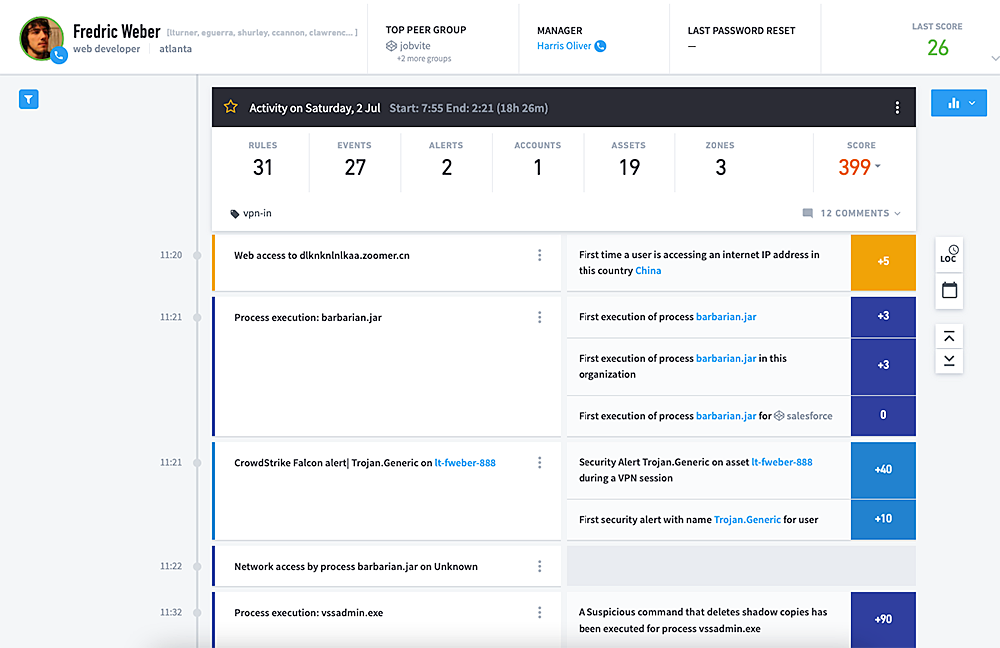
Exabeam ist ein führender Anbieter von SIEM-Lösungen (Security Information and Event Management), der UEBA, SIEM, SOAR und TDIR kombiniert, um Sicherheitsoperationen zu beschleunigen. Seine Security-Operations-Plattformen ermöglichen es Sicherheitsteams, Bedrohungen schnell zu erkennen, zu untersuchen und darauf zu reagieren und gleichzeitig die betriebliche Effizienz zu steigern.
Hauptmerkmale:
- Skalierbare Protokollerfassung und -verwaltung: Die offene Plattform beschleunigt das Onboarding von Protokollen um 70 %, sodass keine fortgeschrittenen technischen Kenntnisse mehr erforderlich sind, und gewährleistet gleichzeitig eine nahtlose Protokollaggregation in hybriden Umgebungen.
- Verhaltensanalyse: Verwendet erweiterte Analysen, um normales und abnormales Verhalten zu vergleichen und Insider-Bedrohungen, laterale Bewegungen und komplexe Angriffe zu erkennen, die von signaturbasierten Systemen übersehen werden. Kunden berichten, dass Exabeam 90 % der Angriffe erkennt und darauf reagiert, bevor andere Anbieter sie abfangen können.
- Automatisierte Reaktion auf Bedrohungen: Vereinfacht Sicherheitsvorgänge durch Automatisierung der Vorfallzeitpläne, Reduzierung des manuellen Aufwands um 30 % und Beschleunigung der Untersuchungszeiten um 80 %.
- Kontextbezogene Vorfalluntersuchung: Da Exabeam die Zeitleistenerstellung automatisiert und den Zeitaufwand für Routineaufgaben reduziert, verkürzt sich die Zeit für die Erkennung und Reaktion auf Bedrohungen um über 50 %. Vorgefertigte Korrelationsregeln, Modelle zur Anomalieerkennung und Anbieterintegrationen reduzieren die Anzahl der Warnmeldungen um 60 % und minimieren Fehlalarme.
- SaaS- und Cloud-native Optionen: Flexible Bereitstellungsoptionen bieten Skalierbarkeit für Cloud-First- und Hybridumgebungen und gewährleisten eine schnelle Wertschöpfung für Kunden. Für Unternehmen, die ihr SIEM nicht in die Cloud migrieren können oder wollen, bietet Exabeam ein marktführendes, voll funktionsfähiges und selbst gehostetes SIEM.
- Netzwerktransparenz mit NetMon: Bietet tiefe Einblicke über Firewalls und IDS/IPS hinaus, erkennt Bedrohungen wie Datendiebstahl und Botnet-Aktivitäten und erleichtert die Untersuchung durch flexible Suchfunktionen. Deep Packet Analytics (DPA) basiert außerdem auf der NetMon Deep Packet Inspection (DPI)-Engine, um wichtige Indikatoren für Kompromittierungen (IOCs) zu interpretieren.
Die Kunden Exabeam betonen immer wieder, wie die KI-gestützten Tools für Echtzeittransparenz, Automatisierung und Produktivität die Sicherheitskompetenz des Unternehmens verbessern, überforderte Analysten in proaktive Verteidiger verwandeln und gleichzeitig die Kosten senken und branchenführenden Support bieten.
2. Splunk Enterprise

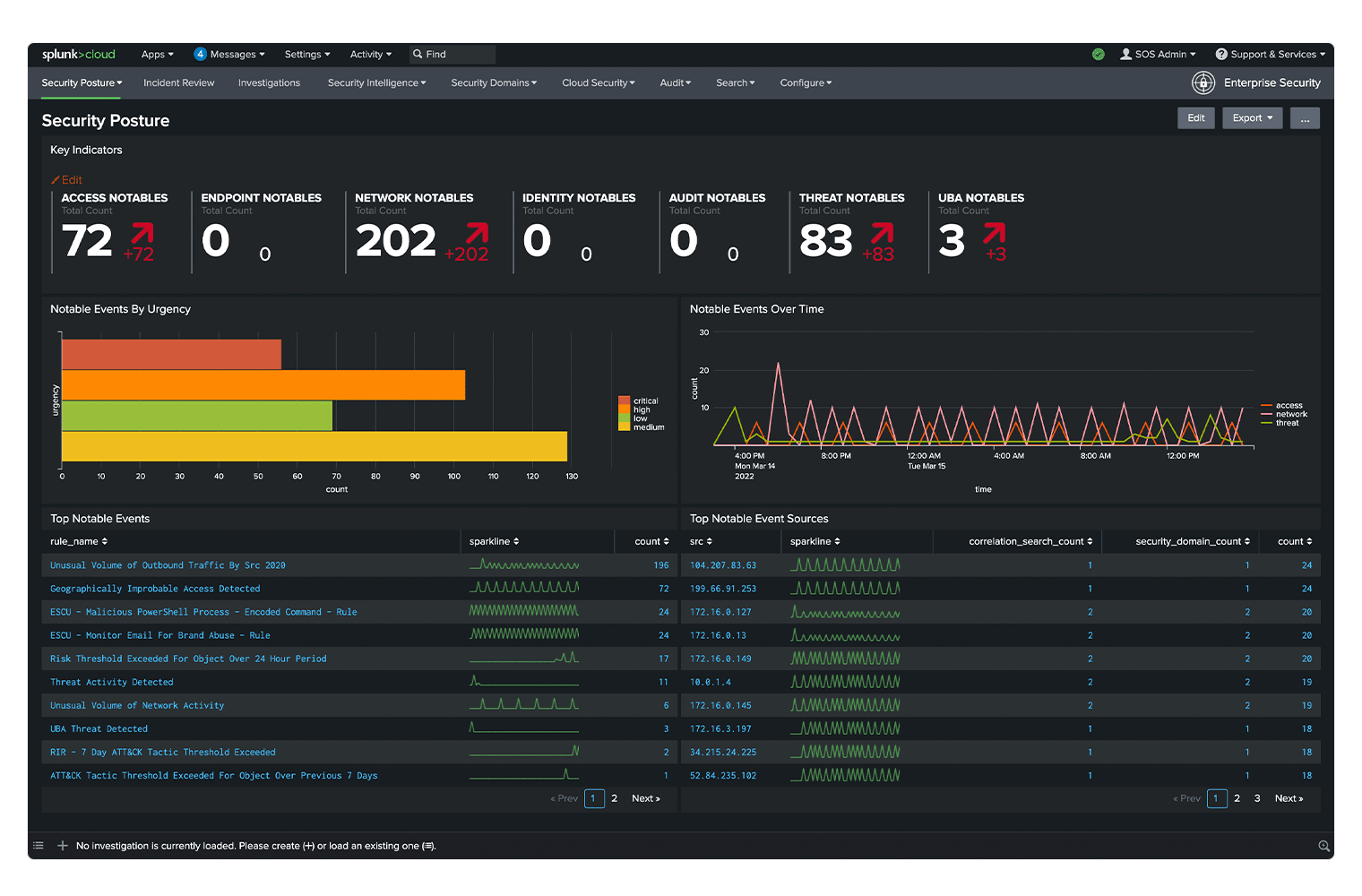
Splunk Enterprise Security is a security platform to support threat detection, investigation, and response across complex environments. It aggregates and analyzes security data from multiple sources, including cloud services, devices, and applications, enabling security teams to identify and investigate threats. The platform integrates SIEM, SOAR, and user and entity behavior analytics (UEBA) capabilities to provide visibility across security operations.
Hauptfunktionen von Splunk Enterprise:
- Unified threat detection, investigation, and response platform: Centralizes security operations workflows to manage detection, investigation, and remediation activities within a single platform.
- Data visibility: Enables teams to manage, search, and analyze data from various environments, including cloud infrastructure, networks, and endpoints.
- User and entity behavior analytics (UEBA): Uses machine learning to detect behavioral anomalies that may indicate insider threats, compromised credentials, or lateral movement.
- Security automation with SOAR: Supports automated workflows and response plans to reduce manual investigation effort and improve response consistency.
- Detection lifecycle management: Provides tools for developing, testing, deploying, and monitoring detection rules, with coverage mapped to frameworks such as MITRE ATT&CK.

Erfahren Sie mehr in unserem ausführlichen Leitfaden zu Microsoft Sentinel vs. Splunk
3. IBM Security QRadar SIEM

IBM Security QRadar SIEM is a security information and event management platform to centralize security monitoring and enable real-time threat detection. It collects and correlates security data from multiple systems to provide visibility into potential threats across an organization’s environment.
Hauptfunktionen von IBM Security QRadar SIEM:
- Centralized security visibility: Aggregates and analyzes data from multiple security tools and systems to provide a unified view of security events.
- Real-time threat detection: Monitors activity across the environment to identify potential security threats and suspicious behaviors.
- User behavior analytics: Identifies anomalies and risky user activities to help detect insider threats and compromised accounts.
- Threat hunting capabilities: Enables analysts to investigate threats by analyzing correlated datasets and monitoring attack paths.
- Integration across security ecosystems: Supports integrations with various security tools and data sources to improve visibility and operational coordination.

4. SentinelOne

SentinelOne AI SIEM is part of the SentinelOne Singularity platform and provides centralized visibility and threat detection across enterprise environments. The platform is designed to collect and analyze security telemetry from endpoints, cloud environments, identities, and networks. Using artificial intelligence and automation, it helps security teams detect threats, investigate incidents, and manage security operations across distributed infrastructures.
Hauptfunktionen von SentinelOne AI SIEM:
- AI-driven threat detection: Uses artificial intelligence to analyze security telemetry and identify suspicious activity across environments.
- Unified security platform: Consolidates security monitoring across endpoints, cloud environments, and identities within a single platform.
- Autonomous security operations: Supports automated detection and response processes to reduce manual workloads for analysts.
- Real-time threat visibility: Provides centralized monitoring and insight into security events across the organization.
- Integrated security ecosystem: Operates within the SentinelOne Singularity platform alongside other security capabilities such as endpoint and cloud protection.

5. Rapid7 InsightIDR

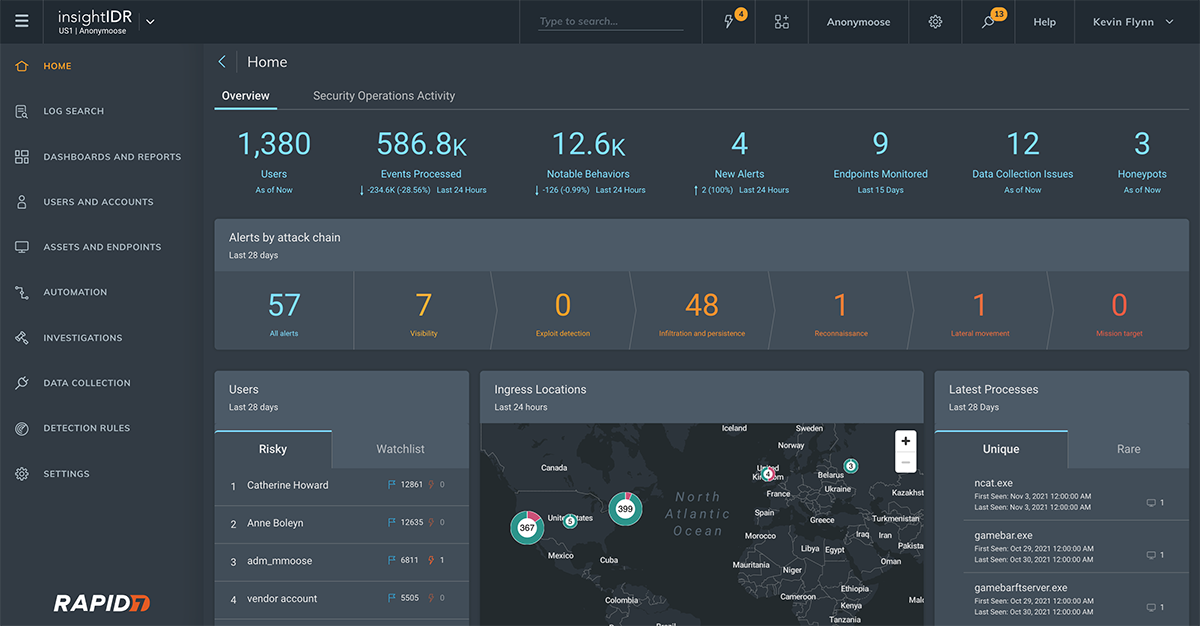
Rapid7 InsightIDR is a cloud-native SIEM and extended detection and response (XDR) solution to detect suspicious activity across IT environments. The platform collects telemetry from endpoints, authentication systems, and network infrastructure, then analyzes the data to identify potential indicators of compromise. InsightIDR combines log analysis, endpoint visibility, and behavioral analytics to support security teams during threat detection and investigation.
Hauptfunktionen von Rapid7 InsightIDR:
- Cloud-native SIEM architecture: Operates as a SaaS-based platform that collects and analyzes security data across hybrid and cloud environments.
- Unified security data analysis: Aggregates logs, endpoint telemetry, authentication activity, and network traffic into a centralized security view.
- User behavior analysis: Correlates user actions and authentication events to identify suspicious activity and potential account compromise.
- Threat detection and alerting: Uses detection rules and analytics to identify indicators of compromise and highlight suspicious activity.
- Investigation and response tools: Provides dashboards, log search capabilities, and investigation workflows to help analysts examine incidents and respond to threats.

Abschluss
Microsoft Sentinel bietet eine Cloud-native SIEM- und SOAR Lösung, die sich in diverse Datenquellen integrieren lässt und gleichzeitig die Bedrohungserkennung verbessert sowie automatisierte Reaktionen mithilfe von Playbooks unterstützt. Zu den Einschränkungen zählen hohe Kosten für die Verarbeitung großer Datenmengen und Herausforderungen bei der Integration mit Nicht-Microsoft-Systemen. Die Vorteile liegen hingegen in der Flexibilität und Skalierbarkeit. Bei der Auswahl einer Sicherheitsmanagementlösung sollten Unternehmen ihre Bedürfnisse, die Komplexität ihrer Datenumgebung und die Integrationsanforderungen berücksichtigen.
Weitere Leitfäden zu wichtigen Themen der Informationssicherheit finden Sie hier.
Gemeinsam mit unseren Content-Partnern haben wir ausführliche Leitfäden zu verschiedenen anderen Themen verfasst, die Ihnen auch bei der Erkundung der Welt vonInformationssicherheit.
SIEM-Tools
Autor: Exabeam
- [Leitfaden] SIEM-Tools: Top 5 SIEM-Plattformen, Funktionen, Anwendungsfälle und Gesamtbetriebskosten
- [Leitfaden] Top 5 der kostenlosen Open Source SIEM-Tools [Aktualisiert 2025]
- [Leitfaden] Beste SIEM-Lösungen: Top 10 SIEM-Systeme und wie man sie 2025 auswählt
Bot-Schutz
Autor: Radware
- [Leitfaden] Bot-Schutz: Angriffsbeispiele und 8 Möglichkeiten zur Verteidigung Ihres Netzwerks
- [Leitfaden] Was ist ein Botnetz? Arten, Beispiele und 7 Abwehrmaßnahmen
- [Produkt] Radware KI-gestützter Bot-Schutz | Umfassendes Bot-Management
Anwendungssicherheit
Autor: Oligo
- [Leitfaden] Was ist Application Detection and Response (ADR)? Leitfaden 2025
- [Leitfaden] Anwendungssicherheit im Jahr 2025: Bedrohungen, Lösungen und Best Practices
- [Blog] Kritische RCE-Schwachstellen in OpenSSH (CVE-2024-6387, CVE-2024-6409) – Erkennen und Abschwächen
- [Produkt] Oligo | Anwendungssicherheit und Risikoerkennung in Echtzeit
Mehr über Exabeam erfahren
Vertiefen Sie Ihr Wissen mit Webinaren, Leitfäden und Analystenberichten.
-
 Der Blog
Wie Verhaltensanalyse die Lücke in der Verweildauer von Insiderbedrohungen schließen
-
Knapp
Exabeam und Google Cloud: Sicherung der KI-Agenten und LLM-Nutzung mit Verhaltensanalyse
- Mehr anzeigen