Why Insider Threats Don’t Trigger Alerts
- Jun 17, 2026
- Heidi Willbanks
- 2 minutes to read
Table of Contents
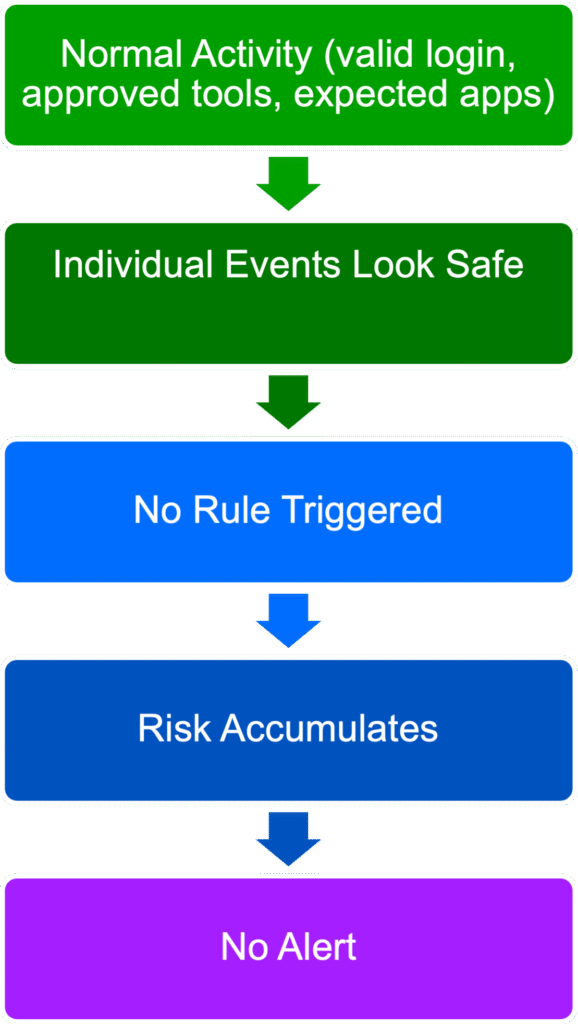
Insider threats often don’t trigger alerts because the activity relies on valid credentials, approved tools, and authorized workflows. When viewed as individual events, this behavior looks normal and stays below traditional rule thresholds. Risk accumulates across otherwise valid actions without producing a signal that meets alert thresholds.
Insider Risk No Longer Looks Like Known Threats
Most security detection models were designed to identify known bad signatures, exploits, or activity that matches predefined patterns. That assumption no longer holds for insider risk.
Today, many threats operate entirely within legitimate access. Users authenticate successfully. Applications behave as expected. Service identities, automation, and AI agents perform approved tasks. From an event-level perspective, nothing appears suspicious.
This shift changes how risk presents itself. Insider risk rarely appears as a clear violation. It emerges within normal operations, where each action appears acceptable when viewed independently.
Why Traditional Alerts Miss Insider Threats
Alert-driven detection focuses on isolated signals such as failed logins, policy violations, or known indicators. Insider threats rarely behave this way.
Risk develops through small, incremental changes in access, usage, and behavior. Each action remains within acceptable bounds, so detection logic treats the activity as trusted because access is valid.
When events are evaluated independently, the relationships between actions disappear. Short correlation windows fail to connect gradual changes into a meaningful signal. No single action stands out enough to prompt investigation.
| Detection View | Actual Risk |
|---|---|
| Login event | First unusual login for this user |
| File access | Gradual increase in sensitive data access |
| API call | Expanding automation scope |
| No violation | Behavioral drift over time |
Table 1. Event-level detection shows activity that looks normal. Behavioral context reveals the progression that signals risk.
The result is more alerts without better insight. Insider risk remains fragmented, deprioritized, and easy to overlook.
What This Reveals About Insider Risk
Insider risk is defined by how behavior changes across related actions.
Without sequence, duration, and context, detection logic can’t reliably distinguish routine activity from misuse. The most important signals blend into background noise.
This is why insider threats often surface late, after damage has already occurred. The delay isn’t caused by a lack of data. It reflects how risk is evaluated.
What Security Teams Should Reevaluate
Security leaders should reconsider how insider risk is identified by asking:
- Which activities are treated as inherently trusted because access is valid?
- Are behavior patterns evaluated in addition to individual events?
- Where does alert fatigue hide slow changes in activity?
- What signals indicate progression rather than a single violation?
These questions shift focus away from alert volume and toward how risk develops inside normal operations.
See the Full Framework
This challenge reflects one of several structural shifts reshaping insider risk.
The guide, Six Shifts in Insider Risk for the Agentic Enterprise, examines how legitimate activity, identity expansion, and automation change how risk develops and how detection models need to adapt.

Heidi Willbanks
Heidi Willbanks | Senior Product Marketing Manager, Content | Exabeam | Heidi Willbanks leads content strategy and go-to-market execution at Exabeam, focusing on product launches, cybersecurity solutions marketing, and technical alliances. She has 20+ years of marketing experience, including over a decade in information security and data privacy, and holds a Level IV certification from Pragmatic Institute. Heidi specializes in creating clear, technically accurate content for security practitioners and decision-makers.
More posts by Heidi WillbanksLearn More About Exabeam
Learn about the Exabeam platform and expand your knowledge of information security with our collection of white papers, podcasts, webinars, and more.