Features Don’t Win Budget Conversations. Operational Evidence Does.
- Aug 18, 2026
- Kevin Kirkwood
- 3 minutes to read
Table of Contents
CISOs can strengthen security budget conversations by replacing feature comparisons with measurable operational evidence. Establish the current burden, show how an investment changes security operations, and connect those improvements to financial impact. Metrics such as alert volume, analyst investigation time, manual effort, and capacity gained help CFOs evaluate security investments in terms of cost, benefit, predictability, and measurable business value.
Every CISO has been there.
You’ve built the technical case. You’ve documented why one platform delivers better analytics, stronger automation, or more effective detection than another. You know the technology is superior.
Then the conversation reaches the CFO and the discussion shifts.
In the previous blog in this series, Beyond the Budget: What CISOs Need to Understand About Their CFO Relationship, Exabeam CFO Mike Byron and I talked about what makes budget conversations successful. Coming from different roles, we naturally look at investments through different lenses. As a CISO, I focus on reducing risk. As a CFO, Mike focuses on balancing cost, benefit, and predictability.
That means my job as a CISO isn’t simply to explain what a platform does. It’s to translate technical capabilities into operational outcomes with measurable business value.
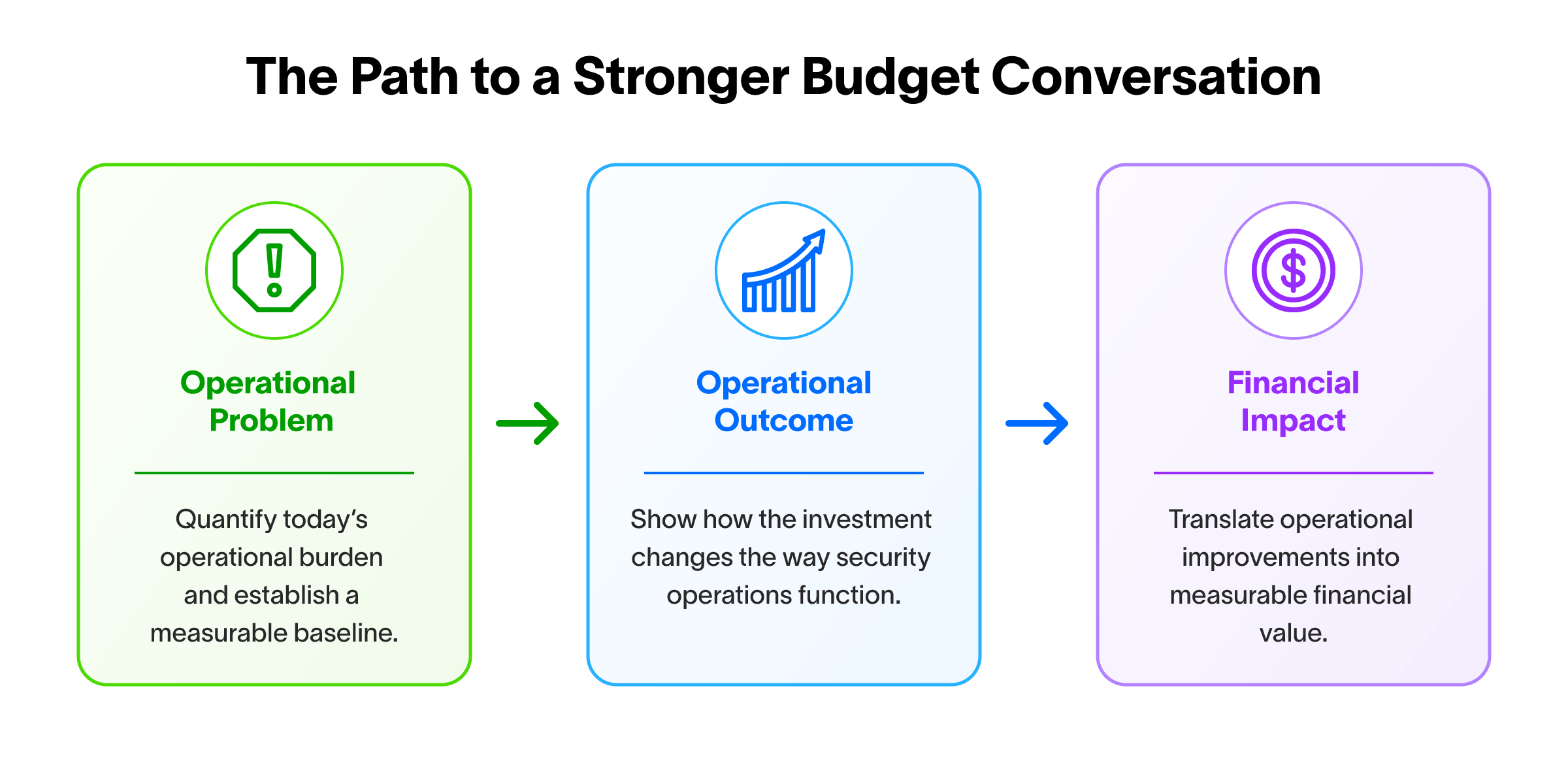
The technology still matters. But the conversation has to move from capability, to outcome, to financial impact. That’s where many budget requests begin to fall apart.
Start With the Operational Problem
Security leaders know when something isn’t working.
The team is overwhelmed with alerts. Analysts spend too much time investigating false positives. Engineers are constantly tuning rules or maintaining integrations.
Those frustrations are real. But they’re difficult for finance to evaluate because they describe symptoms rather than scale.
Operational evidence provides the missing context.
How many alerts does your team investigate every month? How much analyst time is spent separating meaningful threats from operational noise? How much manual effort is required to maintain your current platform?
Those are measurable business inputs. They establish a baseline that everyone in the room can understand.
Instead of saying, “We have too many alerts,” show exactly what that burden looks like today.
Then Show the Operational Outcome
Once you’ve established the baseline, the next step is demonstrating what changes. Not what the platform does, but what the security operation looks like after it’s deployed.
Here’s an example, using representative data from recent Exabeam customer engagements.
An organization was evaluating a replacement for its legacy SIEM after struggling with overwhelming alert volumes and significant manual investigation effort. During the evaluation period, the platform processed nearly 7.8 billion security events that initially generated more than 218,000 alerts. After automated prioritization, those alerts were reduced to just 220 investigation-ready cases, with only 13 identified as high-risk threats requiring immediate analyst attention.
Those results don’t describe features. They describe an operational outcome.
Instead of manually sorting through hundreds of thousands of alerts, analysts could focus on the small number of cases that warranted investigation.
That’s a story both the CISO and the CFO can understand.
Connect the Outcome to Financial Impact
Operational improvements become meaningful to finance when they’re connected to cost.
Recovered analyst time. Reduced operational effort. Greater consistency. The ability to scale without proportionally increasing headcount.
These are business outcomes with financial implications.
In this representative example, the reduction in manual investigation translated to more than 54,000 hours of analyst time saved.
That’s more than an efficiency statistic.
It’s evidence that analysts can spend more time reducing risk and less time processing noise.
It’s the type of operational improvement that allows a CFO to evaluate whether the investment creates measurable value over time.
The CISO and CFO are Already on the Same Page
These are the same outcomes experienced security leaders prioritize when evaluating technology.
Enterprise security teams aren’t searching for platforms with the longest feature lists. They’re looking for platforms that reduce operational effort, improve analyst effectiveness, and help teams focus on the threats that matter most.
That means reducing manual investigations, automating repetitive work, and eliminating unnecessary tuning to give security analysts confidence that the cases reaching them are worth their attention.
Those improvements make security teams more effective every day. They reduce burn out. They reduce risk. They also create the operational evidence needed to justify investment when budget conversations begin.
Download the CFO Conversation Checklist
The CFO Conversation Checklist for CISOs helps CISOs prepare for CFO-level scrutiny by framing security decisions around outcomes, full lifecycle cost, and operational impact rather than price alone. Download the guide to prepare for CFO conversations and defend security investment decisions with clearer cost and outcome framing.

Kevin Kirkwood
Chief Information Security Officer | Exabeam | Kevin Kirkwood is the Chief Information Security Officer at Exabeam, overseeing the global Security Operations Center (SOC), Application Security (AppSec), Governance Risk and Compliance (GRC), and Physical Security. With over 25 years of experience, Kevin has led security initiatives for organizations such as PepsiCo, Bank of America, and the Federal Reserve System. Kevin studied Marine Biology and Journalism at Texas A&M and after six years in the US Navy, he received a Bachelor of Science in Computer Information Systems. Kevin is passionate about giving back and volunteers as the Vice Chairman of the Planning Commission for his county and serves as President of the local water board. In his free time, Kevin enjoys continuous learning, riding motorcycles, and dreams of creating a farm for both fun and profit.
More posts by Kevin KirkwoodLearn More About Exabeam
Learn about the Exabeam platform and expand your knowledge of information security with our collection of white papers, podcasts, webinars, and more.