AI Governance Tools: 8 Key Features and 12 Tools to Know
- 21 minutes to read
Table of Contents
TL;DR: AI governance tools help organizations inventory AI systems, assess risk, enforce policies, and monitor models and agents. Best for: Exabeam for AI agent behavior monitoring, IBM watsonx.governance for AI governance combined with GRC, Credo AI for policy-driven compliance, and ModelOp for AI lifecycle governance.
What Are AI Governance Tools?
AI governance tools are centralized software platforms designed to discover, monitor, and enforce usage policies across an organization’s artificial intelligence models, autonomous agents, and embedded generative AI systems. They provide controls for areas such as model risk, regulatory compliance, data use, security, transparency, and accountability.
Key features of AI governance tools:
- AI asset and model inventory: Maintains a central record of models, applications, agents, datasets, third-party services, owners, versions, and deployment status.
- Risk classification and assessment: Classifies AI systems by factors such as autonomy, data sensitivity, use case, affected users, and potential impact.
- Policy management and enforcement: Defines AI policies and connects requirements such as reviews, testing, documentation, and approvals to operational workflows.
- AI system impact assessments: Evaluates risks related to fairness, explainability, safety, privacy, human oversight, and incorrect outputs.
- Data governance and privacy controls: Tracks AI data sources and applies requirements for consent, classification, permitted use, retention, and privacy.
- Identity and access governance: Controls who can create, modify, approve, deploy, and monitor AI systems based on roles and other access policies.
- AI agent and tool permission management: Restricts which tools, APIs, data sources, environments, and actions AI agents can access.
- Third-party AI risk management: Tracks vendor assessments, contracts, security reviews, data processing details, compliance evidence, and provider changes.
AI Governance Tools at a Glance
The table below summarizes the key differences between the AI governance tools covered in this guide. We explore each tool in more detail in the sections that follow.
| Category | Solution | Best For | Key Strengths | Things to Consider |
| AI Security and Agent Governance | Exabeam Agent Behavior Analytics | Monitoring AI agent behavior and risk | Agent baselining, MCP and tool-use detection, OWASP mapping | Baselines need a tuning period |
| AI Security and Agent Governance | Microsoft Purview | Protecting sensitive data used by AI apps and agents | Sensitivity labels, DLP, insider risk controls | Some features require added licenses |
| AI Security and Agent Governance | Airia | Shadow AI discovery and runtime agent policy | Execution-layer agent controls, MCP gateway | Fewer integrations, limited role granularity |
| AI Governance, Risk, and Compliance | IBM watsonx.governance | AI governance combined with enterprise GRC | Governance graph, shadow AI detection, regulatory content | Configuration-heavy setup, high cost for small teams |
| AI Governance, Risk, and Compliance | ServiceNow AI Control Tower | ServiceNow customers governing AI in the CMDB | AI discovery, lifecycle and risk workflows, regulatory content | Requires platform expertise, costs hard to forecast |
| AI Governance, Risk, and Compliance | Credo AI | Policy-driven governance and evidence | Agent registry, policy packs, GAIA agents | Learning curve for non-technical teams |
| AI Governance, Risk, and Compliance | OneTrust AI Governance | Extending OneTrust programs to AI | Risk tiering templates, runtime guardrails, MCP policies | Post-implementation effort, high total cost |
| AI Governance, Risk, and Compliance | Holistic AI | AI testing and regulatory control mapping | 40+ risk tests, red teaming, Guardian Agents | Integrations and runtime controls need engineering effort |
| AI Lifecycle and Model Oversight | ModelOp Enterprise AI Command Center | Self-hosted system of record for all AI | Intake, risk tiering, control mapping, AI FinOps | Long implementation, may need services |
| AI Lifecycle and Model Oversight | Monitaur | Model governance in regulated industries | Policy design, inventory, vendor governance, validation | Few public reviews, quote-based pricing |
| AI Lifecycle and Model Oversight | Fiddler AI | Monitoring and enforcing policy on agents and models | Inline PII guardrails, agent observability, evaluations | Complex for new users |
| AI Lifecycle and Model Oversight | DataRobot AI Governance | Governing models and agents across environments | Automated compliance docs, guards, red-teaming | Dense interface, cost for smaller teams |
Why Organizations Need AI Governance Tools
Managing Rapid AI Adoption
AI adoption often grows faster than existing governance processes. Different teams may deploy machine learning models, generative AI applications, embedded vendor features, and internal automation without using the same review standards.
AI governance tools create a central inventory of these systems and their:
- Owners
- Use cases
- Data sources
- Risk classifications
This helps governance teams apply consistent review requirements and identify systems that need additional controls before deployment.
Reducing Shadow AI Risks
Shadow AI occurs when employees use AI applications or deploy AI systems without formal approval or oversight. This can expose sensitive data, introduce unverified outputs, or create compliance problems when teams use external AI services without understanding how data is processed.
Governance tools help organizations identify unapproved AI use and establish approved workflows for evaluating new systems. They can also record permitted tools, usage restrictions, and required safeguards, giving employees clear rules for adopting AI without bypassing security or compliance controls.
Establishing Accountability for AI Decisions
AI systems often involve multiple teams, including engineering, security, legal, compliance, data science, and business owners. Without defined responsibilities, it can be unclear who:
- Approves a model
- Monitors its performance
- Responds when a problem occurs
AI governance tools assign ownership and approval responsibilities to individual people or teams. They also maintain records of assessments, decisions, exceptions, and remediation actions. This audit trail makes it easier to determine who made a decision, what information supported it, and whether required controls were followed.
Key Features of AI Governance Tools
AI governance tools combine inventory, risk, policy, and oversight functions in one system. The exact feature set varies, but most platforms focus on helping organizations understand which AI systems they use, what risks those systems create, and which controls apply.
1. AI Asset and Model Inventory
An AI inventory provides a central record of models, applications, agents, datasets, and third-party AI services. It typically stores details such as:
- Ownership
- Purpose
- Deployment status
- Model version
- Data sources
- Business context
A complete inventory gives governance teams visibility into where AI is used across the organization. It also supports audits, risk reviews, and lifecycle management by linking each AI asset to its assessments, controls, approvals, and incidents.
2. Risk Classification and Assessment
Risk classification features help organizations group AI systems according to factors such as:
- Use case
- Autonomy
- Data sensitivity
- Affected users
- Potential impact
Higher-risk systems can then be routed through more detailed reviews. Assessment workflows may include questionnaires, scoring models, control checks, and approval steps. These processes help teams apply consistent evaluation criteria instead of relying on informal judgment for each AI project.
Related content: Read our guide to the NIST AI RMF
3. Policy Management and Enforcement
Policy management features let organizations define rules for how AI systems may be developed and used. Policies can cover areas such as:
- Acceptable use
- Human oversight
- Data handling
- Testing requirements
- Model documentation
- Deployment approvals
Some tools connect these policies directly to workflows. For example, a system handling sensitive personal data may automatically require a privacy review before deployment. This turns policy documents into operational controls rather than leaving enforcement to manual processes.
4. AI System Impact Assessments
Impact assessments evaluate how an AI system could affect individuals, business operations, or regulatory obligations. They often examine factors such as:
- Fairness
- Explainability
- Safety
- Privacy
- Human oversight
- The consequences of incorrect outputs
Governance tools can standardize these assessments with reusable templates and evidence requirements. They can also track remediation tasks and approvals, making it easier to show how identified risks were addressed before or after deployment.
Related content: Read our article about responsible AI
5. Data Governance and Privacy Controls
AI governance tools can record which datasets an AI system uses, where that data comes from, and whether its use is permitted. This helps organizations identify issues involving:
- Personal data
- Confidential information
- Retention requirements
- Restricted data sources
Privacy controls may include consent checks, data classification, purpose limitations, and links to data protection assessments. These features are especially important for generative AI systems that may send prompts or documents to external providers.
6. Identity and Access Governance
Identity and access governance controls determine who can create, modify, approve, deploy, or monitor AI systems. Permissions can be assigned by:
- Role
- Team
- Project
- Risk level
These controls reduce the chance that unauthorized users can change models, bypass approval steps, or access sensitive AI assets. They also create records of administrative actions, which supports audits and incident investigations.
7. AI Agent and Tool Permission Management
AI agents can take actions through connected tools, APIs, databases, and business applications. Governance platforms increasingly need to control which resources an agent can access and what operations it can perform. Permission management may restrict an agent to specified:
- Tools
- Data sources
- Environments
- Action types
Organizations can also define approval requirements for sensitive actions, helping prevent agents from exceeding their intended authority.
8. Third-Party AI Risk Management
Organizations often rely on external AI models, APIs, embedded software features, and cloud services. Third-party risk management features help evaluate these providers before use and monitor them over time. Governance tools can store:
- Vendor assessments
- Contract terms
- Security reviews
- Data processing details
- Compliance evidence
They can also track changes in provider models or services that may affect existing risk assessments and require another review.
Notable AI Governance Tools
How we selected these tools: We shortlisted AI governance tools based on AI inventory and discovery, risk classification and assessment, policy enforcement, monitoring of AI systems and agents, and audit-ready compliance reporting.
AI Security and Agent Governance Platforms
1. Exabeam Agent Behavior Analytics

Best for: Monitoring AI agent behavior and risk across enterprise AI platforms
Strengths: Agent baselining, MCP and tool-use detection, OWASP coverage mapping
Things to consider: Behavioral baselines need a tuning period after deployment
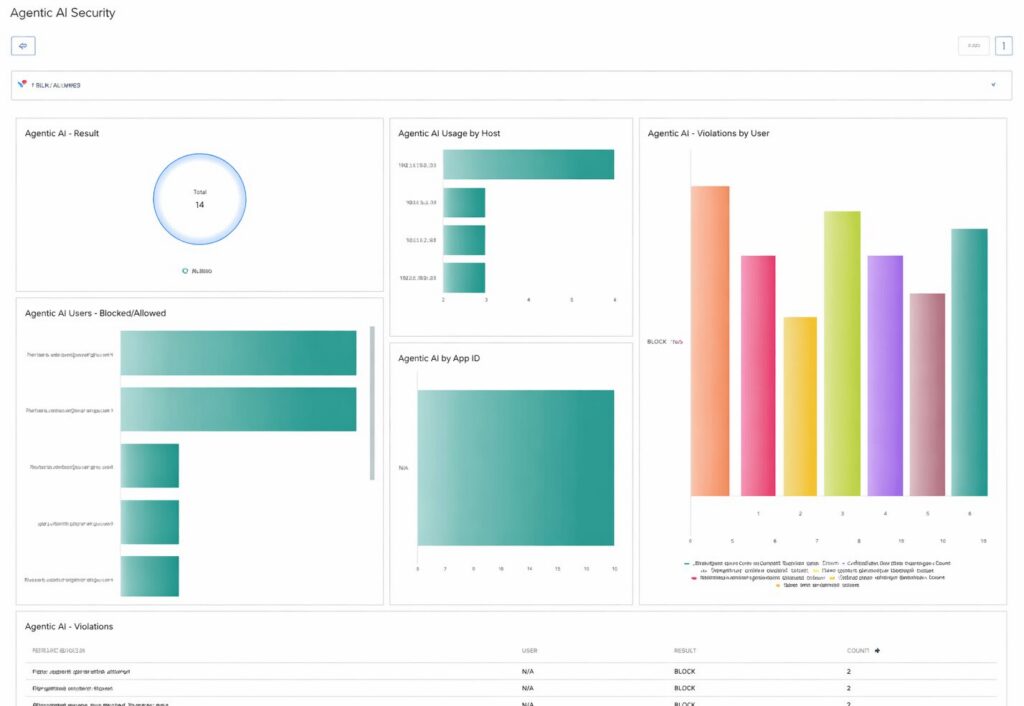
Exabeam Agent Behavior Analytics (ABA) extends user and entity behavior analytics (UEBA) to AI agents and autonomous workflows. The platform applies behavioral intelligence to establish baseline normal activity and surface subtle anomalies across agent operations, flagging misuse, drift, abnormal tool use, risky access, and activity that falls outside defined roles. ABA analyzes activity from Claude, ChatGPT, Google Gemini, Microsoft Copilot, GitHub Copilot, and custom agents. To support compliance with AI governance frameworks, Exabeam contributes to open-source initiatives like Praxen, which provides pre-deployment Agent Behavior Verification (ABV) to align agent boundaries with organizational policies, and Observra, which provides standardized runtime telemetry to ensure AI systems operate within defined guardrails. ABA can run on top of an existing SIEM through New-Scale Analytics or as part of New-Scale Fusion.
Key features include:
- Agent behavior baselining: Establishes expected behavior for AI agents and autonomous workflows, then detects deviations such as misuse, drift, risky access, and actions outside an agent’s defined role.
- Tool and MCP activity detection: Identifies tool usage and Model Context Protocol (MCP) activity, and detects autonomous installation and execution by agents.
- Open agent telemetry: Observra standardizes agent-native telemetry using context based on a Common Information Model (CIM), while Exabeam Agent Sensor collects and normalizes activity from custom agents, models, and runtime environments.
- AI security posture measurement: Outcomes Navigator maps ABA coverage to the OWASP Agentic Top 10, highlights gaps in data and detections, and uses the Exabeam Nova AI advisor capability to recommend data sources and detection content.
- Automated investigation timelines: Machine-built timelines correlate agent actions with related user, entity, and application activity. Nova AI summarizes threats, explains behavioral context, and recommends next steps while analysts stay in control.
- Customizable detection content: ABA detections are available in Threat Detection Management for review, cloning, and tuning. Nova AI rule creator generates behavioral models and correlation rules from natural language and converts Sigma and YARA rules.
- Business risk reporting: Prebuilt dashboards in Outcomes Navigator translate technical detail on AI security use cases into business risk and compliance insights.
- Open-source verification and telemetry: Praxen enables pre-deployment verification by comparing declared behavioral policies with actual implementation evidence. Meanwhile, Observra provides a standardized open-source telemetry library that captures and normalizes agent activity across major frameworks to feed directly into security monitoring.
Limitations (as reported by users on G2):
- Initial tuning period: Because detections rely on behavioral baselines, some users note a period of alert noise before the system learns the environment.
- Log onboarding effort: Initial setup and integration can take time, especially when onboarding a wide variety of log sources.
- Investigation navigation: Some workflows require moving across multiple screens to collect all the information needed for an investigation.
2. Microsoft Purview

Best for: Protecting sensitive data used by Copilot and other AI apps and agents
Strengths: Sensitivity labels, DLP, and insider risk controls for AI interactions
Things to consider: Auto-labeling and advanced features may require added licenses
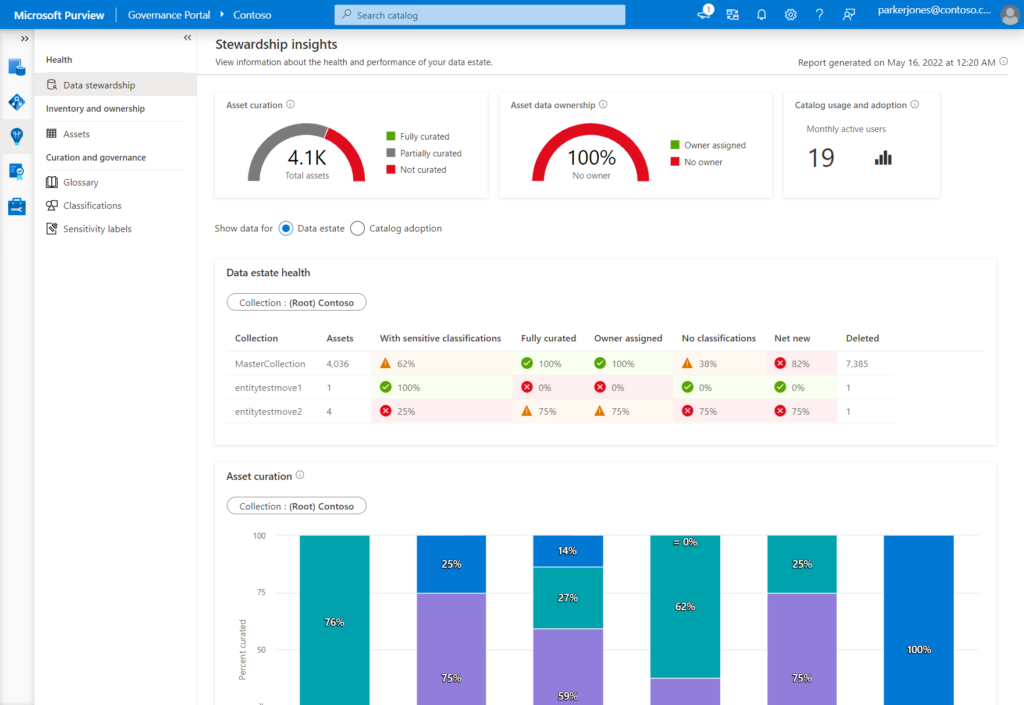
Microsoft Purview is a family of data security, data governance, and compliance solutions covering on-premises, multicloud, and SaaS environments. For AI governance, Purview discovers and investigates data risks across AI apps and agents, and applies controls to limit oversharing and leakage of sensitive data.
Purview combines data security posture management (DSPM), information protection, data loss prevention (DLP), insider risk management, and data security investigations. It works natively with Microsoft 365 Copilot, Microsoft Defender, Microsoft Entra, Microsoft Sentinel, and Microsoft Edge for Business.
Key features include:
- Data security posture management: Discovers sensitive data across the data estate, identifies coverage gaps, evaluates how well current policies protect data, and provides prioritized policy recommendations with analytics reports and trends.
- AI data risk discovery: Surfaces data risks associated with AI apps and agents, including oversharing of sensitive data through Microsoft 365 Copilot and other generative AI applications.
- Classification and sensitivity labeling: Uses a common set of classifiers, exact data match, and sensitivity labels to identify and protect sensitive data in Microsoft 365 apps and services.
- Data loss prevention for AI: Creates and enforces DLP policies across cloud apps, email, devices, browsers, networks, Microsoft Fabric, and AI from the Purview portal, and prevents sensitive data from being shared with AI apps and agents.
- Insider risk management: Analyzes potential insider risks, controls and blocks suspicious AI interactions with custom policies, and offers policy templates that do not require scripting or endpoint agents.
- Data security investigations: Searches Microsoft 365 data, including Copilot prompts and responses, emails, and Teams messages, and uses AI-powered content analysis and a data risk graph to scope incidents.
- Compliance and regulatory reporting: Supports AI regulation and reporting requirements for audits, retention, transparency, and accountability, and governs data and AI across the lifecycle.
Limitations (as reported by users on G2):
- Licensing for automation: Auto-labeling and some automated detection features require additional licenses beyond baseline labeling.
- Setup planning: Initial rollout requires significant internal work to define label naming, policies, and their impact before deploying to users.
- Non-Microsoft environments: Adaptability and integration can be limited for organizations and tools outside the Microsoft ecosystem.
- Documentation gaps: Some users report that training material and documentation are lacking.
- Policy propagation delays: Policy updates are not instant and can take time to apply.
- Label and DLP interaction: Interactions between different label types and DLP policies can cause confusion.
Source: Microsoft
3. Airia

Best for: Discovering shadow AI and enforcing runtime policy on AI agents
Strengths: Execution-layer agent controls, MCP gateway, framework-mapped reports
Things to consider: Limited built-in integrations and granular role permissions
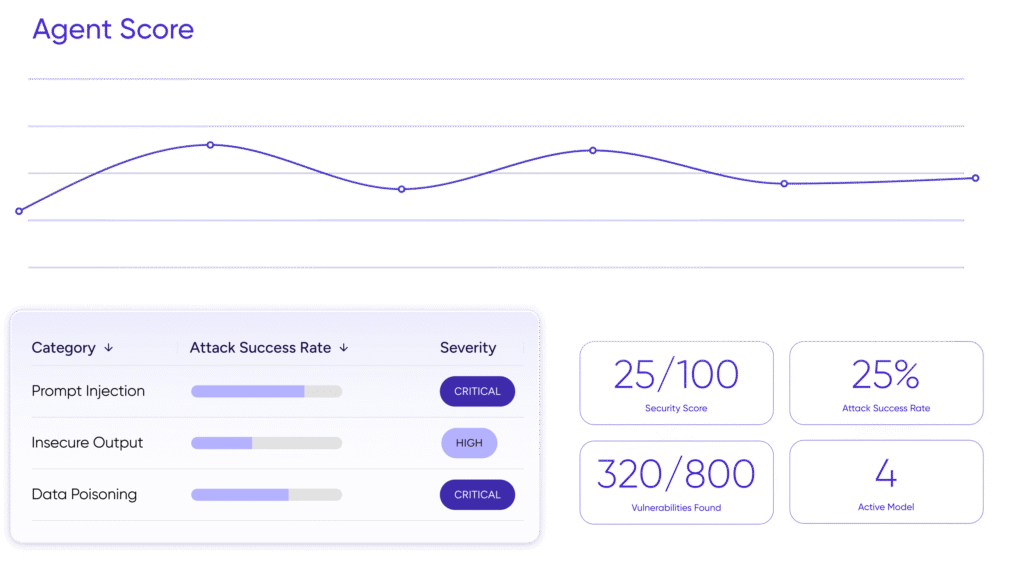
Airia is an enterprise AI platform that combines AI discovery, runtime security, governance, and agent orchestration. It connects to identity, network, SaaS, and browser signals to identify approved and unapproved AI usage, then maps each agent to its owners, permissions, and data exposure.
Airia routes requests through a governed gateway of approved models and tools and applies guardrails that inspect agent actions at runtime. The same controls apply to agents built in Airia, AI embedded in licensed software, and personal AI subscriptions that employees connect to corporate systems.
Key features include:
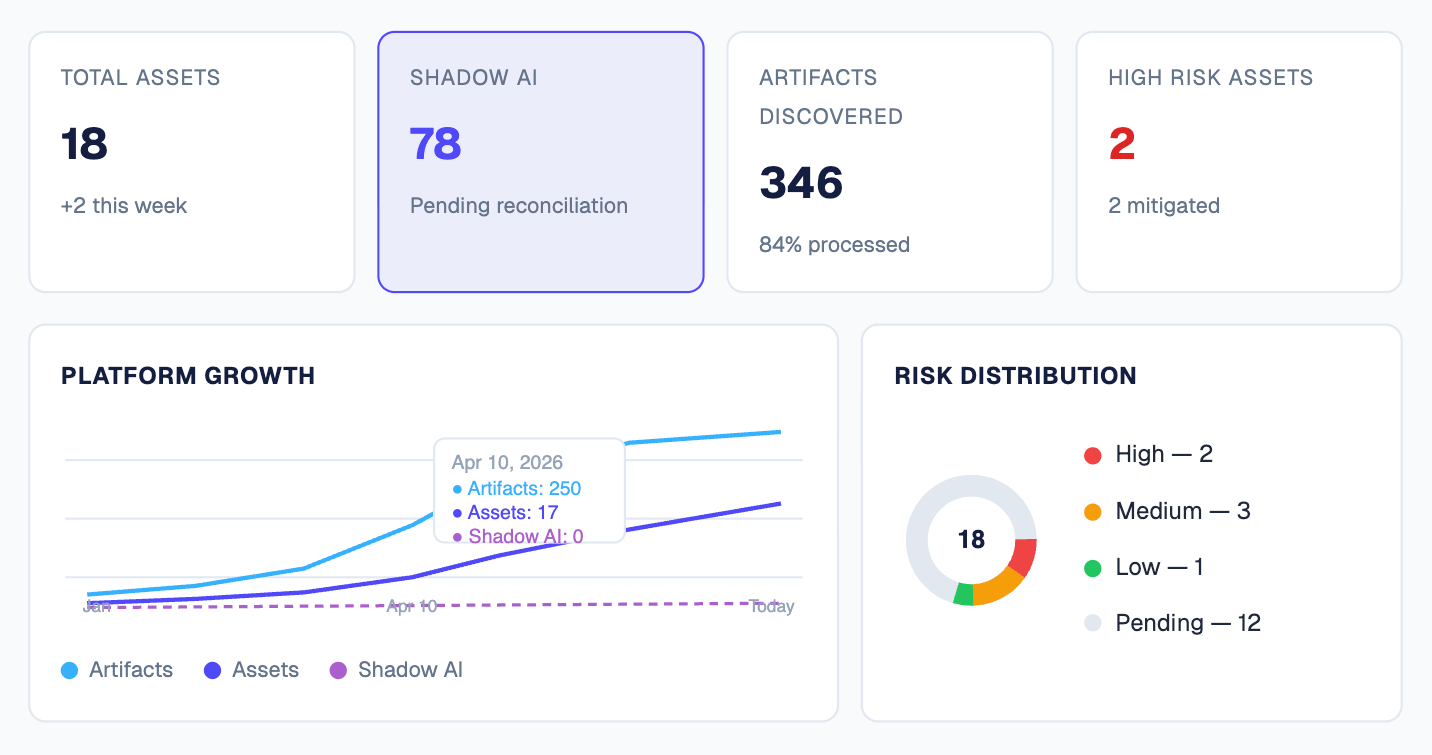
- Shadow AI discovery: Finds AI tools, models, agents, and MCP servers running across the organization, including unapproved ones, and adds them to a central inventory.
- Risk classification and posture: Assigns risk classifications to discovered AI assets and reports on AI security posture, including exposed users and critical exposures.
- Agent constraints: Stops unauthorized agent actions at the execution layer, before a tool call fires, an email sends, or a database query runs.
- MCP gateway and guardrails: Routes model and tool requests through a governed gateway, applies AI guardrails that inspect actions at runtime, and includes red teaming within the security layer.
- Compliance documentation: Generates continuous governance documentation mapped to the EU AI Act, NIST AI RMF, SR 11-7, HIPAA, ISO 42001, and SOC 2, with human approvals and audit evidence built in.
- Agent orchestration and model routing: Provides an agent builder, prototyping studio, model routing, model lifecycle management, and cost optimization, with policy controls configured before agents reach production.
Limitations (as reported by users on G2):
- Learning curve for advanced workflows: Basic workflows are quick to set up, but multi-agent logic, fallback routing, and advanced configuration take time to learn.
- Integration and permission gaps: The library of built-in integrations is smaller than some competitors, and role-based access controls are less granular.
- Troubleshooting visibility: Users report unclear error messages and logs when integrations or workflows fail.
- Documentation coverage: Documentation does not cover all features, which can require contacting support.
- Processing latency: Responses can be slower than the native experience in platforms such as ChatGPT or Claude.
- Reporting depth: Reporting on agent usage and spend is minimal and may require exporting data.
Source: Airia
AI Governance, Risk, and Compliance Platforms
4. IBM watsonx.governance

Best for: Combining AI governance with enterprise GRC across cloud and on-prem
Strengths: Governance graph, shadow AI detection, regulatory content library
Things to consider: Setup is configuration-heavy; cost is high for small teams
IBM watsonx.governance is an AI governance platform that combines AI-native governance capabilities with enterprise governance, risk, and compliance (GRC). It provides visibility into the AI ecosystem, automates policy enforcement and compliance evidence capture, and tracks outcomes and risk signals for AI use cases.
The platform maps relationships between AI systems, risks, controls, and policies, detects unmanaged AI usage, and draws on a library of AI regulatory and risk content. It is available for cloud and on-premises environments, can be purchased on AWS, and offers a 14-day free trial.
Key features include:
- Governance graph: Visualizes relationships between AI systems, risks, controls, and policies as a living map of the AI ecosystem.
- Shadow AI detection: Discovers unmanaged and unapproved AI usage across the organization.
- AI-native governance workflows: Uses embedded AI assistants to onboard AI use cases, capture governance information, and automate governance workflows inside enterprise tools and conversational interfaces.
- Policy enforcement and obligation mapping: Creates, manages, and enforces governance policies across teams, models, and AI workflows, and maps regulatory obligations to controls with continuous evidence capture.
- Regulatory content library: Provides a catalog of AI regulatory and risk frameworks for aligning AI initiatives with regulations and internal standards.
- Continuous monitoring and risk management: Monitors AI systems for compliance, operational issues, and emerging risks, and supports identification, assessment, and mitigation of risk throughout the lifecycle.
- Traceability and value tracking: Tracks governance activities, decisions, and model changes with end-to-end traceability for reporting and accountability.
Limitations (as reported by users on G2):
- Configuration-heavy setup: Onboarding requires setting up workflows, roles, and lifecycle stages, and some implementations take several weeks.
- Cost for smaller teams: Pricing is high relative to alternatives for small businesses, and costs increase when scaling into production.
- Non-IBM integrations: Connecting models outside the IBM ecosystem, such as AWS SageMaker, can require manual configuration with limited documentation.
- Interface complexity: The interface is feature-dense and can load slowly when the inventory contains many use cases.
- Evaluation history: Evaluations run on the same day can overwrite earlier results in AI Factsheets.

Source: IBM
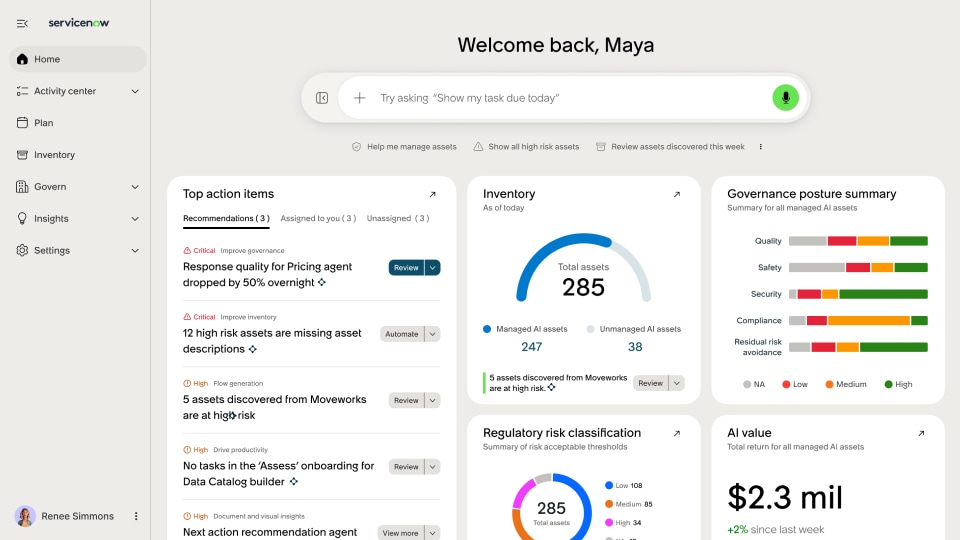
5. ServiceNow AI Control Tower

Best for: ServiceNow customers governing AI assets within CMDB and IT workflows
Strengths: AI discovery, lifecycle and risk workflows, EU AI Act and NIST content
Things to consider: Requires ServiceNow platform expertise; usage costs hard to forecast
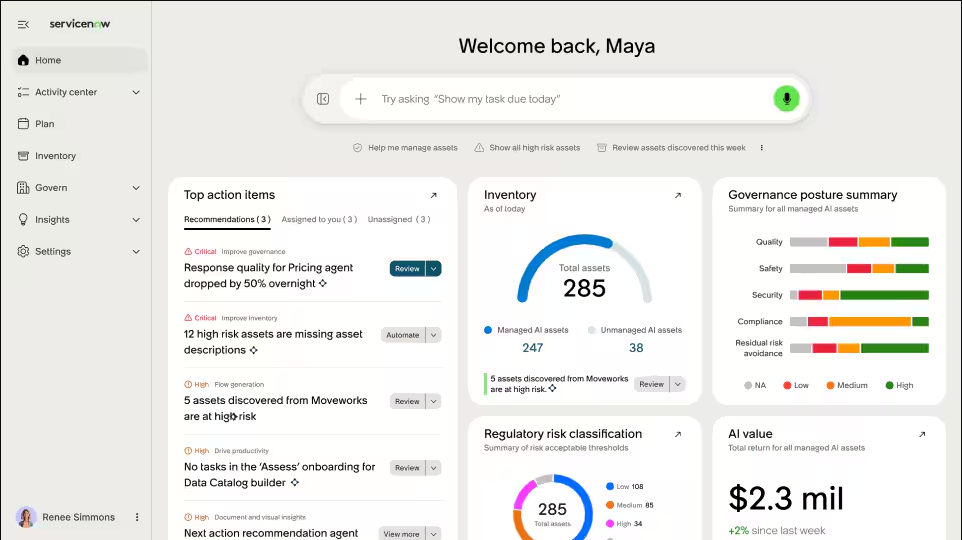
ServiceNow AI Control Tower is a central hub for discovering, securing, governing, observing, and measuring AI across the enterprise. It inventories AI agents, models, copilots, MCP servers, and datasets from first and third parties, and records each AI asset as a configuration item in the ServiceNow CMDB with lineage, ownership, and relationships.
AI Control Tower runs on the ServiceNow AI Platform and connects AI assets to business services and existing workflows. The package includes a workspace, an AI discovery and inventory data model, asset lifecycle management, risk and compliance management, AI case management, and content for the NIST AI RMF and EU AI Act.
Key features include:
- AI discovery and inventory: Automatically inventories AI agents, models, and MCP servers from first and third parties, including shadow AI, in a unified inventory tied to the CMDB.
- AI security controls: Tracks AI identity, access, and exposure, monitors security posture metrics, enforces least-privilege access, and blocks prompt injections.
- Lifecycle and risk governance: Manages AI strategy, asset lifecycle, and risk, and enforces integrated controls through automated, auditable, and traceable compliance gates.
- Regulatory content packs: Provides out-of-the-box governance workflows and content for the EU AI Act, NIST AI RMF, and state regulations such as the California AI Transparency Act.
- AI performance observability: Monitors and evaluates AI agent performance through metrics and log traces.
- Business service mapping: Maps AI assets and their relationships to business services.
- Value measurement: Tracks adoption rates, realized value, and ROI for each AI asset in the inventory.
Limitations (as reported by users on G2):
- Platform expertise required: Setup and configuration are not trivial and require staff who understand the ServiceNow platform to build guardrails and get consistent results.
- Dependence on data quality: Results depend on a well-maintained CMDB, knowledge base, and workflow data, and organizations with incomplete data may need cleanup first.
- Cost predictability: Consumption-based pricing and changing licensing tiers make usage and cost difficult to forecast.
- Ecosystem fit: Extending capabilities to non-ServiceNow legacy or third-party systems can require custom integration work.
- Decision transparency: Users want more native visibility into why AI agents made specific decisions, especially in regulated environments.
Source: ServiceNow
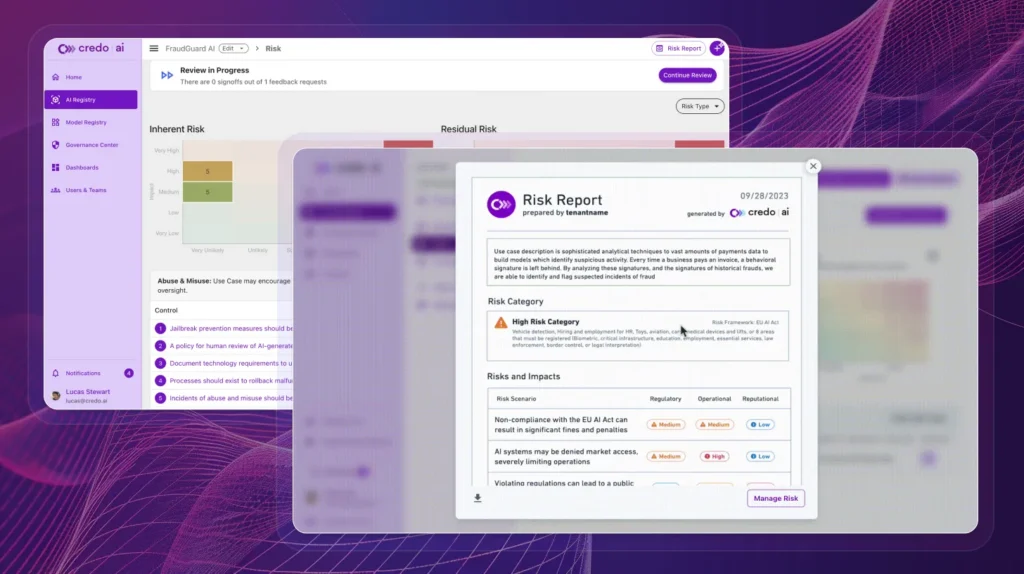
6. Credo AI

Best for: Policy-driven AI governance with regulatory policy packs and evidence
Strengths: Agent registry, policy packs, knowledge graph, GAIA governance agents
Things to consider: Steep learning curve for non-technical risk and compliance teams
Credo AI is an AI governance platform for discovering, assessing, governing, monitoring, and reporting on AI agents, models, and applications. It is built as a set of modules, AI registry and discovery, risk intelligence, a compliance and policy engine, and production governance, that can be adopted separately or together.
A proprietary governance knowledge graph links regulations, business context, and AI system configurations to determine which controls apply to each system. Integrations cover cloud and data platforms, agent frameworks such as LangChain and CrewAI, GRC tools such as ServiceNow and Archer, and development tools such as GitHub and Jira.
Key features include:
- AI registry and discovery: Maintains a centralized inventory of agents, models, applications, and shadow AI, with agent cards that record purpose, tools, data sources, and guardrails, plus platform and MCP server governance.
- Dependency mapping: Builds dependency graphs across agents, sub-agents, models, tools, and data.
- Risk intelligence: Assesses AI-specific risks with an agentic risk library and mapped controls, policy inheritance, aggregate risk scoring, automated red-teaming, and drift detection.
- Compliance and policy engine: Provides pre-built policy packs for the EU AI Act, NIST AI RMF, ISO 42001, and SOC 2, governance workflows with approval gates, and automated evidence generation and audit trails.
- Production governance: Ingests agent traces for continuous evaluation, detects policy violations and drift, and escalates high-risk actions to human reviewers.
- GAIA governance assistant: AI agents retrieve evidence, assess risk, generate governance plans, respond to incidents, and apply remediation, with human oversight for critical decisions.
Limitations (as reported by users on G2):
- Learning curve: The number of workflows, risk categories, controls, and policies can overwhelm new users and non-technical risk teams.
- Configuration effort: Configuring custom policy packs, workflows, integrations, and permissions, and mapping them to internal hierarchies, takes time and training.
- Niche integrations: Organizations using niche data science tools or legacy infrastructure may need custom API work for full automation.
- Cost for smaller programs: Pricing can be high for small businesses or early-stage AI programs.
- Agentic guardrail coverage: Automated guardrails for dynamic agentic workflows sometimes lag behind emerging LLM vulnerabilities.
Source: Credo AI
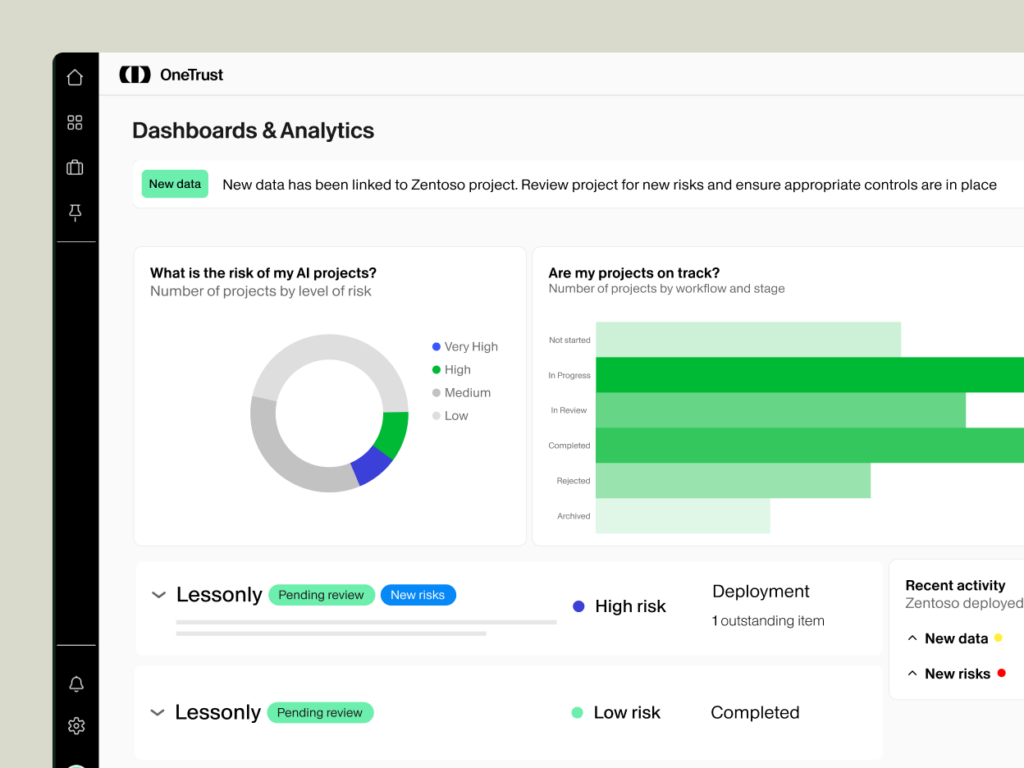
7. OneTrust AI Governance

Best for: Privacy and risk teams extending OneTrust programs to AI systems
Strengths: Risk tiering templates, runtime guardrails, MCP and agent permissions
Things to consider: Post-implementation configuration effort and high total cost
OneTrust AI Governance translates AI policies into controls across homegrown and third-party AI. It discovers AI systems, models, agents, datasets, vendors, and use cases, standardizes risk assessment against the EU AI Act, NIST AI RMF, and ISO 42001, and moves AI projects through intake, approval, attestation, and signoff workflows.
Runtime capabilities connect to Amazon Bedrock, Microsoft Foundry, Databricks, and Gemini Enterprise Agent Platform to surface evaluation metrics, detect PII in prompts and responses, and flag policy violations. Policies, assessments, agent policies, and compliance evidence are managed together in the AI Program Center.
Key features include:
- AI discovery and inventory: Continuously discovers AI systems, models, agents, datasets, vendors, and projects, assigns ownership and lifecycle status, and maps dependencies across the AI estate.
- Risk tiering and assessment: Applies EU AI Act, NIST AI RMF, and ISO 42001 templates, automates risk tiering by use case, system, deployment context, or data sensitivity, and revalidates risk after material changes.
- Governance workflows: Configures intake, approval, attestation, and signoff workflows, routes reviews based on risk, and tracks exceptions and required controls.
- Runtime monitoring: Surfaces evaluation, usage, token consumption, quality, safety, and guardrail signals from supported AI platforms, and analyzes interaction logs to detect PII.
- Policy manager and guardrail enforcement: Defines acceptable use and required controls, then filters prompts and outputs and blocks, allows, redacts, escalates, or routes actions by policy.
- AI Guard SDK: A Python SDK identifies sensitive data in prompts and responses in real time and blocks or redacts it before content reaches the model.
- Agent and MCP governance: Registers agents with a defined purpose, enforces permissions and allowed actions, applies MCP policies with audit logs, and oversees agent activity through Guardian Agents.
Limitations (as reported by users on Gartner Peer Insights):
- Usability: Users describe the platform as not very user friendly, with an end-user experience that is not always smooth.
- Post-implementation work: Clients report a significant amount of configuration work after implementation that they must complete themselves.
- Setup demands: Initial setup of the AI governance program can be demanding.
- Total cost of ownership: Reviewers cite high total cost of ownership and limited guidance.
Source: OneTrust
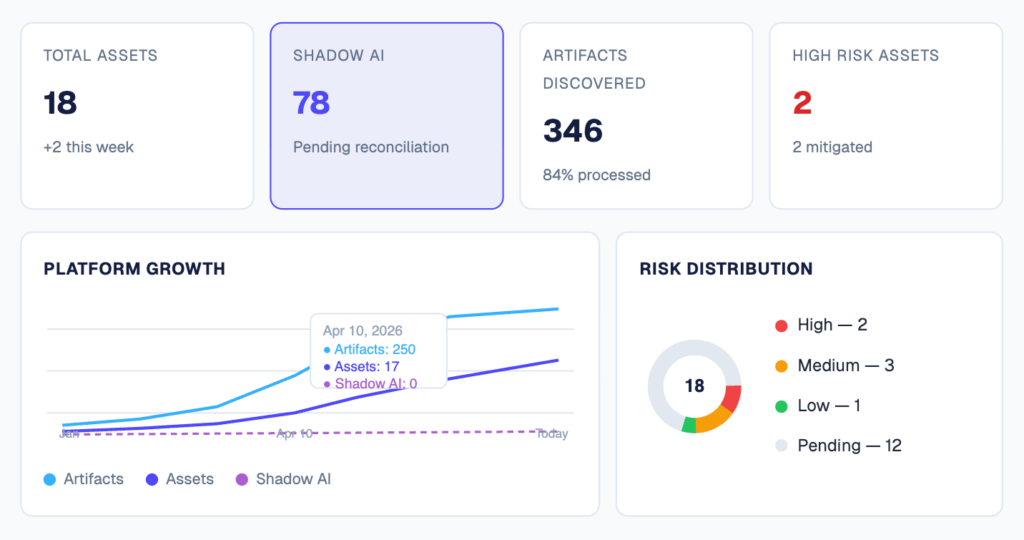
8. Holistic AI

Best for: Testing AI for bias and security and mapping controls to regulations
Strengths: 40+ risk tests, red teaming, Guardian Agents for runtime oversight
Things to consider: Integrations and runtime controls require engineering effort
Holistic AI is an AI governance platform organized into three layers: identify, protect, and enforce. It connects to cloud, code, and SaaS environments through more than 20 integrations, including AWS, Azure, GitHub, and Databricks, to discover models, agents, and AI applications and maintain a continuously synced inventory.
The platform tests models, LLMs, and agents for security, safety, and bias before launch and in production, then maps controls to the EU AI Act, NIST AI RMF, and ISO/IEC 42001. Guardian Agents add a supervisory layer that evaluates agent actions against policy and can block, redirect, or escalate them.
Key features include:
- AI discovery and inventory: Discovers AI systems across AWS, Azure, GitHub, and Databricks, records owners, risk levels, and business purpose, and maps dependencies and lineage automatically.
- Red teaming: Tests LLMs and agents for prompt injection and jailbreak vulnerabilities.
- Risk testing library: Runs more than 40 tests covering bias, hallucination, privacy, and robustness, with evidence linked to governance frameworks.
- Production monitoring: Monitors models for drift and performance after deployment.
- Policy controls and deployment gates: Maps controls to the EU AI Act, NIST AI RMF, and ISO/IEC 42001, and applies approvals, deployment gates, and human oversight with automatically updated audit trails.
- Guardian Agents: Sentinel Agents evaluate each agent tool call, data access, and hand-off against policy, while Operative Agents block or pause non-compliant actions, redirect agents to approved tools, and escalate to humans.
Limitations (as reported by users on Gartner Peer Insights):
- Complex initial setup: Users report a complex initial setup and a learning curve.
- Integration and deployment effort: Some integrations and deployment processes are complex.
- Engineering lift for runtime features: Integrating runtime controls and configuring shadow AI discovery requires effort from engineering and risk teams.
- Customization: Customization options are limited in some areas.
Source: Holistic AI
AI Lifecycle and Model Oversight Platforms
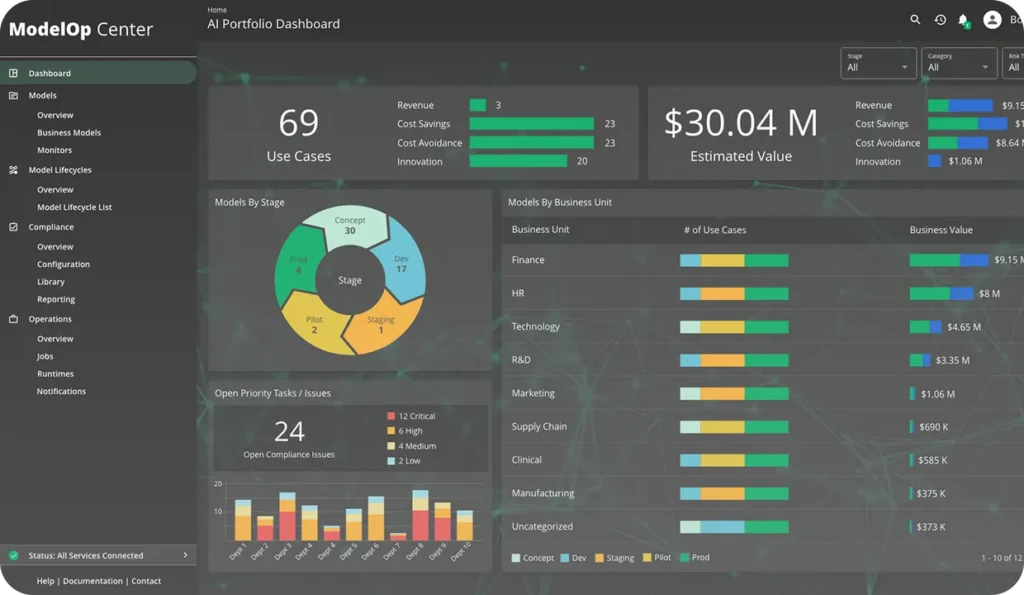
9. ModelOp Enterprise AI Command Center

Best for: Enterprises needing a self-hosted system of record for all AI assets
Strengths: Use-case intake, risk tiering, control mapping, AI FinOps monitoring
Things to consider: Implementation can take long and may need professional services
ModelOp’s Enterprise AI Command Center is a system of record for ML, generative AI, agentic, and vendor AI. It combines an AI inventory, automated lifecycle workflows, policy enforcement, and operational monitoring, and sits above existing MLOps, GRC, ITSM, data, and security tools rather than replacing them.
The platform installs on premises, in a private cloud, or in hybrid environments and references data in place without copying it. Its AI Delivery Engine (MADE) provides interoperability across more than 50 technologies, and licensing includes unlimited seats for stakeholders.
Key features include:
- AI system of record: Maintains a searchable registry of ML models, generative AI, agents, vendor tools, and AI embedded in SaaS, synced from AI development tools and extended through MCP and A2A import.
- Enterprise AI discovery: Continuously finds unregistered AI, including custom GPTs, agents, and MCP-connected tools, and captures code, prompts, agent cards, configurations, dependencies, and data usage.
- Intake and risk tiering: Standardizes use-case intake, automatically classifies risk, and routes approvals across security, privacy, data, IT, architecture, legal, risk, and compliance teams.
- Control mapping and enforcement: Maps controls to the EU AI Act, NIST AI RMF, OCC SR 11-7, and ISO 42001 based on risk tier, geography, and model type, and blocks non-compliant actions.
- Runtime policy at the gateway: Integrates with AI and API gateways to enforce policies and guardrails on live AI traffic.
- Audit evidence: Captures model cards, validation summaries, and evidence across the AI lifecycle.
- Monitoring and AI FinOps: Monitors bias, drift, performance, data stability, and prompt vulnerabilities, and tracks token usage, cost, throughput, and tool invocations by team, business unit, or use case.
Limitations (as reported by users on Gartner Peer Insights):
- Implementation timeline: Integrating with existing tooling took longer than anticipated, and onboarding new business units also takes time.
- Technical skills required: Deployment can involve significant coding and technical skills during implementation.
- Professional services: Users report that implementation requires professional services.
Source: ModelOp
10. Monitaur

Best for: Model governance in insurance and other regulated industries
Strengths: Policy design, model inventory, vendor governance, validation testing
Things to consider: Few public user reviews; pricing is available only by quote
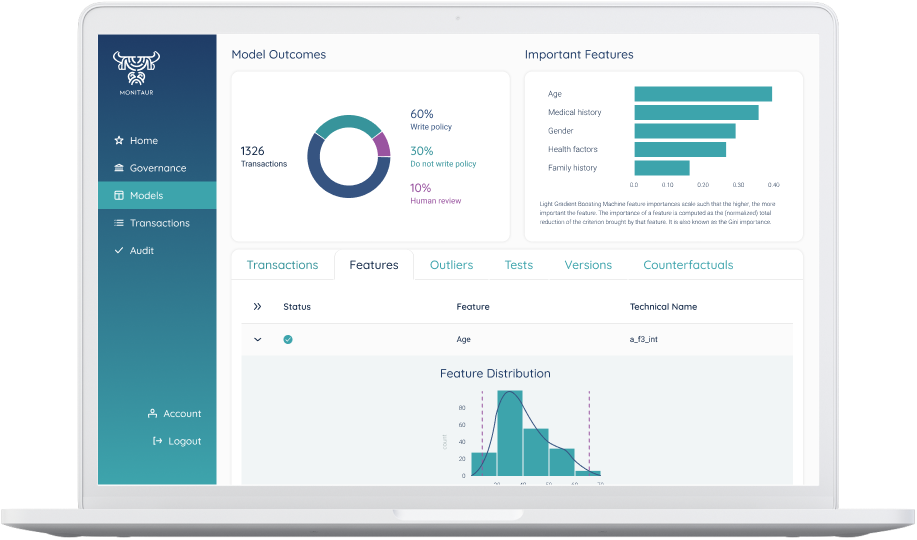
Monitaur is an AI governance platform that covers the model lifecycle for all model types. It is organized into three areas: Define, for policy, program design, risk assessment, and education; Manage, for inventory, controls, collaboration, and vendor governance; and Automate, for drift and bias testing, stress testing, transaction search, and integrations.
The platform supports enterprise-wide AI standards and controls, including unified policies across underwriting, claims, and risk models. Monitaur offers solutions for AI risk and compliance, AI governance strategy, model performance, and regulated industries, with a dedicated offering for insurance.
Key features include:
- Policy and program design: Establishes enterprise AI governance policies, program structure, and risk assessment methods, with education resources for stakeholders.
- Model inventory and controls: Maintains an inventory of AI systems and applies standardized controls and collaboration workflows across teams.
- Vendor governance: Manages internal and third-party AI risks in one system, including governance of vendor-provided AI projects.
- Drift and bias monitoring: Continuously monitors model performance, drift, and bias across AI systems.
- Automated validation: Validates models at scale with consistent protocols, stress testing, and transaction search, and produces transparent reporting for internal teams and external auditors.
- Integrations and enterprise infrastructure: Connects AI governance to existing systems and runs on enterprise-grade security and infrastructure.
Limitations (based on publicly available sources):
- Limited public user feedback: Few independent user reviews are published on major review platforms, which makes peer comparison harder.
- Pricing transparency: Pricing is custom and provided on request based on modules and deployment scale.
- Navigation: Some evaluations describe the interface as confusing to navigate.
- Support model: Buyers are advised to confirm the level of customer support during evaluation.
- Industry orientation: Much of the packaged content and solutions target insurance and financial services, which may require more adaptation for other industries.
Source: Monitaur
11. Fiddler AI

Best for: Monitoring and enforcing policy on AI agents and predictive models
Strengths: Inline PII guardrails, agent observability, in-environment evaluations
Things to consider: Complex for new users; pricing can be high for small projects
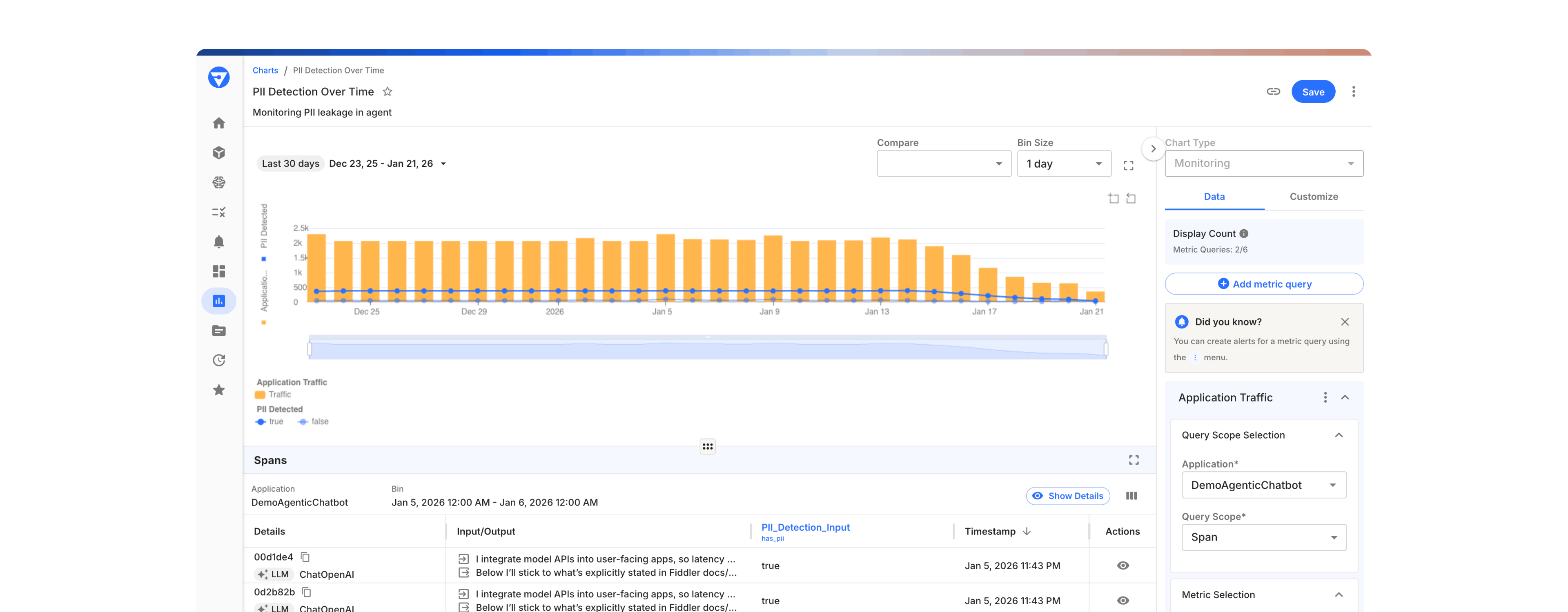
Fiddler AI is an AI control plane for monitoring, evaluating, and enforcing policy on first-party, third-party, and coding agents, as well as predictive models. It covers both the creation layer, where coding agents write code, and the production layer, where agents run in business workflows.
Evaluations and guardrails run on Fiddler Centor Models inside the customer’s environment without external LLM API calls. Fiddler works across Azure OpenAI, Amazon Bedrock, LangGraph, and more than 100 other providers, and deploys as SaaS, in a VPC, on premises, or in AWS GovCloud.
Key features include:
- Agentic observability: Shows the performance of all agents in a single view, including every action, token, and dollar by user and team.
- Continuous evaluations: Runs in-environment evaluations from testing through production, with more than 100 predefined metrics and support for custom metrics and evaluators.
- Inline policy enforcement: Detects and redacts PII, PHI, and secrets in the request and response path, before a prompt reaches the model and before a response reaches the developer.
- Safety guardrails: Applies guardrails for hallucinations, toxicity, PII and PHI, prompt injection, and jailbreak attempts.
- Auditable governance: Records every enforcement decision with who triggered it and what happened, as evidence for GRC standards and AI regulations.
- ML observability: Monitors predictive models alongside agentic applications.
- Deployment and pricing options: Offers Free, usage-based Developer ($0.002 per trace), and Enterprise plans, with SaaS, VPC, on-premises, and AWS GovCloud deployment.
Limitations (as reported by users on G2):
- Learning curve: Users new to AI monitoring find the platform difficult to grasp, especially its advanced features.
- Pricing for small projects: Pricing can feel high for individual users or small projects.
- Dashboard customization: Dashboards and reports could offer more customization, and dashboard creation could be more intuitive.
- Onboarding guidance: Users would like more guided onboarding and tutorials.

Source: Fiddler AI
12. DataRobot AI Governance

DataRobot provides a high performance machine learning automation software platform and an innovative practical data science education program that work together to provide the fastest path to data science success for organizations of all sizes. (PRNewsFoto/DataRobot)
Best for: Governing models, LLMs, and agents across cloud and air-gapped sites
Strengths: Auto compliance docs, guard library, pre-deployment red-teaming
Things to consider: Dense interface and licensing costs for smaller teams
DataRobot AI Governance is part of the DataRobot platform for building, operating, and governing AI. It provides end-to-end lineage, automated compliance documentation, and policy controls for models, LLMs, agents, tools, apps, and vector databases across cloud, private cloud, hybrid, on-premises, and edge environments.
Policies are defined once and propagated across agents built by different teams. Teams can work through the DataRobot UI or code-first, and governance combines infrastructure, IT, and agentic controls in a single system alongside real-time moderation and pre-deployment testing.
Key features include:
- Central AI registry: Manages models, LLMs, agents, tools, apps, and vector databases from a single hub, with policies propagated across teams and environments.
- Automated compliance documentation: Generates documentation structured for the EU AI Act, NYC Law No. 144, Colorado SB21-169, California AB-2013 and SB-1047, EEOC guidance, NIST AI RMF, and SR 11-7.
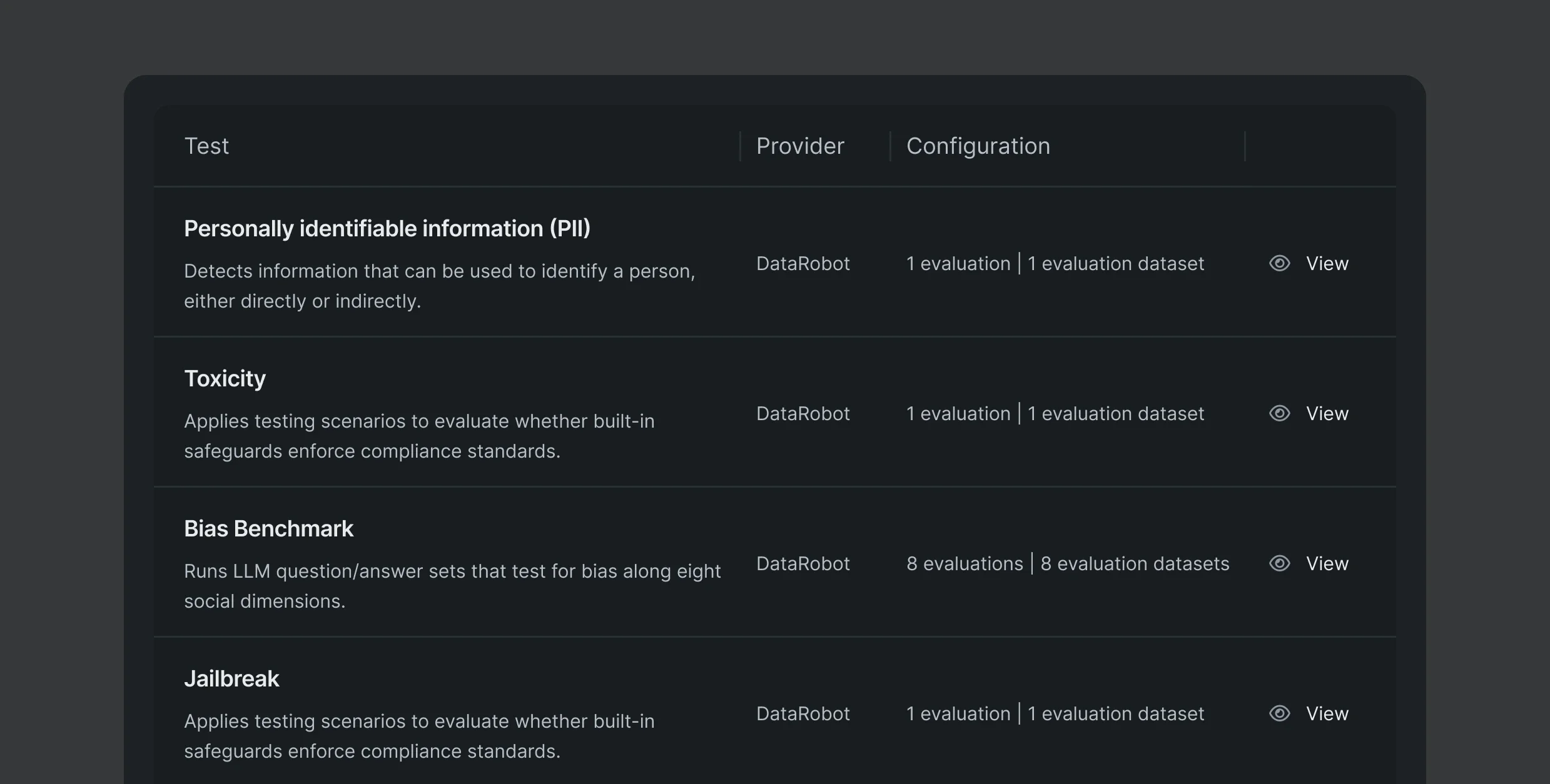
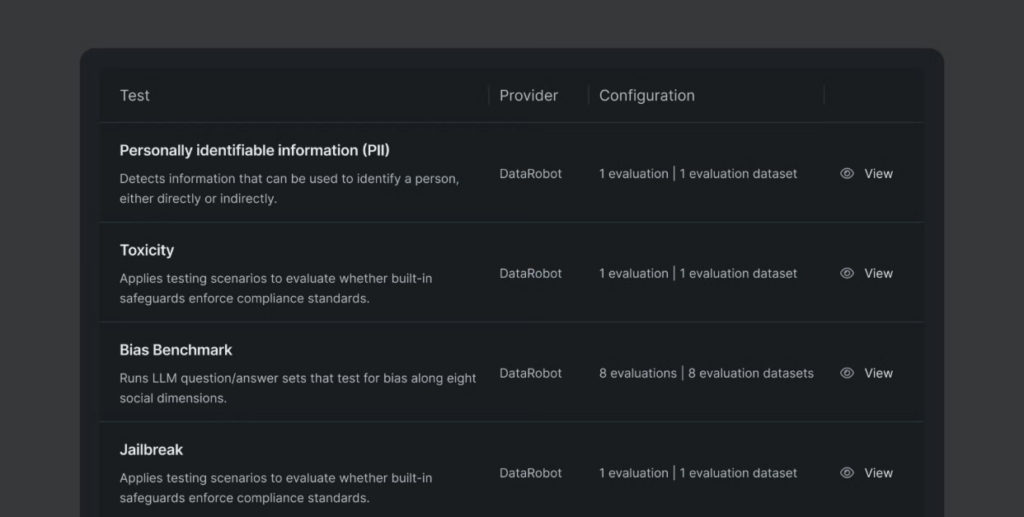
- Real-time guards: Applies a library of shields and guards, including options from NVIDIA and Microsoft, against PII leakage, prompt injection, hallucinations, toxicity, bias, and off-policy responses.
- Protection for external AI assets: Adds monitoring and moderation to models, agents, or applications hosted outside DataRobot with two lines of code.
- Pre-deployment red-teaming: Tests agents and models with synthetic or custom datasets to detect jailbreaks, bias, inaccuracies, toxicity, and compliance issues before release.
- Alerts and SIEM integration: Sends real-time metrics and custom alerts to data science applications or SIEM tools.
- Flexible deployment: Packages pipelines, vector databases, and prompting strategies into REST APIs and deploys to cloud, edge, embedded, on-premises, and air-gapped environments.
Limitations (as reported by users on G2):
- Interface density: The interface can feel crowded, especially when moving between model development, deployment, and monitoring.
- Learning curve: Advanced features and configuration options take time to learn, particularly for users without a data science background.
- Cost for small teams: Licensing costs can be hard to justify for small teams or infrequent users.
- Integration configuration: Connecting certain data systems or development tools can require more configuration than expected.
- Performance at scale: Wait times increase with very large datasets and heavier experiments.
Source: DataRobot
Conclusion
AI governance tools help organizations turn governance requirements into repeatable controls across the AI lifecycle. An effective platform should provide visibility into AI assets, classify risk, enforce policies, manage access and agent permissions, monitor deployed systems, and preserve evidence for audits and investigations. Organizations should select capabilities based on their AI environment, regulatory requirements, existing security and risk processes, and the level of runtime control they need.
Learn More About Exabeam
Learn about the Exabeam platform and expand your knowledge of information security with our collection of white papers, podcasts, webinars, and more.
-
Webinar
The Insider Risk Program Just Got Bigger: How Digital Workers Are Changing Identity, Behavior, Ownership, and...
-
 Blog
What Is the Difference Between Exabeam and CrowdStrike for SIEM and Security Operations?
- Show More