What Makes Agent Activity Harder to Detect
- Aug 05, 2026
- Heidi Willbanks
- 3 minutes to read
Table of Contents
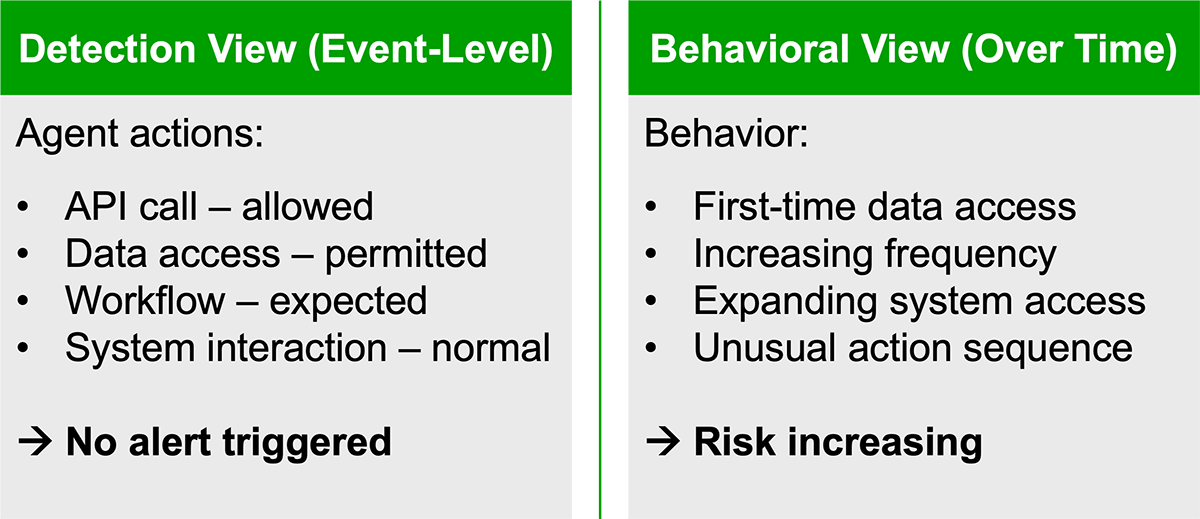
Agent activity is harder to detect because it operates through legitimate identities, permissions, and approved tools. Individual actions often appear expected at the event level. Risk emerges through sequences, first-time actions, and behavioral drift across sequences and first-time actions. These are signals that traditional rules and short correlation windows often miss.
Why Agent Actions Appear Legitimate at the Event Level
Agent activity frequently occurs within approved processes.
Agents authenticate using valid credentials, access permitted data, and interact with trusted applications. Each action aligns with allowed behavior and does not violate policy.
When detection focuses on individual events, this activity is indistinguishable from routine operations. The signal doesn’t exist within a single event. It appears only when actions are evaluated in context and over time.
How Autonomy and Machine Speed Change Detection Signals
Organizations are deploying AI agents and autonomous workflows that operate continuously across enterprise systems.
These agents act without direct human initiation and execute tasks at machine speed. This increases both the volume and velocity of internal activity that remains technically authorized.
As activity accelerates, individual actions generate more data but not more meaningful signals. Detection systems must interpret larger volumes of routine activity while identifying the smaller number of sequences that indicate risk.
| Agent Characteristic | What Detection Sees | What Determines Risk Over Time |
| Continuous execution | More events | Behavioral continuity |
| Machine-speed actions | Higher volume | Sequence progression |
| Autonomous decisions | Valid actions | First-time behavior |
| Multi-system activity | Disconnected logs | Cross-system patterns |
Table 1. Agent behavior increases activity volume, but risk depends on how actions connect over time.
Why Rules and Short Correlation Windows Miss Agent-Driven Risk
Rules are designed to detect clear violations or known patterns. Short correlation windows are designed to identify risk within a defined time frame.
Agent-driven activity does not follow these assumptions.
Risk develops through extended sequences of low-signal actions. Activity can span systems and time periods while remaining within expected thresholds. When detection evaluates events individually or within limited windows, it can’t capture progression.
As a result, event-level evaluation misses how risk develops and prioritization becomes more difficult.
Where Detection Approaches Diverge
Detection approaches differ in how they interpret agent activity.
Some methods validate whether individual actions are permitted. These approaches can confirm compliance, but they can’t determine whether behavior is expected for a given identity over time.
More effective approaches evaluate behavior continuously, comparing current activity to historical patterns for the same identity. This makes it possible to identify first-time actions, behavioral drift, and sequences that indicate emerging risk.
What This Reveals About Insider Risk
Agent activity expands insider risk by introducing additional identities operating with trusted access.
For both human users and AI agents, detection depends on behavioral context over time. The key question is whether behavior aligns with what is normal and expected, not whether an isolated action is allowed.
Without this context, risk remains embedded within routine activity.
Questions That Help Security Teams Scope Agent Oversight
Security leaders and security operations teams can evaluate detection gaps for agent activity by asking:
- Which agents and workflows operate continuously with persistent access?
- Which actions would be unusual or first-time for a given agent?
- How are sequences evaluated when activity spans systems and time periods?
- How is agent behavior correlated with related human activity?
- How do you identify unmanaged or unknown AI agents already operating within your environment?
These questions help define how agent activity is monitored, evaluated, and prioritized as behavior evolves.
See the Full Framework
Agent activity increases insider risk at machine scale, but the detection model remains behavioral.
The guide, Six Shifts in Insider Risk for the Agentic Enterprise, explains why behavior over time and unified identity oversight are required as AI agents expand internal activity.

Heidi Willbanks
Heidi Willbanks | Senior Product Marketing Manager, Content | Exabeam | Heidi Willbanks leads content strategy and go-to-market execution at Exabeam, focusing on product launches, cybersecurity solutions marketing, and technical alliances. She has 20+ years of marketing experience, including over a decade in information security and data privacy, and holds a Level IV certification from Pragmatic Institute. Heidi specializes in creating clear, technically accurate content for security practitioners and decision-makers.
More posts by Heidi WillbanksLearn More About Exabeam
Learn about the Exabeam platform and expand your knowledge of information security with our collection of white papers, podcasts, webinars, and more.