Why Insider Risk Detection Requires Long-Term Memory
- Jul 22, 2026
- Heidi Willbanks
- 3 minutes to read
Table of Contents
Insider risk detection requires long-term memory because misuse depends on retaining behavioral history long enough to evaluate change. Detection models that rely on short correlation windows reset context too frequently to recognize progression or prioritize developing risk.
Why Insider Risk Develops Gradually
Many detection approaches rely on short correlation windows and frequently reset context.
Insider activity rarely fits into narrow timeframes. Access patterns, data usage, and workflows shift beyond the time range most detection systems retain while remaining technically allowed. When evaluated individually, each action appears acceptable, even as behavior inches toward misuse.
How Detection Systems Handle Behavioral Memory
The effectiveness of insider risk detection depends on how detection systems retain and apply behavioral history.
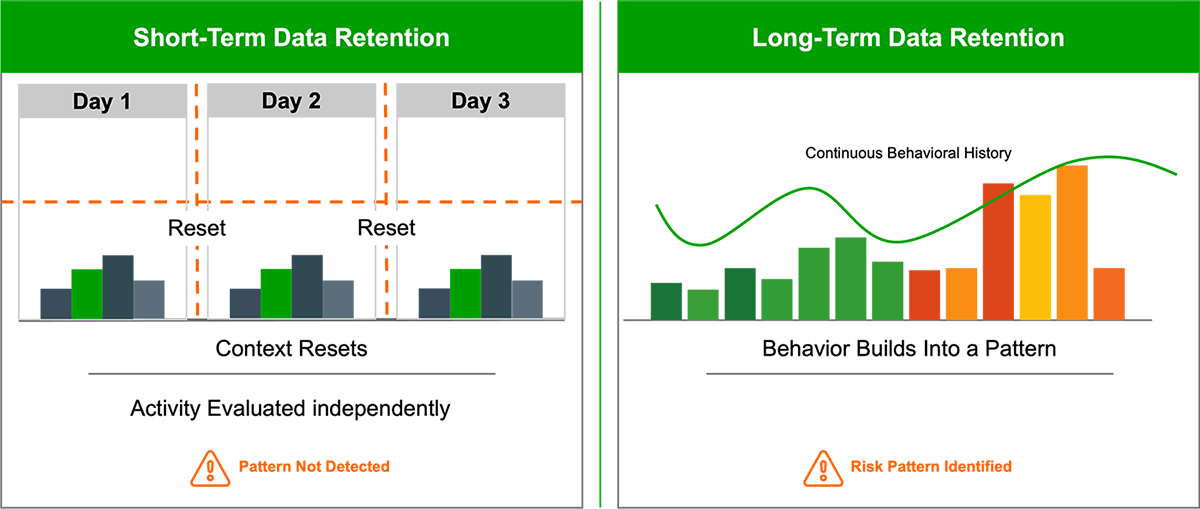
Short Correlation Windows
Many security platforms rely on short lookback periods designed to manage performance or alert volume.
These models typically:
- Evaluate activity in narrow timeframes.
- Reset context frequently.
- Prioritize spikes, violations, or bursty behavior.
While effective for external threats, this approach fragments insider activity and obscures slow behavioral progression.
Periodic or Rolling Windows
Some tools extend memory using rolling windows or periodic aggregation.
This can improve visibility, but these approaches still:
- Break behavioral continuity between windows.
- Treat each period as a new baseline.
- Lose context during role, access, or workflow changes.
As a result, risk is often detected late, if at all.
Persistent, Identity-Centric Memory
Detection systems designed for insider risk maintain continuous behavioral memory linked to identities.
This approach enables:
- Accumulation of weak signals over time
- Recognition of sustained behavioral drift
- Prioritization based on trajectory instead of isolated anomalies
Here, memory functions as an active detection capability rather than passive storage.
What Happens When Detection Context Resets
When detection context resets, behavioral continuity is lost at each reset point, forcing detection to start from zero.
Each activity window is evaluated as if it were the first, forcing systems to repeatedly relearn what normal looks like. Weak signals never accumulate, behavioral narratives collapse into isolated alerts, and risk remains invisible until a clear violation occurs.
Why Short Windows Are Insufficient for Insider Detection
Short memory favors spikes and violations.
Insider risk is cumulative. Only long‑term memory makes it possible to understand how small changes add up. Without it, detection remains reactive and surfaces after impact.
Long-Term Memory Is Not the Same as Long-Term Storage
Many platforms retain data for long periods, but retention alone doesn’t create memory.
Long-term memory for insider risk requires:
- Continuous behavioral context rather than archived logs
- Identity-linked history that persists beyond time windows
- Detection logic that actively references past behavior during evaluation
Without these elements, historical data remains passive. It supports investigation, but not detection or prioritization.
How Long-Term Memory Changes Prioritization
Persistent behavioral memory allows detection to evaluate direction, not just deviation. As history accumulates, systems can determine whether behavior is stabilizing, fluctuating, or accelerating toward risk.
This enables earlier prioritization, while activity still appears allowed and before policy violations occur.
What This Reveals About Insider Risk
Insider risk depends on accumulation, not singular events.
Without long‑term memory, detection logic can’t reliably distinguish developing misuse from normal variation. Visibility improves only when systems retain enough history to evaluate change.
What Security Leaders Should Reevaluate
When evaluating insider risk detection, security leaders should assess:
- How long behavioral context persists, not just how long logs are stored
- Whether detection logic references historical behavior during evaluation
- Which risks depend on accumulation rather than spikes
- Where context resets break behavioral narratives
- How prioritization changes as behavioral history grows
These questions reveal whether long-term memory is foundational or merely incidental.
See the Full Framework
Long-term memory represents a foundational shift in insider risk detection from evaluating events to understanding behavioral evolution.
The guide, Six Shifts in Insider Risk for the Agentic Enterprise, explores why persistent behavioral context is essential for identifying insider risk early, while action is still possible.

Heidi Willbanks
Heidi Willbanks | Senior Product Marketing Manager, Content | Exabeam | Heidi Willbanks leads content strategy and go-to-market execution at Exabeam, focusing on product launches, cybersecurity solutions marketing, and technical alliances. She has 20+ years of marketing experience, including over a decade in information security and data privacy, and holds a Level IV certification from Pragmatic Institute. Heidi specializes in creating clear, technically accurate content for security practitioners and decision-makers.
More posts by Heidi WillbanksLearn More About Exabeam
Learn about the Exabeam platform and expand your knowledge of information security with our collection of white papers, podcasts, webinars, and more.
-
Video
Mizuho Financial Group Enhances Security Governance and Advances Internal Fraud Prevention with Exabeam
- Show More