Why CISOs Need an Agentic SOC Strategy
- Oct 14, 2026
- Heidi Willbanks
- 5 minutes to read
Table of Contents
CISOs need an agentic SOC strategy because traditional staffing models can’t scale to match machine-speed threats, a global talent shortage, and rising alert volume.
An agentic SOC pairs AI agents that collect evidence and investigate at machine speed with analysts who provide judgment, context, and accountability. Exabeam combines Agent Behavior Analytics (ABA), Exabeam Nova AI, and automated investigation to expand coverage and speed response without adding headcount.
Key Takeaways
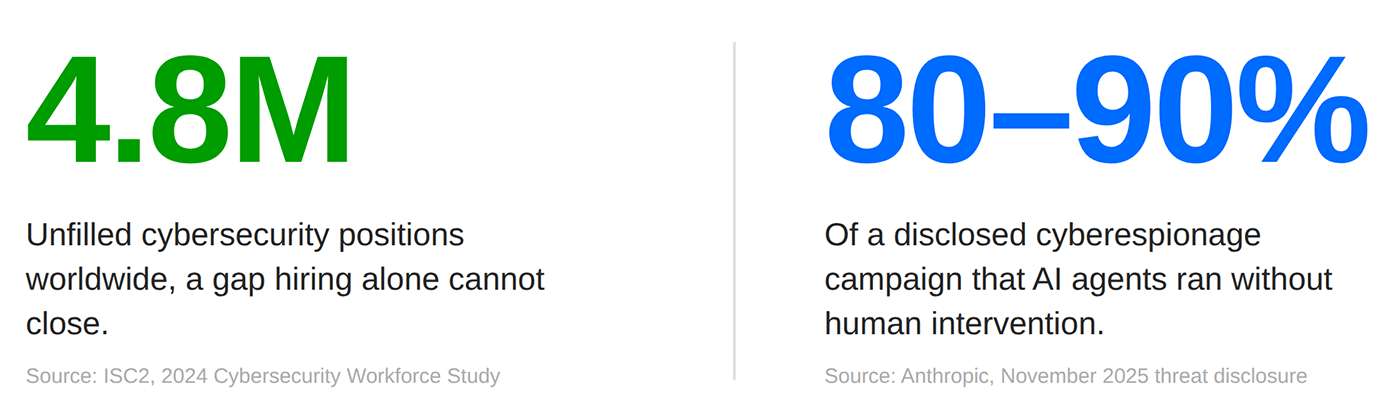
- The global cybersecurity workforce shortfall exceeds 4.8 million positions, so most SOCs can’t hire their way out of the capacity gap.
- A state-sponsored group disclosed by Anthropic ran 80%–90% of a cyberespionage campaign autonomously through AI agents, executing multiple operations per second.
- An agentic SOC uses AI agents for evidence collection and investigation and analysts for assessment, expanding coverage without adding headcount.
- ABA and Nova AI reduce manual investigation work, freeing analysts to focus on decisions that require human expertise.
- An agentic SOC strategy can give CISOs more flexibility to scale coverage and manage budget pressure as the talent gap persists.
Why This Is Now a Board-Level Problem
CISOs face a widening gap between attack speed and analyst capacity. The global cybersecurity workforce shortfall exceeds 4.8 million positions, and 94% of leaders now call AI the top driver of change in how attacks unfold.
Scaling coverage by adding people alone is costly and difficult. An agentic SOC strategy helps teams absorb more volume and complexity without a proportional rise in headcount. That shift changes both the security posture and the budget conversation a CISO brings to the board.
Why Staffing Alone Can’t Solve the SOC’s Capacity Problem
Organizations continue to address SOC gaps by hiring, but the math no longer works. ISC2 estimates a global cybersecurity workforce gap of 4.8 million positions, and 67% of security teams report ongoing staffing shortages. At the same time, cloud services, AI agents, and non-human identities generate more activity than human teams can review line by line.
Adding analysts can help, but it doesn’t change the underlying ratio: One person can review only so many alerts per shift. That limit hasn’t moved as the threat surface has grown. Security leaders who plan around headcount alone depend on a labor market that remains constrained. An agentic SOC strategy creates capacity beyond the hiring pipeline.
Why Machine-Speed Threats Outpace Traditional Security Operations
Traditional security operations workflows assume an analyst has time to notice an alert, open a case, and investigate before an attacker’s next move. That assumption is breaking down. Breakout time (the interval between initial access and lateral movement) is shrinking industry-wide as attackers adopt AI agents of their own. Anthropic disclosed a campaign in which a state-sponsored group used AI agents to run 80% to 90% of a cyberespionage operation autonomously, executing multiple operations per second against roughly 30 targets, with humans stepping in only at strategic decision points.
Manual triage can’t beat that pace, but AI agents can. They can correlate signals, score risk, and surface alerts that need a human decision while the attack is still in its early stages. Matching machine-speed threats takes a machine-speed first pass, with analysts positioned to make the decisions.
How an Agentic SOC Expands Coverage Without Expanding Headcount
An agentic SOC pairs AI agents with the analyst team already in place. ABA extends the behavioral baselining Exabeam built for human users to AI agents, service accounts, and other non-human identities. This approach helps teams monitor a growing population of digital workers without creating a visibility gap.
Nova AI assists in investigations by drafting case titles, timelines, summaries, and recommended next steps so an analyst can close a case in minutes instead of hours. Nova AI can also converse with the analyst regarding any aspect of the case, write emails or case notes, and consult the CISO on security coverage across use cases, MITRE ATT&CK® TTPs, and compliance frameworks. The Exabeam Agentic SOC Plugin for Anthropic Claude Code and OpenAI Codex extends Nova AI with curated, purpose-built skills for tasks such as case summarization and evidence gathering. As identities, log sources, and alert types grow, each receives the same automated first review without a corresponding increase in analyst headcount.
What an Agentic SOC Changes for Analyst Efficiency and Retention
Analyst burnout creates business risk. SANS research puts average SOC analyst tenure at three to five years, with repetitive, low-value triage contributing to turnover. An agentic SOC reduces repeated tool switching, manual evidence gathering, and time spent on alerts that turn out to be nothing.
Exabeam Related Cases groups related alerts automatically, so analysts don’t end up reinvestigating the same incident from multiple angles. The result is a team that can cover more activity while spending more time on decisions that require human understanding.
What This Means for Your Team
For Security Leaders
An agentic SOC strategy expands coverage and accelerates response without a proportional increase in headcount costs. It directly addresses the workforce gap shaping your budget and hiring plans. It also strengthens governance by extending the behavioral analytics used for human users to the AI agents your organization deploys.
For Security Architects
ABA and Nova AI work within New-Scale Fusion, extending behavioral baselining to non-human identities without a separate toolset. A shared behavioral risk model reduces the need to manage detection logic for humans and AI agents as unrelated problems, simplifying your architecture and your audit trail.
For Security Analysts
An agentic SOC automates the repetitive first pass, alert triage, evidence gathering, and case summarization. According to Exabeam validation testing, Related Cases and Nova AI reduce the manual work of assembling context from scattered tools by up to 80%, so less of your time goes to busywork and more goes to the cases that need a human being.
The Bottom Line
Traditional SOC staffing models can’t keep pace with workforce shortages, machine-speed threats, and rising alert volume. Coverage must come from a model that pairs AI agents with human analysts. An agentic SOC strategy gives CISOs a way to scale security operations without scaling costs at the same rate.
Key Terms
Agentic SOC: A security operations model in which AI agents handle investigation and triage at machine speed while human analysts retain judgment, accountability, and response decisions.
Agent Behavior Analytics (ABA): Exabeam technology that apples behavioral baselining and dynamic risk scoring to AI agents and other non-human identities, as user and entity behavior analytics (UEBA) does for human users.
Nova AI: A built-in suite of AI agents that assists analysts with investigations by drafting timelines, summarizing context, and recommending next steps.
Breakout time: The time between an attacker’s initial access to a network and their first lateral movement, a measure of how quickly a security team must respond.
Non-human identity: An account or actor that performs actions in a system without direct human control at the time of action, including AI agents, service accounts, and automated workflows.
Related Cases: An Exabeam capability that automatically groups related alerts into a single case, reducing duplicate investigation work.
Get the framework for governing human and AI agent identity together in the white paper, Securing the Agentic Enterprise.

Heidi Willbanks
Heidi Willbanks | Senior Product Marketing Manager, Content | Exabeam | Heidi Willbanks leads content strategy and go-to-market execution at Exabeam, focusing on product launches, cybersecurity solutions marketing, and technical alliances. She has 20+ years of marketing experience, including over a decade in information security and data privacy, and holds a Level IV certification from Pragmatic Institute. Heidi specializes in creating clear, technically accurate content for security practitioners and decision-makers.
More posts by Heidi WillbanksLearn More About Exabeam
Learn about the Exabeam platform and expand your knowledge of information security with our collection of white papers, podcasts, webinars, and more.
-
 Blog
Blog
Five Ways Exabeam Delivers Better Detection and Security Outcomes Than Microsoft Sentinel
- Show More